Key Takeaways
- HOS violations rose from 410,000 in 2023 to more than 500,000 in 2025, according to RigDig data cited by Overdrive in April 2026, making ELD compliance the single most consequential part of fleet management for most carriers.
- FMCSA has revoked 80 ELD devices from its registered list since January 2025, with TRUCKSTAFF ELD removed on June 23, 2026, confirmed by FMCSA Administrator Derek Barrs via Overdrive, June 2026.
- Motor carriers face maximum civil penalties of up to $19,246 per HOS violation, and drivers face up to $4,812 per violation, under 49 CFR Appendix B to Part 386, adjusted annually for inflation.
- At full ELD mandate adoption, FMCSA projected 1,844 fewer crashes, 562 fewer injuries, and 26 lives saved per year, according to FMCSA’s own published estimates on the FMCSA ELD program.
- HOS citation rates dropped from 1.19% in December 2017 to 0.69% once full ELD enforcement began in April 2018, according to FMCSA enforcement data.
- CVSA ran its 2026 International Roadcheck on May 12 to 14, with ELD tampering and log integrity as the primary focus, per the CVSA 2026 Roadcheck announcement.
- Unplanned vehicle downtime costs between $448 and $760 per vehicle per day, and 78% of breakdowns are preventable, according to fleet maintenance KPI research 2026.
- Vehicles over 10 years old account for 12.1% of miles driven but 33.5% of total service spend, according to the Fleetio 2026 Fleet Benchmark Report.
Introduction
When most people hear the phrase fleet solutions, they think of a single tool that logs their drivers hours and calls it done. That covers only one layer of what running a compliant commercial fleet actually requires. A real fleet solution covers every part of keeping your vehicles legal, your drivers safe, and your back office out of trouble. It starts the moment a driver clocks in and runs through to the moment you file your quarterly fuel tax return. For fleet owners and owner-operators running commercial motor vehicles, none of this is optional planning. These are federal requirements with real financial consequences attached.
The compliance side of fleet management has grown more demanding every year. HOS violations rose from 410,000 in 2023 to more than 500,000 in 2025, according to RigDig data cited by Overdrive in April 2026. FMCSA has revoked 80 ELD devices from its registered list since January 2025, with the most recent removal on June 23, 2026, as confirmed by FMCSA Administrator Derek Barrs. If your truck is running a device that gets pulled from that list, you have 60 days to replace it before your driver gets placed out of service at the next roadside inspection. That is the environment your fleet is operating in right now, and it is not letting up.
What follows breaks down what fleet solutions actually cover, including ELD compliance, hours of service tracking, driver vehicle inspection reports, and IFTA fuel tax reporting, and explains how each piece connects to the others. You will also find a comparison table, a list of questions to ask before choosing a platform, and a FAQ section covering the concerns we hear most often from fleet owners.
If you would rather talk through your situation than read the whole guide, our team is available 24 hours a day, 7 days a week. You can see what the Geosavi ELD covers or get in touch with us whenever you are ready.
What Are Fleet Solutions and Why Do They Matter?
Fleet solutions are the systems, tools, and processes that keep commercial vehicles compliant, maintained, and moving. For carriers subject to FMCSA rules, that covers ELD compliance, hours of service tracking, driver vehicle inspection reports, and fuel tax reporting at a minimum.
The term gets used loosely across the trucking industry, which creates confusion for smaller fleet owners and owner-operators trying to figure out what they actually need. At its most practical level, a fleet solution is anything that replaces manual, paper-based processes with a connected digital system that records, stores, and transfers your compliance data automatically. An ELD that records driving time automatically, transfers data to a roadside inspector in seconds, and keeps your logs available for six months under 49 CFR 395.8(k)(1) is a fleet solution. A handwritten logbook that a driver fills out at the end of a shift and carries in the cab is not, because it cannot meet the accuracy, storage, or transfer requirements that federal compliance now demands.
For fleets running commercial motor vehicles with a gross vehicle weight rating over 10,001 pounds, the core components are not optional. Federal regulations under 49 CFR Part 395 require most drivers to use a registered ELD, follow hours of service limits, and complete driver vehicle inspection reports under 49 CFR 396.11. IFTA fuel tax reporting applies to carriers operating qualified motor vehicles across multiple states or Canadian provinces. Missing any of these creates compliance gaps that show up on your CSA record, your insurance rates, and eventually your ability to keep operating.
The real value of a connected fleet solution is that these pieces work together. When your ELD records driving time automatically, that same data supports your IFTA mileage calculation. When your driver completes a digital DVIR before dispatch, any defects are flagged before the truck leaves the yard instead of at a weigh station. The goal is not to layer more tools on top of what you already have, but to replace disconnected manual processes with one platform that keeps your compliance records connected, your drivers moving, and your back office ready if an auditor ever comes calling.
What Role Does ELD Compliance Play in Fleet Solutions?
ELD compliance is the foundation of fleet management for any carrier subject to the federal mandate. Without a registered, functioning ELD, your driver cannot legally operate a commercial motor vehicle on US roads, and a roadside inspector will place them out of service on the spot.
The requirement applies to commercial motor vehicles as defined under 49 CFR Part 390.5, generally vehicles with a GVWR of 10,001 pounds or more used in interstate commerce and subject to federal HOS rules. Drivers who qualify for an exemption, such as the short-haul exemption under 49 CFR 395.1(e)(1) for CDL drivers operating within 150 air miles of their reporting location, may not need an ELD. If your drivers do not qualify, the mandate applies and the device must appear on the current FMCSA registered ELD list.
Here is where the 2026 enforcement environment changes things significantly for fleet owners. FMCSA revoked 80 ELD devices since January 2025, with TRUCKSTAFF ELD removed as recently as June 23, 2026, per FMCSA Administrator Derek Barrs as reported by Overdrive. Carriers using a revoked device have 60 days to replace it. After that window closes, any driver still running the revoked device gets cited under 49 CFR 395.8(a)(1) for no record of duty status and placed out of service. That citation creates a CSA record entry, triggers fine exposure under the FMCSA civil penalty schedule of up to $19,246 per violation for the carrier, and costs your driver at least one day of lost income while parked roadside.
The practical takeaway is straightforward: check the FMCSA registered ELD list monthly, not just when you buy a device. A device that was registered at purchase can be removed at any time if FMCSA finds it does not meet the minimum technical requirements in ELD technical standard Appendix A to Subpart B of Part 395. Geosavi has remained on that registered list since registration and connects via J1939, J1708, or OBD-II to support a wide range of commercial vehicles. If you want to confirm compatibility with your specific trucks before making any decision, our team is available around the clock at (800) 261-4361.
How Does Hours of Service Tracking Work in a Fleet Solution?
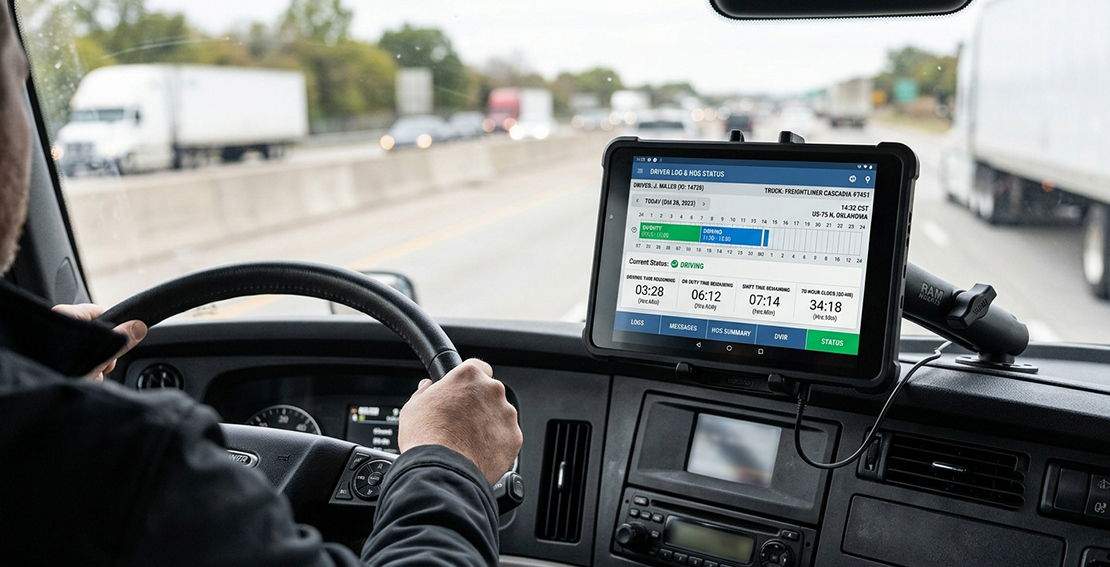
Hours of service tracking is the process of recording and monitoring the time your drivers spend driving, on duty, in the sleeper berth, and off duty so they stay within federal driving limits. An ELD handles this automatically by connecting to your truck’s engine and recording activity in real time.
The core limits under the FMCSA hours of service rules for property-carrying commercial motor vehicles are well established: 11 hours of driving time after 10 consecutive hours off duty, a 14-hour on-duty window that does not pause for breaks, a mandatory 30-minute off-duty break after 8 cumulative hours of driving, and a 60 or 70-hour weekly cap depending on your operating schedule. Violating any one of these is a separate citation, each carrying its own fine exposure and CSA scoring weight.
What most fleet managers find when they move from paper logs to an ELD is that violations they were unaware of become visible immediately. Over 30% of HOS violations involve dispatchers failing to account for actual driving time when assigning loads, according to Forward Thinking Systems CSA research 2026. Paper logs cannot catch this in real time, an ELD alerts your back office when a driver is approaching their limit, which gives dispatchers time to adjust the run before a violation occurs rather than discovering it after a roadside inspection.
The FMCSA Safety Measurement System tracks every HOS citation your fleet receives and weights it by severity and recency. Citations from the previous 24 months affect your CSA scores, which affect your insurance rates, your access to freight networks, and your risk of triggering a compliance review. A fleet that manages HOS proactively has a fundamentally different compliance position than one reacting to violations after inspections. If you want to understand exactly how violations follow a driver and carrier through the system, our article on how ELD violations affect your record covers the scoring timeline in detail.
What Is a DVIR and Why Is It Part of Fleet Management?
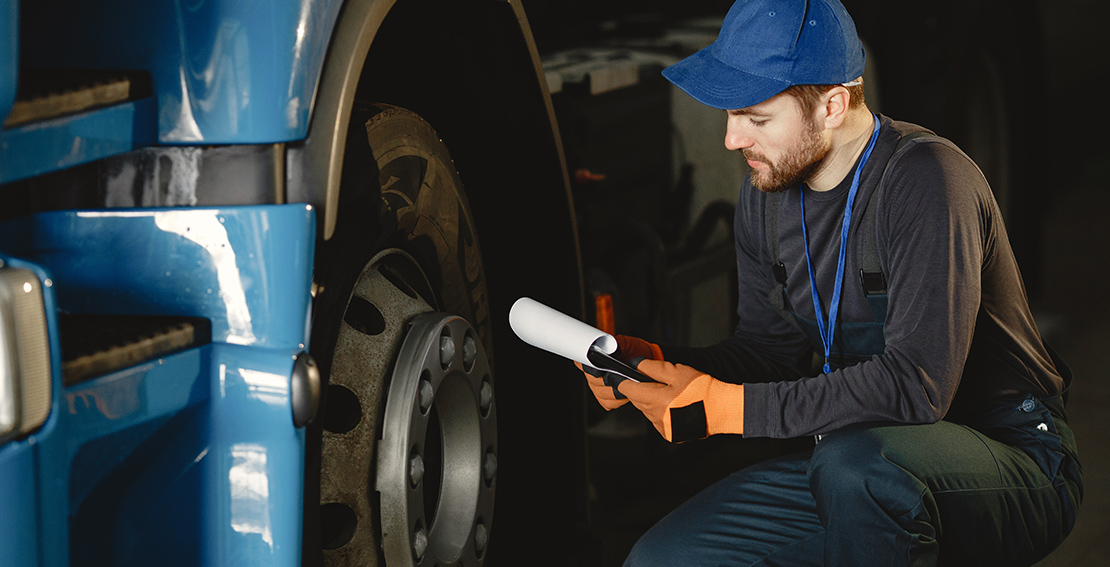
A DVIR, or Driver Vehicle Inspection Report, is a pre-trip and post-trip inspection document that drivers must complete to identify and report vehicle defects before and after each shift. Under 49 CFR 396.11, drivers must report any defect or deficiency that could affect the safe operation of the vehicle, and the carrier must make sure those defects are addressed before the truck goes back out.
The practical purpose of a DVIR in your fleet is to catch mechanical problems before they become breakdowns or safety violations. Unplanned vehicle downtime costs between $448 and $760 per vehicle per day, according to fleet maintenance KPI research 2026, and 78% of breakdowns are preventable with consistent inspection practices. A digital DVIR built into your fleet platform means defects get reported immediately, flagged for repair before dispatch, and documented with a time stamp that protects both your driver and your carrier record if a question ever comes up during an audit.
Vehicles over 10 years old account for 12.1% of miles driven but 33.5% of total service spend, according to the Fleetio 2026 Fleet Benchmark Report. That gap tells you where maintenance risk concentrates in a typical fleet. A consistent DVIR process keeps that risk visible and documented rather than hidden until it shows up as an out-of-service order at the roadside.
When a digital DVIR is connected to the rest of your fleet platform, a defect the driver logs in the morning creates a repair record automatically. The mechanic gets notified, the repair gets completed, and the driver confirms the vehicle is safe before the next dispatch. That loop, done consistently, is what keeps your vehicles passing inspections. If you want to see how DVIR and ELD records connect in practice, our piece on how ELD and DVIR work together walks through the details.
What Is IFTA Reporting and Does Your Fleet Need It?
IFTA stands for the International Fuel Tax Agreement, and it applies to qualified motor vehicles operating in two or more member jurisdictions, covering the 48 contiguous US states and 10 Canadian provinces. If your trucks cross state lines regularly, IFTA reporting is most likely a requirement for your operation.
The way IFTA works is that your fleet pays fuel taxes to your base state, which then distributes the correct share to each state or province where your vehicles traveled. Without automated tracking, this means manually rebuilding miles driven per jurisdiction each quarter, cross-referencing fuel receipts, and filing a return that has to be accurate enough to survive an audit. That process alone takes hours every quarter and leaves plenty of room for errors that can follow you into an audit.
When your ELD records mileage automatically, that same trip data can feed directly into your IFTA calculation. You can see miles by jurisdiction without rebuilding routes from memory, match fuel purchases to the correct states, and generate a quarterly return that is fully traceable back to source records. That traceability is what protects you if an auditor wants to verify your figures, because if your ELD data and your IFTA report tell the same story, you are in a much stronger position than a fleet rebuilding data from receipts alone.
For owner-operators and small fleets, IFTA can feel like one more burden on top of everything else compliance-related. Connecting it to your ELD platform removes most of the manual work. If you have questions about how the Geosavi platform handles multi-state mileage and IFTA, our answers to common compliance questions cover the most frequent ones.
How Does a Fleet Solution Handle Driver Qualification and Safety Records?
Driver qualification records are the documentation that proves your drivers meet federal fitness requirements, and they are a required part of your carrier file under FMCSA rules. A fleet solution that covers compliance properly should help you track and manage these records, not just log ELD data.
The qualification file for a CDL driver includes the employment application, medical certificate, motor vehicle record, road test documentation or equivalent, and an annual review of the driving record. Under 49 CFR Part 383, CDL requirements define who may legally operate a commercial motor vehicle, and carriers are responsible for verifying that every driver holds the correct license class and endorsements for what they are hauling. English proficiency enforcement under 49 CFR 391.11(b)(2) has been active since June 25, 2025, adding another documentation point that carriers need to stay on top of.
For medium-duty fleets operating vehicles in the 10,001 to 26,000 lb range, 2026 has brought increased roadside attention from FMCSA. Keeping qualification records current and accessible reduces your exposure during compliance reviews. The FMCSA safety fitness procedures set the standard for how FMCSA evaluates carriers during investigations, and documentation gaps in driver qualification files are among the findings that can affect your safety rating.
A good fleet solution does not replace the judgment you use to hire the right drivers. What it does is make sure the documentation behind those decisions is current, organized, and available the moment an auditor asks for it. The cost of finding qualification gaps during a compliance review is not just the fine. It is the administrative pressure to correct records under scrutiny, the hit to your safety rating, and the downstream effect on your insurance rates and freight access.
What Makes a Fleet Solution Right for a Small Fleet or Owner-Operator?
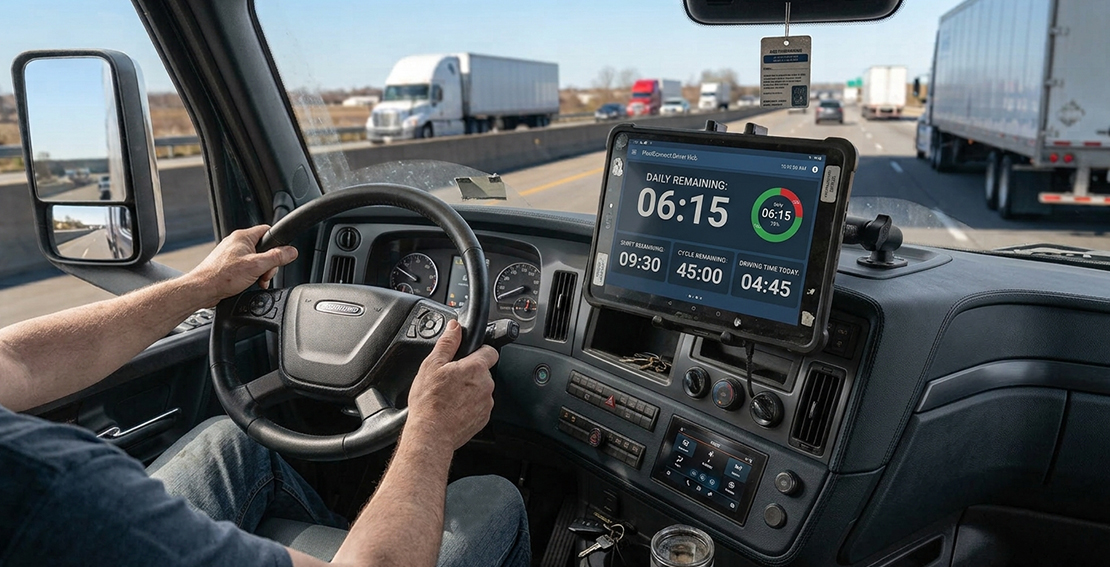
For a small fleet or owner-operator, the right fleet solution is one that covers your federal compliance requirements without adding complexity your drivers cannot manage on the road. The most important features are a registered ELD, simple log transfer for roadside inspections, and support you can actually reach when something goes wrong at 2 a.m.
Small fleets and owner-operators face the same compliance requirements as large carriers but with far fewer administrative resources to manage them. A single driver placed out of service is not a minor inconvenience for a small fleet. It is a revenue loss that can affect the entire operation for days, sometimes longer if a CSA violation follows. That makes device reliability and support availability the two factors that matter most when choosing a platform at this scale.
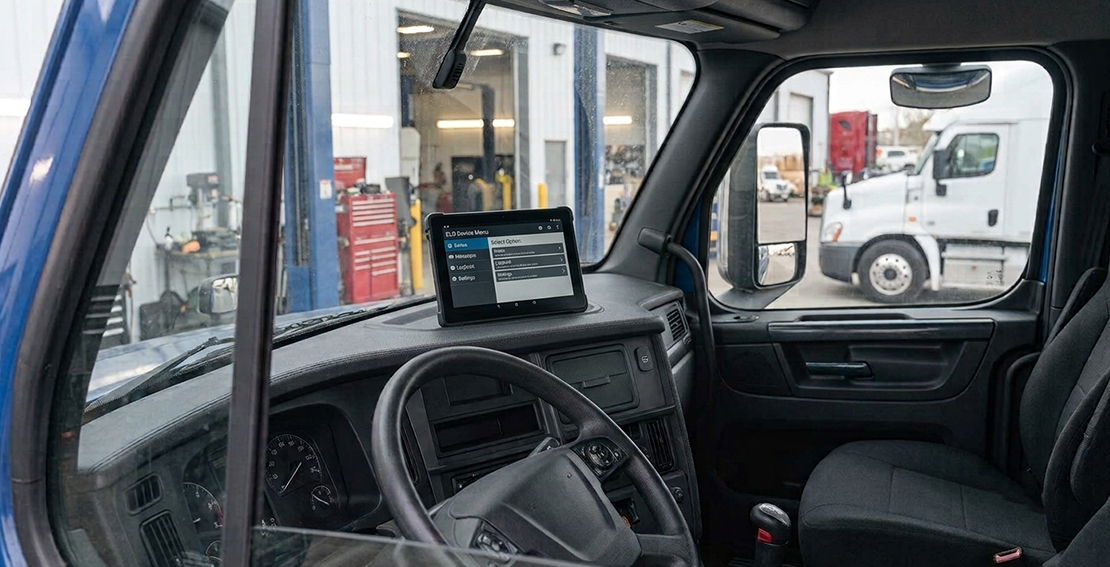
The ELD itself needs to connect reliably to your truck’s engine via J1939, J1708, or OBD-II, display your log status clearly, and transfer data to an inspector using Bluetooth, USB, or web service within seconds. The hardware also needs to hold up in a real vehicle environment. The Geosavi tablet is SAE J1455 certified for vehicle use, which means it is built for the vibration, temperature swings, and power conditions that standard consumer devices are not designed to handle. You can learn more about what the Geosavi ELD covers for different truck types in our guides on ELD requirements for box trucks and ELD rules for local drivers who run shorter routes.
For owner-operators evaluating their options, a 30-day money-back guarantee is the clearest signal that a provider stands behind what they sell. If you want to understand what different setup levels cost before committing to a call with anyone, our pricing calculator gives you a clear picture in a few minutes.
How Does a Fleet Solution Affect Your CSA Score?
Your CSA score is a direct reflection of how well your fleet manages compliance, and every citation your drivers receive at roadside goes into the FMCSA Safety Measurement System and stays there for 24 months. A fleet solution that catches HOS and ELD problems before they reach a roadside inspection is the most practical way to protect that score.
The FMCSA CSA methodology weights violations by severity and recency. More recent violations carry more weight, which means a cluster of HOS citations in a short period can push a fleet toward investigation thresholds faster than most managers expect. The HOS Compliance BASIC is one of seven categories FMCSA tracks, and carriers with elevated scores in any category are prioritized for compliance reviews that can affect their operating authority, insurance rates, and access to freight networks.
The practical connection between your fleet solution and your CSA score is visibility. When your platform shows you real-time HOS status for every driver before dispatch, your back office can catch a driver who is close to their limit before a load gets assigned to them. When your DVIRs create a documented maintenance record, defects that would generate a Vehicle Maintenance BASIC citation get fixed before a roadside inspector finds them. When your ELD data is clean, accurate, and stored correctly under 49 CFR 395.8(k)(1), you have a defensible record if a violation is recorded incorrectly, and you can challenge it through the FMCSA DataQs system.
Carriers with unsatisfactory safety ratings pay up to $18,500 per vehicle annually in insurance versus $8,200 for satisfactory-rated carriers, according to 2026 fleet safety compliance research. That gap, applied across even a small fleet, is the real ongoing cost of letting compliance problems accumulate without a system to catch them early.
What Should You Look for in an ELD Platform in 2026?
The table below compares the key features fleet owners and owner-operators should evaluate when choosing a platform this year. Use it as a starting checklist, because the right fit ultimately depends on your fleet size, vehicle types, and the states you operate in.
| Feature | Why It Matters | What to Look For |
|---|---|---|
| FMCSA registration status | A device not on the registered list results in an immediate out-of-service order | Confirm before purchasing and check monthly after |
| Engine connection type | Determines compatibility with your trucks | J1939, J1708, or OBD-II confirmed against your vehicle ECM type |
| Data transfer methods | Inspectors must be able to pull your logs at roadside | Bluetooth, USB, and web service all available |
| USA and Canada HOS support | Required if your drivers ever cross into Canada | Both rulesets built in and switchable by the driver |
| DVIR integration | Connects inspection records to your maintenance workflow | Defects logged by the driver should trigger a repair record automatically |
| IFTA mileage tracking | Reduces quarterly reporting burden and audit risk | Mileage tracked by jurisdiction from engine data, not entered manually |
| Driver harassment protection | Protects drivers from pressure to violate HOS | Log annotations supported and records protected under 49 CFR 390.36 |
| Technical support availability | Device problems happen at night and on weekends | 24-hour, 7-day phone support is the minimum standard |
| Hardware durability | Vehicle environments expose electronics to vibration and temperature extremes | SAE J1455 certification confirms the hardware is built for vehicle use |
| Money-back guarantee | Gives you time to confirm the device works in your actual trucks | 30 days is a reasonable standard |
Questions To Ask Before Choosing a Fleet Solution
Is the ELD currently on the FMCSA registered list, and how will you know if it gets removed?
Yes or no on the registered list at the time of purchase is not enough on its own. FMCSA has revoked 80 devices since January 2025, with removals as recent as June 23, 2026. Ask the provider how they alert customers when a device is removed and what their process is for helping carriers replace a device within the 60-day window. A provider without a clear answer to this question is not watching the registered list as closely as your fleet needs them to.
Does the platform support both USA and Canada hours of service rules?
If your drivers cross into Canada even occasionally, your ELD needs to switch between US and Canadian HOS rulesets without a call to dispatch. Ask specifically whether both rulesets are built into the platform and whether the driver can toggle between them directly on the device. An ELD that only covers US rules creates a compliance gap the moment a driver crosses the border.
What happens if the ELD malfunctions during a run?
Under 49 CFR 395.34, your driver must switch to paper logs if the ELD fails, and the carrier has a deadline to repair or replace the device. Ask the provider what a malfunction notification looks like on their platform, how quickly someone responds, and whether they have a replacement process for devices that fail in the field. A provider who cannot walk you through this before the sale is not prepared to help you when it actually happens.
How does the platform handle log edits and annotations?
ELD log editing is allowed under specific conditions in 49 CFR 395.30, but every edit must be annotated with a reason and the original record must be preserved. Ask whether the platform enforces this automatically or whether a dispatcher can edit a driver’s log without a documented annotation. Platforms that allow unannotated edits create falsification risk, and knowing falsification carries a maximum penalty of $15,846 per entry under the FMCSA civil penalty schedule.
What data transfer methods does the ELD support for roadside inspections?
An inspector at a weigh station needs to pull your ELD data quickly and without delay. The device must support at least one wireless transfer method such as Bluetooth or web service, plus a local option via USB. Ask the provider to walk you through exactly how a driver transfers logs to an inspector, and confirm the process works in areas with poor cell coverage.
How does the platform track mileage for IFTA reporting?
If your trucks operate across state lines, you need jurisdiction-by-jurisdiction mileage records for every quarter. Ask whether the platform captures this from engine data automatically or requires manual trip entry. Also ask whether the system produces an IFTA-ready quarterly summary or whether your back office still needs to compile that data from raw trip records before filing.
What support is available to your drivers on the road after business hours?
Compliance problems do not wait for Monday morning. A driver with a malfunctioning ELD at 11 p.m. on a Friday needs someone who can solve the problem, not a voicemail that gets reviewed the next business day. Ask the provider directly whether after-hours support is phone-based or ticket-based and what the typical resolution time looks like for a device that stops recording correctly. Geosavi provides 24-hour, 7-day technical support so your drivers are never left without help when they need it most. If you want to understand what that covers, you can read through how we support drivers and fleet managers at any hour.
Is there a money-back guarantee, and what exactly does it cover?
A 30-day money-back guarantee gives your drivers enough time to use the device in real conditions before you are fully committed. Ask exactly what the guarantee covers, whether that includes hardware, subscription fees, or both, and what the return process looks like. A provider confident in their product will have a clear and simple answer. If the answer is vague or conditional, that tells you something important about how they handle problems after the sale.
About ELD Compliance and Fleet Management
What is an ELD and do I need one for my fleet?
An ELD, or electronic logging device, is hardware that connects to your truck’s engine and automatically records your driving time, duty status, and vehicle movement in place of a paper logbook. Most commercial motor vehicle drivers operating vehicles with a GVWR over 10,001 pounds in interstate commerce are required to use a registered ELD under 49 CFR Part 395. Some drivers qualify for exemptions, such as the short-haul exemption under 49 CFR 395.1(e)(1) for CDL drivers who operate within 150 air miles of their reporting location and return there each day, but if your drivers do not qualify, the mandate applies without exception. Our guide on what an ELD is and how it works covers the basics in plain terms if you are starting from scratch.
What happens if my ELD is removed from the FMCSA registered list?
If your device is removed, you have 60 days from the removal announcement to replace it with a device currently on the FMCSA registered ELD list. During that window, your drivers should switch to paper logs while the replacement is arranged. After the grace period ends, any driver still using the revoked device gets cited under 49 CFR 395.8(a)(1) for no record of duty status and placed out of service at the next inspection. FMCSA does not send individual notice to carriers when a device is removed, so checking the registered list monthly is the only reliable way to stay ahead of a removal that affects your fleet.
How do HOS violations affect my fleet’s CSA score?
Every HOS citation your drivers receive at roadside gets recorded in the FMCSA Safety Measurement System and stays on your record for 24 months, with more recent violations weighted more heavily than older ones. Violations in the HOS Compliance BASIC category contribute to a percentile score that FMCSA uses to prioritize carriers for compliance reviews. Repeated violations, or a pattern of citations combined with other findings, can push your fleet toward thresholds that affect your safety rating, your insurance costs, and your ability to qualify for contracts with shippers and brokers who screen carrier scores. Our article on how ELD violations affect your compliance record covers the timeline and what you can do when a violation appears incorrectly.
What is the difference between a DVIR and an ELD?
An ELD records your driving time and duty status automatically from engine data, while a DVIR documents the physical condition of your vehicle through a driver-completed inspection before and after each shift. They are two separate federal requirements that work together in a connected fleet platform. The ELD covers the driver record side under 49 CFR Part 395, and the DVIR covers the vehicle inspection side under 49 CFR 396.11. When the two are integrated, a defect the driver reports on the DVIR creates a repair record automatically and the inspection is time-stamped alongside the driver’s duty status, giving you a clean, connected compliance record during an audit.
Can local drivers who stay close to their home base skip the ELD?
Some can, depending on their specific operation. CDL drivers who operate within 150 air miles of their normal reporting location, return there at the end of each shift, and meet the other conditions in 49 CFR 395.1(e)(1) may qualify for the short-haul exemption. Non-CDL drivers have a separate exemption under 49 CFR 395.1(e)(2). Qualifying requires meeting every condition consistently, because missing even one condition on a given day can void the exemption for that shift. Our guide on ELD requirements for local drivers covers the exact conditions and what happens when a driver misses one of them.
What does IFTA have to do with fleet compliance?
IFTA is a fuel tax agreement that requires carriers operating qualified motor vehicles across multiple states or Canadian provinces to file quarterly reports showing miles traveled and fuel purchased by jurisdiction. It is not an FMCSA requirement, but it carries its own audit and penalty exposure. When your ELD records mileage by jurisdiction automatically, that data feeds directly into your quarterly IFTA calculation, saving your back office significant time and reducing your risk if an auditor examines your records. A fleet solution that does not connect ELD mileage to IFTA reporting leaves that work as a manual quarterly task prone to errors and hard to defend in an audit.
How long do I need to keep ELD records?
Under 49 CFR 395.8(k)(1), carriers must retain records of duty status for a minimum of six months, including the ELD data itself, supporting documents such as bills of lading and fuel receipts, and any edited or annotated log entries. Under 49 CFR 395.30(f), the original version of any edited entry must also be preserved. A carrier cannot overwrite the original log, only annotate it with a documented reason for the change. Many carriers retain records longer than the six-month minimum to support DataQs challenges if a violation is recorded incorrectly at roadside.
About Choosing the Right Fleet Platform
How do I know if a fleet platform actually covers everything I need?
Start with the compliance requirements that apply to your specific operation, including ELD mandate, HOS rules, DVIR, and IFTA if you cross state lines, and confirm that the platform addresses each one in concrete terms rather than general promises. Ask for a demonstration using your actual vehicle types. Ask about USA and Canada HOS support, data transfer methods for roadside inspections, and what happens when the device malfunctions on the road. A platform that cannot answer those questions clearly before you buy is unlikely to answer them well when a compliance problem appears at 11 p.m. on a Sunday.
What is the risk of using a fleet platform that is not properly registered with FMCSA?
If your ELD is not on the FMCSA registered list at the time of a roadside inspection, your driver is treated as operating without an ELD regardless of the device they are using. That means an immediate out-of-service order, a citation under 49 CFR 395.8(a)(1), and a CSA record entry that stays on your fleet’s profile for 24 months. The carrier also faces maximum civil penalty exposure of up to $19,246 per violation. The only way to protect your fleet from this is to buy from a provider that is currently registered and to monitor that registration going forward. You can verify any provider against the FMCSA registered ELD list at any time.
Does the size of my fleet change what I need from a fleet solution?
The compliance requirements are the same regardless of fleet size. A single truck running interstate commerce needs the same registered ELD, the same HOS compliance, and the same DVIR documentation as a fleet of 50 trucks. What changes with fleet size is the reporting complexity and the amount of manual work required to keep everything organized. An owner-operator can review their own logs daily without additional tools, while a fleet manager covering 15 drivers needs exception reporting that flags potential violations before dispatch and a portal showing all drivers’ current status in one view. Our article on what successful fleet management looks like in practice covers how compliance priorities shift across fleet sizes.
What should I expect from a provider’s technical support when something goes wrong on the road?
At a minimum, you should be able to reach a person, not a voicemail or a ticket system, who understands ELD compliance and can help your driver get back into a legal operating status. The most common roadside ELD problems include malfunctions requiring a switch to paper logs under 49 CFR 395.34, connectivity issues during a data transfer at inspection, and driver error when changing duty status. A support team that can walk a driver through each of these scenarios in real time, at any hour of the day, is the standard every fleet should hold a provider to before signing anything.
Is a tablet-based ELD as reliable as a hardwired device?
A tablet-based ELD can meet the same federal technical standards as any other form factor, since the ELD technical standard in Appendix A to Subpart B of Part 395 applies regardless of whether the device is a tablet, a handheld unit, or a permanently mounted display. What matters most is whether the tablet is built for vehicle environments. Standard consumer tablets are not designed for the vibration, temperature swings, and power conditions inside a commercial truck cab. An SAE J1455 certified tablet, like the one included with the Geosavi ELD, is tested specifically for vehicle conditions. Our article on using a tablet for ELD compliance covers the technical details for fleets evaluating tablet-based options.
How does the Geosavi ELD work for a fleet running both short and long haul routes?
Our platform supports both US and Canadian hours of service rules and covers J1939, J1708, and OBD-II connections, which means it works across mixed fleets with different vehicle ages and ECM configurations. Drivers who qualify for the short-haul exemption under 49 CFR 395.1(e)(1) can operate on that basis, while drivers running longer routes work under the full ELD rules, all within the same account and management portal. If you want to confirm that the platform works for your specific trucks before making any decision, you can browse the hardware options in our ELD product store or call us at (800) 261-4361 to talk through your setup.
What is the first step to getting my fleet set up with a compliant ELD?
The first step is confirming which of your vehicles and drivers are actually subject to the ELD mandate and which, if any, qualify for an exemption. Once you know that, you can match the right ELD configuration to each vehicle and verify that the device you are considering is currently on the FMCSA registered ELD list. From there the setup process is straightforward: the ELD connects to your engine port, your driver logs in with assigned credentials, and the system starts recording automatically. If you want to walk through the setup for your specific fleet, reach out to our team and we will go through it with you.
Ready to Get Your Fleet Compliant?
Fleet solutions cover every part of keeping your commercial vehicles legal, your drivers safe, and your operation running without interruption. ELD compliance, HOS tracking, DVIR, driver qualification records, IFTA reporting, and CSA score management are not separate problems that need separate tools. They are connected responsibilities that share the same records, the same risk, and the same consequences when something slips. A platform that treats them as connected keeps your fleet in a fundamentally stronger position than one where each area is managed in isolation.
The enforcement environment in 2026 makes that connection more important than ever. FMCSA has revoked 80 ELD devices since January 2025 and is removing non-compliant devices at a pace the industry has not seen before. HOS violations exceeded 500,000 nationally in 2025 per RigDig data cited by Overdrive, and the CVSA 2026 International Roadcheck ran with ELD tampering and log integrity as its primary stated focus. Carriers managing compliance proactively are operating in a different risk environment than those finding out about problems at a weigh station.
If you would like to understand whether your current setup covers everything it should, our team is happy to go through it with you. You can explore the Geosavi ELD platform, use our pricing calculator to understand costs before any conversation, or simply get in touch with us and we will take it from there. We offer a 30-day money-back guarantee, 24-hour 7-day support, and we have remained on the FMCSA registered list since registration. You can verify that yourself before making any decision.