Key Takeaways
- An ELD violation recorded at a roadside inspection enters FMCSA’s Safety Measurement System. Driver PSP records retain violations for 36 months; the carrier SMS scoring window is 24 months, according to FMCSA’s CSA methodology.
- Motor carriers face maximum civil penalties of up to $19,246 per HOS violation under the FMCSA penalty schedule; individual drivers face up to $4,812.
- Knowing falsification of records carries a maximum civil penalty of up to $15,846 per violation under 49 CFR 395.8(e)(1).
- HOS violations rose from 410,000 in 2023 to more than 500,000 in 2025, according to RigDig data cited by Overdrive in April 2026.
- CVSA Roadcheck 2026, which ran May 12 to 14, focused on ELD tampering and log integrity, meaning inspectors are actively looking for these violations.
- 58,382 falsification violations were recorded in 2024 according to CVSA annual data, showing enforcement is not slowing down.
- A sufficient number of HOS violations can trigger a compliance review regardless of fleet size, and the HOS compliance category has one of the lower SMS intervention thresholds.
- Using an ELD removed from the FMCSA-registered ELD list results in a citation under 49 CFR 395.8(a)(1) and can lead to an immediate out-of-service order.
- Drivers have the right under 49 CFR 390.36 to report carrier pressure to falsify logs without fear of retaliation.
| Table of contents |
|---|
| Violation Basics |
| Violation Types |
| CSA Impact |
| Penalties |
| Out-of-Service |
| Falsification |
| Deregistered Devices |
| Driver Rights |
| Fighting Violations |
| Fleet Managers |
| Choosing a Provider |
| FAQs |
Introduction
An ELD violation does go on your record, it goes into FMCSA’s Safety Measurement System. For drivers, it stays on your Pre-Employment Screening Program record for 36 months. For carriers, the SMS scoring window is 24 months. It affects both you as a driver and the carrier you operate under. That is the short answer, the longer answer is that not all violations carry the same weight, not all of them result in fines, and some of them can be challenged and corrected if you know the process.
This article is for drivers who want to understand exactly what a violation means for their career, and for fleet managers who need to know what their exposure looks like when a driver gets cited at a scale. We cover every type of ELD-related violation, what each one costs, how the CSA scoring system works, when an out-of-service order gets issued, and what options exist to respond to an incorrect citation.
HOS violations topped 500,000 in 2025 according to RigDig data cited by Overdrive in April 2026. That number tells you enforcement is not easing off. CVSA Roadcheck 2026, which ran May 12 to 14, made ELD tampering and log integrity its primary focus. If your device, your logs, or your supporting documents are not in order, inspectors are trained to find it.
The rules that govern all of this sit under 49 CFR Part 395. Everything in this article traces back to those regulations, verified against ecfr.gov. Where a driver or fleet manager needs a lawyer or compliance officer, we say so directly.
What Is an ELD Violation and When Does It Get Recorded?
An ELD violation is any failure to meet the requirements of 49 CFR Part 395 at the point of a roadside inspection, and it gets recorded in FMCSA’s Safety Measurement System the moment the officer enters it into the DataQs-connected inspection system. The violation appears on your driver record and on the carrier’s SMS profile within days of the inspection.
Does the Violation Stay on Your Permanent Record?
The violation stays on a driver’s Pre-Employment Screening Program (PSP) record for 36 months from the date of the inspection. For carriers, the SMS scoring window is 24 months, according to FMCSA’s Safety Measurement System methodology. After those windows close, the inspection record remains in FMCSA’s MCMIS system indefinitely. That distinction matters. For CSA scoring purposes, the 24-month carrier window is what affects your carrier’s percentile ranking. For a DOT compliance review, investigators can pull historical data going back further if they are looking at a pattern of behavior.
The 36-month driver PSP retention period is separate from the 6-month record retention requirement for drivers under 49 CFR 395.8(k)(1). That rule requires drivers to keep their logs for six months. The carrier SMS scoring window is two years. The driver’s PSP window is three years. Do not confuse the two.
Who Sees the Violation?
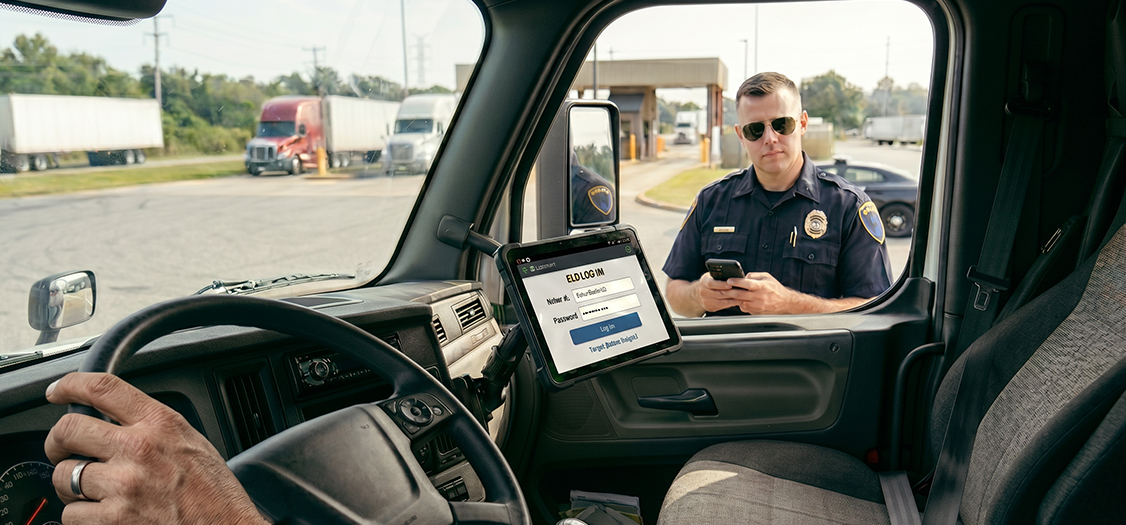
Once entered, the violation is visible to FMCSA, state enforcement agencies, and any party that accesses the carrier’s public SMS profile. Shippers, brokers, and insurance companies do check SMS data. A string of HOS violations on a carrier’s record has real consequences for contract eligibility and insurance rates. For individual drivers with a CDL, serious violations can also appear in the Commercial Driver’s License Information System depending on the severity and how the state processes the record.
What Are the Different Types of ELD Violations?
ELD violations fall into several distinct categories, and each carries a different severity weight in the FMCSA Safety Measurement System. Knowing the difference helps you understand which citations create the most risk.
What Counts as a Form and Manner Violation?
A form and manner violation means your ELD data was present but not properly formatted, transferred, or accessible. This includes situations where a driver cannot produce logs on demand in a format the inspector can read, where the required data fields are incomplete, or where the ELD did not transfer data correctly during an inspection. These violations sit under 49 CFR 395.8(a)(1) and typically receive a lower severity weight than hours-of-service violations in the SMS system.
Form and manner violations are the ones drivers most often get cited for by accident. A device that freezes during a data transfer, a driver who cannot demonstrate how to display logs, or a missing in-vehicle information packet required under 49 CFR 395.22(h) can all generate a form and manner citation even when the underlying hours are legal. This is why knowing how to operate your ELD before you get to a scale matters as much as the hours themselves. If you have questions about how our device handles data transfer during inspections, the Geosavi FAQ page covers the process in detail.
What Counts as an Hours-of-Service Violation?
An HOS violation is a citation for exceeding one of the driving or on-duty limits set under 49 CFR 395.3. The most common are exceeding the 11-hour driving limit, exceeding the 14-hour on-duty window, failing to take the required 30-minute break, or violating the 60/70-hour weekly limit under 49 CFR 395.3(b). These violations carry a higher severity weight in the SMS system than form and manner violations, and they are the ones most likely to put a driver out of service.
HOS violations rose from 410,000 in 2023 to more than 500,000 in 2025, according to RigDig data cited by Overdrive in April 2026. That increase suggests more drivers are pushing limits, more inspectors are checking closely, or both.
What Is a No Record of Duty Status Violation?
A no record of duty status violation is issued when a driver subject to ELD requirements has no electronic log on file at all. This is cited under 49 CFR 395.8(a)(1) and is one of the more serious form violations because it suggests either a device failure that was not handled correctly or a driver who ignored the requirement. If your ELD malfunctions, 49 CFR 395.34 requires the driver to notify the carrier immediately and keep paper logs until the device is repaired. Failing to do that and arriving at an inspection with no logs generates this citation.
How Does an ELD Violation Affect Your CSA Score?
Every ELD and HOS violation recorded at a roadside inspection feeds directly into FMCSA’s Safety Measurement System under the Hours-of-Service Compliance behavior category. The violations are weighted by severity, with more serious violations receiving a higher point value, and then time-weighted so that older violations count less than recent ones.
How Does the Severity Weighting Work?
FMCSA assigns severity weights ranging from 1 to 10 to each violation type. Hours-of-service violations for exceeding driving or duty limits typically receive higher weights than form and manner violations. The exact weight assigned to each violation code is set by FMCSA and updated periodically; check the current SMS methodology for the latest figures. Falsification violations carry the highest weights. Each violation is also multiplied by a time weight: violations in the most recent six months receive the full multiplier, while those in the 7 to 12 month range receive a reduced one, and violations from 13 to 24 months ago receive the lowest multiplier before dropping out of the carrier SMS window entirely.
The HOS Compliance category has one of the lower SMS intervention thresholds compared to most other categories. That means carriers do not need a large number of violations before FMCSA may initiate a compliance review. The exact threshold percentiles are published by FMCSA and updated periodically, so check the current figures on the FMCSA website rather than relying on any static number.
Does One Violation Automatically Trigger a Review?
One violation by itself does not trigger a compliance review. The SMS system looks at patterns across a 24-month window and compares your carrier’s violation rate against similar carriers in the same category. A single citation raises your score but typically will not put a carrier over the intervention threshold on its own. What puts carriers over the threshold is repeated violations across multiple drivers, the same driver getting cited repeatedly, or a single severe violation combined with an already elevated score. Fleet managers who check their SMS scores regularly catch problems before they accumulate. You can monitor your fleet’s standing through the Geosavi ELD platform, which keeps your logs organized and ready for any compliance review.
Can a Driver’s Violations Be Separated from the Carrier’s?
Driver violations and carrier violations are both captured in the SMS system. The carrier’s record reflects all violations by all drivers operating under that DOT number. A driver who is an owner-operator has both a driver record and a carrier record, and violations appear in both. For company drivers, the violation appears in the carrier’s SMS profile and in the driver’s inspection history, but the CSA score itself is primarily a carrier metric. That said, carriers reviewing driver history before hiring will see individual inspection records, so repeated violations on a driver’s history affect hiring decisions.
What Are the Actual Penalty Amounts for ELD Violations?
The fines are real, and they are not small. FMCSA fines motor carriers up to $19,246 per HOS violation and drivers up to $4,812, with knowing falsification carrying a maximum civil penalty of up to $15,846. All figures are maximum civil penalty amounts adjusted annually for inflation under the FMCSA penalty schedule. These are not fixed amounts; the actual penalty assessed in any specific case depends on the nature of the violation, the carrier’s history, and whether the violation was willful.
What Is the Penalty Range for Common Violations?
The penalty schedule under the FMCSA penalty schedule sets out ranges for different violation categories. Not every citation results in a formal penalty notice. Many roadside citations result only in a score on the carrier’s SMS record. A penalty notice comes when FMCSA initiates a compliance review or when an inspector issues a civil penalty directly at the roadside for a serious violation. Fleet managers who have never received a penalty notice may not realize they still have violations accumulating on their SMS record from inspections that did not involve any paperwork beyond the inspection report.
The amounts that matter most in practice are the ones tied to knowing falsification under 49 CFR 395.8(e)(1). A driver who edits logs to hide hours, or a carrier that instructs drivers to misrepresent their duty status, faces penalties that are in addition to any out-of-service order or loss of operating authority. The word knowing in that citation is key. FMCSA has to show the falsification was deliberate, but 58,382 falsification violations were recorded in 2024 according to CVSA annual data, and not all of them involved elaborate schemes. Many were simple edits that left a paper trail.
When Does an ELD Violation Result in an Out-of-Service Order?
An out-of-service order removes the driver from operation immediately and the truck does not move until the driver has met the required rest conditions or the violation is resolved. Not every ELD violation triggers an out-of-service order, but certain conditions make one automatic.
Which Violations Lead to Immediate Out-of-Service?
Under the CVSA Out-of-Service Criteria, a driver is placed out of service for exceeding the 11-hour driving limit by three or more hours, operating without any record of duty status, or exceeding the 14-hour window by more than three hours. A driver who arrives at an inspection having driven 14 or more hours without the required off-duty period is placed out of service on the spot. The truck stays where it is until a replacement driver arrives or the driver takes the required rest time.
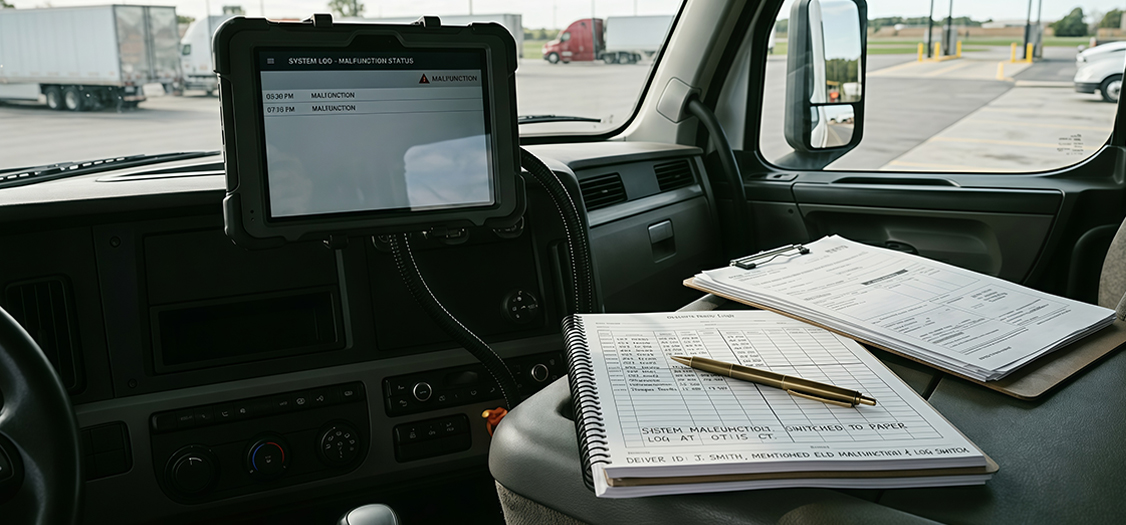
A device issue can also trigger an out-of-service order. If your ELD malfunctions and you have not followed the correct procedure under 49 CFR 395.34, meaning you did not notify your carrier and did not switch to paper logs, the inspector treats it as a no-record violation. That generates an out-of-service order. The repair deadline for the carrier under 49 CFR 395.34(d)(1) is eight days. If the device is not repaired or replaced within that window, the driver cannot operate under the malfunctioning device exemption.
What Happens if Your ELD Was Already Removed from the FMCSA List?
This is the situation that many carriers are not watching closely enough. Since January 2025, FMCSA has removed 79 ELD devices from its registered list, according to the agency’s May 19, 2026 press release. The most recent removal, announced May 19, 2026, covered 12 additional devices with a replacement deadline of July 20, 2026, according to fmcsa.dot.gov. Safe ELD and MyLogs ELD were removed on May 7, 2026, giving affected carriers until July 7, 2026 to replace their devices. After the 60-day grace period expires, operating on a deregistered device generates a citation under 49 CFR 395.8(a)(1) and can result in an immediate out-of-service order. Carriers using any of the 12 devices removed on May 19, 2026 face that deadline on July 20, 2026, according to fmcsa.dot.gov. You can check whether your device is currently registered on the FMCSA-registered ELD list. Our platform is FMCSA-registered and listed there; you can verify your device status directly on the Geosavi electronic logging device page.
What Are the Consequences of ELD Falsification?
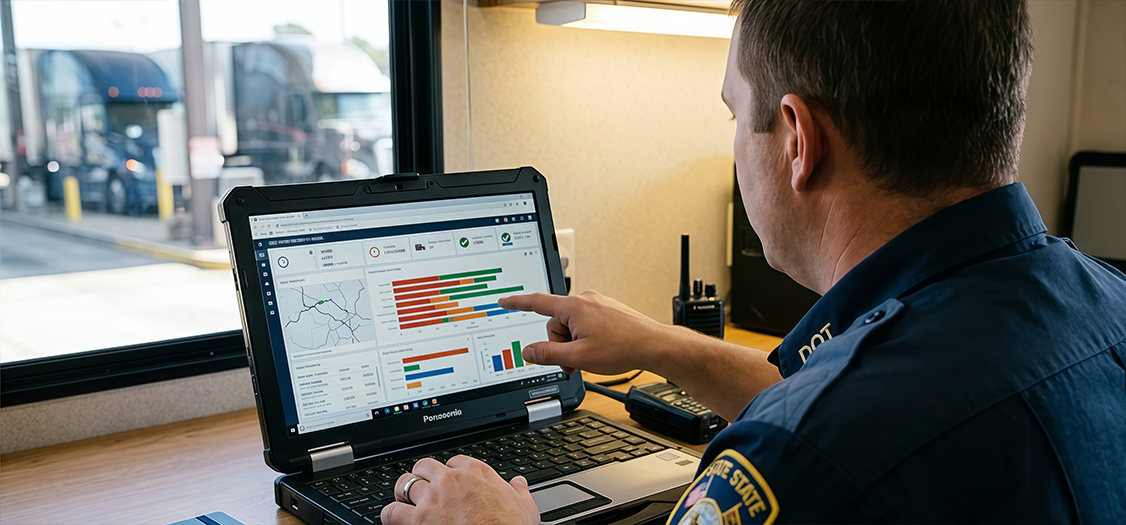
Falsification of records is treated differently from any other ELD violation. It is not a form error or an hour’s miscalculation. It is deliberate deception of a federal safety system, and FMCSA and DOT treat it that way.
What Does Falsification Include?
Under 49 CFR 395.8(e)(1), falsification covers any knowing entry in a record of duty status that does not accurately reflect the driver’s actual status. This includes editing drive time after the fact to make it appear legal, switching between ELD profiles to split hours across two records, using personal conveyance status to hide drive time, and asking a co-driver to log hours under their record that were actually driven by someone else. CVSA inspectors are trained to look for patterns in the data that do not match vehicle movement records, fuel receipts, or toll records. The supporting documents rule under 49 CFR 395.8(k) exists precisely to give investigators a cross-reference against the electronic log.
Can a Falsification Charge End a Driving Career?
A knowing falsification finding can result in a civil penalty of up to $15,846, a compliance review for the carrier, and in serious cases a referral to DOT’s Office of Inspector General for criminal investigation. For CDL holders, a disqualification proceeding is possible depending on the severity and frequency. That outcome is not guaranteed from a single violation, but it is real. Carriers that pressure drivers to falsify records are also exposed under 49 CFR 390.36, which prohibits harassment of drivers over HOS compliance.
What Are the Risks of Running a Deregistered ELD?
Running a deregistered ELD is not a gray area. Once a device is removed from the FMCSA-registered list and the 60-day grace period expires, operating with that device is treated the same as operating with no ELD at all.
How Do Carriers Find Out Their Device Was Removed?
FMCSA does not send individual notices to every carrier using a deregistered device. The announcement is made publicly, and carriers are expected to check the FMCSA-registered ELD list and monitor FMCSA news releases. Carriers that rely on their ELD vendor to notify them are trusting a vendor that may no longer be operating. When Safe ELD and MyLogs ELD were removed on May 7, 2026, their user bases were left without a functioning registered device. Carriers in that situation have until July 7, 2026 to replace their devices before every road inspection becomes a potential citation.
The 79-device removal figure since January 2025 is not a minor housekeeping event. It represents a large number of fleets that need to act. If you are not certain your device is on the current registered list, check now and replace before the grace period runs out. Our ELD products store lists every device we carry, all of which are on the active FMCSA registered list.
What Rights Do Drivers Have When Facing Carrier Pressure Over HOS?
Drivers are protected by federal regulation from carrier pressure to violate HOS rules or falsify records. Many drivers do not know this protection exists, and carriers that exploit that ignorance create serious legal exposure for themselves.
What Does 49 CFR 390.36 Actually Cover?
Under 49 CFR 390.36, it is illegal for any motor carrier to coerce a driver to violate federal safety regulations, including HOS rules. This means a dispatcher cannot tell a driver to keep driving past their 14-hour window. A fleet manager cannot instruct a driver to edit their log. A shipper or receiver cannot threaten a driver with lost loads if they take the required rest time. The regulation covers all forms of pressure, not just direct orders.
How Does a Driver Report Harassment?
Drivers who face this kind of pressure can report it directly to FMCSA through the FMCSA coercion complaint process. FMCSA has a coercion complaint process, and carriers found to have violated 49 CFR 390.36 face their own civil penalty exposure. A driver who reports harassment is protected from retaliation. If you are in a situation where you feel pressured to violate your hours, document it in writing, keep a copy, and contact our support team so we can help you understand your options before the situation becomes a citation on your record.
How Can a Driver or Carrier Challenge an Incorrect Violation?
Not every roadside violation is accurate. Inspectors make data entry errors. ELD software can display status in ways that look like a violation when the underlying hours are legal. The DataQs system exists to challenge inaccurate inspection data.
What Is the DataQs Process?
DataQs is FMCSA’s online system for requesting a review of inspection data that a driver or carrier believes is inaccurate. You submit a challenge within 90 days of the inspection, provide documentation, and the reviewing agency, typically the state patrol or FMCSA office that conducted the inspection, has 60 days to respond. If the challenge is accepted, the violation is removed from the record and the SMS score is adjusted. If it is rejected, you can escalate to FMCSA for a final determination.
The key to a successful DataQs challenge is documentation. You need the original inspection report, your ELD logs for the day in question, any supporting documents under 49 CFR 395.8(k), fuel receipts, toll records, and any written communication that supports your account of the hours. Drivers who keep their records organized have a much higher success rate on DataQs challenges than those who are trying to reconstruct what happened weeks after the fact.
What Violations Can Actually Be Challenged?
DataQs is designed for factual errors, not legal disputes. If an officer recorded the wrong regulation number, got the time wrong, or cited a driver who was actually exempt, those are challengeable. If a driver actually exceeded their hours and the log shows it, a DataQs challenge will not succeed. Carriers and drivers who face a valid violation are better served by correcting the underlying operation than by filing a challenge that the reviewing agency will reject. If you need guidance on what your logs show and whether a challenge is worth pursuing, our support team can walk you through the documentation.
What Should Fleet Managers Do to Prevent ELD Violations?
The best time to handle an ELD violation is before it happens. Fleet managers carry the compliance responsibility for every driver operating under their DOT number, and the SMS score reflects every citation across the entire fleet.
What Does a Fleet Manager Miss Most Often?
The violations fleet managers miss most often are not the obvious ones. Drivers who routinely run 10 hours and 50 minutes are not a problem. The violations that accumulate quietly are personal conveyance misuse, missing or incomplete supporting documents under 49 CFR 395.8(k), and form-and-manner errors where the log data is correct but not accessible in the right format during an inspection. These do not generate out-of-service orders, so they do not create immediate operational disruption, but they add to the SMS score over time.
Regular internal audits of ELD data, spot-checking supporting documents against vehicle records, and making sure every driver knows how to display and transfer their logs during an inspection are the three things that catch these violations before an inspector does. The Geosavi ELD platform keeps all log data in one place and makes it easy to pull records for any driver on any date without waiting for a driver to send files manually.
What Training Do Drivers Need?
Drivers need to know four things: how to display their current log on demand, how to transfer logs to an inspector via Bluetooth or USB, what to do if the device malfunctions under 49 CFR 395.34, and when they are legally allowed to use personal conveyance. These are not complicated procedures, but drivers who have never practiced them under pressure can fumble at a scale and generate a form-and-manner violation on logs that are otherwise clean. Running through these procedures during onboarding and at least once a year after that removes a category of violations that should never happen.
ELD Violation Severity and Penalty Reference
| Violation Type | Regulation | Severity Weight (SMS) | Max Driver Penalty | Max Carrier Penalty |
|---|---|---|---|---|
| Exceeding 11-hr driving limit | 49 CFR 395.3 | High | Up to $4,812 | Up to $19,246 |
| Exceeding 14-hr on-duty window | 49 CFR 395.3 | High | Up to $4,812 | Up to $19,246 |
| No record of duty status | 49 CFR 395.8(a)(1) | High | Up to $4,812 | Up to $19,246 |
| Form and manner error | 49 CFR 395.8(a)(1) | Low to Medium | Varies | Varies |
| Knowing falsification | 49 CFR 395.8(e)(1) | Highest | Up to $15,846 | Up to $19,246 |
| Operating deregistered ELD | 49 CFR 395.8(a)(1) | High | Out-of-service | Up to $19,246 |
| ELD malfunction not reported | 49 CFR 395.34 | Medium | Up to $4,812 | Up to $19,246 |
All penalty amounts are maximum civil penalty amounts adjusted annually for inflation under the FMCSA penalty schedule.
Out-of-Service Trigger Comparison
| Condition | Out-of-Service? | Regulation |
|---|---|---|
| Exceeded 11-hr limit by 3+ hours | Yes | 49 CFR 395.3 |
| No record of duty status | Yes | 49 CFR 395.8(a)(1) |
| Exceeded 14-hr window by 3+ hours | Yes | 49 CFR 395.3 |
| ELD malfunction, paper logs not kept | Yes | 49 CFR 395.34 |
| Deregistered ELD after grace period | Yes | 49 CFR 395.8(a)(1) |
| Form and manner error, hours legal | No | 49 CFR 395.8(a)(1) |
| Weekly limit exceeded by less than 2 hours | Generally No | 49 CFR 395.3(b) |
Questions to Ask Before Choosing an ELD Provider
Before you commit to an ELD provider, especially given that FMCSA has removed 79 devices from its registered list since January 2025, ask these questions directly.
Is your device currently on the FMCSA-registered list at eld.fmcsa.dot.gov?
Any provider that cannot answer this with a direct yes and a registration number is not a safe choice. Check the list yourself at eld.fmcsa.dot.gov and verify the device name and provider match exactly.
What happens if your device is removed from the FMCSA list?
Ask whether they will notify you immediately, how long it will take to ship replacement hardware, and whether there is a cost. A provider that cannot answer this question has not thought through the situation that caught thousands of carriers off guard in 2025 and 2026.
How does your device handle data transfer during a roadside inspection?
Both Bluetooth and USB transfer methods must work correctly. Ask to see a demonstration of how logs are displayed and transferred. A driver who cannot do this in under two minutes at a scale is at risk of a form-and-manner citation.
What connection types does your device support?
For accurate vehicle data recording, the device needs to connect to the engine via J1939, J1708, or OBD-II. Our device supports all three, confirmed on our ELD platform page. Devices that rely only on GPS or accelerometers do not meet the FMCSA technical standard in Appendix A to Subpart B of Part 395.
What is your support coverage when a driver has a device issue at 2 a.m. on a Saturday?
Compliance problems do not follow business hours. Our technical support runs 24 hours a day, seven days a week.
What is your return policy if the device does not work as described?
We offer a 30-day money-back guarantee. If the device does not perform, you are not locked in. Ask any provider whether they offer the same before you sign a multi-year contract.
Is your hardware certified to any environmental standard?
Our tablet is SAE J1455 certified for temperature, vibration, and shock resistance. A device that fails in cold weather or on rough roads creates compliance problems you did not sign up for.
How do I check pricing before committing?
Our price calculator gives you a clear number based on your fleet size without a sales call.
Your ELD Violation Questions Answered
Violations and Your Record
Does an ELD violation show up on a background check?
ELD violations that result in a citation at a roadside inspection go into FMCSA’s Safety Measurement System, which is publicly accessible. Background check companies that pull motor vehicle and safety records can see your inspection history, including any violations recorded against your driver record. CDL holders should also be aware that certain serious violations may be reported to the Commercial Driver’s License Information System depending on the state where the inspection occurred.
How long does an ELD violation stay on my record?
For driver Pre-Employment Screening Program (PSP) records, violations remain for 36 months. For carrier CSA scores, the SMS scoring window is 24 months, according to FMCSA’s CSA methodology. The inspection record itself, including any violations noted, stays in FMCSA’s Motor Carrier Management Information System indefinitely, and investigators can access that history during a compliance review even after the scoring windows have closed.
Can I get a violation removed from my record?
Yes, if the violation was recorded in error. FMCSA’s DataQs system allows drivers and carriers to challenge inaccurate inspection data. If the challenge is accepted, the violation is removed from the record and the SMS score is recalculated. You have 90 days from the date of the inspection to file a challenge. Valid violations cannot be removed, but you can add a rebuttal statement to your record explaining the circumstances.
Does a form-and-manner violation count the same as an hours-of-service violation?
No. The SMS system assigns different severity weights to different violation types. Hours-of-service violations for exceeding driving or duty limits carry higher weights than form-and-manner violations. Both go on your record, but the hours violations do more damage to your carrier’s SMS percentile ranking.
What happens to the carrier when a driver gets an out-of-service order?
The out-of-service order applies to the driver and requires that driver to stop operating until the condition is resolved. The carrier’s SMS record receives the violation. If the carrier has a pattern of drivers being placed out of service, FMCSA can initiate a compliance review. The carrier is also responsible for any operational disruption caused by the order, including arranging a replacement driver or waiting for the original driver’s rest time to be satisfied.
Can an owner-operator be penalized as both the driver and the carrier?
Yes. An owner-operator holds both a driver record and a carrier DOT number. A violation at a roadside inspection can be cited against both the driver and the carrier in the same inspection report. The penalty exposure for the driver and the carrier are separate line items under the FMCSA penalty schedule.
Device and Technical Violations
What do I do if my ELD malfunctions during a trip?
Under 49 CFR 395.34, you must notify your carrier immediately when the device malfunctions. From that point, you switch to paper logs and continue the trip. The carrier has eight days to repair or replace the device under 49 CFR 395.34(d)(1). Do not ignore the malfunction and continue using a device that is not recording correctly. That creates a no-record situation that generates a more serious citation than the malfunction itself.
Can I be cited for using an ELD that my carrier provided?
Yes. The driver is responsible for operating with a compliant ELD under 49 CFR Part 395. If your carrier gives you a device that is deregistered or malfunctioning and you operate with it without following the correct malfunction procedure, you can be cited at a roadside inspection. The carrier also faces a citation, but that does not remove your exposure as the driver. Check the FMCSA-registered ELD list if you have any doubt about your device’s status.
What does a Level VIII electronic inspection check for?
A Level VIII inspection is an electronic review of ELD data that does not require the driver to stop. Inspectors access the data remotely or from a fixed site and check for HOS violations, missing records, and inconsistencies between the electronic log and supporting data. Level VIII inspections are expanding nationwide in 2026. A driver whose logs are clean has nothing to worry about. A driver with hours that are borderline or supporting documents that do not match the log is at risk even without a physical stop.
Does using personal conveyance incorrectly create a violation?
Yes. Personal conveyance misuse is one of the patterns CVSA inspectors look for specifically because it is a common way drivers try to extend available hours without showing an HOS violation. Personal conveyance is only permitted when the driver is relieved of all duty and moving for personal reasons. Using it to drive to a nearby truck stop after being dispatched, or to reposition the truck in a way that benefits the carrier, does not qualify. If the supporting documents do not support the personal conveyance claim, a falsification citation under 49 CFR 395.8(e)(1) is possible.
My ELD transferred logs during an inspection but the inspector said the data was not readable. Is that my problem or the vendor’s?
It is your problem at the time of the inspection. The transfer may have worked correctly on your end while producing a file the inspector’s system could not read due to a format mismatch. That generates a form-and-manner citation against you. After the inspection, it becomes a vendor issue if their device produced a non-compliant output. Contact our support team immediately if this happens; we can help you document the device’s output for a DataQs challenge.
Conclusion
An ELD violation on your record is not the end of your operation, but it is also not something to ignore. Every citation adds to your carrier’s CSA score for up to 24 months and stays on your driver PSP record for 36 months. Every out-of-service order creates an operational disruption, and a pattern of violations puts your carrier’s compliance profile in front of FMCSA reviewers. The drivers and fleets that avoid these problems are not doing anything special. They know their regulations, they keep their logs accurate, and they make sure the device they are running is registered and working correctly.
The 2026 enforcement picture is not getting easier. CVSA Roadcheck focused on ELD tampering. Level VIII electronic inspections are expanding. Seventy-nine devices have been pulled from the registered list since January 2025, with 12 more removed on May 19, 2026 carrying a July 20, 2026 replacement deadline, according to fmcsa.dot.gov. If you have not checked your device’s status recently, check it today on the FMCSA-registered ELD list. If your device is not on that list, you need a replacement before the next inspection.
If you have questions about your current ELD setup, your violation history, or switching to a registered device, call our 24/7 support team at 800-261-4361 or reach out through our contact page. We back every device with a 30-day money-back guarantee and round-the-clock technical support because compliance problems do not wait for business hours.