Key Takeaways
- A box truck does not need an ELD simply because it is called a box truck. The answer depends on the operation, vehicle or combination, RODS requirement, and any valid exception.
- For federal motor-carrier rules, a property-carrying vehicle used in interstate commerce is generally a CMV when its GVWR, GCWR, actual gross weight, or actual gross combination weight is 10,001 pounds or more, whichever is greater.
- Interstate commerce can include a trip that stays within one state when the freight is part of a movement that originated or will terminate outside the state.
- A driver who qualifies for the 150-air-mile short-haul exception does not prepare RODS, but the carrier must maintain the time records required by 49 CFR § 395.1(e).
- A driver who needs RODS on no more than eight days in any 30-day period may use manual records instead of an ELD under § 395.8(a)(1)(ii).
- CDL and ELD requirements use different tests. A non-CDL box truck can still be a CMV subject to HOS and ELD rules.
Introduction
Do you need an ELD for a box truck? Many interstate box-truck drivers do, but vehicle style alone does not decide the issue. The correct answer comes from a sequence of questions about commerce, vehicle weight or use, Hours-of-Service applicability, record-of-duty-status requirements, and exceptions.
That sequence matters because several common shortcuts are wrong. Crossing a state line is not the only way an operation becomes interstate commerce. GVWR is not the only weight value in the CMV definition. A CDL is not the trigger for an ELD. And short-haul drivers must still meet the exception conditions and maintain required time records through the carrier.
This guide explains current federal box truck ELD requirements. Intrastate rules can differ, and specialized operations may have additional exceptions, so confirm the facts for the specific driver, vehicle, freight, and trip.
How to Decide Whether a Box Truck Needs an ELD
Use this five-step review:
- Identify the commerce. Determine whether the trip is interstate commerce or solely intrastate commerce.
- Determine CMV status. Apply the complete federal CMV definition, including rated weight, actual weight, passengers, and placarded hazardous materials.
- Determine HOS and RODS applicability. Confirm whether the driver is subject to Part 395 and must prepare a record of duty status.
- Check each ELD exception. Review short-haul time records, the eight-days-in-30 rule, driveaway-towaway operations, pre-2000 vehicles or engines, agriculture, and other operation-specific provisions.
- If an ELD is required, verify the exact device. The model and software version must appear on FMCSA’s registered list and be used in compliance with the rule.
Does the truck have to cross a state line?
No. Under the interstate-commerce definition in 49 CFR § 390.5T, a trip can be interstate commerce when it occurs between two points in one state as part of transportation that originated or will terminate outside that state or the United States. The freight’s overall movement matters, not only the route driven by this truck.
A truly intrastate operation is generally governed by state HOS and electronic-log requirements rather than the federal ELD rule. States may adopt rules similar to the federal standards, but operators should check the responsible state agency rather than assume that staying inside state lines removes every requirement.
When does the ELD rule apply?
The ELD rule generally applies when a motor carrier subject to Part 395 uses a driver who must prepare RODS under 49 CFR § 395.8. A driver using a valid short-haul time-record exception does not prepare RODS for that day. A driver who must prepare RODS may still qualify for one of the manual-record exceptions in § 395.8(a)(1)(ii).
How Weight Determines Box Truck CMV Status
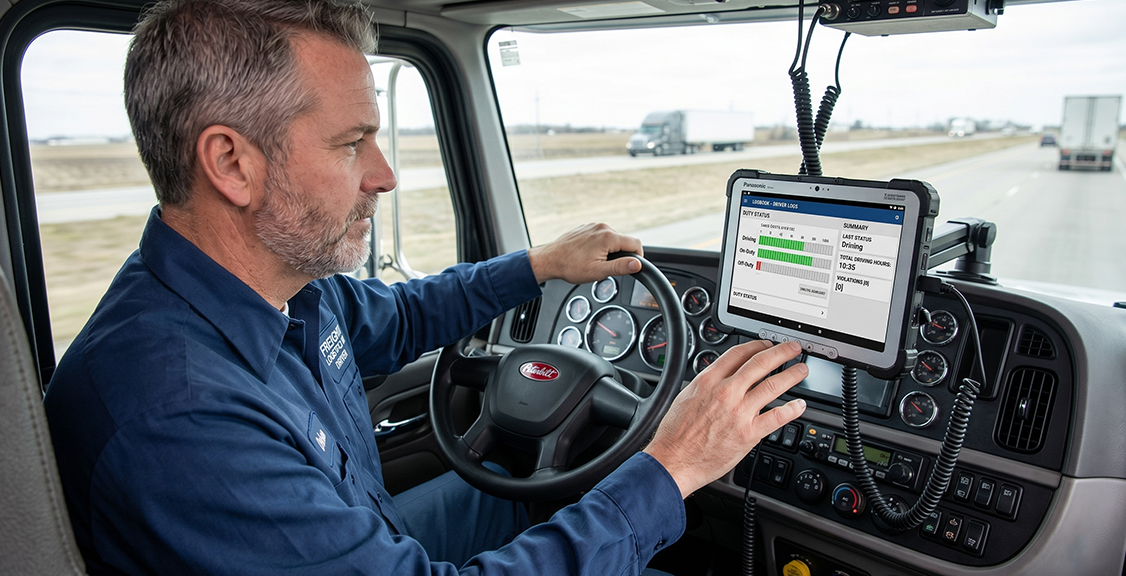
For a property-carrying vehicle used on a highway in interstate commerce, § 390.5T generally defines a CMV at 10,001 pounds or more based on the greater of:
- gross vehicle weight rating (GVWR);
- gross combination weight rating (GCWR);
- actual gross vehicle weight (GVW); or
- actual gross combination weight (GCW).
This means a 10,000-pound-GVWR truck can still fall within the federal CMV definition if its actual gross weight reaches 10,001 pounds or more. A trailer can also change the analysis because the applicable combination rating or actual combination weight may control.
Weight is not the only trigger. A vehicle may also qualify based on passenger design or use, or because it transports hazardous material in a quantity requiring placarding. A lightweight box truck is therefore not automatically outside the federal rules.
| Operation | Federal CMV result | ELD result |
|---|---|---|
| Interstate property vehicle or combination at 10,001 pounds or more by the controlling rated or actual weight | Generally a CMV | Required if the driver must prepare RODS and no ELD exception applies |
| Interstate property vehicle or combination below 10,001 pounds by every applicable weight measure | Generally not a CMV based on weight | Generally not required based on weight alone |
| Placarded hazardous-material transportation | CMV regardless of the ordinary weight threshold | Depends on RODS and applicable exceptions |
| Solely intrastate transportation | Federal definition may not control | Check state law |
Does a Box Truck Need a CDL Before It Needs an ELD?
No. CDL and ELD requirements use different thresholds. A typical interstate box truck can fall between the 10,001-pound CMV threshold and the 26,001-pound CDL threshold. Its driver may not need a CDL based on weight, but may still be subject to HOS and ELD rules.
Under federal CDL definitions, a Class B vehicle generally has a GVWR of 26,001 pounds or more. A Class A combination generally has a GCWR of 26,001 pounds or more when the towed vehicle has a GVWR over 10,000 pounds. Passenger and placarded-hazardous-material operations can trigger CDL requirements through separate provisions.
Do not use the license class as a substitute for the ELD analysis. Start with the operation and Part 395 obligations.
Which HOS Rules Apply to Property-Carrying Box Trucks?
For drivers subject to 49 CFR § 395.3, the core property-carrier limits include:
- up to 11 hours of driving after 10 consecutive hours off duty;
- no driving beyond the 14th consecutive hour after coming on duty following 10 consecutive hours off duty;
- a 30-minute interruption after eight cumulative hours of driving without a qualifying interruption; and
- the applicable 60-hour/7-day or 70-hour/8-day limit.
The 34-hour restart is an available method of restarting the 60/70-hour calculation; it is not the only way a driver can regain available cycle hours. Sleeper-berth, adverse-driving-condition, and other provisions should be applied only when their conditions are met.
Passenger-carrying operations use different limits under § 395.5. A vehicle’s body style does not convert a passenger operation into a property-carrier operation.
Which ELD Exceptions Can Apply to a Box Truck?
Short-haul time records
Under § 395.1(e)(1), a driver can be excepted from RODS when the driver operates within a 150-air-mile radius of the normal work reporting location, returns there and is released within 14 consecutive hours, receives the required qualifying off-duty period, and the carrier keeps the required time records.
The carrier’s records must show the reporting time, total on-duty hours, release time, and specified prior-seven-day information for a first-time or intermittent driver. These records must be accurate and retained for six months. An air mile is a nautical mile; 150 air miles is approximately 172.6 statute miles.
Section 395.1(e)(2) contains a separate short-haul provision for certain property-carrying vehicles that do not require a CDL. It has distinct conditions, including limited use of a 16-hour duty window. Operators should document which paragraph they use instead of blending the two exceptions.
No more than eight RODS days in any 30-day period
Section 395.8(a)(1)(ii)(A)(1) allows manual records when the operation requires RODS on no more than eight days within any rolling 30-day period. This is an ELD exception, not an exemption from HOS or RODS on those days. The count is driver-specific and is not limited to a calendar month.
Track all RODS days across the rolling window. If the driver needs RODS on a ninth day, the driver no longer fits this manual-record exception for that operation.
Driveaway-towaway operations
Manual RODS may be used in the driveaway-towaway situations described in § 395.8(a)(1)(ii), including when the vehicle being driven is part of the shipment delivered. Ordinary freight carried inside a box truck is not a driveaway-towaway operation.
Vehicles manufactured before model year 2000
The regulation permits manual records for a vehicle manufactured before model year 2000, generally identified through the VIN on the registration. Model year 2000 itself is not “before model year 2000.”
FMCSA’s October 2, 2026 revised guidance also states that a vehicle with an engine predating model year 2000 may be excepted even when the vehicle VIN indicates a later model year. The carrier should retain documentation of motor and engine changes at its principal place of business. Because the engine guidance is interpretive and fact-specific, preserve reliable manufacturer, installer, or dealer documentation.
Agricultural operations and covered farm vehicles
Section 395.1(k) removes Part 395 requirements during state-determined planting and harvesting periods for specified transportation within a 150-air-mile radius, including qualifying agricultural commodities from their source. Section 395.1(s) separately addresses covered farm vehicles. These provisions are narrower than “carrying farm products,” so verify the commodity, source, radius, season, vehicle status, and type of operation.
| Provision | What it changes | Recordkeeping point |
|---|---|---|
| Short haul, § 395.1(e) | Excepts qualifying driver from RODS | Carrier time records required and retained six months |
| Eight days in 30, § 395.8(a)(1)(ii) | Allows manual RODS instead of an ELD | Count RODS days in every rolling 30-day period |
| Driveaway-towaway | Allows manual RODS in specified operations | Document why the operation fits the definition |
| Pre-2000 vehicle or qualifying engine | Allows manual RODS | Retain reliable vehicle and engine documentation |
| Agricultural or covered farm vehicle | Can remove Part 395 requirements when all conditions apply | Document commodity, source, radius, season, and vehicle status |
What Happens When a Required ELD Is Missing?
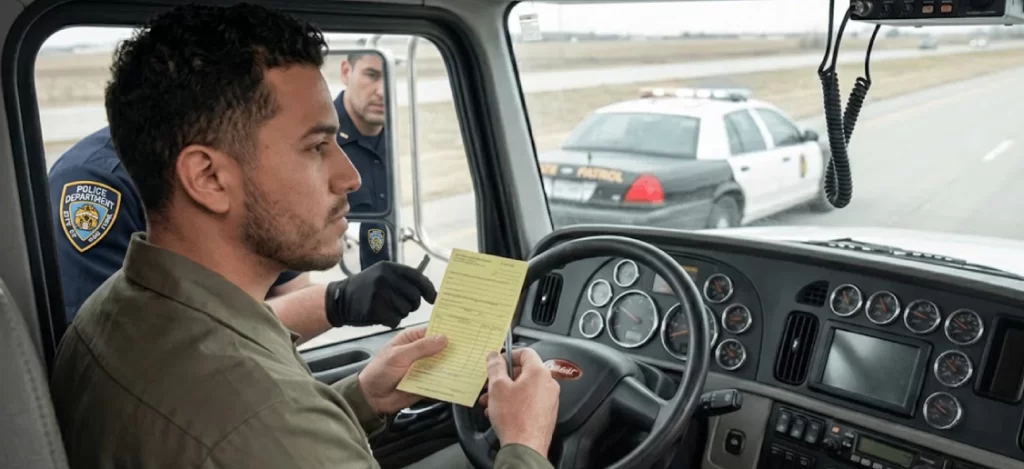
A roadside officer can document ELD or RODS violations, and the current North American Standard Out-of-Service Criteria may require a driver to stop operating for certain conditions. The result depends on the exact violation and current enforcement criteria. Section 395.13 should not be read as making every ELD issue an automatic immediate out-of-service event.
Civil-penalty maximums are adjusted and depend on the statutory and regulatory violation. Rather than relying on a fixed dollar amount in an evergreen guide, consult the current penalty schedule and the actual enforcement document.
Roadside inspection violations can enter FMCSA’s Safety Measurement System under the applicable BASIC. SMS uses inspection and other safety data to prioritize carriers for interventions; a BASIC percentile is not a federal safety rating and does not automatically determine insurance pricing.
If an inspection record is incomplete or inaccurate, a carrier or driver can submit supporting evidence through DataQs. Correcting the equipment or paying a citation does not, by itself, prove that the original inspection data was wrong.
Do Owner-Operators Need an ELD?
Owner-operator status does not create a general ELD exemption. If the driver operates a CMV in interstate commerce, must prepare RODS, and does not qualify for an exception, an ELD is required.
An owner-operator leased to an authorized carrier should follow the carrier’s safety-management and ELD procedures, but the driver remains responsible for accurate duty-status records. Agreements should clearly address device assignment, account ownership, access to records, unidentified driving, proposed edits, support, and record retention.
A one-truck operation still needs the same core controls: a registered device, accurate carrier and driver profiles, a malfunction process, the required onboard information, and access to retained records.
How to Choose and Set Up an ELD for a Box Truck
If an ELD is required, verify the exact device name, model, and software version on the FMCSA registered ELD list. Registration is based on provider self-certification and is not an FMCSA product endorsement. Check registration status before deployment and periodically afterward.
Evaluate the device against the truck and operation:
- compatibility with the vehicle’s available diagnostic connection and engine data;
- supported roadside data-transfer method;
- secure, unique driver and support accounts;
- a fixed, driver-visible mounting method for a portable ELD;
- procedures for unidentified driving, annotations, proposed edits, and certifications;
- access to records and backups for the required retention period;
- clear malfunction reporting, troubleshooting, and replacement steps; and
- training that lets the driver display or transfer records without guessing.
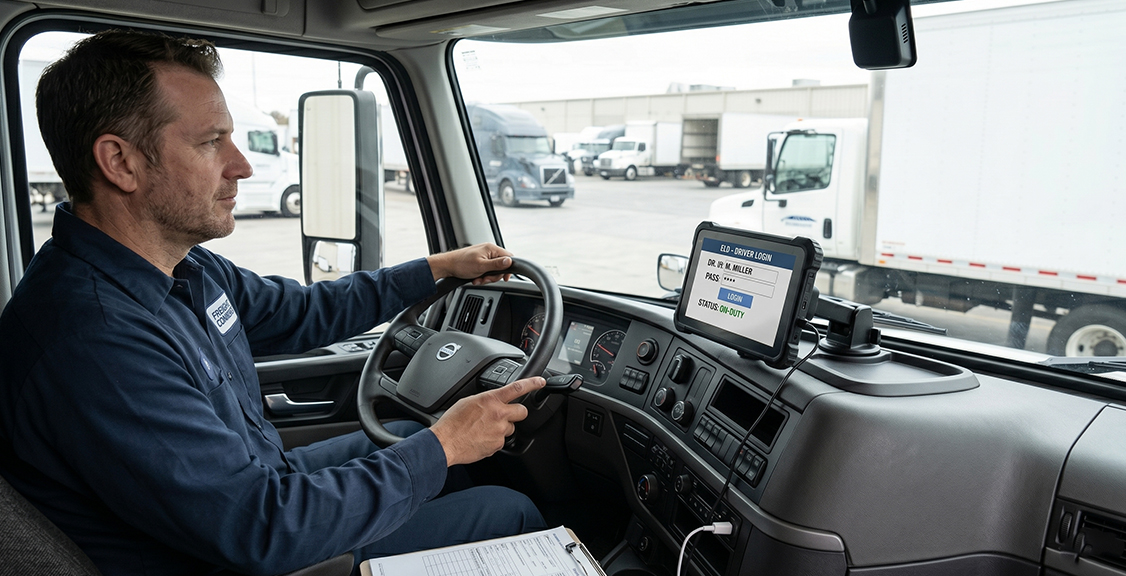
Before the first dispatch, test login, vehicle assignment, location and engine synchronization, duty-status changes, annotations, certification, and roadside transfer. Confirm the carrier name, USDOT number, home-terminal address, time zone, and driver-license data.
Under § 395.22, the vehicle must carry instructions for transferring records, malfunction instructions, and enough blank graph grids for at least eight days. These items may be electronic when accessible. A portable ELD must be mounted in a fixed position and visible to the driver while operating.
For general product information, review the Geosavi ELD overview, then confirm the exact listed model and its fit for the vehicle before purchase or installation.
Common Box Truck ELD Mistakes
- Using GVWR alone: the federal definition also considers GCWR, actual gross weight, and actual combination weight.
- Assuming local means intrastate: freight moving in interstate commerce can make an in-state leg interstate.
- Using CDL status as the ELD test: many non-CDL CMVs remain subject to HOS and ELD rules.
- Treating short haul as no-record operation: the carrier must keep the time records specified in § 395.1(e).
- Counting only calendar-month RODS days: the manual-record exception uses any rolling 30-day period.
- Citing § 395.1 for the eight-day exception: the ELD exception is in § 395.8(a)(1)(ii).
- Calling model year 2000 “pre-2000”: the regulatory text says manufactured before model year 2000.
- Keeping an unverified device in service: confirm the exact model and version on the registered list.
- Leaving drivers unprepared for roadside transfer: test the process and keep required instructions accessible.
Box Truck ELD Requirements: Frequently Asked Questions
Does every box truck over 10,000 pounds need an ELD?
No. At 10,001 pounds or more by the controlling rated or actual weight, an interstate property-carrying vehicle is generally a CMV. An ELD is required only when the driver must prepare RODS and no ELD exception applies.
Does a 10,000-pound-GVWR box truck need an ELD?
Not based on GVWR alone, but check actual weight, combination weight, passenger use, and placarded hazardous materials. A truck rated at 10,000 pounds can meet the CMV definition if its actual gross weight is 10,001 pounds or more.
Can a local box truck driver use the short-haul exception?
Possibly. “Local” is not the legal test. The driver must satisfy the applicable § 395.1(e) conditions, and the carrier must maintain the required time records. A day outside those conditions may require RODS.
Can paper logs be used instead of an ELD?
Yes, when a § 395.8(a)(1)(ii) exception applies, such as requiring RODS on no more than eight days in any 30-day period, a qualifying driveaway-towaway operation, or a qualifying pre-2000 vehicle. Paper or manual RODS must still meet the applicable requirements.
Is a model-year-2000 box truck exempt?
No, not under the “manufactured before model year 2000” language. FMCSA’s October 2, 2026 guidance separately addresses vehicles with engines predating model year 2000 and recommends that carriers retain documentation of motor and engine changes.
Does an owner-operator get a one-truck exemption?
No general one-truck ELD exemption exists. Apply the same commerce, CMV, RODS, and exception analysis used for any other motor carrier.
Does an ELD replace every other compliance record?
No. An ELD records duty-status data. It does not replace short-haul time records, driver qualification files, maintenance records, DVIRs when required, shipping documents, drug-and-alcohol program records, or other applicable records.
Conclusion
Box truck ELD requirements become manageable when the questions are asked in the correct order: Is the transportation interstate? Is the vehicle or combination a CMV under the complete definition? Must the driver prepare RODS? Does a current exception apply? If not, is the exact ELD registered and correctly configured?
Document the answer for each driver and operating pattern. Recheck it when the vehicle, trailer, freight, route, work-reporting location, or number of RODS days changes. That approach is more reliable than using vehicle appearance, CDL status, or an old penalty amount as the deciding factor.