Key Takeaways
- Under 49 CFR 395.30(f), carriers must preserve original HOS information and ELD source data when records are edited; an edit does not erase the original event.
- Under 49 CFR 395.8(k)(1), carriers retain records of duty status (RODS) and required supporting documents for six months from the date of receipt. A later edit does not replace the original record.
- Under 49 CFR 395.22(i), carriers also keep a six-month backup of ELD records on a device separate from the one storing the original and protect driver privacy.
- Supporting documents are governed by 49 CFR 395.11: carriers generally keep up to eight per driver duty day, while drivers generally submit them within 13 days of the duty day or receipt, whichever is later.
- Drivers must be able to access their own ELD records. If they cannot do so independently, FMCSA says the carrier must provide access on request during the six-month retention period.
- When an authorized official requests ELD records, 49 CFR 395.22(j) requires the carrier to produce them electronically at the time of request, subject to the rule’s multiple-office exception.
- At roadside, a driver must be able to present the current 24-hour period and previous seven days of RODS. If electronic transfer fails, FMCSA says an ELD display or printout can still be used for review.
- Carrier retention is separate from what an enforcement agency may keep after an inspection. Maintain your own complete, retrievable archive rather than relying on a roadside transfer.
| Table of Contents |
|---|
| What Law Protects |
| 6-Month Retention |
| Backup Copy Rule |
| Supporting Documents |
| Enforcement Reality |
| Retention Table |
| Provider Questions |
| Common Questions |
Introduction
ELD record retention is an important FMCSA compliance requirement for motor carriers. The precise answer is that 49 CFR 395.8(k)(1) requires the motor carrier to keep each driver’s records of duty status and supporting documents for six months from the date the carrier receives them. Separately, 49 CFR 395.22(i) requires a six-month backup of ELD records on a separate device and protection of driver privacy.
Retention is only part of the workflow. Original ELD information must remain intact when a log is edited under 49 CFR 395.30(f); drivers need access to their records; and carriers must be able to produce ELD records when an authorized official requests them under 49 CFR 395.22(j). Supporting documents have their own rules under 49 CFR 395.11.
This guide separates those obligations so your team can check its archive, provider backup, driver access, and production process without treating them as one rule. For the supporting-document categories and daily cap, see our fact-checked supporting documents guide.
What Does 49 CFR 395.30(f) Actually Prohibit, and Why Does It Matter to Your Fleet?
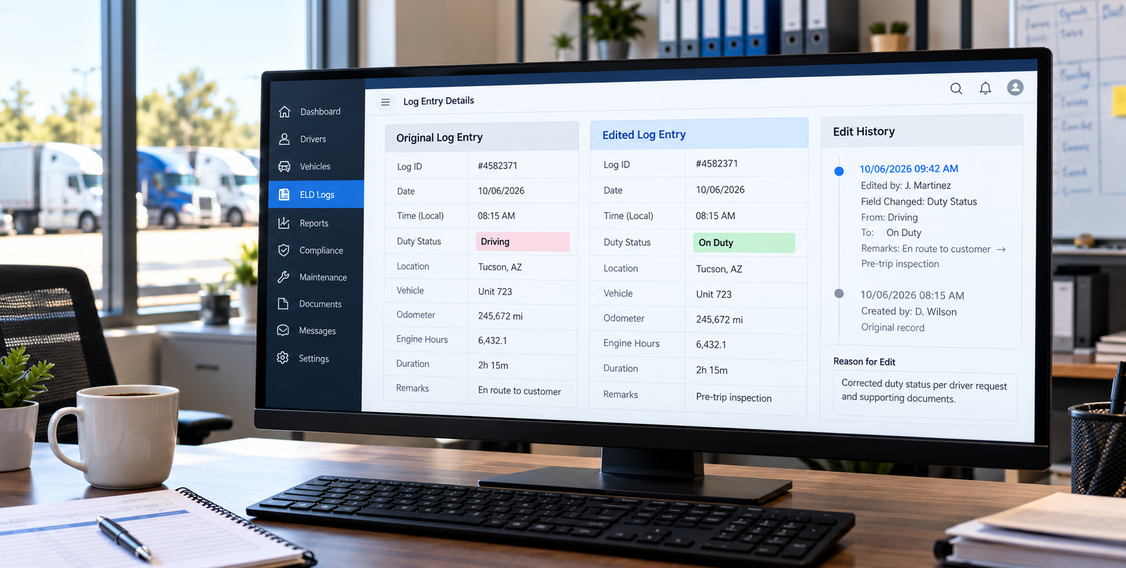
Under 49 CFR 395.30(f), a carrier may not alter or erase the original HOS information collected, the source data streams used to provide it, or ELD information based on those sources. A permitted edit adds a corrected event and an explanation; it does not rewrite what the device originally recorded.
Ask your provider to show the original event, the corrected event, and the annotation after a sample edit. FMCSA explains that original records remain available even after edits, and that a carrier must provide driver access on request if the driver cannot obtain the records independently from the ELD. That access relates to the six-month record-retention period. See FMCSA’s guidance on original records and driver access and our ELD edit annotation guide.
Section 395.30(f) protects original data; it does not turn every edited ELD event into a record with an unlimited retention period. Keep the original information and edit history available throughout the applicable retention period.
How Long Must Your Fleet Actually Keep ELD Records?
The federal minimum for a carrier’s RODS and supporting documents is six months from the date of receipt under 49 CFR 395.8(k)(1). FMCSA states the same rule in its ELD FAQ. Do not substitute the date a duty day began or the date of a later edit for the date the carrier received the record or document.
An edit or recertification does not erase the original event or create a new RODS in place of the one the carrier received. Keep the original and correction together. If a document arrives after the underlying duty day, track its own receipt date rather than assuming every item in a driver’s file has one identical clock.
Carriers may retain records longer for business, litigation-hold, or other applicable obligations, but six months is the federal HOS minimum addressed here. A provider change does not remove the carrier’s duty to retain and retrieve the records already received.
What Does the Backup Copy Rule Require, and Where Must the Copy Live?
Under 49 CFR 395.22(i)(1), a motor carrier must keep a backup copy of ELD records for six months on a device separate from the device holding the original data. Paragraph (i)(2) also requires the carrier to protect driver privacy in a manner consistent with sound business practices.
The regulation specifies a separate device; it does not prescribe a particular cloud account, geographic distance, RAID layout, or vendor architecture. Ask the provider which device or storage system holds the original records, which separate device holds the backup, how long both are retained, and how records are recovered if one fails. A portal copy is not proof of compliance until its relationship to the original and backup is understood.
The backup requirement applies to ELD records. Required supporting documents still have the six-month retention rule under 49 CFR 395.8(k), but § 395.22(i) does not separately require each bill of lading or receipt to be copied to another device. For broader ELD data management, see our ELD data management guide.
What Supporting Documents Must Be Retained Alongside ELD Records?
Under 49 CFR 395.8(k)(1), the carrier keeps required supporting documents for six months from receipt alongside RODS. 49 CFR 395.11 defines five document categories: trip origin and destination records, dispatch or trip records, expense receipts tied to on-duty not-driving time, electronic mobile communications, and payroll or settlement records.
The rule generally limits the required set to up to eight supporting documents per driver for each 24-hour duty period. If more than eight qualifying documents exist, retain the earliest- and latest-time documents plus six others; if fewer exist, retain each one. Toll receipts have an additional rule for drivers keeping paper RODS. Drivers generally submit supporting documents within 13 days of the duty day or the day they receive the document, whichever is later.
A fuel or toll receipt may be relevant if it meets the regulatory criteria, but neither is a universal named category for every ELD driver. Our supporting documents guide explains the categories, cap, and submission rule in more detail. DVIRs follow separate Part 396 requirements.
What Do Missing Records and Falsification Look Like in Enforcement?
Retention and roadside production answer different questions. The carrier’s archive must satisfy the six-month rule in § 395.8(k) and the ELD record retention backup and production duties in § 395.22(i)-(j). At roadside, the driver must be able to present RODS for the current 24-hour period and previous seven days. A failed electronic transfer is not automatically a missing-record citation: FMCSA says an officer may review the ELD display or printout when transfer fails.
If the ELD cannot accurately record or present the required RODS, follow the malfunction procedures in 49 CFR 395.34. If an authorized official requests carrier-held ELD records, § 395.22(j) requires electronic production at the time of request, subject to its multiple-office provision. Check both the driver-facing roadside workflow and the carrier’s archive export before an inspection or audit.
Missing records, an unavailable transfer method, and a knowingly false record are not interchangeable findings. Avoid assuming a particular citation or penalty from a single symptom; the applicable rule and facts determine the outcome.
ELD Records, Backup, and Access: A Side-by-Side Breakdown
| Record or duty | Governing rule | Minimum period | What the carrier should verify |
|---|---|---|---|
| Records of duty status (RODS) | 49 CFR 395.8(k)(1) | 6 months from carrier receipt | Keep each driver’s RODS; retain original ELD information when edited. |
| Supporting documents | 49 CFR 395.8(k); 395.11 | 6 months from carrier receipt | Keep the required documents, generally up to eight per driver duty day. |
| Backup of ELD records | 49 CFR 395.22(i) | 6 months | Keep a copy on a device separate from the one storing the original; protect driver privacy. |
| Unidentified driving records | 49 CFR 395.32(c) | At least 6 months from receipt | Review and assign appropriately or explain why time remains unassigned; make records available to officials. |
| Driver access to ELD records | 49 CFR 395.30(f); FMCSA guidance | During the 6-month retention period | Provide access on request if the driver cannot obtain the records independently. |
| ELD record production | 49 CFR 395.22(j) | At request; not a separate retention period | Produce electronically for an authorized official, subject to the multiple-office provision. |
Questions to Ask Before You Trust an ELD Provider With Your Fleet’s Records
Does your ELD system preserve the original record entry after an edit, or does the corrected version replace it?
Ask the provider to show an edited record with its original event, correction, and annotation. Under § 395.30(f), original HOS information and ELD source data must not be overwritten. The driver-facing and carrier views may differ, so confirm how an authorized user can retrieve the full edit history when needed.
Is the ELD backup stored on a separate device?
Section 395.22(i)(1) requires the backup to reside on a device separate from the one holding the original ELD data. Ask the provider to identify both devices or storage systems and demonstrate restoration. The rule does not itself require a different city, cloud account, or named replication design; those are possible implementation details to verify, not regulatory text.
How does the system capture the timestamp and editor identity for every change made to a record of duty status?
Under § 395.30(c)(2), changes or additions require an annotation explaining the reason. Ask the provider to demonstrate the ELD’s edit history, including the original and corrected events and available origin, date, and time information. Our annotation guide covers the driver and carrier edit workflow in more detail.
What happens to your drivers records when their accounts are deactivated after they leave your fleet?
FMCSA says drivers must be able to access their own ELD records during the six-month retention period; if the driver cannot obtain them independently from the ELD, the carrier must provide access on request. Ask how the provider handles record requests after an account is disabled and how your staff can retrieve the records still within the required period.
What format are records exported in, and can your fleet download a complete historical archive before switching providers?
When your fleet moves to a different ELD platform, the records generated on the previous system do not automatically migrate, and your 6-month retention obligation does not pause during that transition. Ask your current or prospective provider what file format records export in, whether a complete historical archive is downloadable on demand, and how long the provider retains your records after your contract ends. If you are evaluating a platform change and want to understand the cost differences, our price calculator is a useful starting point.
Does the system include unassigned driving records in the standard audit export?
Under § 395.32(c), carriers keep unidentified driving records for at least six months from receipt and make them available for the relevant period during an inspection, audit, or investigation. Ask whether the standard archive export includes these records or whether they require a separate retrieval step. Test that process before a request arrives.
How would your provider respond to a device removal from the FMCSA registered ELD list, and what happens to your stored records during that transition?
Check the FMCSA registered ELD list and any device-specific removal notice. Replacement instructions and deadlines are notice-specific, so an older removal count or general transition period is not a reliable rule. Ask how the provider will preserve and export the records already in your custody if a device or service is discontinued.
Can we verify how record retrieval works before an audit arrives, rather than discovering the gaps during one?
Yes. Test the driver display or printout, electronic transfer, carrier archive export, and recovery from the separate backup before a time-sensitive request. Our support team can explain the Geosavi workflow for your configuration. Document the result of a sample retrieval so your staff knows which method to use if a transfer fails.
What should we check in our current ELD system right now to confirm we are meeting all three retention obligations?
Check four things: retain RODS and required supporting documents for six months from carrier receipt; preserve original ELD information through edits; confirm the six-month ELD record retention backup is on a separate device; and test driver access and electronic record production. Record the source and receipt dates in your archive without replacing the regulation’s receipt-based rule with an edit or creation date.
Common Questions About ELD Record Retention and Preservation
About Retention Rules and Your Compliance Obligations
How long must a motor carrier keep ELD records of duty status?
Under 49 CFR 395.8(k)(1), a carrier must keep each driver’s RODS and required supporting documents for six months from the date of receipt. Under § 395.22(i)(1), it must also keep a backup copy of ELD records for six months on a separate device. These are related but distinct duties.
Does the retention clock reset when a record is corrected or a driver recertifies?
An edit does not erase the original ELD event or turn the correction date into a substitute for the carrier’s receipt date under § 395.8(k)(1). Keep the original information and edit history with the record. Track the receipt date for RODS and supporting documents; do not assume a document received later has the same retention start as the duty day.
Are drivers required to keep their own personal copies of ELD records?
Drivers need access to their own ELD records. FMCSA says that if a driver cannot retrieve those records independently from the ELD, the carrier must provide access on request during the six-month retention period. The carrier’s retention duty does not depend on a driver keeping a personal archive.
What supporting documents must be retained alongside ELD records?
49 CFR 395.11 identifies five categories: trip origin and destination documents, dispatch or trip records, expense receipts tied to on-duty not-driving time, electronic mobile communications, and payroll or settlement records. Carriers generally retain up to eight qualifying documents per driver duty day, with the earliest- and latest-time documents plus six others when more than eight exist. Toll receipts have an additional rule for paper-RODS drivers. See our supporting documents guide.
Can ELD records from a paper log period satisfy the same retention requirement?
When an ELD malfunction prevents accurate HOS recording, § 395.34 requires the driver to reconstruct the current 24-hour period and previous seven days on graph-grid paper logs unless those records are already possessed or retrievable, and to continue compliant manual logs until the ELD is restored. The carrier retains required RODS and supporting documents under the same six-month rule. Our paper-log guide explains related recordkeeping.

About Enforcement, Inspections, and Penalty Exposure
What happens if a driver cannot produce ELD records during a roadside inspection?
A driver must be able to present the current 24-hour period and previous seven days of RODS. If electronic transfer fails, FMCSA says an ELD display or printout can still be used for review. If records cannot be presented by an available compliant method, the officer evaluates the facts and applicable rules. An ELD malfunction may also trigger the procedures in § 395.34.
What is the legal difference between a missing record and a falsification violation?
A missing record and a knowingly false record are different issues. Section 395.8(e)(1) prohibits false reports of duty status; § 395.30(f) protects original ELD record retention information from alteration or erasure. A missing original event or failed transfer does not, by itself, establish knowing falsification. The finding depends on what happened and what the evidence shows.
How much can FMCSA fine a carrier for HOS and record violations?
Civil penalty amounts are adjusted over time and depend on the violation and circumstances. Consult the current 49 CFR Part 386 Appendix B rather than relying on a fixed dollar figure in an article. A recordkeeping deficiency and a knowingly false RODS are not interchangeable violations.
What should a retention review check beyond a past inspection campaign?
Check whether RODS and supporting documents are retained from receipt, original ELD events remain available after edits, the separate-device backup can be restored, and records can be produced when requested. These standing FMCSA duties matter regardless of a past inspection campaign’s focus.
Does a roadside ELD transfer replace the carrier’s archive?
No. A roadside transfer is a way to provide records to an authorized official; it does not replace the carrier’s six-month retention and backup duties under §§ 395.8(k) and 395.22(i). Keep your own complete, retrievable records regardless of whether an agency retains an inspection copy.
What must we do if a driver refuses to accept a carrier-proposed edit to their record?
Under § 395.30(d), a carrier may propose an edit only after the driver has submitted the record. The driver must confirm or reject it; an accepted change requires recertification and resubmission to take effect. If the driver rejects the proposal, the proposed edit and response remain in the ELD record, while the original certified record is not replaced by the proposal.
Are box trucks and lighter vehicles subject to the same ELD records retention requirements?
The six-month RODS and supporting-document rule in § 395.8(k)(1) applies to carriers and drivers required to maintain those records; it is not limited only to vehicles that use an ELD. Whether a particular box truck driver needs an ELD or qualifies for a RODS exception requires a separate applicability review. Our box-truck ELD guide covers that decision.
What happens to our stored ELD records when we switch providers mid-year?
A provider change does not pause the carrier’s retention duty. Confirm that records still within the six-month window can be exported, read, backed up where required, and produced after the old account closes. Keep the carrier’s receipt dates and test access to the archive before deactivating the outgoing service.
What Solid ELD Records Actually Protect
The practical baseline is clear: keep RODS and required supporting documents for six months from carrier receipt; retain a six-month ELD backup on a separate device; preserve original ELD information when correcting logs; and make records accessible to drivers and authorized officials as the rules require. The details differ by record type, so test each part of the workflow rather than relying on one generic archive setting.
Good retention practices also make provider transitions and malfunction recovery less disruptive. For a review of how Geosavi Compliance Now stores, backs up, and produces records in your configuration, contact our team or call (800) 261-4361.