Key Takeaways
- Supporting documents fall into five categories defined under 49 CFR 395.11(c): bills of lading and equivalent origin or destination records, dispatch or trip records, expense receipts tied to on-duty, not-driving time, electronic mobile communications sent through a fleet management system, and payroll records or settlement sheets.
- Carriers must retain documents within these categories, along with the driver’s records of duty status, for six months from the date the carrier receives them, under 49 CFR 395.8(k)(1).
- Motor carriers must retain up to eight supporting documents for each 24-hour period a driver is on duty. If more than eight qualifying documents exist, the carrier must retain the documents with the earliest and latest time indications plus six others; if fewer than eight exist, the carrier must retain each document, under 49 CFR 395.11(d).
- Under 49 CFR 395.11(c)(2), a supporting document generally must contain four data elements: a link to the driver, the date, location, and time. If fewer than eight documents contain all four elements for the duty day, a document containing all except time may also qualify.
- Common examples include bills of lading, dispatch records, fuel receipts, and payroll or settlement records, each falling under one of the five required categories.
- For drivers required to use ELDs, the ELD creates the electronic record of duty status, but the five supporting-document categories under 49 CFR 395.11(c) verify the detail behind it. Neither one replaces the other.
- The absence of a supporting document is not automatically a violation if no qualifying document was generated or received in the normal course of business. However, carriers must retain the supporting documents required under 49 CFR 395.11(d), and failure to retain those required records can create a recordkeeping violation.
- FMCSA may assess civil penalties for applicable recordkeeping violations under 49 CFR Part 386, including Appendix B. Penalty amounts and enforcement outcomes depend on the specific violation and applicable requirements.
Introduction
An ELD records how many hours your driver spent on the road, but it does not capture every detail behind those hours. Bills of lading, fuel receipts, dispatch records, and similar documentation fill in the details an electronic log cannot capture, and FMCSA still expects carriers to keep these records even in a fully electronic logging environment. For a lot of fleet owners, this is the part of compliance that quietly slips through the cracks, often because paperwork workflows are inconsistent rather than any deliberate gap in compliance.
It matters more than it seems, if your fleet is ever reviewed, this documentation is often what an FMCSA reviewer uses to confirm your ELD hours actually match what your driver was doing that day, and staying organized from the start beats reconstructing everything after the fact.
From what counts as a supporting document under 49 CFR 395.11(c) to how long carriers must keep these records, why they still matter alongside a compliant ELD, what tends to go wrong when the paperwork gets neglected, and how to stay organized without it becoming a headache for your back office, we cover all of it below. If your fleet would rather talk it through, you can schedule time with our team, or reach us anytime at (800) 261-4361, with no obligation.
What Are Supporting Documents Under FMCSA Rules?
Supporting documents fall into five categories defined under 49 CFR 395.11(c): bills of lading, itineraries, schedules, or equivalent origin and destination records; dispatch or trip records; expense receipts tied to on-duty, not-driving time; electronic mobile communications sent through a fleet management system; and payroll records, settlement sheets, or equivalent payment records. Carriers must retain documents in these categories, along with the associated driver’s records of duty status, for six months under 49 CFR 395.8(k)(1).
Beyond falling into one of these five categories, a supporting document generally must contain four data elements under 49 CFR 395.11(c)(2)(i): the driver’s name or a carrier-assigned identification number that can be linked to the driver, the date, the location, and the time. If fewer than eight supporting documents contain all four elements for a 24-hour period, a document containing all of these elements except time may also qualify under 49 CFR 395.11(c)(2)(ii).
Think of your ELD as the primary record and these five categories as the backup evidence. The rule exists because an electronic log, on its own, is a summary. It shows driving time, on-duty time, and off-duty time, but it does not explain the full context behind a stop, a delay, or a location change. Supporting documents fill that gap. A dispatch record might show why a driver was held at a shipper for two extra hours. A payroll or settlement record might confirm a trip actually happened the way the log describes. None of this replaces the ELD, but it gives a reviewer or your own compliance team something to cross-reference if a question ever comes up.
This is not a new concept that arrived with the ELD mandate. Paper-log carriers have always been expected to keep some form of corroborating paperwork. What changed is that fleets running electronic logs sometimes assume the ELD alone is sufficient, and it is not treated that way under FMCSA’s own recordkeeping rules. With that foundation in place, the next question most fleet owners ask is which specific documents actually count.
What Types of Documents Count as Supporting Documents?
FMCSA’s five supporting-document categories under 49 CFR 395.11(c) cover a wide range of paperwork most fleets already generate in the normal course of business.
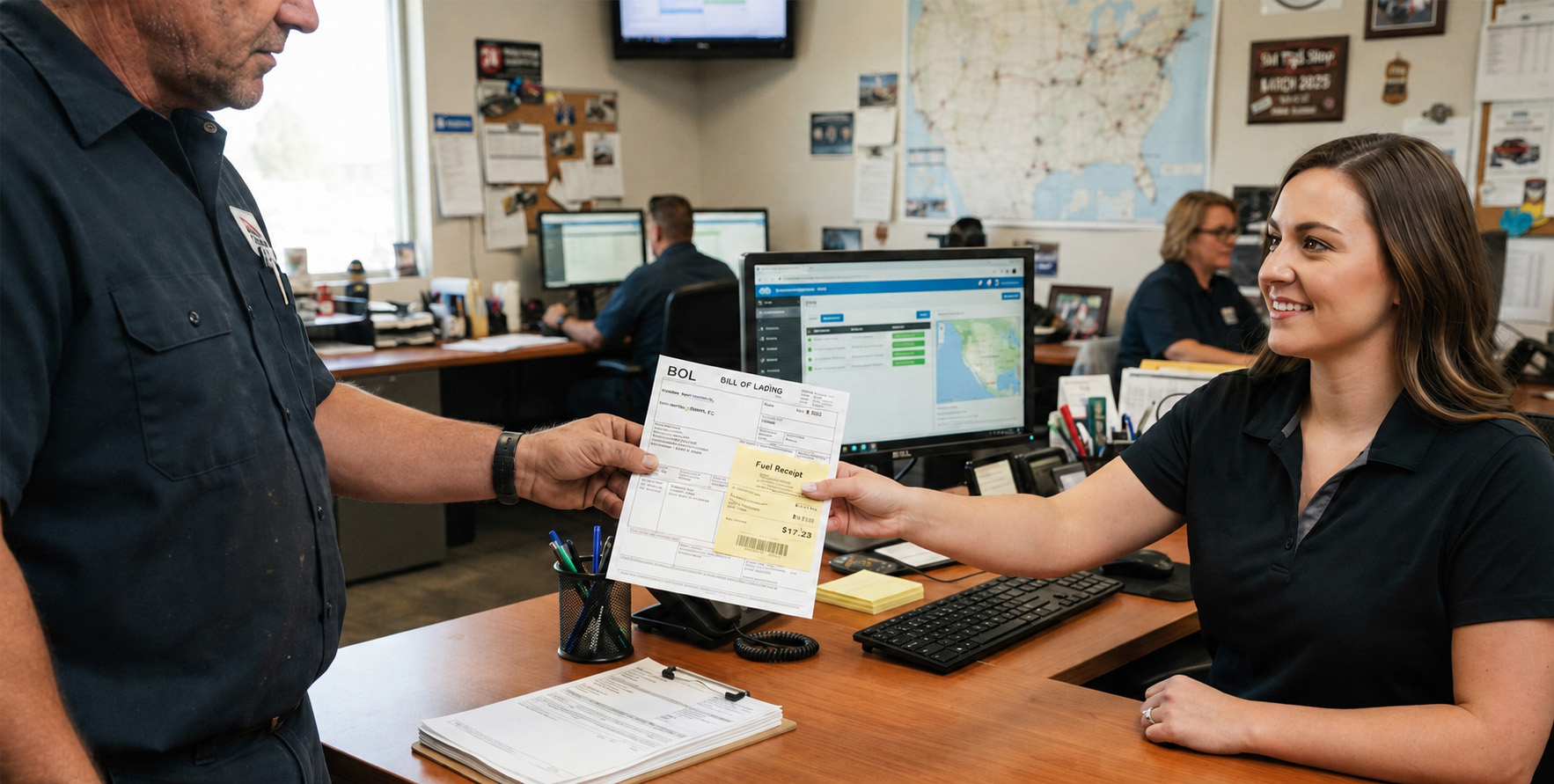
Bills of lading and dispatch records fall under the first two categories. Fuel receipts and lodging expenses may qualify as expense receipts when they relate to on-duty, not-driving time. For drivers who keep paper records of duty status under the limited ELD exception in 49 CFR 395.8(a)(1)(iii), the motor carrier must also retain toll receipts. Those toll receipts do not count toward the eight-supporting-document limit under 49 CFR 395.11(d). Mobile communications sent through a fleet management system make up the fourth category, and payroll or settlement records make up the fifth. Inspection paperwork fits into this broader picture too, since many fleets already track vehicle inspection findings through their DVIR process, and keeping that documentation organized alongside supporting documents saves time if the two ever need to be reviewed together.
Not every piece of paper needs to be treated as a supporting document. The standard is whether a document falls into one of the five categories above and could reasonably help verify a driver’s duty status for a specific day. A generic company memo or an unrelated invoice would not typically qualify. Once your fleet has a clear sense of what qualifies, the next practical question is how long, and how many, you actually need to hold onto.
How Long Must Carriers Retain Supporting Documents?
Carriers must retain documents within the five supporting-document categories, along with the associated driver’s records of duty status, for six months, under 49 CFR 395.8(k)(1). Under 49 CFR 395.11(d), motor carriers must retain up to eight supporting documents for each 24-hour period a driver is on duty. If more than eight qualifying documents exist, the carrier must retain the documents with the earliest and latest time indications plus six others; if fewer than eight exist, the carrier must retain each document.
The six-month retention period runs from the date the carrier receives the document, not from the date it was created. Under 49 CFR 395.11(a), drivers must submit supporting documents to the motor carrier no later than 13 days after receiving them, so a fleet’s internal deadline for driver submissions should be set well inside that window rather than at the edge of it.
If a document relates to an ongoing audit, investigation, or other compliance matter, it may be prudent to retain it until the matter is resolved, even if the ordinary retention period has passed. FMCSA’s DataQs system may be used to request review of eligible data maintained in FMCSA systems, but it is not a general dispute process for all driver records or supporting documents. Some carriers also retain records past the required window simply because storage is inexpensive relative to the risk of not having something on hand if a question comes up later. A driver turning in a stack of receipts every two weeks, instead of within the required window, makes it easy for something to get lost or misfiled before it is ever properly recorded.
Why Do Supporting Documents Matter If You Already Use an ELD?
For drivers required to use ELDs, the ELD creates the electronic record of duty status, built into the broader 49 CFR Part 395 HOS rules. But an ELD cannot explain why a driver was stationary at a particular location for an extended period, or confirm that a delivery actually happened where the log says it did.
If a reviewer sees an unusual pattern in the ELD data, such as a long stop with no corresponding activity, a matching bill of lading or dispatch note can resolve the question in minutes instead of days. Supporting documents also come into play when a log entry needs to be corrected, since any edit still has to follow the annotation requirements laid out in 49 CFR 395.30, and having the underlying paperwork on hand makes that kind of correction far easier to explain and support.
There is also a practical, day-to-day reason this matters beyond audits. Fuel receipts help with IFTA reporting and expense tracking regardless of compliance requirements, so keeping this paperwork organized tends to pay off in more than one part of the business at once.
How Should Carriers Organize and Store Supporting Documents?
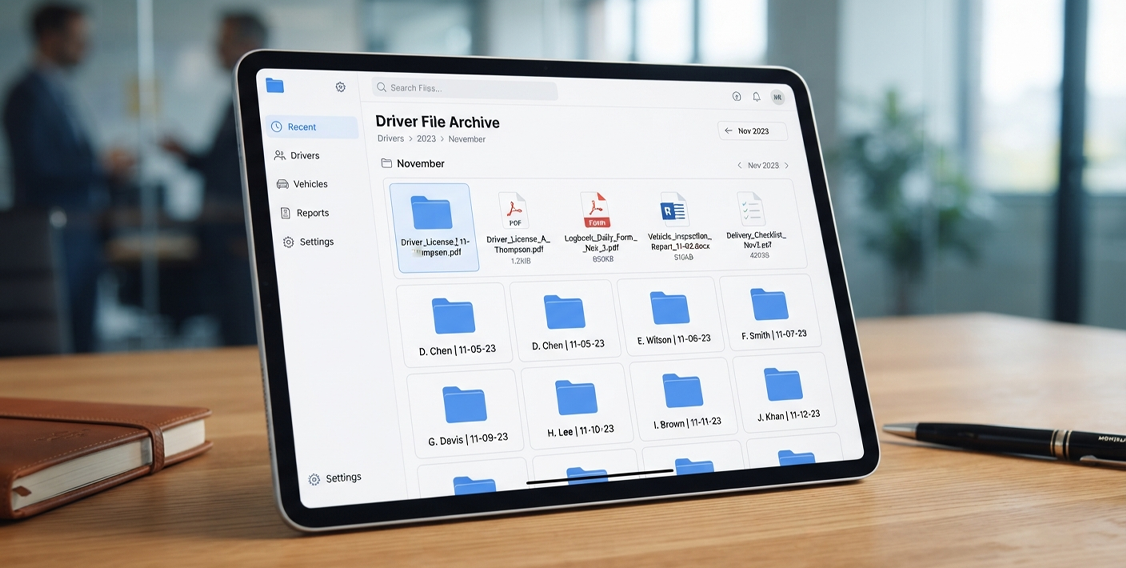
Carriers should organize supporting documents by driver and by date, in a system that lets any record be retrieved quickly if it is ever needed for a review or an internal check.
Digital storage is acceptable and, for most fleets, far more practical than a filing cabinet full of paper. What matters is consistency. Documents should be legible, dated, and tied clearly to the driver and trip they relate to. Under 49 CFR 395.11(d), motor carriers must retain up to eight supporting documents for each 24-hour period a driver is on duty. When more than eight qualifying documents exist, the carrier must retain the documents with the earliest and latest time indications plus six additional supporting documents, so a system that makes those records easy to identify, organize, and retrieve is worth prioritizing. A folder structure organized by driver name and month works for smaller fleets, while larger operations often benefit from software that tags documents automatically and cross-references them against ELD records.
Photos of paper receipts, taken and uploaded close to when they are received, are a reasonable way to convert paper into a searchable digital record, as long as the images stay clear enough to read later. Fleets still working out the right setup are welcome to reach our support team for guidance on what tends to work well.
The biggest organizational failure point tends to be delay. A receipt that sits in a driver’s cab for two weeks before it gets turned in is far more likely to get lost, damaged, or forgotten than one submitted the same day. Building a habit of same-day or same-week submission, well inside the required window, tends to prevent most of the gaps that show up later.
What Happens During an Audit If Supporting Documents Are Missing?
The absence of a supporting document is not automatically a violation if no qualifying document was generated or received in the normal course of business. However, motor carriers must retain the supporting documents required under 49 CFR 395.11(d). Failure to retain those required records can create a recordkeeping violation, separate from any hours-of-service violation the documents might have helped identify or explain.
If an FMCSA reviewer flags something unusual in a driver’s ELD data and there is no supporting paperwork available to clarify it, the reviewer is left relying on the electronic record alone, which may not tell the full story. This does not necessarily mean a citation will follow, but it does raise the risk that an otherwise explainable situation gets treated as a discrepancy. Recordkeeping issues, including failure to retain required supporting documents, can create compliance problems during an FMCSA review. FMCSA may assess civil penalties for applicable recordkeeping violations under the penalty provisions in 49 CFR Part 386, including Appendix B. Penalty amounts and enforcement outcomes depend on the specific violation and applicable requirements, and civil penalty amounts may be adjusted for inflation.
The outcome of a documentation gap depends on the records involved and the circumstances of the review. Maintaining complete, organized supporting documents makes it easier to cross-reference ELD records and demonstrate compliance when questions arise. The table below breaks down the five FMCSA supporting-document categories so fleets can see what types of records may need to be retained.
Supporting Document Categories Compared
| FMCSA Category (49 CFR 395.11(c)) | What It Covers | Common Example | Typical Format |
|---|---|---|---|
| Bills of lading, itineraries, schedules | Origin and destination details, timing | Bill of lading | Paper or digital |
| Dispatch or trip records | Assigned route, timing, load instructions | Dispatch record | Digital, usually company system |
| Expense receipts, on-duty not-driving time | Time and location tied to a stop | Fuel or lodging receipt related to on-duty, not-driving time | Paper or digital |
| Electronic mobile communications | Messages sent through a fleet management system | System-generated message log | Digital |
| Payroll records or settlement sheets | Payment details tied to a trip or load | Settlement sheet | Paper or digital |
| Outside these five categories | Generally not considered a supporting document | Internal company memo | Not applicable |
Questions to Ask Before Choosing a Recordkeeping System
Does the system let drivers upload supporting documents directly from the road, and does it work without a strong data connection?
A system that requires drivers to wait until they are back at the yard, or that fails in low-signal areas, creates the same delay problems as an all-paper system. Ask specifically how uploads behave when a driver is out of range and whether documents queue automatically until connection returns.
Can documents be tagged automatically to a specific driver, date, and trip, or does someone have to do it by hand?
Manual filing is where most small errors happen. Ask whether the platform pulls driver and date information automatically from the ELD record itself, rather than relying on a dispatcher to type it in correctly every time.
What is the platform’s default retention window for uploaded documents, and can it be extended for a specific driver or compliance matter?
Since carriers must retain records for six months under 49 CFR 395.8(k)(1), confirm the platform’s default storage period meets or exceeds that requirement, and ask whether individual documents can be flagged to remain on file longer during an audit, investigation, or other compliance matter.
Can documents be searched and filtered by date range, driver name, and document category at the same time?
During a review, speed matters. Ask for a live demonstration of a search, not just a description of the feature, since some platforms technically support filtering but make it slow or clumsy in practice.
Does the platform link supporting documents directly to the corresponding ELD log entry, or do the two systems stay separate?
Recordkeeping tools work best when a reviewer can click from a specific hour on the ELD log straight to the document that explains it. Ask whether that connection exists, or whether your team would still need to manually cross-reference two separate systems.
If your fleet switches ELD providers, what happens to historical supporting documents, and in what format can they be exported?
Ask directly whether documents export as a bulk, organized file set or whether they would need to be pulled one at a time. Losing easy access to older records during a provider switch can create real gaps in your retention window.
Does the system accept photo uploads of paper receipts, and does it flag images that are too blurry or dark to read later?
Many supporting documents still originate as paper, particularly fuel and lodging receipts. Ask whether the platform has any built-in quality check, since an unreadable photo is functionally the same as no document at all.
Who on your team will be responsible for reviewing uploaded documents for completeness, and how often will that review happen?
A good system still needs a person checking that documents are actually being submitted consistently. Decide who owns this task, and on what schedule, before problems surface during an actual review.
Supporting Documents FAQs
For anything specific to your fleet that falls outside the general guidance below, the way FMCSA advises carriers to handle documentation questions is worth reviewing directly, and our own FAQ covers a number of related ELD questions as well.
About Supporting Documents and Recordkeeping
Do supporting documents replace the need for an ELD?
No. Supporting documents work alongside ELD records, not instead of them. For drivers required to use ELDs, the ELD remains the primary electronic record of duty status.
Are digital copies of paper receipts acceptable, or does the original paper need to be kept too?
Yes. Supporting documents may be retained electronically, provided the retained record is legible, accessible, and contains the information required by FMCSA’s supporting-document rules. A carrier does not generally need to retain the original paper solely because the document originated in paper form.
Do owner-operators need to keep supporting documents too, or does this only apply to larger carriers?
The requirement applies to the entity responsible for a driver’s records of duty status, which for an owner-operator is usually themselves, regardless of fleet size.
What if a document was never generated for a particular stop, such as a quick fuel-only stop with no receipt kept?
Not every stop or activity will generate a supporting document. Under 49 CFR 395.11, the requirement applies to qualifying supporting documents generated or received in the normal course of business. Carriers are not required to create a document after the fact solely because none was generated for a particular stop, but they must retain the supporting documents required under the rule when qualifying records do exist.
Can a driver’s own carrier review supporting documents internally, separate from any FMCSA request?
Yes. Many carriers review this paperwork as part of their own internal checks, which helps catch discrepancies early rather than discovering them for the first time during an official review.
Is there a specific number of supporting documents required per day?
Yes. Under 49 CFR 395.11(d), motor carriers must retain up to eight supporting documents for each 24-hour period a driver is on duty. If more than eight qualifying documents exist, the carrier must retain the documents with the earliest and latest time indications plus six additional supporting documents. If fewer than eight exist, the carrier must retain each document. A carrier may retain additional records for its own purposes.
About FMCSA Compliance and Audits
What happens if a carrier has no supporting documents on file at all?
If qualifying supporting documents were required to be retained but the carrier does not have them, the carrier may be out of compliance with FMCSA recordkeeping requirements. Under 49 CFR 395.11 and 395.8(k), motor carriers must retain required supporting documents and associated records for the applicable retention period. The specific enforcement outcome depends on the circumstances and records involved.
Can a fleet be penalized specifically for missing supporting documents, separate from other violations found during the same review?
FMCSA may assess civil penalties for applicable recordkeeping violations under the penalty provisions in 49 CFR Part 386, including Appendix B. Penalty amounts and enforcement outcomes depend on the specific violation and applicable requirements, and civil penalty amounts may be adjusted for inflation.
Who typically reviews supporting documents during an audit, and do they contact the carrier directly if something looks off?
During an FMCSA investigation or compliance review, a safety investigator may review supporting documents alongside ELD data and other required records. If a document or record raises a question, the investigator may request additional information or clarification from the motor carrier.
Should supporting documents be organized before an audit is announced, or is there usually time to organize them afterward?
Before. Organizing records only after an audit notice arrives tends to be far more stressful and error-prone than maintaining a consistent system from the start.
Do supporting-document rules apply the same way to a two-truck fleet as they do to a large carrier?
The underlying requirement applies broadly regardless of fleet size, though how a fleet organizes and stores records in practice often scales with available resources and staff.
Where can a fleet manager confirm specific document requirements for an unusual or borderline situation?
Directly with FMCSA, or with a qualified compliance professional who knows your fleet’s specific operation. This article provides a general overview, not a substitute for that kind of tailored guidance.
Staying Ahead of Recordkeeping Before It Becomes a Problem
Supporting documents are one of the easiest parts of compliance to let slide, mostly because the paperwork already exists as a normal byproduct of running loads. The mistake most fleets make is not ignoring the requirement outright, but letting the filing habit slip until receipts and dispatch records are scattered across trucks, glove boxes, and someone’s inbox. A consistent system, where documents are submitted well inside the required window and organized by driver and date, is what actually keeps a fleet ready if a review ever comes up.
Fleets that treat recordkeeping as a daily habit, rather than a once-a-year scramble, tend to move through reviews with far less friction than fleets that do not.
If your fleet is looking for a way to keep ELD data and supporting documentation organized in one place, our ELD platform is built to make that kind of daily recordkeeping simpler. You can also schedule time with our team, or reach us anytime at (800) 261-4361, to talk through what would work best for your fleet.