Key Takeaways
- Every edit to an ELD record needs an annotation explaining why the change was made, under 49 CFR 395.30.
- An edit changes how a record reads, but it never erases the original entry. Both versions stay in the ELD’s file (49 CFR 395.30(f)).
- When an ELD prompts for a required annotation, the technical specification requires at least four characters; the standardized annotation field is limited to 60 characters.
- A carrier can only request an edit after the driver has already submitted that day’s record, not before, and the driver must confirm or reject the request before it becomes part of the official record (49 CFR 395.30(d)(1)-(2)).
- Automatically recorded driving time cannot be shortened or converted to non-driving time. Narrow exceptions address records assigned to the wrong team driver, driving mistakenly accepted from the Unidentified Driver profile, and certain non-motion records created after power-off.
- A missing or unclear annotation is not, by itself, falsification. Knowingly falsifying a record of duty status is a separate and more serious violation, under 49 CFR 395.8(e)(1).
- We built this guidance around FMCSA’s own process for correcting a record and explaining why the change was made, per FMCSA’s ELD editing guidance.
- CVSA’s 2026 International Roadcheck results reported 266 false-record-of-duty-status out-of-service violations and 146 out-of-service orders for ELD tampering during the three-day event.
Introduction
ELD records sometimes need legitimate corrections: a driver may have recorded training time as off-duty, omitted on-duty work performed before entering the vehicle, or accepted driving time that belongs to another driver. FMCSA allows defined edits and additions so the record accurately reflects what happened, but the process cannot erase the original entry or shorten automatically recorded driving time.
The correction process depends on what kind of record is involved. A normal duty-status mistake may be edited and annotated. A carrier-proposed change requires the driver’s confirmation or rejection, followed by recertification and resubmission for the change to take effect. Unidentified driving follows a separate assignment-and-review process. Treating those workflows as interchangeable is where compliance errors begin.
This guide explains what counts as an ELD edit, what a compliant annotation must contain, which driving records can be reassigned, how carrier-proposed edits work, how to resolve unidentified driving, and how long the complete history must remain available. It also separates an annotation problem from knowingly making a false record.
If your team is still working out how your current ELD platform handles this part of the process, our ELD platform and hardware setup is built to make daily log management easier for your drivers, and if you have questions about how it works, you can schedule a call with our team or reach us at (800) 261-4361.
What Counts as an ELD Edit?
An edit is any change made to an ELD record after it was first recorded, whether that’s correcting a duty status, filling in a missed entry, or adjusting a detail your driver typed in wrong the first time, and it is not the same as deleting something. Under 49 CFR 395.30(f), the original data has to stay on file even after an edit is made, so an inspector or auditor pulling the full record can see both what was first logged and what was changed.
We think of this distinction as the whole point of the rule. An edit is not erasing a mistake, it’s layering a corrected version on top of the original while keeping both visible. That’s also why the ELD system your fleet uses matters here. We built our platform to support this kind of layered record, similar to how our ELD and DVIR integration setup keeps inspection history connected to a vehicle’s full record rather than replacing it, and we’ve found it makes this part of compliance easier for drivers filling out logs at the end of a shift.
Common edits include correcting training time from off-duty to on-duty not driving, adding missing on-duty work, or correcting manually entered information. An edit cannot delete the original event. Automatically recorded driving time is more restricted and cannot be shortened or converted to non-driving time simply because the resulting HOS record is inconvenient.
Why Does Every Edit Need an Annotation?
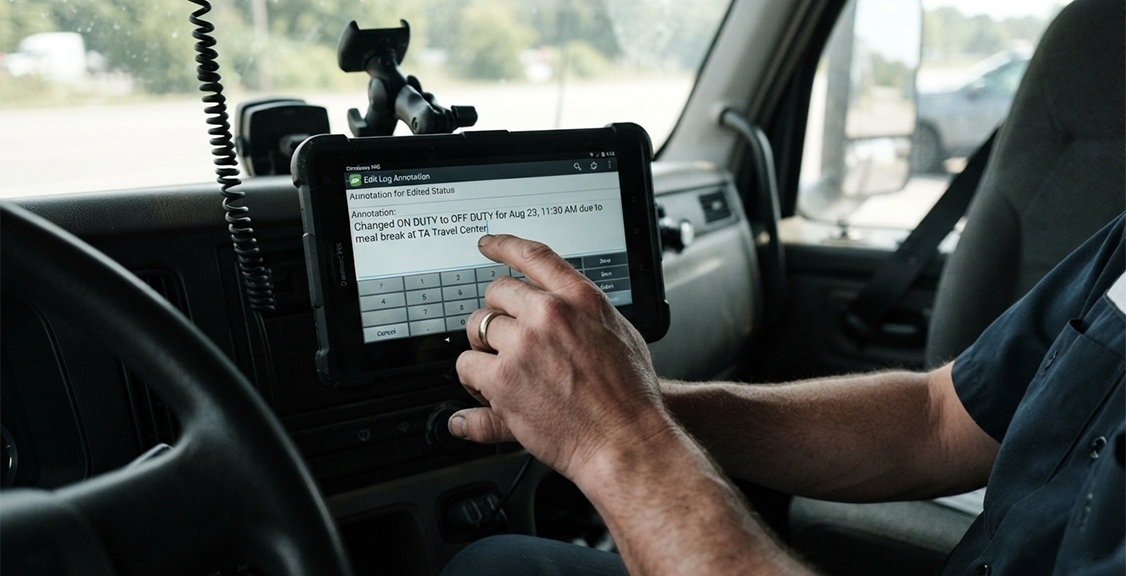
An annotation is the written explanation attached to an edit or addition. Under 49 CFR 395.30(c)(2), the driver or support personnel must annotate each change or addition to a record.
A useful annotation states the actual reason in direct language, such as “Driver logged training time incorrectly as off-duty.” The ELD technical specification requires a prompted annotation to contain at least four characters, and the standardized output field allows no more than 60 characters. That is a narrow space, so the explanation should identify the mistake and the reason for correction without filler. A missing annotation is not automatically falsification, but it fails the edit-documentation requirement and makes the change harder to evaluate.
This is also where your own review habits come into play. We recommend reviewing driver compliance records on a regular schedule, not just before an audit, since that helps catch a thin annotation before it becomes a pattern rather than a one-time gap.
What Can and Cannot Be Edited on an ELD?
Drivers may correct inaccurate non-driving records, enter missing information, and annotate events, subject to the technical limitations in Appendix A to Subpart B of Part 395. Automatically recorded driving time cannot be shortened or converted to off-duty, sleeper berth, or on-duty not driving.
FMCSA recognizes narrow assignment corrections. Driving time may be reassigned between properly identified team drivers; time accepted from the Unidentified Driver profile by mistake may be returned so the correct driver can assume it; a driver may assume only the portion of unidentified driving that belongs to that driver; and certain driving-status records created after engine power-off while the vehicle was not moving may be corrected. These exceptions do not allow actual vehicle movement to disappear from the record.
Carrier staff do not unilaterally change the driver’s official RODS. Under 49 CFR 395.30(d), a carrier may propose an edit only after the driver has submitted the record. The driver must confirm or reject the proposal, implement the appropriate edit, and recertify and resubmit the RODS before a carrier-proposed change takes effect.
How Should Unidentified Driving Time Be Resolved?
When a vehicle moves without an authenticated driver, 49 CFR 395.32 requires the ELD to place that time in the Unidentified Driver profile. When prompted at login, a driver must assume records that belong to that driver or indicate that they do not.
The carrier must review unidentified driving and either assign it to the correct driver or annotate the record to explain why it remains unassigned. These records must be retained for at least six months and made available during an inspection, audit, or investigation. Assigning unidentified time changes who is responsible for the event; it does not reduce the amount of automatically recorded driving. Our guide to unidentified driving time covers the operational workflow in more detail.
How Does the Edit Process Actually Work?
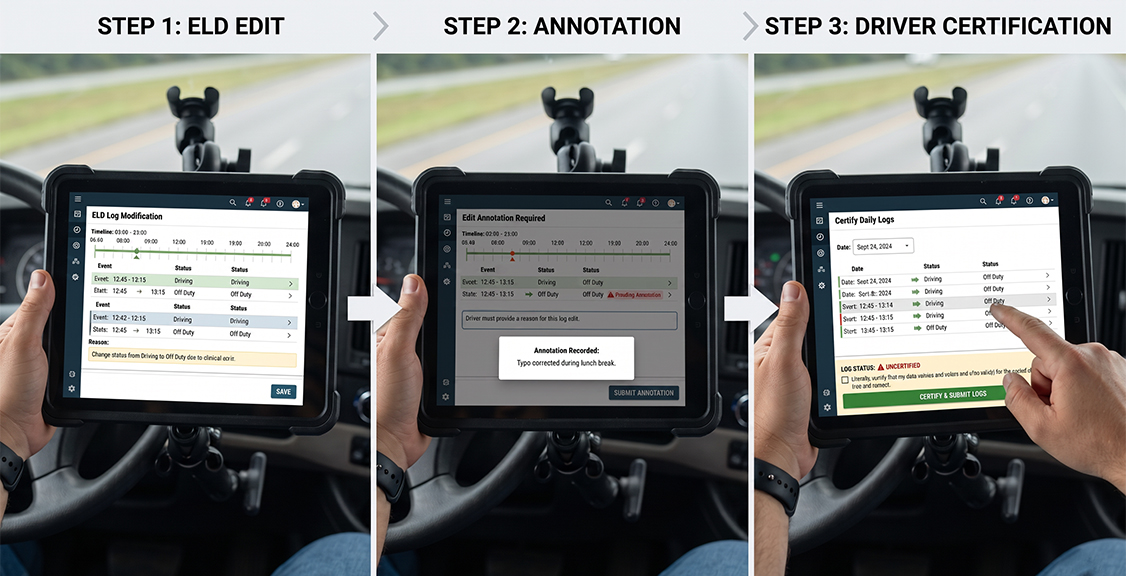
The driver reviews the daily record, corrects inaccurate information, enters anything missing, annotates each change or addition, and certifies the completed 24-hour record. If the driver edits a record after submitting it to the carrier, the driver must recertify it.
A carrier that finds an issue in a submitted record sends a proposed edit with an annotation explaining the reason. The driver must electronically confirm or reject the proposal. For an accepted proposal to take effect, the driver implements the appropriate edit, recertifies, and resubmits the RODS. If the driver rejects the proposal or does not recertify, the carrier’s proposal and annotation remain in the ELD history, and the driver’s response or refusal is reflected rather than treated as silent approval.
We know this back-and-forth can feel slower than just fixing something directly, and we understand why some carriers find it frustrating when a correction seems obvious. The structure exists specifically so a driver’s hours can’t be adjusted by someone else without their knowledge, which protects your drivers as much as it protects the accuracy of the record itself.
What Happens If an Edit Is Missing an Annotation?
A missing or unclear annotation is not, by itself, falsification. Knowingly falsifying a record of duty status is a separate and more serious violation, covered under 49 CFR 395.8(e)(1), and we’re careful not to treat the two as the same thing. What a missing annotation does remove is the explanation that would otherwise show a change was a genuine correction rather than something that needs a closer look.
Knowingly making a false RODS is prohibited by 49 CFR 395.8(e)(1). Penalty exposure depends on the violation charged and the facts, not merely on the presence of an imperfect note. Routine review should therefore focus on correcting inaccurate records through the permitted workflow, documenting each change, and escalating suspected falsification rather than trying to “fix” it through an unsupported edit.
How Long Do Edited Records Need to Be Kept?
Under 49 CFR 395.8(k)(1), motor carriers must retain RODS and required supporting documents for six months. Section 395.30(f) separately prohibits alteration or erasure of the original HOS information and source data. The ELD must retain the original event, identify the replacement or proposed event, and preserve the edit history and annotations.
Unidentified driving has its own explicit six-month requirement under 49 CFR 395.32(c). During an audit or investigation, the fleet should be able to retrieve the active record, original inactive record, identities associated with edits, annotations, carrier proposals, and the driver’s confirmation or rejection. Ask the provider to demonstrate that history before relying on a generic retention claim.
Edit vs Annotation vs Certification
| Aspect | Edit | Annotation | Certification |
|---|---|---|---|
| What it does | Changes how a record reads | Explains why the edit was made | Confirms the record is accurate |
| Who can create it | Driver; carrier staff may propose a change that requires driver action | Driver or support personnel responsible for the change or proposal | Driver only |
| Required every time | No, only when a correction is needed | Yes, whenever an edit is made | Yes, for every daily record |
| Character limit | Not applicable | At least 4 characters when prompted; standardized field maximum is 60 | Not applicable |
| Governing rule | 49 CFR 395.30 | 49 CFR 395.30(c)(2) | 49 CFR 395.30(b) |
| Recordkeeping | Original data is preserved, not erased | The ELD must retain the edit history and associated annotations | If a log changes through a permitted edit, the driver reviews and recertifies/resubmits it as required |
Questions to Ask Your ELD Provider
Does the annotation field appear on the same screen as the edit itself?
If a driver has to leave the edit screen to find a separate annotation field, annotations tend to get skipped or rushed. Ask your provider directly whether their platform keeps both together, since this is a design choice that varies between systems.
Can carrier staff apply an edit directly, or only request one?
Under the rule, carrier staff should only ever be able to request an edit, never apply it directly to a driver’s record. If a platform allows staff to bypass driver confirmation, that’s a compliance gap worth asking about before you commit to it.
How does the system store the original record after an edit is made?
The original record must remain retained, accessible, and included in ELD outputs. Ask the provider to demonstrate how the active edit, original inactive event, annotation, timestamp, and record origin appear to fleet staff and in an output file.
What happens if a driver rejects a proposed edit?
The driver must be able to confirm or reject the proposal electronically. The carrier’s proposed edit and annotation remain part of the record, and a refusal to recertify must also be reflected rather than discarded.
Does the annotation field enforce the required length?
Ask the provider to demonstrate the four-character minimum for prompted annotations and the 60-character output-field maximum. The interface should warn the user before text is rejected or truncated and should preserve the final annotation in the ELD output.
How far back can your team pull edit history during an audit?
Since edited records generally need to stay on file for six months, confirm the platform actually keeps that full window accessible, not just the most recent few weeks.
How does the platform handle attempted edits to automatically recorded driving time?
Ask the provider to demonstrate that automatically recorded driving cannot be shortened or converted to non-driving time, while still supporting the limited team-driver, unidentified-profile, and qualifying power-off corrections recognized by FMCSA.
Will your drivers get any built-in guidance on what makes a strong annotation?
Some platforms offer short prompts or examples within the annotation field itself. We’ve found that kind of built-in guidance can reduce how often a compliance team has to follow up on a vague annotation after the fact.
Edit Annotation FAQs
About ELD Edits and Annotations
Does every single edit need an annotation, even a small one?
Yes. The rule under 49 CFR 395.30(c)(2) does not carve out an exception for minor edits, so even a small correction needs a short explanation attached to it.
Can a driver edit their own driving time if they think it was recorded wrong?
Automatically recorded driving cannot be shortened or converted to non-driving time. Limited corrections are allowed for qualifying team-driver reassignments, driving accepted from the Unidentified Driver profile by mistake, partial assumption of unidentified time, and certain non-motion records created after engine power-off. Actual vehicle movement must remain recorded.
Who writes the annotation when a carrier requests an edit?
The carrier support person proposing the change must provide the annotation explaining the reason. The driver then confirms or rejects the proposal and, if accepting it, implements the appropriate edit, recertifies, and resubmits the RODS.
What happens if a driver never responds to a requested carrier edit?
If a driver does not confirm and recertify a carrier-proposed edit, the proposed change does not replace the driver’s certified record. However, the carrier’s proposed edit and annotation remain part of the ELD record. Carriers should follow up rather than assume silence means approval.
Is there a time limit on how long after the original entry an edit can be made?
Section 395.30 does not state one universal edit deadline for every scenario. However, certification, resubmission, record-retention, and original-record-preservation requirements still apply. A provider’s workflow cannot erase the source event or bypass driver confirmation for a carrier proposal.
Does an edited record look different to an inspector than an unedited one?
The ELD output must retain the old record, mark the replacement through the required event-status and origin fields, and include the related annotation. The exact screen design varies, but an inspector reviewing the electronic output can access the edit history.
About Staying Compliant During a Roadside Inspection
Will a roadside inspector always ask about edited entries?
Not necessarily, but it’s worth being ready to explain any recent edits if asked, since edited entries are one of the things inspectors know to look for.
Does a pattern of frequent edits raise a red flag by itself?
The number of edits is not itself a standalone violation. Inspectors evaluate whether the RODS are accurate, whether original events remain available, whether changes are permitted and annotated, and whether the record suggests false reporting or concealed driving time.
What’s the difference between an edit issue and actual falsification?
An edit issue is generally a process or documentation gap, like a missing annotation. A missing or unclear annotation is not, by itself, falsification. Knowingly falsifying a record of duty status is a separate and more serious violation under 49 CFR 395.8(e)(1). If you believe a violation was recorded in error, you can challenge it directly through the FMCSA DataQs system.
How common are falsification violations industry-wide?
During the 2026 International Roadcheck, inspectors recorded 266 false-record-of-duty-status out-of-service violations and issued 146 out-of-service orders for ELD tampering, according to CVSA’s published results. Those event-specific results should not be treated as an annual industry total.
Can a carrier be penalized for a driver’s incomplete annotation?
Drivers and motor carriers share responsibility for accurate ELD records. An incomplete annotation may establish a failure to document a change, but the enforcement consequence depends on the cited violation and the surrounding facts. It should not automatically be described as falsification or assigned a fixed penalty without reviewing the actual record.
What should a driver do if they realize an annotation was unclear after the fact?
Contact the carrier’s compliance team promptly and use the ELD’s permitted annotation or edit workflow. Do not overwrite the original event. If the record is edited after submission, the driver must recertify and resubmit it; the original and corrected history must remain available.
Conclusion
We built our approach to edits and annotations around a simple problem: records change over time, whether from an honest mistake or a missed entry, and FMCSA needs a way to tell a genuine correction apart from something more serious. A clear, specific annotation attached to every edit is what makes that distinction easier to see, both for your own compliance team and for anyone reviewing your logs at the roadside.
CVSA’s completed 2026 International Roadcheck confirmed that log integrity remains an enforcement concern: false RODS and ELD tampering both appeared in the published out-of-service results. The practical response is not to avoid legitimate edits, but to make permitted corrections promptly, explain them within the annotation limits, preserve the original event, and train drivers to review unidentified time and carrier proposals.
If you have questions about how edits and annotations work on your fleet’s ELD, you can schedule a call with our team or reach us at (800) 261-4361.