Key Takeaways
- An ELD only counts as compliant if it currently appears on the FMCSA registered ELD list, not just at the time you bought it.
- FMCSA can remove an ELD from its Registered ELDs list when the agency determines that the device no longer meets applicable requirements, so fleets should periodically verify the current status of every ELD model they use.
- When FMCSA removes an ELD, affected carriers and drivers should follow the specific instructions and replacement deadline in FMCSA’s removal notice rather than assuming that every removal has the same transition period.
- Hours-of-service and recordkeeping violations can result in civil penalties under 49 CFR Part 386 and its applicable penalty schedule. Maximum amounts vary by violation and may be adjusted for inflation.
- CVSA’s 2026 International Roadcheck, held May 12–14, 2026, named ELD tampering, falsification, and manipulation as its driver focus area, following 58,382 falsification-of-record-of-duty-status violations recorded in 2025.
- ELD providers self-certify that their ELD models meet FMCSA’s technical specifications and register those models with FMCSA; FMCSA does not individually test and certify each ELD before it appears on the Registered ELDs list.
Introduction
If you drive for a living or run a fleet, you’ve probably heard the phrase FMCSA-registered tossed around like it settles the question once and for all, but it doesn’t work that way in practice. Registration is a snapshot, not a guarantee, and the list of registered devices moves throughout the year as FMCSA pulls devices that no longer meet the technical standard. A device that was registered when your truck rolled off the lot could be gone from that list by the time you’re stopped for a roadside inspection.
This matters because an unregistered ELD is treated the same way as having no ELD at all. That single fact can turn a routine inspection into a citation, a delay, or in some cases an out-of-service order that keeps your truck parked until the problem is fixed. With more removals happening in 2026 than in most prior years, and with CVSA putting log integrity and device tampering at the center of its 2026 Roadcheck, this is not a background detail. It’s a status you need to check on your own schedule, not just trust once and forget.
We run an FMCSA-registered ELD platform out of Tucson, Arizona, and this is a question our own customers ask us often, usually right after they hear about another wave of removals. If you’d rather talk it through than search it yourself, our team is reachable at (800) 261-4361. In this guide, you’ll get a straightforward rundown of what FMCSA-registered actually means, how a device lands on the list in the first place, why devices get removed, and what happens if yours is one of them. You’ll also see how to check your own device’s status in a few minutes rather than guessing.
Checking your status doesn’t have to be complicated. Search your model on the FMCSA registered ELD list, and you’ll know within a couple of minutes exactly where your device stands.
What Does FMCSA-Registered Actually Mean?
FMCSA-registered means a device’s manufacturer has self-certified it against the ELD technical standard and FMCSA has added it to the public list of devices carriers are allowed to use for hours of service records.
That’s the short version, and it’s worth sitting with for a second because the word registered makes it sound more official than it is. FMCSA is not in your cab testing your device. The manufacturer runs its own testing, submits paperwork confirming the device meets the requirements laid out in 49 CFR Appendix A to Subpart B of Part 395, and FMCSA adds the model to the FMCSA registered ELD list once that submission is accepted. The registered ELD list itself carries a plain disclaimer on this point: FMCSA does not endorse any electronic logging device, and every listed device is self-certified by its manufacturer. Registration is really a promise from the manufacturer, backed by FMCSA’s willingness to pull the device later if that promise doesn’t hold up in practice.
For your fleet, the practical meaning is simple: if the model and version you’re running is on that list right now, your logs are generally treated as valid electronic records during a roadside stop. If it isn’t on the list anymore, the officer doing the inspection has no reason to treat your device as a legitimate ELD, even if it was fine last year. That gap between was registered and is registered right now is where the next section picks up.
How Does an ELD Get Added to the FMCSA List?
A device gets added to the list after its manufacturer self-certifies compliance with the ELD technical standard and FMCSA accepts that registration.
The process runs on the honor system more than most drivers expect. A manufacturer builds a device, runs it against the requirements in the ELD technical standard, and submits a registration to FMCSA stating the device meets those requirements. FMCSA doesn’t run its own lab tests before adding a device to the list, and instead reviews the submission and, if everything checks out on paper, puts the device live on the registered list, alongside details like model number, software version, and a unique ELD Identifier code.
This is also why the list is never really finished. New devices get added regularly, and FMCSA reserves the right to audit or test a registered device at any point after the fact. If a device turns out not to meet the standard, whether that’s a data recording problem, a malfunction it can’t detect correctly, or a security gap, FMCSA can pull it from the list even if it’s been registered for years. That’s the piece most fleets miss, since registration isn’t a one-time badge but a status that depends on the device continuing to hold up under scrutiny, which is exactly what’s been happening throughout 2026. It also works the other way: if a provider fixes whatever the agency flagged, FMCSA can restore the device to the registered list and notify the industry, so a removal isn’t necessarily permanent for the manufacturer.
Why Do ELDs Get Removed From the FMCSA List?
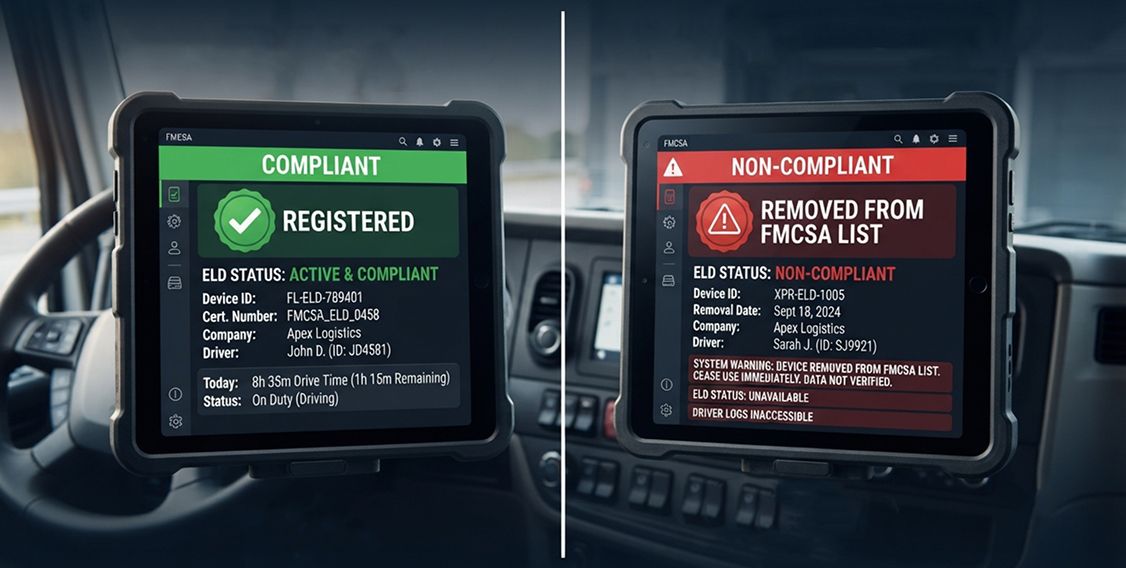
An ELD can leave FMCSA’s Registered ELDs list either because the provider self-revokes the device’s registration or because FMCSA revokes the device. When FMCSA removes an ELD, the agency may determine that the device no longer meets applicable ELD requirements.
FMCSA’s ELD listings distinguish between devices that are self-revoked by the ELD provider and devices that are revoked by FMCSA. A self-revoked status indicates that the provider has withdrawn the ELD’s registration, while an FMCSA-revoked status indicates that FMCSA removed the ELD from the Registered ELDs list. The reason and circumstances can vary by device, so fleets should not assume that every self-revocation or FMCSA revocation occurred for the same reason. Fleets can review the current status of individual ELD models and applicable removal information on FMCSA’s ELD website.
FMCSA periodically removes ELD models from its Registered ELDs list when the agency determines that a device no longer meets applicable requirements. When a model is removed, FMCSA publishes a removal notice identifying the affected ELD and providing instructions for motor carriers and drivers using it. Those notices may establish a period for replacing the removed ELD and explain how affected drivers should maintain required hours-of-service records during the transition. Because removal notices and deadlines are device-specific, fleets should review the current FMCSA notice for any ELD they use rather than relying on an older removal count or replacement date.
The circumstances behind an ELD removal can vary by device. When FMCSA revokes an ELD, fleets should review the agency’s removal notice to understand the reason for the action, the instructions for affected motor carriers and drivers, and any applicable replacement deadline. Because an ELD’s registration status can change after a fleet purchases or installs it, periodically checking FMCSA’s current Registered ELDs list is an important part of ongoing ELD compliance.
What Happens If You Use an ELD That Gets Removed?
When FMCSA removes an ELD from its Registered ELDs list, affected motor carriers and drivers should review the agency’s specific removal notice and follow the instructions and replacement deadline provided for that device. During an FMCSA-established replacement period, the notice may provide temporary instructions for maintaining required hours-of-service records while the fleet transitions to a compliant ELD.
After the applicable replacement deadline, continued use of a removed device does not satisfy the ELD requirement for a driver who is required to use an ELD. The driver may then be cited for failing to use a compliant ELD and may be placed out of service in accordance with applicable enforcement criteria. Because the instructions and deadlines can be specific to a particular removal, fleets should rely on the current FMCSA removal notice rather than assuming every removed ELD receives the same transition period.
Hours-of-service and recordkeeping violations can also result in civil penalties under 49 CFR Part 386 and its applicable penalty schedule. Maximum penalty amounts vary depending on the violation and may be adjusted for inflation. For fleets, the practical takeaway is to periodically verify that each ELD model remains on FMCSA’s current Registered ELDs list and respond promptly if FMCSA removes a device.
For a closer look at the compliance consequences, see our guide to what happens if your fleet uses an unregistered ELD.
How Do You Check If Your ELD Is Still Registered?
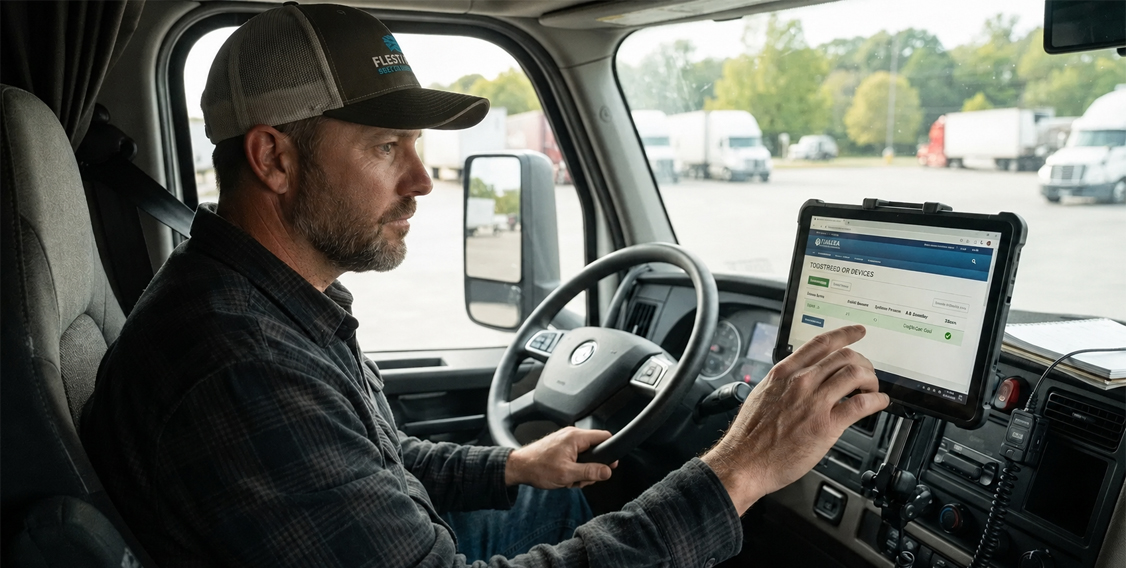
The fastest way to check is to search your device’s exact model and version on the FMCSA registered ELD list, which FMCSA updates as devices are added or removed.
It only takes a couple of minutes, but it is worth checking on a regular basis rather than only when you first purchase a device. The FMCSA ELD list includes identifying information such as the device name, model number, software version, ELD identifier, and provider, which fleets can use to confirm that the exact ELD model and version they operate matches the current listing. If a device no longer appears on the Registered ELDs list, check its current status and any applicable FMCSA removal information. A device may be identified as self-revoked by the provider or revoked by FMCSA. If an ELD has been removed, review the applicable notice or status information and follow the instructions and replacement deadline provided for that device.
If you’re not sure how to read the list, or you want a second set of eyes on your specific device and version, our support team is available around the clock and can help you confirm where things stand and what a reasonable next step looks like for your setup. For anything specific to your carrier’s compliance history or an active citation, your carrier’s compliance team, FMCSA’s newsroom, or FMCSA directly is generally the better source than any single article.
What Is the Difference Between FMCSA-Registered and FMCSA-Approved?
There’s no such thing as FMCSA-approved in the way most people mean it, since FMCSA registers self-certified devices but doesn’t test, endorse, or formally approve any single ELD brand over another.
This distinction can be confusing because the word “approved” is sometimes used loosely in marketing. FMCSA’s Registered ELDs list is based on ELD providers self-certifying that their devices meet the applicable technical specifications and registering those devices with FMCSA. FMCSA states that the devices on its list are self-certified by the provider and that the agency does not independently test, certify, or endorse individual ELDs. A device’s appearance on the Registered ELDs list therefore means that the provider has certified the device as compliant with FMCSA’s ELD requirements; it should not be interpreted as an independent FMCSA endorsement or guarantee of the device’s performance.
That distinction matters when you’re comparing vendors. A device that’s currently registered is meeting the baseline legal requirement, but registration alone doesn’t tell you how reliable the device is day to day, how good the support is when something goes wrong, or how quickly a vendor would help you if your model ever showed up on a removal list. Registration status is only the starting point, not the whole picture, when you’re picking a device to run your fleet on. The table below lays that starting point out side by side with what changes once a device is removed.
Registered vs. Removed ELDs: What Fleets Should Know
| Factor | Currently Registered ELD | Removed ELD |
|---|---|---|
| Treated as valid HOS record at roadside | Yes, when the ELD is operating properly and used in compliance with applicable requirements | Depends on the applicable FMCSA removal notice and whether the replacement deadline has passed |
| Citation risk under 49 CFR 395.8(a)(1) or 49 CFR 395.22(a) | Generally lower when the driver is using a compliant, properly functioning ELD as required | May increase after the applicable replacement deadline if the driver is required to use an ELD |
| Out-of-service risk | Depends on the driver’s overall compliance and applicable enforcement criteria | May apply after the applicable replacement deadline under current enforcement criteria |
| Replacement deadline | Not applicable | Set by the specific FMCSA removal notice |
| Effect on driver logs already recorded | Records remain part of the driver’s required HOS record | Follow the applicable FMCSA removal notice for instructions on maintaining and presenting required HOS records during the transition |
| Path back onto the registered list | Not applicable | Depends on the provider and FMCSA; fleets should rely on the device’s current status on FMCSA’s ELD website |
Questions to Ask Before You Choose an ELD Provider
Once you know how registration works, the next step is picking a vendor you can count on if your own device’s status ever changes. These are the questions worth asking before you buy, not after.
Is this exact model and version currently on the FMCSA registered ELD list?
Don’t just take a vendor’s word for it, and search the model yourself on the official list before you commit to a purchase. A vendor that’s confident in its device will have no problem pointing you straight to the listing, including its exact ELD Identifier code.
How does the vendor find out when a device gets flagged for removal?
Some vendors monitor the registered list closely and reach out to customers directly. Others leave it entirely up to the fleet to notice. Ask which one you’re dealing with before you’re relying on them during an active compliance issue.
What happens to my existing logs if my device is removed from the list?
FMCSA’s own guidance points carriers toward paper logs, logging software, or the ELD’s own display as a backup during the replacement window, so ask the vendor to walk you through exactly what that transition looks like on their specific device.
How fast can I get a replacement installed if my device comes off the list?
Replacement deadlines vary depending on the applicable FMCSA removal notice, so fleets should act promptly when an ELD is removed. Ask your ELD provider about typical shipping, activation, and installation turnaround times before you need a replacement so your fleet is prepared to meet any applicable deadline.
Is the vendor itself established enough to be reachable a year or two from now?
A registered device from a vendor that disappears or stops answering support calls doesn’t help you much when something goes wrong. Ask about support hours and how long the company has been selling ELDs.
What documentation can the vendor provide proving current registration?
A reasonable vendor should be able to point you to their exact listing on the FMCSA site without hesitation, and hesitation here is a signal worth paying attention to.
Does the price reflect ongoing support, or just the upfront hardware cost?
Some setups look affordable until you need help and find out support costs extra or isn’t available when you actually need it. Ask what’s included, including whether the hardware comes with a return window, before you compare prices across vendors.
What’s the actual process if I need to swap a removed device for a new one?
Ask whether it’s a full re-purchase, a discounted upgrade, or something covered under warranty. The answer tells you a lot about how the vendor treats existing customers when the list changes.
FMCSA-Registered ELD FAQs
Between the buyer questions above and the day to day reality of running an ELD, most fleets end up asking a smaller set of recurring questions. Here are the ones we hear most often, grouped by topic.
About FMCSA Registration and Road Safety
What does FMCSA-registered mean for an ELD?
It means the device’s manufacturer has self-certified it against the ELD technical standard and FMCSA has added it to the official list of devices carriers can use for hours of service records. It’s a current status, not a one-time approval.
Is FMCSA registration the same as FMCSA approval or testing?
No, because FMCSA doesn’t test devices before registering them. Manufacturers self-certify, and FMCSA can remove a device later if it turns out not to meet the standard.
Can FMCSA remove an ELD after it has been registered?
Yes. An ELD’s appearance on FMCSA’s Registered ELDs list does not guarantee that it will remain there indefinitely. FMCSA can remove an ELD when the agency determines that the device no longer meets applicable requirements. Fleets should periodically verify that the exact ELD model they use remains on the current Registered ELDs list and review any applicable FMCSA removal notice.
What happens if my ELD is removed from the FMCSA list while I’m using it?
If FMCSA removes an ELD your fleet is using, review the specific FMCSA removal notice for that device. The notice may provide a replacement period and temporary instructions for maintaining required hours-of-service records while the fleet transitions to a compliant ELD. After the applicable replacement deadline, continued use of the removed device does not satisfy the ELD requirement for a driver who is required to use an ELD and may result in a citation and applicable out-of-service enforcement.
Can I be cited for using a device that used to be registered?
Yes, once the replacement window has passed. Before that, safety officials are directed to request backup records rather than cite immediately.
Does FMCSA test every ELD before it’s added to the list?
No, since registration relies on manufacturer self-certification against the ELD technical standard in 49 CFR Appendix A to Subpart B of Part 395, and FMCSA can audit or test devices after they’re already on the road.
Why does the FMCSA list keep changing?
Manufacturers add new devices regularly, and FMCSA removes devices that no longer meet the technical standard, either because the manufacturer self-revokes the device or because FMCSA revokes it directly. A device can also be added back if the provider fixes the issue.
About Choosing an FMCSA-Registered ELD Provider
How do I confirm an ELD is FMCSA-registered before buying?
Search the exact model and version on the FMCSA registered ELD list yourself rather than relying only on what a vendor’s product page claims.
What should I ask a vendor about ongoing FMCSA compliance?
Ask how they monitor the registered list, how they’d notify you if your device were flagged, and how quickly they could get you a replacement if that happened.
Is your ELD currently on the FMCSA registered list?
Yes, our ELD platform is FMCSA-registered, and our support team can confirm the exact listing tied to your specific device if you’d like a second set of eyes on it.
What support should I expect if my device gets flagged for removal?
A reasonable vendor should reach out ahead of time, explain what’s changing, and help coordinate a replacement rather than leaving you to figure it out during a roadside stop.
Is a cheaper, unregistered device ever a reasonable option?
Generally not, since an unregistered device carries the same risk as having no ELD at all during an inspection, which tends to cost more in fines and downtime than the upfront savings are worth.
How does registration status affect my CSA record?
A citation tied to an unregistered or noncompliant device can factor into your compliance history and inspection results going forward, though the exact effect depends on your carrier’s broader record.
What’s the real difference between choosing a registered device and choosing the right long-term vendor?
Registration confirms a device currently meets the legal minimum, but it doesn’t tell you how the company handles support, replacements, or communication if your device’s status ever changes. Both matter, but they’re not the same question.
Conclusion
FMCSA registration is not a one-time status that fleets should assume will remain unchanged. An ELD must continue to meet applicable requirements to remain on FMCSA’s Registered ELDs list, and FMCSA can remove a model when the agency determines that it no longer complies. With ELD tampering, falsification, and manipulation named as the driver focus area for CVSA’s 2026 International Roadcheck, periodically verifying the registration status of the ELDs in your fleet is a practical compliance step.
Checking an ELD’s current registration status takes only a few minutes. If a device your fleet uses has been removed, review FMCSA’s specific removal notice for the applicable instructions and replacement deadline, and make arrangements to transition to an ELD that appears on the current Registered ELDs list. If you want help reviewing your fleet’s ELD setup or replacement options, you can reach our team or call (800) 261-4361.
Staying ahead of registration changes is a small habit that saves a lot of trouble down the road. Build the check into your routine, and you’ll never be caught off guard by a list that changed without you noticing.