Key Takeaways
- FMCSA has removed electronic logging devices from its registered list in waves since January 2025: 67 by early May 2026, 79 by mid-May 2026, and 95 by early August 2026, according to FMCSA statements cited by Overdrive.
- Carriers get 60 days after a device is revoked before enforcement treats it as no record of duty status under 49 CFR 395.8(a)(1).
- A driver caught using a revoked device after that window is placed out of service under CVSA criteria, which stops the truck on the spot.
- Motor carriers face a maximum penalty of $19,246 per hours-of-service violation, adjusted annually for inflation under 49 CFR Appendix B to Part 386.
- Hours-of-service violations rose from about 410,000 in 2023 to more than 500,000 in 2025, according to RigDig data cited by Overdrive in April 2026.
- Only a device that appears on FMCSA’s registered list counts as valid for hours-of-service purposes under 49 CFR Part 395, regardless of how well it performs day to day.
| Table of Contents |
|---|
| Unregistered ELD Meaning |
| Reasons for Removal |
| Roadside Inspection Risk |
| Citations and Fines |
| Next Steps After Revocation |
| Checking ELD Status |
| CSA Score Impact |
Introduction
We’ve had more fleets ask us about this one thing than almost any other compliance question this year: what actually happens if the ELD you’ve trusted for months suddenly isn’t valid anymore. It’s a fair thing to worry about, because the answer isn’t obvious until it happens to you.
Here’s the scenario we hear most often. Your ELD has worked fine for a year. Your drivers log hours on it every shift without a hiccup. Then one morning, a roadside officer tells your driver the device isn’t on FMCSA’s list anymore, and now your truck is sitting out of service for something you never saw coming, which is a real cost for a small fleet and something worth taking seriously before it happens. We’re seeing this catch more fleets off guard than it should, because FMCSA has been pulling noncompliant devices off its registered list faster than most of the industry expected.
The part that catches people off guard is this: a revoked ELD isn’t the same as a broken one. Your driver won’t get an error message or a warning light. The device keeps logging hours, keeps transferring data, and looks completely normal, right up until the moment it stops counting as valid at all. That gap between still working and still compliant is exactly where fleets get caught, and it’s the problem we built this guide to solve.
Once the replacement deadline passes, your driver can be cited for having no record of duty status and placed out of service, even if the screen shows perfectly normal logs. For an owner-operator or a small fleet, one truck stuck at a scale house is lost hours you don’t get back.
Below, we walk through what an unregistered ELD actually means, why devices get removed, what a roadside stop looks like when it happens, and what your fleet can do about it, both right now and going forward. As an FMCSA-registered ELD provider ourselves, we track these removal notices as part of keeping our own platform compliant, so this reflects what we watch internally, not just what we’ve read secondhand. If you’re weighing whether your current setup still makes sense, our price calculator is worth a look, and if you’d rather just talk it through, you can schedule a call or reach us at (800) 261-4361 too.
What Does It Mean for an ELD to Be Unregistered?
An unregistered ELD is a device that either never made FMCSA’s list of self-certified electronic logging devices, or one that was on it and got removed. Either way, it no longer counts as valid for hours-of-service purposes under federal rules, no matter how well it seems to work for your drivers.
FMCSA keeps two lists side by side: a Registered Devices list and a Revoked Devices list. Every provider self-certifies that its device meets the technical standard, and FMCSA can move a device to the revoked side if it later finds the device falls short. We check both lists regularly ourselves, and we’d encourage you to do the same through the FMCSA registered ELD list, which is worth bookmarking rather than checking once and forgetting.
That naturally raises the next question: why does this happen at all if a device was compliant to begin with?
Why Do ELDs Get Removed From the FMCSA List?
ELDs get removed when FMCSA determines the device no longer meets the technical requirements for hours-of-service records, whether that device has been on the road for 6 months or 6 years.
This kind of review has picked up noticeably since early 2025, with the numbers showing just how fast:
- By early May 2026, FMCSA had removed 67 devices since January 2025.
- Two weeks later, in mid-May 2026, that count reached 79.
- By early August 2026, the total had climbed to 95.
Some of these actions covered a single device with a narrow issue, while others hit several products from the same provider at once, usually when the underlying platform behind multiple branded devices had the same flaw.
Most of these failures come down to a short list of technical problems we watch for on our own side too: incorrect handling of malfunction codes, engine synchronization that doesn’t match the standard, or data transfer formats that roadside systems can’t read correctly. FMCSA answers common questions about these removals in its FMCSA advises carriers resource, and we’d rather you hear about a revocation from us proactively than find out at the roadside.
That’s the mechanism behind the removal. What matters more for your drivers is what actually happens once one of these removals catches up with your truck at a roadside stop.
What Happens at a Roadside Inspection With an Unregistered ELD?
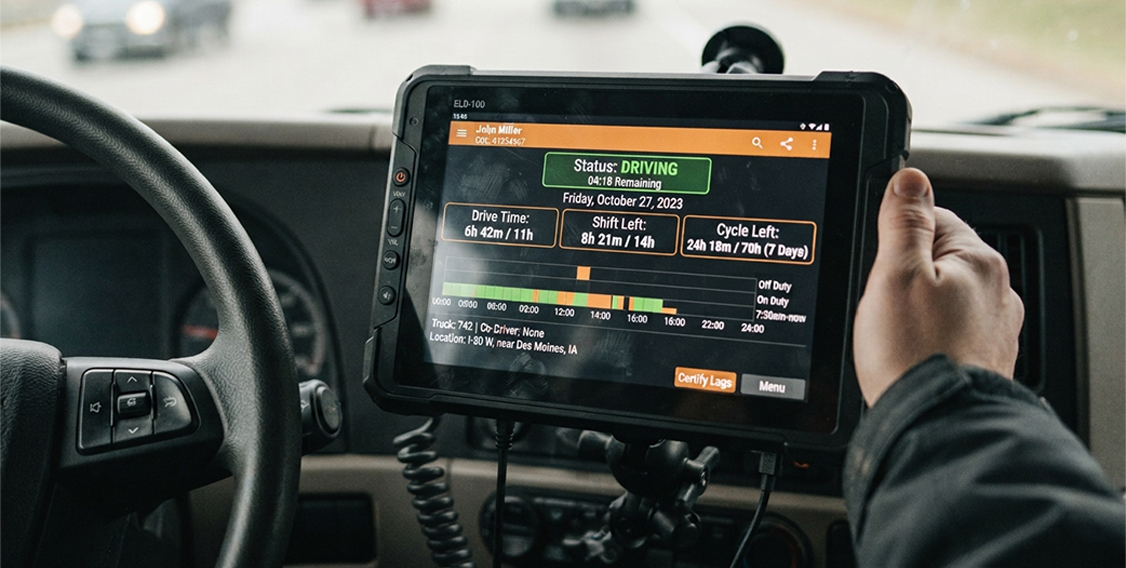
At roadside, an inspector who spots a revoked device treats the truck as if it has no valid electronic logging device at all, which is a more serious finding than a malfunctioning ELD and changes how the stop plays out. Here’s the timeline we walk our own customers through when this comes up:
- Day 0: FMCSA announces the removal. The device moves from the Registered list to the Revoked list.
- Days 1 to 60: Grace period. Officers are generally told not to cite drivers right away, as long as the driver can show paper logs, logging software records, or the device’s own display as backup.
- Day 61 onward: The grace period ends. An officer who spots the same revoked device will cite the driver under 395.8(a)(1) and place them out of service under Commercial Vehicle Safety Alliance criteria, and the truck doesn’t move again until it’s resolved.
That 60-day window exists so carriers have time to react, not so the device can keep running indefinitely. We think this connects to something bigger than paperwork too, since a valid record ties directly to driver fatigue and road safety, which we cover in more depth in our article on how ELDs promote safer roads.
The roadside stop itself is one part of this. What it can cost you afterward is the next piece worth understanding.
What Citations and Fines Apply to Unregistered ELD Use?
The direct citation for using a revoked device past the deadline is 395.8(a)(1), no record of duty status, and it can carry a real financial penalty once the case moves past the roadside stop.
Under the FMCSA penalty schedule, motor carriers face a maximum penalty of $19,246 per hours-of-service violation, drivers face $4,812, and knowing falsification can reach $15,846. These are maximum amounts, adjusted annually for inflation, not flat fines, so the actual number depends on severity and history. We’d also point out this fits a broader pattern, since hours-of-service violations rose from roughly 410,000 in 2023 to more than 500,000 in 2025, according to RigDig data cited by Overdrive, which tells us enforcement attention on this category isn’t easing up.
Beyond the fine, an out-of-service order stops the load right there, and the violation follows both the driver and the carrier into future inspection records. The full 49 CFR Part 395 HOS rules lay out how these get classified.
We’re not sharing this to alarm you, only to make the next step obvious: act during the grace period, not after it.
What Should Your Fleet Do If Your ELD Gets Revoked?
If your ELD gets revoked, our advice is straightforward: stop using it, switch to paper logs or FMCSA-compliant logging software to keep recording hours, and get a replacement device installed before the 60-day window closes.
The transition period is there so your drivers always have a legal way to record hours, but paper logs and generic software are meant to bridge the gap, not replace a working ELD long term. We’d recommend keeping copies of anything your provider sends about the revocation, along with your paper logs during the switch, since those records help if a question ever comes up about that transition period.
Reach out to your provider as soon as you learn about a revocation so you know your specific replacement path and timeline. Our support team is available around the clock for exactly this kind of situation, and there’s no charge for asking a question before it becomes a bigger problem.
Reacting well to a revocation matters, but catching it early matters even more.

How Do You Check If Your ELD Is Still Registered?
You can confirm your device’s status in a few minutes by searching its name or ELD identifier on FMCSA’s registered list, the same one we linked earlier in this article, which separates registered devices from revoked ones clearly so there’s no guesswork involved.
We’d suggest making this a habit rather than a one-time check. A device that’s compliant today can be removed next month for reasons that have nothing to do with how your fleet uses it. A quarterly look takes a few minutes and costs nothing, while missing a removal notice can cost you a truck sitting at a scale house. It also helps to keep your supporting records current during any device transition, since inspectors may ask for backup documentation regardless of which device you’re running. Our guide on ELD and DVIR integration covers how those records tie together.
If your routes are mostly local with shorter days, it’s also worth understanding how paper-log fallbacks interact with any short-haul exemption you rely on. Our local drivers log books guide walks through that distinction in plain terms.
Checking your device protects you at the roadside, and there’s a longer-term reason we’d point to for staying on top of it as well.
How Does an Unregistered ELD Affect Your CSA Score?
An hours-of-service violation tied to an unregistered ELD becomes part of your carrier’s inspection history and can affect the Hours-of-Service Compliance BASIC used in FMCSA’s Safety Measurement System (SMS).
FMCSA doesn’t publish a single score threshold that one violation crosses, so we wouldn’t tell you that one citation automatically triggers an intervention, because that isn’t accurate. What we do know is that repeated or serious HOS violations build up over a rolling window and weigh on your overall record, which can affect insurance rates and, for some carriers, eligibility for certain contracts. We treat device registration as a routine check on our own platform for exactly this reason, and we’d recommend the same habit on yours.
Registered vs. Revoked ELD: Side-by-Side Comparison
| Factor | Registered ELD | Revoked/Unregistered ELD |
|---|---|---|
| Legal status under 49 CFR Part 395 | Valid record of duty status | Not valid once the deadline passes |
| Roadside citation risk | None tied to registration | Citation under 395.8(a)(1) after deadline |
| Out-of-service risk | Low, only for actual malfunctions | High once past the 60-day window |
| Data transfer to inspectors | Accepted as compliant | May be rejected or disregarded |
| Manufacturer support and updates | Ongoing | Often frozen or discontinued |
| Effect on inspection history | Neutral | Adds a documented HOS violation |
| Insurance and contract standing | Unaffected | Can be affected by repeat violations |
| Ease of defending at audit | Straightforward | Requires a clear paper trail |
Questions to Ask Before Choosing or Keeping an ELD Provider
Is this device currently on FMCSA’s registered list?
Check the name and identifier directly rather than relying on the provider’s own claims, since the list changes between public announcements.
How does the provider notify carriers if a device gets revoked?
A provider with a clear, direct notification process gives you more of the 60-day window to actually act on it.
What is this manufacturer’s compliance history?
A provider with multiple past removals across its product line is a different risk than one with a clean record, even if the current device hasn’t been affected.
Does the provider offer a fast replacement path if a device is revoked?
Ask what a swap actually looks like, including shipping time and how quickly drivers can get trained on the new unit.
Can the device produce a valid record without relying on a constant live signal?
Devices that lean heavily on connectivity can create gaps in dead zones, a separate issue that compounds risk during any transition.
What support is available if something goes wrong on the road?
Confirm hours of operation and response time before you sign anything, since a revocation on a Friday night needs a real answer, not a ticket queue.
How does the provider handle data transfer at a roadside inspection?
Confirm the device supports both telematic and local transfer methods, since inspectors may ask for either.
What would switching actually cost if my device got pulled from the list?
Get a straight answer on hardware costs and contract terms, so an unexpected revocation doesn’t also mean an unexpected bill.
Common Questions About Unregistered ELDs
About Unregistered ELDs and Compliance Risk
What does it mean if my ELD is on FMCSA’s revoked list?
It means the device no longer meets the technical requirements for a valid electronic logging device. Records from that device stop counting as compliant going forward, even though it may still work normally.
How long do I have to replace a revoked ELD?
Typically 60 days from the removal announcement. The exact deadline appears in the specific notice for your device.
Will I be cited immediately if my ELD is revoked?
No. During the grace period, officers generally won’t cite the revocation itself as long as paper logs, logging software, or the device display can back up your hours. Citations and out-of-service orders start once the deadline passes.
Can a revoked ELD be reinstated?
Yes, if the provider fixes the technical issues FMCSA identified. FMCSA notifies the industry when that happens, but we’d still recommend planning a replacement rather than waiting on the possibility.
What should I use to record hours while I wait for a new device?
Paper logs or FMCSA-compliant logging software both work during the transition. Keep these organized in case you need to explain the gap later.
Does a revoked ELD affect logs I already recorded?
Generally no. Past records made while the device was still registered stay valid. The concern is with records made after the device is revoked, especially past the deadline.
About Choosing the Right ELD Provider
How can I tell if an ELD provider is likely to stay compliant?
Look at its track record on FMCSA’s list over time, not just its current status. A provider with a clean history, or one that resolved past issues quickly, is a safer long-term choice.
What should I ask before switching ELD providers?
Ask about compliance history, support hours, hardware compatibility, and what happens if a device you buy today gets revoked later. Clear answers matter more than the lowest price.
Does Geosavi appear on FMCSA’s registered list?
Yes. Our ELD connects through J1939, J1708, or OBD-II depending on your vehicle, and you can confirm our registration status directly on FMCSA’s list at any time.
What kind of support should I expect from an ELD provider?
Around-the-clock support matters most in exactly the situation this article covers, when a device issue needs a fast answer. Confirm response times before signing, not after a problem shows up.
Is a cheaper ELD device a bigger compliance risk?
Not automatically, but low-cost devices from newer manufacturers have made up a notable share of recent removals. Price alone isn’t a reliable signal either way, so check the manufacturer’s history directly.
How often should I check my ELD’s registration status?
We’d suggest a quarterly check as a reasonable habit, with an extra look any time you hear about a wave of removals in industry news. It takes a few minutes and can save a truck from sitting at a scale house.
Conclusion
An unregistered ELD isn’t a distant risk for 2026. FMCSA has pulled dozens of devices off its registered list since January 2025, and the pace hasn’t slowed. The device in your truck today could land on the revoked list next month for reasons that have nothing to do with how your drivers use it.
This problem has a manageable solution. Checking your device’s registration status takes a few minutes, and the 60-day window gives you real time to react if your provider’s device ever gets pulled. Enforcement in 2026 has made one thing clear to us: a revoked device that still seems fine is not the same as a compliant one, and that gap is exactly where out-of-service orders happen.
If you’d like a second opinion on your current setup, you’re welcome to call us at (800) 261-4361 or schedule a brief conversation, whichever works best for you.