Key Takeaways
- ELD providers self-certify their devices, but motor carriers are responsible for confirming that each exact model appears on FMCSA’s registered ELD list.
- FMCSA can move a device to the revoked list after registration. Fleets should follow the instructions and replacement deadline in the specific removal notice rather than assume every case follows the same timeline.
- Current removal notices may direct carriers to stop using the revoked ELD, use paper logs or logging software temporarily, and replace the device by a stated date. Continued use after that date may lead to citations under 49 CFR 395.8(a)(1) and 395.22(a) and an out-of-service order under the applicable criteria.
- A monthly check is Geosavi’s practical recommendation for most fleets, not a specific FMCSA-mandated interval. Also check before buying or deploying a device and whenever FMCSA or the provider announces a status change.
- During the 2026 International Roadcheck, inspectors conducted 54,575 inspections and issued 146 out-of-service orders for ELD tampering. Tampering is distinct from using a revoked device, but the results reinforce the importance of accurate, compliant electronic records.
Introduction
You selected an ELD that appeared on FMCSA’s registered list, installed it, and moved on with running your fleet. That’s the normal order of things. But registration is not a one-time check. FMCSA can later move a device to the revoked list if it no longer meets the technical requirements.
A revoked device may continue to power on and display logs. That does not mean it remains acceptable for compliance. The specific FMCSA removal notice tells carriers what to do and gives the deadline for replacing the device. After that deadline, continued use may lead to citations and an out-of-service order under the applicable enforcement criteria.
FMCSA has issued multiple removal notices, so relying on a purchase-time check or occasional trucking news is not enough. A simple recurring verification process helps the person responsible for compliance catch a status change before the notice deadline.
You’ll find out why FMCSA pulls devices from the list, how often a check actually needs to happen, and the right way to search so you don’t miss a removal that applies to you. You’ll also see what to do if your device shows up on a removal notice, what’s actually at stake if that check gets skipped, and the questions worth asking before you commit to any ELD provider.
If you want to check where your current setup stands right now, pull up your ELD platform and hardware and compare it against what FMCSA has on file. If anything looks uncertain along the way, our team is a call away at (800) 261-4361.
What Is the FMCSA Registered ELD List?
The FMCSA registered ELD list is the official directory of devices whose providers have self-certified them as meeting Appendix A to Subpart B of Part 395. A motor carrier subject to the ELD rule must use an ELD that is registered with FMCSA, as required by 49 CFR 395.22(a).
Registration is based on provider self-certification. FMCSA does not pre-approve or independently lab-test every device before it appears on the list. That makes it important to match the device name, model number, ELD identifier, provider, and software version rather than relying on a brand name alone.
FMCSA can later place a device on the revoked list when it determines that the device does not meet the technical specifications. Because the status can change, use the live registered and revoked device lists instead of relying on an old device count or an undated screenshot.
This isn’t a static list you check once at purchase. Treat it as a live compliance source that should be part of your fleet’s recurring review process.
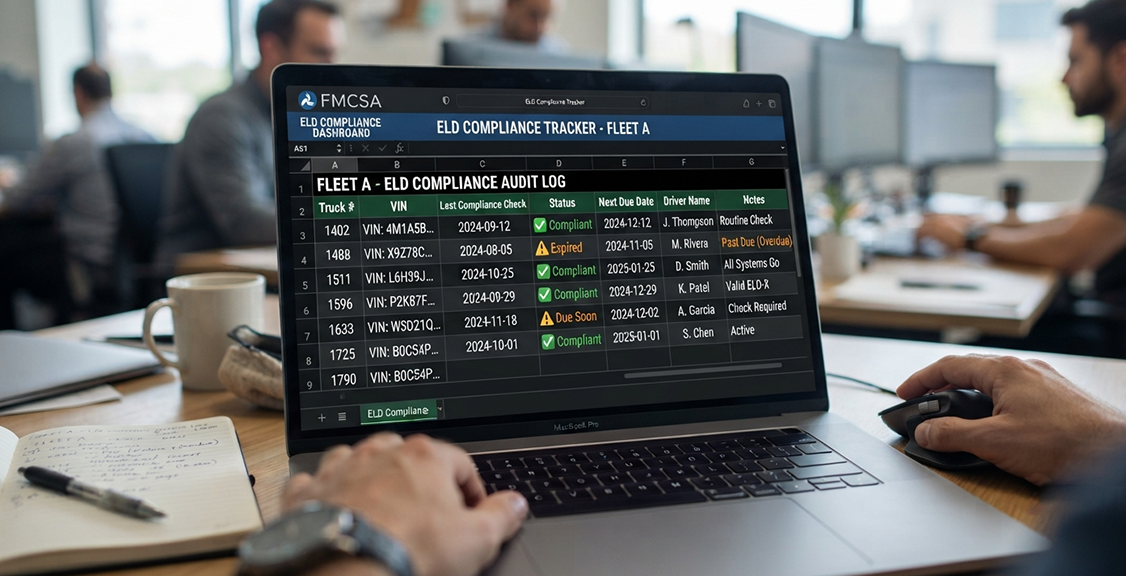
Why Do Devices Get Removed From the FMCSA List?
FMCSA removes a device when it determines that the device does not meet the ELD technical specifications. A removal notice identifies the affected device, its model and ELD identifier, the effective date, the carrier transition instructions, and the replacement deadline.
The exact deficiency and timeline are notice-specific. Do not assume that every removal involves the same technical problem or that every transition period is automatically 60 days. Recent notices have often allowed carriers up to 60 days, but the controlling date is the one stated in the notice for the affected device.
When a notice applies to your fleet:
- Confirm the exact device: Match the device name, model number, ELD identifier, provider, and software version.
- Read the required transition steps: FMCSA may direct carriers to discontinue the revoked ELD and use paper logs or logging software while arranging a replacement.
- Use the stated deadline: Build the replacement plan around the date in the notice, not a general rule of thumb.
- Watch for reinstatement updates: FMCSA may return a device to the registered list if the provider corrects the identified deficiencies.
The screen may look normal even when the model’s registration status has changed. The live list and the removal notice, not the device display, determine what action the fleet needs to take.
How Often Should You Check the FMCSA Registered ELD List?
FMCSA makes the motor carrier responsible for using a registered device, but it does not prescribe a monthly list-check schedule. A monthly review is Geosavi’s practical recommendation for most fleets because it is frequent enough to catch many status changes without creating a heavy administrative burden.
Check more than once a month when circumstances call for it:
- before purchasing or deploying a new device;
- when adding a different model or software version;
- after an FMCSA removal announcement or provider compliance alert; and
- before a large rollout across multiple vehicles.
Owner-operators can add the check to a monthly compliance calendar. Larger fleets should assign an owner, keep an inventory of every distinct device model and software version, and record the date and result of each review.
The goal is not to create paperwork for its own sake. It is to identify a revoked device early enough to read the notice, source a replacement, install and test it, and prepare drivers before the deadline.
How Do You Search the FMCSA Registered ELD List Correctly?
Searching the list sounds simple, but a rushed search is one of the easiest ways to miss a removal. A few steps make the check more reliable.
Search by exact model, not brand: Devices are listed by specific model name and number, not by manufacturer alone. A search for a broad brand name can return other models from the same company that are still fine, while missing the one model that was actually pulled.
Check the manufacturer name too: Some model names are reused or are similar across different manufacturers. Confirming both the model and the manufacturer avoids matching the wrong listing.
Note the date of your search: The list changes over time, so a search from six months ago doesn’t confirm anything about today. Save the date alongside the result.
Keep a record: A screenshot or saved search result, dated and filed, turns a one-time check into a piece of documentation you can point to later if a question ever comes up about when compliance was last confirmed.
Repeat for every distinct device model in the fleet: If different trucks run different ELD models, each one needs its own search. Confirming one model doesn’t confirm the others.
What Happens If Your ELD Gets Removed From the List?
Start with the specific FMCSA removal notice. Current notices commonly tell carriers to discontinue using the revoked device, revert to paper logs or logging software for required hours-of-service records, and replace the device with one from the registered list by a stated date.
Many recent notices have allowed up to 60 days, but that is not a substitute for reading the notice. The device-specific deadline and instructions control the transition. A fleet should not assume that it can continue using the revoked ELD as its compliance system throughout that period unless the notice says so.
A practical response plan is:
- Immediately: Confirm the exact model, ELD identifier, provider, effective date, and replacement deadline.
- During the transition: Follow the notice’s logging instructions, preserve required records, select a registered replacement, and coordinate installation.
- Before the deadline: Install and test the replacement, confirm data transfer, train drivers, and document which vehicles were updated.
After the deadline stated in the notice, safety officials may cite a carrier or driver under 49 CFR 395.8(a)(1) for no record of duty status and 49 CFR 395.22(a) for failing to use a registered ELD. The applicable notice may also state that the driver can be placed out of service under CVSA criteria.
If your current provider stops supporting your device or appears on the revoked list, our support team can help you plan the transition, including record access and driver preparation.
How Can You Check If Your Device Is Still Registered?
Confirm registration by matching the exact device name, model number, ELD identifier, provider, and software version on the FMCSA list. A broad brand search is not enough because a provider may have more than one model or version with different listing details.
Record the date checked and the exact listing reviewed. For a multi-model fleet, repeat the check for every distinct device and keep the result with the fleet’s compliance records.
The rule depends on whether the driver is required to use an ELD. Drivers who qualify for an ELD exception may use the alternative records allowed by that exception. When a driver is required to use an ELD, the device must be registered. Our local-driver ELD guide explains why route type alone does not determine whether the ELD rule applies.

What Are the Risks of Ignoring List Changes?
Ignoring a removal notice can leave a driver operating without a registered ELD after the stated deadline. Depending on the notice and the inspection, that may lead to citations under 49 CFR 395.8(a)(1) and 395.22(a) and an out-of-service order under CVSA criteria.
Keep the violation categories separate. Using a revoked ELD after a deadline is not automatically the same as falsifying a record of duty status. Penalties and enforcement consequences depend on the specific violation, so fleets should avoid applying a falsification penalty figure to every revoked-device case.
ELD records still receive close enforcement attention. During the 2026 International Roadcheck, inspectors conducted 54,575 inspections across North America and issued 146 out-of-service orders for ELD tampering, representing 3.7% of driver out-of-service violations recorded for that category. Those results concern tampering, not registration status, but they show why accurate records and a compliant device both matter.
The practical risk is preventable downtime. A recurring list check gives the fleet time to respond to a notice before a driver learns about the problem during an inspection.
Checking Frequency Compared
| Checking Habit | How It Works | Risk Level | Best Fit |
|---|---|---|---|
| Never checking | Assumes the device stays compliant forever | High | Not recommended for any fleet |
| Checking only after a violation | Reacts to a problem instead of preventing one | High | Fleets with no current process |
| Checking once a year | Catches major changes but misses mid-year removals | Medium-high | Very small, single-truck operations |
| Checking quarterly | Catches most removal announcements within a season | Medium | Small fleets with a few trucks |
| Checking monthly | Catches removals close to when they happen | Low | Most owner-operators and small fleets |
| Checking monthly plus alerts from your provider | Adds a second layer so nothing slips through | Lowest | Fleets wanting the most coverage with the least manual work |
Questions to Ask Before Choosing or Switching ELD Providers
A checking habit only helps if the underlying device and provider are actually reliable. These are worth asking before committing to any vendor.
Does the provider confirm their device is currently on the FMCSA registered ELD list?
A provider should be able to point to their exact listing without hesitation. If they can’t answer clearly, treat that as a warning sign.
What happens to your logs if the provider’s device gets removed from the list?
Ask specifically how records transfer if you ever need to switch devices, and whether historical logs remain accessible afterward.
How does the provider notify you of a removal or compliance issue?
Some providers send direct alerts by email or text. Others expect the carrier to check on their own. That difference changes how much you need to rely on your own monthly search habit.
What support is available if your device is flagged during a roadside inspection?
Inspections don’t wait for business hours, so ask whether support is available around the clock, and how quickly a driver could expect a callback in that situation.
Does the device work for both long haul and local routes your fleet runs?
Some devices are built with one type of route in mind. If you run a mix, as covered in the box truck ELD guide, confirm the device fits both.
How does the provider handle log editing and annotation requirements?
Ask how edits are recorded and whether the original data stays preserved, since 49 CFR 395.30(f) requires the original record to remain intact even after an edit.
What is the actual cost over time, not just the upfront price?
A cheap device that gets pulled from the list mid-contract can cost more in downtime than a higher upfront cost with a stable provider. The price calculator is a quick way to compare full costs.
Does the provider have a track record of staying on the registered list without gaps?
Ask how long the provider has held current registration without a removal, and whether that history is something they can actually point to.
Common Questions
About ELDs and Road Safety
Is a device that was compliant last year automatically still compliant this year?
No. FMCSA can remove a device from the registered list at any time if it no longer meets technical requirements, regardless of how long it was previously approved.
Can a driver be cited for using a device that was removed from the list without knowing?
After the deadline in the applicable removal notice, safety officials may cite 49 CFR 395.8(a)(1) and 395.22(a). A lack of notice to the driver does not make the device registered, which is why the carrier should monitor notices and brief affected drivers.
Does CVSA’s Roadcheck focus on ELD tampering affect regular inspections too?
International Roadcheck is a specific three-day initiative. Inspectors can review records of duty status during ordinary inspections throughout the year, but the Roadcheck focus should not be presented as a separate year-round enforcement rule.
Do local drivers need to worry about the registered list the same way long haul drivers do?
It depends on whether the driver is required to use an ELD. A driver who qualifies for an ELD exception may use the alternative records allowed by that exception. If an ELD is required, it must be registered. See the local drivers log books guide for the route and recordkeeping distinctions.
Does a removed device stop working immediately?
Not necessarily. A revoked device may still power on and display data, but the fleet must follow the removal notice and replace it by the stated deadline. Technical operation does not equal registered status.
Does a removed device affect logs that were already recorded before the removal?
A removal notice primarily directs future use and replacement of the device. Carriers must still retain and produce required historical records, so confirm continued access and export options with the provider during the transition.
About Choosing the Right ELD Provider
How do you know if your specific ELD model is affected by a recent removal?
Search your exact model and manufacturer name on the FMCSA registered ELD list rather than relying on the brand name alone.
Should you switch providers every time you hear about an unrelated removal in the news?
No, only if your specific device is affected. A removal news story about a different manufacturer’s device is a reminder to check your own listing, not a reason to switch on its own.
What should a fleet manager document when checking the list each month?
The date checked, the device model confirmed, and a screenshot or saved search result.
Is 24/7 support actually necessary for ELD compliance issues?
FMCSA does not require a provider to offer 24/7 customer support. It is an operational consideration for fleets whose drivers may need help during nights, weekends, or roadside inspections.
Does switching ELD providers disrupt existing driver records?
It depends on the provider and how the transition is handled. Ask this directly before switching so you know what to expect for your specific drivers and routes.
What role does DVIR play alongside ELD compliance?
DVIR and ELD compliance work together to build a fuller compliance record. Our DVIR integration guide walks through it in more detail.
How long should a fleet keep records of past ELD list checks?
FMCSA does not specify a retention period for a voluntary ELD-list check log. Set an internal policy that supports procurement and compliance reviews, and do not confuse that log with the separate six-month retention rules for records of duty status and supporting documents.
Conclusion
The FMCSA registered ELD list is a live compliance source, not a purchase-time checkbox. A monthly check is a practical Geosavi recommendation, with additional checks before deployment and after any FMCSA or provider status alert.
If a device is revoked, match the exact model and identifier, read the removal notice, follow its logging instructions, and replace the device by the stated deadline. Do not assume that every notice gives the same transition period.
The final 2026 International Roadcheck results also reinforce the importance of accurate electronic records, but ELD tampering and use of a revoked device are different issues. A clear review schedule, documented device inventory, and notice-specific transition plan help protect the fleet from avoidable roadside disruption.
If you want to talk through where your fleet stands right now, get in touch with us or call (800) 261-4361.