Key Takeaways
- FMCSA removed 10 more devices from its registered list on July 9, 2026, with a replacement deadline of September 8, 2026 for carriers still running them.
- As of FMCSA’s May 20, 2026 announcement, the agency had revoked 79 electronic logging devices since January 2025, and removals have continued since.
- Motor carriers get 60 days from the revocation date to replace a decertified ELD with a compliant one, confirmed under 49 CFR 395.8(a)(1).
- A driver caught running a revoked ELD past the deadline can be placed out of service under Commercial Vehicle Safety Alliance criteria.
- FMCSA does not send a personal notice to your fleet when your specific device is revoked; the agency posts an industry-wide announcement instead, according to the FMCSA ELD program.
- A revoked ELD violation stays part of your safety record for 24 months under FMCSA’s Safety Measurement System methodology, and it also carries a civil penalty that can reach into the tens of thousands of dollars per violation, adjusted annually under 49 CFR Appendix B to Part 386.
- HOS violations rose from roughly 410,000 in 2023 to more than 500,000 in 2025, according to RigDig data cited by Overdrive.
- A revoked ELD and a malfunctioning ELD are governed by two different rules with two different deadlines, and mixing them up is one of the most common compliance mistakes fleets make.
Introduction
On July 9, 2026, FMCSA pulled 10 more devices off its list of registered ELDs, including Ontime Logos, Last Minute ELD, Porter ELD, and several others, giving carriers running those devices until September 8, 2026 to replace them. If your fleet bought an ELD, installed it, trained your drivers on it, and moved on to running your operation, this is exactly the kind of notice that can slip past you entirely until a driver gets pulled at a scale house.
As of FMCSA’s own May 20, 2026 announcement, the agency had already revoked 79 electronic logging devices since January 2025, and the July 9 batch adds to that count, which shows this is a recurring pattern rather than an isolated incident. The agency has said publicly it plans to keep going. A device does not have to be cheap or unknown to end up on that list. Some of the removals have involved vendors that had been selling ELDs for years before failing to meet the technical standard, which tells you that a device’s history is not a guarantee of its future.
Here is what you need to know: what decertification actually means, how long you have to act, what happens if you miss the window, and how a revoked ELD is different from one that simply malfunctions. If you want to check where your current device stands against a compliant ELD and hardware setup built to stay ahead of these removals, that option is available whenever you are ready to look at it, and if any of it raises questions along the way, reaching out to Geosavi is easy enough to do whenever it’s convenient for you.
What Does It Mean When FMCSA Decertifies an ELD?
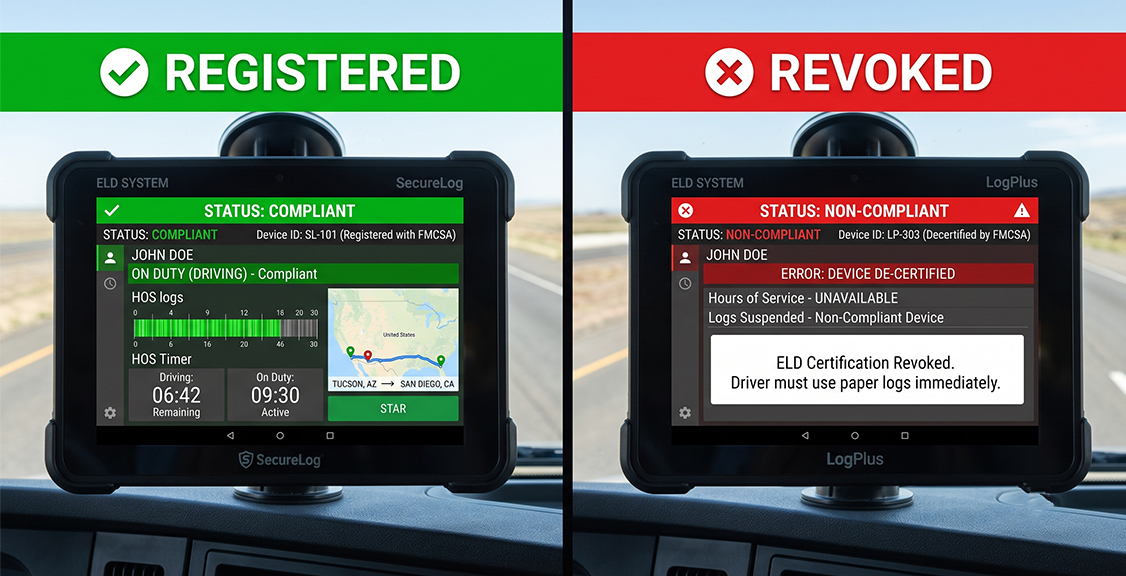
Decertification, which FMCSA calls revocation, means a device provider failed to meet the minimum technical requirements set out in the ELD technical standard, and FMCSA pulled that device off its list of registered devices. It has nothing to do with your fleet’s own compliance record.
Every ELD sold in the United States is supposed to meet the same set of technical requirements under the ELD technical standard Appendix A. ELD vendors self-certify that their device meets those requirements when they register it, which means FMCSA does not test every device before it goes on the market. Instead, the agency reviews devices after the fact. When it finds one that cannot reliably record duty status, transfer data to inspectors, or display required information in the cab, it moves that device to the revoked list.
This self-certification approach is a big part of why revocations keep happening in waves rather than tapering off. A manufacturer completes a form stating that its device meets the technical specifications, and nobody at FMCSA plugs the device in to confirm that claim before it goes on the registered list. That gap between what a provider claims and what the agency later verifies is where these problems tend to surface, sometimes years after a device was first sold.
A revocation is a decision about the device and the company that built it, not about how you or your drivers have used it. Your logs, your training, and your driver behavior stay exactly as compliant as they were the day before. What changes is that the tool itself is no longer legally usable once your replacement window closes, and that timing gap is what catches most fleets off guard.

How Will You Know If Your ELD Gets Revoked?
FMCSA does not call, email, or text your fleet individually. The agency posts the revocation publicly and sends one industry-wide notice, then leaves the responsibility of checking on you.
Every time FMCSA revokes a device, it publishes the announcement through its newsroom and updates the FMCSA-registered ELD list at the same time, exactly as it did with the July 9, 2026 removal. The agency also sends a general email to its subscriber list covering the removal. That email is not addressed to your fleet specifically. If your dispatcher, safety manager, or the driver running that device is not subscribed, it is easy to miss entirely, and there is no second notice coming to catch the gap.
This is why a growing number of small fleets build a monthly habit around checking the registry directly instead of waiting for a notice to land in an inbox. No news is not the same thing as good news here, and checking the list yourself is the only way to know for sure where your device stands. If your team ever needs help walking through how to confirm a device’s current status, our support team can talk you through it.
How Long Do You Have to Replace a Revoked ELD?
You get 60 days from the date FMCSA publishes the revocation to install a compliant replacement device, and that deadline is fixed and does not extend for individual fleets.
The July 9, 2026 removal shows exactly how this plays out. Carriers running one of the 10 devices named that day have until September 8, 2026, the 60-day mark, to have a compliant device installed. During most of that window, FMCSA has told safety officials not to cite drivers for the revoked device itself, so long as the driver can produce paper logs or another backup method to show hours of service. This grace period exists specifically so fleets have time to source and install a new device without a driver getting shut down mid-route. It is not a signal that the deadline itself is flexible.
Sixty days sounds like a comfortable stretch of time until you break down what actually has to happen inside it. A replacement device has to be selected, ordered, and shipped. Drivers need to be trained on a new interface, which usually takes some amount of time per driver even for an intuitive system. Your back office needs to confirm the new device is pulling data correctly before you can trust it at a roadside inspection. Fleets that start this process in week one of the window tend to finish with time to spare. Fleets that wait until week seven are the ones who end up scrambling.
Once the 60 days run out, the device is treated exactly as if it were never installed at all, and that is when the real risk starts. If your fleet is watching a deadline right now, checking your current device against the registry early is worth doing rather than waiting until the last week.
What Happens If You Keep Using a Revoked ELD Past the Deadline?
Past the 60-day deadline, a driver running a revoked device is treated as having no ELD at all, which is one of the most serious violations an officer can write at the roadside.
An officer who finds a revoked device past the deadline cites 49 CFR 395.8(a)(1), no record of duty status, and places the driver out of service under Commercial Vehicle Safety Alliance criteria. The truck gets parked on the spot, and the driver cannot move it again until the violation is corrected. That correction usually means a compliant device is installed before the load can continue, which can mean a truck sitting idle for hours or longer depending on how quickly a replacement can be sourced and configured at that location.
On top of the out-of-service order, this violation carries a civil penalty. Maximum penalties for HOS violations are adjusted annually for inflation under the FMCSA penalty schedule, and a knowing falsification finding under 49 CFR 395.8(e)(1) carries an even higher maximum. Enforcement checks whether the device on the registered list matches the device in the cab rather than whether your fleet is meant to keep running it, so a driver who genuinely did not know the device had been revoked still faces the same citation as one who did.
That last point is worth sitting with for a moment. Ignorance of the revocation is not a defense at the roadside, which is exactly why checking the registry regularly matters more than most fleets initially assume it does.
How Does a Revoked ELD Affect Your CSA Score and Insurance?
A no-ELD violation goes directly into your Hours of Service Compliance BASIC, and it stays part of your safety record for 24 months under FMCSA’s own Safety Measurement System methodology, well after the fine is paid and the truck is back on the road. More recent violations carry more weight in that window than older ones, so a fresh out-of-service order affects your score more heavily right after it happens than it will a year later.
The FMCSA Safety Measurement System tracks HOS violations as part of your fleet’s ongoing compliance record. A worsening HOS score raises your odds of getting pulled for inspection at the next stop, because officers use that data to decide which trucks to check more closely. It can also affect how insurance underwriters view your fleet at renewal and how brokers evaluate your fleet before offering loads, given that both groups pull safety data as part of their own review process.
The insurance side of this tends to move slower than the fine but often costs more in the end. A single out-of-service order will not usually tank a renewal by itself, but a pattern of HOS violations building up over a 24-month window is exactly the kind of trend an underwriter looks for when setting premiums. Brokers work the same way on the load-access side. A carrier with a clean HOS record gets first pick of the better-paying freight, while a carrier with a rising score gets pushed toward the loads nobody else wanted.
Nationally, this kind of exposure has been growing. HOS violations rose from roughly 410,000 in 2023 to more than 500,000 in 2025, according to RigDig data cited by Overdrive, a trend that lines up with FMCSA’s own accelerated pace of device revocations over the same period. Our guide on how ELDs support fatigue compliance covers how this same data gets used across the industry beyond just enforcement. If you believe a violation was recorded unfairly, the FMCSA DataQs system is the formal process for requesting a review, though the stronger position is always avoiding the violation in the first place.
What Should Your Drivers Do During the Replacement Window?
During the 60-day window, your drivers should stop using the revoked device immediately and switch to paper logs or another backup method until a compliant ELD is installed.
FMCSA’s own guidance for a revocation event is direct: discontinue using the device, record hours of service on paper or logging software in the meantime, and replace the device with one from the registered list before the deadline. Drivers should keep a copy of the revocation notice or a screenshot of the device’s status on the revoked list in the cab. If an officer asks questions during the transition, there is something concrete to show, which tends to make the stop shorter and less tense for everyone involved.
Paper logs during a transition period should be filled out with the same discipline as an ELD entry. An incomplete or sloppy paper log during the grace period can create its own separate violation, even though the underlying reason for using paper logs in the first place was fully legitimate. Drivers who have not filled out a paper RODS in years sometimes need a quick refresher before the switch happens, not after an officer is already standing at the window.
This is also a good moment to double check your fleet’s DVIR and maintenance records are staying current while the ELD swap is underway, because an inspection during a transition period tends to draw more attention to the rest of the paperwork too. Our guide to ELD and DVIR record integration walks through how those two pieces work together.
How Can Your Fleet Avoid Getting Caught by a Future Revocation?
The most reliable way to avoid being caught off guard is checking the registered devices list on a set schedule, rather than waiting for a problem to surface at a scale house.
FMCSA has removed devices in batches every few weeks throughout 2026, most recently on July 9, and the agency has said publicly it intends to keep reviewing ELD vendors going forward. This is not a one-time risk your fleet clears and moves past. A short monthly check against the FMCSA-registered ELD list takes a few minutes and tells you immediately if anything in your fleet needs attention. Some fleets also build this into a broader look at their total compliance costs, comparing what a replacement device would run against what they are currently paying using a price calculator built for that kind of side-by-side check.
Vendor stability matters here too, since a device does not get revoked overnight, and providers that have struggled to maintain compliance in the past are worth a second look before you commit a fleet-wide rollout to them. A few practical signs are worth watching for even before a formal revocation happens: slow or unresponsive customer support, evasive answers when you ask about compliance testing, and a pattern of other carriers reporting data transfer problems in online reviews. None of these guarantee a future revocation, but taken together they describe the kind of provider that tends to show up on the revoked list eventually.
How Does an ELD Malfunction Differ From a Decertified Device?
A malfunction is a problem with one specific unit in your fleet, while a decertification is a nationwide decision that affects every carrier running that device model, regardless of whether your own unit has ever caused a problem.
| Factor | ELD Malfunction | ELD Decertified (Revoked) |
|---|---|---|
| What triggers it | The individual unit stops recording, syncing, or displaying data correctly | FMCSA removes the device model from the registered list agency-wide |
| Who is affected | Just your fleet’s specific unit | Every carrier using that device model nationwide |
| Governing rule | 49 CFR 395.34 | 49 CFR 395.8(a)(1) |
| Notice requirement | Driver must notify the carrier within 24 hours | FMCSA posts a public notice; no individual notice to your fleet |
| Repair or replace window | Up to 8 days under 49 CFR 395.34(d)(1) | Up to 60 days from the revocation date |
| Paper logs allowed during window | Yes | Yes |
| What happens after the window closes | Treated as operating without an ELD | Treated as operating without an ELD |
Fleets tend to confuse these two situations because the end result looks identical: paper logs, a countdown clock, and the same underlying risk of an out-of-service order. The trigger, the scope, and the response window are all different, though, and treating one like the other is a common way small compliance mistakes turn into bigger ones. A malfunction is a problem your driver has to notice and report. A revocation is a decision made in Washington about an entire product line.
What Questions Should You Ask Before You Choose an ELD?
The right questions before signing with an ELD provider focus less on features and more on the provider’s compliance track record, since that history is what determines whether you end up dealing with a revocation down the road.
Is the provider currently on the FMCSA-registered devices list, and has it stayed on that list consistently?
Check the FMCSA-registered ELD list directly rather than relying on the vendor’s own marketing claim. A provider with a stable multi-year history on the registered list carries less risk than one that has been added, removed, and re-added.
What is the provider’s plan if a firmware or software issue puts the device at risk of revocation?
Ask directly how the company handles a compliance finding and how quickly it typically resolves one. A provider that cannot answer this clearly is telling you something.
Does the provider notify carriers directly if a compliance issue comes up, or only rely on FMCSA’s general notice?
FMCSA’s own notice goes to a general subscriber list rather than to your fleet by name, so a provider that adds its own direct customer notification is giving you an extra layer of warning time.
How does the device handle a data transfer request at the roadside, and has that been tested in real inspections?
This matters separately from revocation risk, because a device that struggles with data transfer creates its own violations even while fully registered.
What kind of technical support is available if a driver has a problem mid-route?
A device that is technically compliant but leaves a driver stuck without help during an inspection creates the same practical problem as a revoked one.
Is the hardware built for the conditions your trucks actually operate in?
Vibration, temperature swings, and power interruptions all affect whether a device keeps performing the way it did in a demo.
What does switching providers actually involve if you ever need to migrate?
Ask about data export, driver retraining time, and installation logistics before you need the answer under deadline pressure.
Does the provider’s pricing model lock you into a term that makes switching difficult if a compliance issue comes up later?
A shorter commitment gives your fleet more room to move if a provider’s registered status ever becomes a concern.
Common Questions About ELD Revocation and Replacement
About ELD Decertification and Road Safety
What does it mean if FMCSA decertifies your ELD?
It means the device provider failed to meet the federal technical requirements for electronic logging devices, and FMCSA removed that specific device model from its registered list. It is a finding about the device and the company that built it, not about your fleet’s own compliance history.
How often is FMCSA decertifying ELDs right now?
The pace has been steady through 2026, with the most recent batch of 10 devices removed on July 9, 2026 and a replacement deadline of September 8, 2026 for carriers running those devices. FMCSA has said publicly it intends to keep reviewing vendors and pulling non-compliant devices on an ongoing basis.
Will your driver get pulled over just because your ELD was decertified?
No, not automatically, and not during the 60-day replacement window if paper logs or another backup method are available. The risk appears once that window closes and the device is still in use, at which point an inspection could result in an out-of-service order.
Can a revoked device be reinstated?
Yes, if the provider corrects the deficiencies FMCSA identified, the device can be placed back on the registered list, and FMCSA will announce that update publicly. Your fleet should not count on that happening before your own 60-day deadline, though.
Is a decertified ELD the same thing as a malfunctioning one?
No, the two follow different rules and different deadlines. The comparison table above breaks down exactly how the repair window, the notice requirement, and the governing regulation differ between the two.
Does this affect owner-operators the same way it affects larger fleets?
Yes. The rule applies per device, not per fleet size, so an owner-operator running a single truck faces the same 60-day deadline and the same out-of-service risk as a fleet running fifty trucks on the same revoked device.
About Choosing the Right ELD Provider
What details should you have on hand before checking a device’s status?
Gather the provider name, exact model number, and firmware version before searching the FMCSA-registered ELD list. Some revocations apply to a specific firmware release rather than an entire product line, so the version number matters as much as the model itself.
Should price be the main factor when choosing an ELD provider?
No. A device that costs less but comes from a provider with a shaky compliance history can end up costing far more once fines, out-of-service time, and a rushed replacement are factored in. Provider stability matters as much as the sticker price.
What should you look for in a provider’s compliance track record?
Look for a consistent, unbroken history on the registered devices list rather than a pattern of removals and reinstatements. A provider’s own support responsiveness is also worth weighing, since that becomes important the moment a compliance question comes up.
Is it worth switching providers proactively if you are not sure about your current one’s stability?
That depends on your specific provider’s history and your fleet’s tolerance for risk. If you are unsure where your current device stands, checking its status on the FMCSA list is the first step before deciding anything else.
What questions should you ask a new provider about their FMCSA registration status?
Ask how long they have held their current registration, whether they have ever appeared on the revoked list, and what their process looks like if a compliance issue arises. A provider willing to answer these directly is generally a better sign than one that deflects.
Does Geosavi help fleets confirm their ELD is currently compliant?
Yes, our team can walk you through checking a device’s current status and what your options look like if a replacement becomes necessary. If your fleet has questions about a specific situation, calling (800) 261-4361 is the fastest way to get a direct answer.
Your ELD Compliance Is Only as Strong as the Device Behind It
A device that was fully compliant the day you bought it can end up on the revoked list a year later through no fault of your own. That is the uncomfortable part of this issue for a lot of fleet owners, because it puts a piece of your compliance in the hands of a vendor’s ongoing performance rather than something fully within your control.
The response to that risk is not complicated, even if it takes discipline to keep up with. Check the registered list on a regular schedule, know the difference between a malfunction and a revocation, and treat the 60-day window as a real deadline rather than a soft suggestion. Fleets that build this into a routine rarely get caught by a surprise out-of-service order. The ones that do usually say the same thing afterward: they meant to check and never got around to it.
If any of this has you thinking about where your own setup stands, reaching out to Geosavi is an easy way to find out, and you can always just call (800) 261-4361 directly if that’s simpler.