Key Takeaways
- Drivers required to keep Records of Duty Status may use paper logs for no more than 8 days in any rolling 30-day period under 49 CFR 395.8(a)(1)(ii), according to FMCSA.
- When an ELD malfunctions, the carrier must repair or replace it within 8 days of discovery or driver notification, whichever occurs first, under 49 CFR 395.34, per the Electronic Code of Federal Regulations verified June 2026.
- Carriers whose ELD is revoked from the FMCSA-registered list have 60 days to replace it before drivers face citation under 49 CFR 395.8(a)(1) and an immediate out-of-service order, per FMCSA enforcement notices published in 2026.
- 80 ELD devices have been removed from the FMCSA-registered list since January 2025. The most recent removal was TRUCKSTAFF ELD on June 23, 2026, giving those carriers until August 23, 2026 to replace it, according to FMCSA Administrator Derek D. Barrs.
- HOS violations rose from 410,000 in 2023 to more than 500,000 in 2025, according to RigDig data cited by Overdrive, April 2026.
- Drivers running paper logs past the permitted window without an approved exemption or extension are treated as having no record of duty status under 49 CFR 395.8(a)(1) and can be placed out-of-service under CVSA criteria.
- FMCSA projects 1,844 fewer crashes, 562 fewer injuries, and 26 lives saved per year at ELD mandate adoption, according to FMCSA’s own published estimates.
- 58,382 falsification violations were recorded across FMCSA inspections, making falsification of records of duty status the second most-cited driver violation in 2025, according to CVSA’s 2026 International Roadcheck announcement.
Introduction
Paper logs have been part of trucking for decades, but the rules around when your drivers can legally use them have tightened considerably since the ELD mandate took full effect. If your drivers are still reaching for a paper logbook, whether out of habit, because a device stopped working on the road, or because your carrier received a revocation notice for the ELD you were running, you need to know exactly where the legal line sits. Running past it does not result in a warning. It results in a citation under 49 CFR 395.8(a)(1) and, in many cases, an immediate out-of-service order that parks the truck until the situation is resolved.
How long paper logs are permitted depends entirely on which situation your driver is in. There are three distinct scenarios, each with its own deadline and its own set of conditions. A driver in a qualifying exemption category operates under different rules than a driver whose ELD malfunctioned at 3 a.m., who in turn operates under different rules than a carrier whose device was just pulled from the FMCSA-registered list. Getting these three situations mixed up is exactly how a fleet ends up with a driver sitting at the roadside, prohibited from moving until the records are sorted out.
None of these scenarios care about your fleet size. The deadlines and documentation requirements are the same whether you run one truck or twenty, and they apply the moment your driver is required to keep a Record of Duty Status.
If you want to talk through your current setup before reading further, our team is available any time at (800) 261-4361. Drivers and fleet managers who want to review device options can find full details on our FMCSA-registered ELD hardware.
What Does Federal Law Actually Say About Paper Logs?
Federal law does not prohibit paper logs outright. What it does is restrict them to specific, defined situations where a driver either qualifies for an exception or is inside a permitted transition window.
The ELD mandate under 49 CFR Part 395 HOS rules requires most commercial motor vehicle drivers who must keep Records of Duty Status to use an FMCSA-registered electronic logging device. Paper logs are permitted only when the driver or carrier falls into one of three categories: a qualifying exception, a temporary malfunction window, or a transition period following a device revocation. Outside these three categories, using a paper logbook instead of an ELD is a compliance violation the moment the truck moves.
All three categories share one important rule: your drivers must still follow every HOS requirement that applies to them even when they are on paper. Paper logs do not suspend the 11-hour driving limit, the 14-hour on-duty window, the 30-minute break requirement, or the weekly hour caps under 49 CFR 395.3. The only thing that changes is the method of recording. Some drivers assume that a paper logbook gives them more flexibility in how their hours are counted. It does not, and paper records typically receive more scrutiny at roadside because they are easier to alter and harder to verify against engine data.
Failing to have a proper record of duty status under 49 CFR 395.8(a)(1) is a violation regardless of the logging method. Whether an inspector finds no log at all, an expired paper log window, or paper logs being used outside a permitted situation, the citation reads the same: no record of duty status. That citation carries maximum civil penalty amounts of up to $19,246 per violation for motor carriers and up to $4,812 for drivers under the FMCSA civil penalty schedule, with all amounts adjusted annually for inflation. Knowing exactly which situation applies to your drivers, and what conditions come with it, is where every compliance decision in this area starts.
What Is the 8-Day Paper Log Limit and How Does It Work?
The 8-day rule is a specific exception built into the ELD mandate, not a general grace period that applies every time something goes wrong.
Under 49 CFR 395.8(a)(1)(ii), drivers who are required to maintain Records of Duty Status are not required to use an ELD if they use paper logs for no more than 8 days in any rolling 30-day period. FMCSA built this exception for drivers who only occasionally operate vehicles requiring log books, and for drivers whose ELD breaks down on the road and hinders accurate HOS recording.
The phrase rolling 30-day period is what catches most drivers off guard. The count does not reset at the start of each calendar month. It looks back from whatever date you are currently on, counts every paper log day used in the previous 30 days, and checks whether the total has exceeded 8. If your driver used 8 paper log days in the past three weeks, there are no remaining paper days until those earlier days fall outside the lookback window. Drivers are responsible for tracking this count themselves, and inspectors can ask to see the supporting records that show how many paper log days have been used.
The 8-day limit is a ceiling on total paper log use across any 30-day period, not 8 fresh days every time something goes wrong. If your ELD fails on a Monday and your driver runs paper for 8 consecutive days, the full 30-day allowance is used. If the device fails again two weeks later, there are no paper days left, and the carrier must either have the device repaired before the truck moves or submit a formal extension request to FMCSA. That extension process is covered in the next section.
What Happens When an ELD Malfunctions? How Long Can You Use Paper While It Gets Fixed?
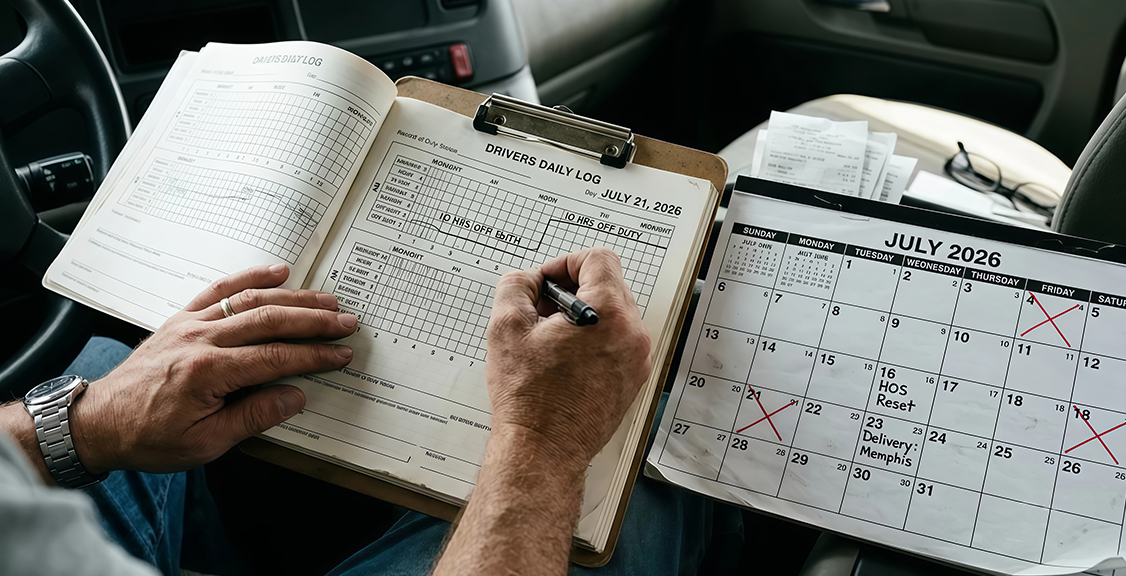
When your ELD malfunctions and prevents accurate HOS recording, your driver may use paper logs while your carrier arranges a repair or replacement. The carrier has 8 days to correct the malfunction, and that clock starts from whichever comes first: the motor carrier’s own discovery of the problem, or the driver’s written notification, as set out in 49 CFR 395.34. The driver must provide that written notification to the carrier within 24 hours of discovering the malfunction under 49 CFR 395.34(a)(1).
The steps the driver must take are specific and sequential. Within 24 hours, the driver must notify the carrier in writing. The driver must then reconstruct Records of Duty Status for the current 24-hour period and the previous 7 consecutive days on paper graph-grid logs that comply with 49 CFR 395.8, unless those records are already in hand or can be retrieved from the ELD. From that point, the driver must continue keeping paper RODS for every day the device remains out of service and the malfunction continues to hinder accurate recording. At a roadside inspection during this period, those manually kept records must be handed over to the safety official, along with a clear explanation of when the malfunction occurred, when the carrier was notified, and what is being done to resolve it. An inspector who finds no documentation of the malfunction and no reconstructed logs from the previous 7 days can still issue a citation even when the malfunction itself is genuine.
If 8 days is not enough time to get the device corrected, your carrier can submit a formal extension request to the FMCSA Division Administrator for the state where your principal place of business is located. That option is available under 49 CFR 395.34(d)(2), but the request must be filed within 5 days of the driver’s written notification to the carrier. It must be signed by the carrier and must include the contact details of the representative filing it, the make, model, and serial number of the malfunctioning device, the date and location the malfunction was reported, and a clear description of what steps the carrier is taking and why more than 8 days is needed. If FMCSA approves the extension, the carrier is considered in compliance while the determination is pending, provided all other requirements in 49 CFR 395.34 continue to be met.
What Is the Deadline If Your ELD Gets Revoked from the FMCSA Registered List?
When FMCSA removes an ELD from its registered list, carriers using that device have exactly 60 days to replace it with a compliant alternative. During that window, drivers must stop using the revoked device immediately and switch to paper logs or approved logging software to record their RODS. Once the 60 days expire, any driver still on paper because of that revocation is treated as operating without a compliant ELD under 49 CFR 395.8(a)(1) and will be placed out-of-service at the next roadside inspection.
The pace of revocations in 2026 makes this directly relevant to more carriers than most people expect. FMCSA has removed 80 ELD devices from the registered list since January 2025. The most recent removal was TRUCKSTAFF ELD on June 23, 2026, confirmed by FMCSA Administrator Derek D. Barrs. Carriers using TRUCKSTAFF ELD have until August 23, 2026 to replace it before drivers face citation and out-of-service orders. Before that, the batch of 12 devices removed on May 20, 2026, including 888 ELD, Dragon ELD, Action ELD, Mondo ELD HOS, First ELD, First ELD V2.0, MTL ELD, USPower ELD, Sam Freight ELD, DSGELOGS, Cobra ELD, and GT USA ELOGS, carries a July 20, 2026 deadline. Safe ELD and MyLogs ELD were removed May 7, 2026, with a July 7, 2026 deadline for those carriers. All of these deadlines are fixed. Once each window closes, FMCSA has directed inspectors to cite and place out-of-service any driver still running on paper because of those revocations.
Verifying your device’s current status on the FMCSA-registered ELD list at regular intervals, not just once at purchase, is the only reliable way to catch a revocation before it becomes a compliance crisis. With 80 devices removed since January 2025 and the pace showing no sign of slowing, assuming your device stays registered without checking is a risk no carrier can afford. If you are currently running one of the affected devices and need to move quickly, our ELD compliance team can walk you through replacing a revoked device before your deadline.
Who Can Legally Stay on Paper Logs Long Term?
Some drivers and operations are exempt from the ELD mandate entirely and can continue using paper logs as long as they still follow all applicable HOS rules. These exemptions are based on specific vehicle types and operational patterns, not on fleet size or how long a carrier has been operating.
Drivers of commercial motor vehicles with engines manufactured before model year 2000 are not required to use an ELD under 49 CFR 395.8(a)(1)(iii). Pre-2000 engines typically lack the electronic control modules that an ELD needs to connect to a vehicle’s diagnostic port, which is why the exemption exists. Per FMCSA guidance, the exemption is based on the engine model year, which means a truck with a newer registration VIN but a confirmed pre-2000 engine still qualifies. Drivers are not required to carry engine documentation with them at all times, but the motor carrier must maintain all documentation on engine changes at the principal place of business under 49 CFR Part 379 Appendix A. If an inspector cannot confirm the engine model year at the roadside, they may refer the case for further investigation rather than issuing an immediate citation.
Driveaway-towaway operators are also exempt when the vehicle being driven is the commodity being delivered, or when the load is a motor home or recreational vehicle trailer with at least one set of wheels on the road surface. Outside these vehicle-based exemptions, the only long-term paper log situation for most commercial drivers is the 8-days-in-30 exception covered above. Drivers who frequently qualify for the short-haul exemption under 49 CFR 395.1(e) may go many days without needing either an ELD or paper logs, but the 8-day paper ceiling still applies on any day that falls outside the short-haul exemption criteria.
There is no exemption based on fleet size. One truck or one hundred, if your drivers are required to keep RODS and do not fall into one of the categories above, a compliant ELD is required. Carriers who assume that being a small operation provides some informal flexibility tend to find out otherwise at the first roadside inspection. Common exemption questions are covered in our ELD compliance FAQ for drivers who want to check where they stand before their next trip.
What Does the Paper-to-ELD Switch Actually Involve?
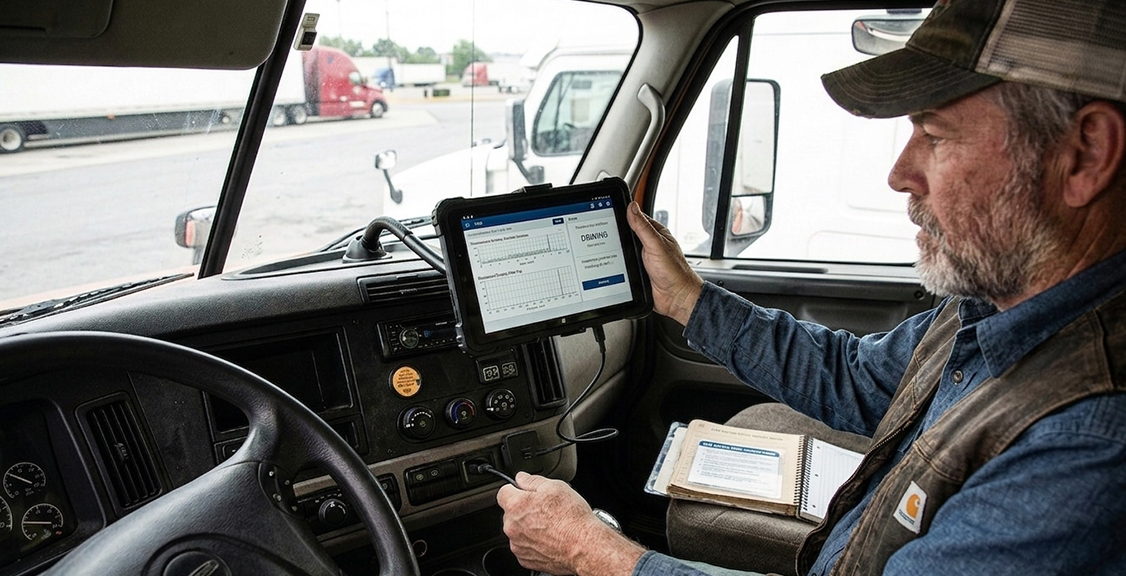
Switching from paper logs to an ELD is simpler than most drivers and back offices expect, once you choose a device built for real-world trucking conditions. The transition comes down to four steps: selecting a compliant device, connecting it to the truck, setting up driver profiles, and learning how to present logs at an inspection.
Confirming that the ELD you are considering is currently on the FMCSA-registered list before committing to any purchase or subscription is the first and most important step. A device that was registered when it was marketed to you may have since been revoked. Check the FMCSA-registered ELD list at the time of purchase and build a habit of rechecking every few months, since the list updates whenever a device is added, revoked, or reinstated. Once you have a confirmed registered device, installation connects the ELD to the truck’s diagnostic port. The connection type depends on the engine: heavy-duty trucks typically use J1939 or J1708, while lighter commercial vehicles connect through OBD-II. Our hardware supports all three connection types, which matters for fleets running mixed equipment with different engine generations.
After installation and driver profile setup, your drivers need a short walkthrough covering how to change duty status, how to review and certify logs at the end of the day, how to handle an unidentified driving event under 49 CFR 395.32(c), and how to present records to an inspector via Bluetooth, USB, or encrypted email. The in-cab information packet required under 49 CFR 395.22(h), which includes operating instructions, the data transfer process, and malfunction reporting procedures, should be in the truck before the first run on the new device. If you want a full breakdown of how ELD data recording, storage, and inspection transfers work, our guide on how an ELD records and transfers hours of service data covers the full process step by step.

What Should Your Drivers Carry in the Cab During a Paper Log Period?
During any legitimate paper log period, your driver needs specific documentation ready for an inspector at the roadside. Missing pieces can turn an otherwise legal paper log window into a citation regardless of whether the situation was genuinely permitted.
At a minimum, the driver must have paper RODS for the current 24-hour period and the previous 7 consecutive days. Those logs must be completed in graph-grid format as required by 49 CFR 395.8 and must accurately show all four duty statuses: off duty, sleeper berth, driving, and on-duty not driving. If the paper log period follows an ELD malfunction, the reconstructed records from the prior 7 days must also be in the cab, along with written documentation that the driver notified the carrier within the required 24 hours. The driver should be ready to tell the inspector when the malfunction occurred, when the carrier was notified, and what is being done to fix the device.
If the paper log period follows a device revocation, the driver should be able to show that the 60-day transition window announced by FMCSA has not yet expired. Inspectors who are aware of a recent revocation will typically verify that the paper records are current and that the carrier is still within the permitted window. Once that deadline passes, the transition period provides no further protection, and the driver will be cited as if operating without a compliant device. The FMCSA ELD FAQ sets out exactly what inspectors are instructed to look for during malfunction and revocation transition periods, and it is worth reviewing before your drivers go out. Levels of inspector familiarity vary between locations, so a well-prepared driver who can clearly explain the situation and produce the right documentation is always in a stronger position than one who cannot.
How Does Paper Log Use Affect Your Fleet’s CSA Score?
HOS citations from paper log violations do not disappear after a roadside inspection. Every citation for improper paper log use or for running paper past a permitted window gets recorded in your fleet’s compliance history and factors into your score through the FMCSA Safety Measurement System. The HOS compliance category draws from 24 months of violation data, which means a stretch of paper log errors can affect your carrier’s standing for nearly two years after those inspections occurred.
When your HOS violation count climbs high enough relative to carriers of similar size, the Safety Measurement System can flag your fleet for increased enforcement attention, and repeated violations can eventually trigger a compliance review under FMCSA safety fitness procedures. A compliance review is not just an inconvenience. It can result in a formal safety rating that affects your ability to secure certain contracts and significantly increases what you pay for insurance. Carriers with unsatisfactory safety ratings pay up to $18,500 per vehicle annually compared to $8,200 for satisfactory-rated carriers, according to 2026 fleet safety compliance research.
Moving to a compliant ELD removes the entire category of violations that comes from improper paper log use. It does not eliminate all HOS violations, since drivers can still exceed their hours with an ELD, but it removes the layer of errors from manual entry mistakes, missing logbooks, and records that do not match fuel receipts or dispatch data. If your fleet has accumulated paper log violations and you want to see what your current compliance record shows, roadside inspection data and correction requests can be reviewed through the FMCSA DataQs system. Our article on how ELD violations stay on your record covers the scoring and review process in full detail.
Paper Logs vs. ELD: What Changes When You Switch
| Feature | Paper Logs | ELD |
|---|---|---|
| RODS entry method | Handwritten on graph grid by the driver | Automatic from engine ECM, no manual entry for driving time |
| Risk of entry errors | High, a common source of HOS violations | Low, driving time is recorded automatically by the device |
| Roadside inspection time | Longer, officer reviews paper manually | Faster, data transfers via Bluetooth, USB, or encrypted email |
| Falsification risk | Higher, paper records are easier to alter | Lower, FMCSA-compliant ELDs preserve original records per 49 CFR 395.30(f) |
| Back office visibility | None until the driver returns with the logbook | Real-time HOS status visible to your fleet manager at any time |
| Record storage | Physical logbooks retained by carrier for 6 months per 49 CFR 395.8(k) | Electronic storage, retrievable on demand |
| Penalty exposure | Up to $19,246 per HOS violation for carriers per FMCSA civil penalty schedule | Fewer violations when duty status is recorded automatically |
| Out-of-service risk at inspection | Higher when the paper log window has expired or was misused | Lower when the device remains on the FMCSA-registered list |
Questions to Ask Before You Switch from Paper to ELD
Is the ELD currently on the FMCSA registered list?
Check the FMCSA-registered ELD list before agreeing to any purchase or subscription. A device that was registered when it was first marketed may have since been revoked. With 80 devices removed since January 2025, checking once at purchase and never again is not sufficient protection for your fleet.
Does the ELD connect to every engine type in your fleet?
Your trucks may use different engine communication protocols depending on their age and manufacturer. J1939 is standard in most modern heavy-duty engines, J1708 is common in older equipment, and OBD-II is typical in lighter commercial vehicles. Confirm the device covers all connector types your operation uses before committing.
What support is available when a driver has a problem overnight?
ELD problems do not happen on schedule. If your driver is at a truck stop with a device error and cannot reach the provider’s support team, they are either starting a malfunction paper log period or sitting until the issue gets resolved. Confirm that the provider offers 24-hour, 7-day phone support before signing anything.
What does data transfer look like during a roadside inspection?
Inspectors request HOS data using one of the approved transfer methods. Your driver needs to know how to initiate that transfer within the time the inspector allows. Ask the provider to walk your drivers through the process before their first inspection on the new device.
How does the ELD handle co-driver situations?
Fleets running team drivers need a device that correctly assigns driving time between drivers, supports duty status changes when a co-driver takes the wheel, and handles unidentified driving events under 49 CFR 395.32(c). Confirm how the device manages team operations before installing it.
Does the device come with a money-back guarantee?
A provider that stands behind their hardware will offer a trial period. A 30-day money-back guarantee gives you enough time to verify that the device works across your trucks and that your drivers can use it without problems before your commitment is locked in. Our ELD comes with that guarantee built in.
What is the provider’s history with FMCSA registration?
With 80 devices removed since January 2025, ask the provider directly whether they have maintained continuous registration without interruption. You can verify their current status on the FMCSA-registered ELD list, and that check takes less than a minute.
Will the ELD handle both USA and Canadian HOS rules?
USA and Canadian HOS rules differ, and a device that covers only US regulations will create compliance gaps on cross-border routes. Confirm the device supports both rule sets before putting it in a truck that runs into Canada.
About ELD Rules and Paper Logs
How many days can a driver legally use paper logs in a 30-day period?
A driver required to maintain Records of Duty Status can use paper logs for no more than 8 days in any rolling 30-day period under 49 CFR 395.8(a)(1)(ii). The window looks back from the current date across the previous 30 days, regardless of which calendar months those days fall in. Once 8 days are used within that window, the driver must have a functioning, registered ELD in place before operating again, or the carrier must file a formal extension request with FMCSA under 49 CFR 395.34(d)(2).
What must a driver do the moment their ELD stops working?
The driver must note the malfunction and notify the carrier in writing within 24 hours per 49 CFR 395.34(a)(1). They must then reconstruct RODS on paper graph-grid logs for the current 24-hour period and the previous 7 consecutive days, and continue keeping paper RODS if the malfunction prevents accurate HOS recording until the device is back in service. At a roadside inspection during the malfunction period, those manually kept records must be available for the safety official, along with a clear account of when the malfunction was reported to the carrier.
Can the 8-day malfunction window be extended?
Yes. Under 49 CFR 395.34(d)(2), the carrier can request an extension from the FMCSA Division Administrator for the state where the principal place of business is located. The request must be filed within 5 days of the driver first notifying the carrier of the malfunction, must be signed by the carrier, and must describe the device, when and where the malfunction occurred, and what steps the carrier is taking. If FMCSA approves the extension, the carrier is considered in compliance while the determination is pending, provided all other requirements in 49 CFR 395.34 continue to be met.
Does paper log use affect a fleet’s CSA score?
Yes. HOS citations recorded during a roadside inspection, including violations for improper paper log use or running paper past a permitted window, are recorded in the Safety Measurement System and remain on the carrier’s compliance history for 24 months per FMCSA’s CSA methodology. Violations that push a fleet’s HOS category above similar-sized peers can trigger increased enforcement attention and, in repeated cases, a formal compliance review.
What happens if a driver runs paper logs after the 60-day revocation window closes?
Once the 60-day replacement deadline passes for a revoked ELD, any driver still using paper logs because of that revocation is treated as operating without a valid record of duty status under 49 CFR 395.8(a)(1). The driver will be cited and placed out-of-service under CVSA criteria. There is no further grace period after the 60-day window expires.
Are drivers on paper logs subject to the same HOS limits as ELD drivers?
Yes, without exception. Paper logs do not change a single HOS rule. Drivers on paper must follow all limits under 49 CFR 395.3, including the 11-hour driving limit, the 14-hour on-duty window, the 30-minute break requirement, and the 60/70-hour weekly cap. Inspectors check paper RODS against all of the same limits they apply to ELD output.
Does an ELD malfunction excuse a driver from following HOS limits?
No. A device malfunction does not suspend any hours of service obligation. The driver must continue tracking and recording duty status on paper, and those records must show compliance with all applicable limits. If the driver’s hours are exceeded during a malfunction period, the violation stands. The FMCSA hours of service rules apply regardless of the logging method in use.
About Choosing the Right ELD
How do you verify an ELD is currently on the FMCSA registered list?
Search for the device by name or provider on the FMCSA-registered ELD list, which is updated whenever a device is added, revoked, or reinstated. Do not rely on the provider’s word alone. Look the device up before you buy, and check again every few months. With 80 devices removed since January 2025, a single check at purchase is not enough.
What connection types does a compliant ELD need to support?
An ELD must connect to the vehicle’s engine through its diagnostic port to automatically record driving data. Heavy-duty trucks typically use J1939 or J1708, while lighter commercial vehicles use OBD-II. A device that does not support the correct connection type on your truck cannot legally record driving data automatically, which is a core technical requirement under the ELD technical standard Appendix A to Subpart B of Part 395.
What records does a driver need to carry during an ELD malfunction period?
The driver must carry paper RODS for the current 24-hour period and reconstructed paper RODS for the previous 7 consecutive days, along with written documentation of the malfunction notification sent to the carrier. If the carrier has submitted an extension request, a copy of that documentation should also be in the cab during any inspection.
Is there a minimum retention period for ELD and paper log records?
Yes. Both ELD records and paper logs used during a malfunction or exemption period must be retained for a minimum of six months per 49 CFR 395.8(k)(1). Keep records organised by driver and date in a format that allows fast retrieval during an audit or compliance review.
What is the difference between an ELD exemption and an ELD exception?
An exception is built directly into the ELD rule and applies automatically when the driver or vehicle meets the defined criteria, such as the 8-days-in-30 allowance or the pre-2000 engine situation. An exemption is a formal grant of temporary regulatory relief issued by FMCSA after a public comment period, limited to specific carriers and time periods under 49 CFR Part 381. If anyone tells you that your operation qualifies for an exemption, ask to see the published Federal Register notice that confirms it.
Can a tablet be used as an ELD?
Yes, provided the tablet runs ELD software meeting FMCSA technical standards and is listed on the FMCSA registered ELD list. The tablet must connect to the truck’s engine diagnostic port and record driving data automatically from the engine, not from manual input alone. Our guide on using a tablet for ELD compliance explains what specifications to look for and how tablet-based ELDs differ from phone apps. The Geosavi tablet is SAE J1455 certified, meaning it is tested for the temperature ranges, vibration levels, and power conditions found in commercial truck cabs.
What should a fleet manager do if a driver disputes a log entry recorded by the ELD?
Drivers and carriers can make edits and annotations to ELD records when a record does not accurately reflect what happened, following the rules in 49 CFR 395.30. Every edit must include an annotation explaining why the change was made, and the original record must be preserved under 49 CFR 395.30(f). Carriers cannot edit a driver’s record before the driver certifies it under 49 CFR 395.30(d). The FMCSA guidance on ELD editing and annotations walks through the full process for both drivers and carriers.
Making the Right Call Before Your Next Inspection
Knowing which paper log situation applies to your operation, and what the exact time limit is in each one, is the difference between a compliant transition and a citation that follows your fleet for two years. Paper logs are a legitimate tool in specific, narrow circumstances. Outside those circumstances, they are a liability.
Enforcement in 2026 reflects that reality clearly. HOS violations rose to more than 500,000 in 2025 according to RigDig data cited by Overdrive, and CVSA’s 2026 International Roadcheck placed ELD tampering and log integrity at the center of its inspection priorities. With 80 devices removed from the FMCSA-registered list since January 2025, including TRUCKSTAFF ELD as recently as June 23, 2026, the risk that your current device will face scrutiny or removal is genuine. Waiting until a revocation notice arrives before planning a replacement puts your drivers inside a 60-day countdown with no preparation behind them.
Whether you are switching from paper for the first time, replacing a revoked device before a deadline, or verifying that your current setup still meets FMCSA standards, our compliance team is available around the clock at (800) 261-4361. Drivers and managers who want to review device options and run the numbers on a new setup can do that through our ELD pricing calculator before committing to anything.