Key Takeaways
- The 8-days-in-30 exception in 49 CFR 395.8(a)(1)(ii)(A)(1) applies to drivers who are required to complete a record of duty status on no more than eight days in any 30-day period. It is separate from the ELD malfunction rule.
- Under 49 CFR 395.34, a driver must report an ELD malfunction to the carrier in writing within 24 hours, reconstruct required records when they are not otherwise available, and keep manual RODS until the ELD is compliant.
- A carrier normally has eight days from discovery or driver notification, whichever occurs first, to repair, replace, or service a malfunctioning ELD. A qualifying extension request must reach the appropriate FMCSA Division Administrator within five days after driver notification.
- When FMCSA revokes an ELD, the replacement deadline and temporary logging instructions come from that device’s removal notice. Notices commonly allow up to 60 days, but carriers should verify the exact date instead of assuming every notice is identical.
- Short-haul drivers who meet § 395.1(e), qualifying driveaway-towaway operations, drivers who need RODS on no more than eight days in 30, and qualifying pre-2000 vehicles or engines may operate without a required ELD when all conditions are met.
- Paper logs change the recording method, not the hours-of-service limits that apply to the driver. Missing, false, incomplete, or unauthorized records can still lead to roadside violations and, when the current CVSA criteria are met, an out-of-service order.
- FMCSA requires carriers subject to the ELD rule to use a device on the registered ELD list and to keep data-transfer instructions, malfunction instructions, and at least eight days of blank graph-grid RODS in the vehicle.
- During the 2026 International Roadcheck, 94.2% of inspected drivers had no out-of-service violation; hours-of-service violations accounted for 883 U.S. driver out-of-service violations and 46 in Canada, according to CVSA’s final results.
Paper logs remain lawful in specific situations, but the controlling rule depends on why they are being used. A driver who only occasionally needs RODS is governed by the 8-days-in-30 exception, a driver with a malfunctioning ELD must follow § 395.34, and a carrier using a revoked device must follow the transition instructions in FMCSA’s removal notice. Using paper outside an applicable exception or temporary procedure can produce a roadside violation. Whether the driver is also placed out of service depends on the current CVSA criteria and the facts documented during the inspection; it is not useful to treat every paper-log error as having one automatic outcome.
How long can you run paper logs? The answer depends on the situation. The recurring categories are rule-based ELD exceptions, temporary recordkeeping during an ELD malfunction, and notice-specific transition relief after FMCSA revokes a device. Each has different eligibility, documentation, and timing requirements. Mixing those situations can leave a driver without the records or authority needed to explain paper-log use during an inspection.
None of these scenarios care about your fleet size. The deadlines and documentation requirements are the same whether you run one truck or twenty, and they apply the moment your driver is required to keep a Record of Duty Status.
If you want to talk through your current setup before reading further, our team is available any time at (800) 261-4361. Drivers and fleet managers who want to review device options can find full details on our FMCSA-registered ELD hardware.
What Does Federal Law Actually Say About Paper Logs?
Federal law does not prohibit paper logs outright. Section 395.8 permits manual RODS for defined operations, including drivers who need RODS on no more than eight days in any 30-day period, qualifying driveaway-towaway operations, and qualifying pre-2000 vehicles. Short-haul drivers who meet § 395.1(e) generally use time records rather than RODS.
Separate rules cover temporary manual records during an ELD malfunction, and FMCSA removal notices may authorize paper logs or compliant logging software for a stated transition period after a device is revoked. A driver who is otherwise required to use an ELD may not substitute paper logs without an applicable exception, malfunction procedure, exemption, or notice-specific transition.
All three categories share one important rule: your drivers must still follow every HOS requirement that applies to them even when they are on paper. Paper logs do not suspend the 11-hour driving limit, the 14-hour on-duty window, the 30-minute break requirement, or the weekly hour caps under 49 CFR 395.3. The only thing that changes is the method of recording. Some drivers assume that a paper logbook gives them more flexibility in how their hours are counted. It does not. Paper RODS must be complete, current, legible, and supported in the same manner required by Part 395.
An inspector may document different violations depending on what is missing or improper, including failure to use a required ELD, failure to maintain RODS, or a false or incomplete record. Civil penalties depend on the specific violation and are adjusted periodically, so statutory maximums should not be treated as automatic roadside fines for each paper-log problem. Correct classification starts with identifying why the driver is on paper and which rule authorizes it.
What Is the 8-Day Paper Log Limit and How Does It Work?
The 8-day rule is a specific exception built into the ELD mandate, not a general grace period that applies every time something goes wrong.
Under 49 CFR 395.8(a)(1)(ii)(A)(1), a driver may use manual RODS instead of an ELD when operating in a manner that requires completion of a record of duty status on no more than eight days within any 30-day period. This exception is designed around how often the driver needs RODS. It is not the authority for temporary paper records during an ELD malfunction; § 395.34 governs that separate situation.
The phrase rolling 30-day period is what catches most drivers off guard. The count does not reset at the start of each calendar month. It looks back from whatever date you are currently on, counts every paper log day used in the previous 30 days, and checks whether the total has exceeded 8. If your driver used 8 paper log days in the past three weeks, there are no remaining paper days until those earlier days fall outside the lookback window. Carriers and drivers should track every day on which RODS were required so they can determine whether the exception still applies. FMCSA guidance does not require a driver to carry a separate document proving the exception, but the underlying duty-status and time records must still be accurate and available as required.
The 8-days-in-30 calculation is a rolling eligibility test for this exception, not a bank of malfunction days. A driver who normally requires an ELD follows § 395.34 when that device malfunctions. The carrier’s ability to request additional repair time under § 395.34(d) applies to a malfunction; it does not extend the separate 8-days-in-30 exception.
What Happens When an ELD Malfunctions? How Long Can You Use Paper While It Gets Fixed?
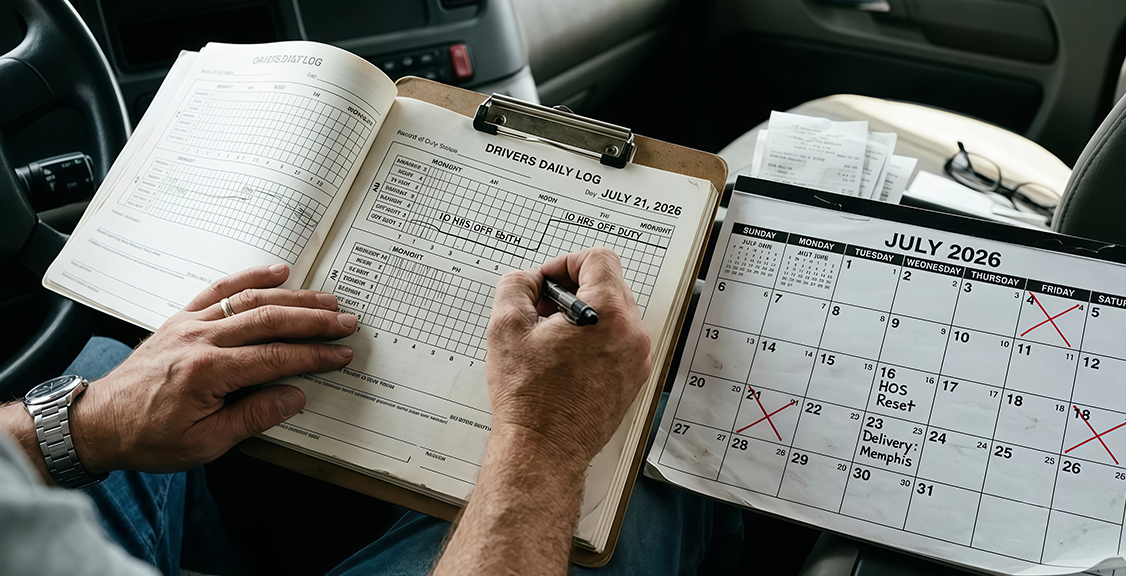
When your ELD malfunctions and prevents accurate HOS recording, your driver may use paper logs while your carrier arranges a repair or replacement. The carrier has 8 days to correct the malfunction, and that clock starts from whichever comes first: the motor carrier’s own discovery of the problem, or the driver’s written notification, as set out in 49 CFR 395.34. The driver must provide that written notification to the carrier within 24 hours of discovering the malfunction under 49 CFR 395.34(a)(1).
The steps the driver must take are specific and sequential. Within 24 hours, the driver must notify the carrier in writing. The driver must then reconstruct Records of Duty Status for the current 24-hour period and the previous 7 consecutive days on paper graph-grid logs that comply with 49 CFR 395.8, unless those records are already in hand or can be retrieved from the ELD. From that point, the driver must continue keeping paper RODS for every day the device remains out of service and the malfunction continues to hinder accurate recording. At a roadside inspection during this period, those manually kept records must be handed over to the safety official, along with a clear explanation of when the malfunction occurred, when the carrier was notified, and what is being done to resolve it. An inspector who finds no documentation of the malfunction and no reconstructed logs from the previous 7 days can still issue a citation even when the malfunction itself is genuine.
If 8 days is not enough time to get the device corrected, your carrier can submit a formal extension request to the FMCSA Division Administrator for the state where your principal place of business is located. That option is available under 49 CFR 395.34(d)(2), but the request must be filed within 5 days of the driver’s written notification to the carrier. It must be signed by the carrier and must include the contact details of the representative filing it, the make, model, and serial number of the malfunctioning device, the date and location the malfunction was reported, and a clear description of what steps the carrier is taking and why more than 8 days is needed. A carrier that submits a request meeting § 395.34(d)(2) is deemed compliant with the specified ELD requirements while FMCSA considers the request, provided the carrier and driver continue meeting the other malfunction requirements. FMCSA may grant additional time and impose conditions in its written determination.
What Is the Deadline If Your ELD Gets Revoked from the FMCSA Registered List?
When FMCSA removes an ELD from the registered list, the removal notice states the temporary logging options and the date by which the device must be replaced. Recent notices have commonly allowed motor carriers up to 60 days to replace affected devices, but the notice for the exact ELD is the controlling source.
During an authorized transition, the notice may permit paper RODS or compliant logging software. After the stated deadline, continued use of the revoked ELD or improper paper logs violates § 395.8(a)(1), and FMCSA notices direct safety officials to cite the violation and apply the current CVSA out-of-service criteria.
Check the device name, model number, identifier, removal notice, and deadline on the FMCSA registered and revoked-device lists. Avoid relying on an article’s running device count because the list changes whenever FMCSA removes or reinstates a device. If you are currently running one of the affected devices and need to move quickly, our ELD compliance team can walk you through replacing a revoked device before your deadline.
Who Can Legally Stay on Paper Logs Long Term?
Some drivers and operations are exempt from the ELD mandate entirely and can continue using paper logs as long as they still follow all applicable HOS rules. These exemptions are based on specific vehicle types and operational patterns, not on fleet size or how long a carrier has been operating.
Drivers of commercial motor vehicles with engines manufactured before model year 2000 are not required to use an ELD under 49 CFR 395.8(a)(1)(iii). Pre-2000 engines typically lack the electronic control modules that an ELD needs to connect to a vehicle’s diagnostic port, which is why the exemption exists. Per FMCSA guidance, the exemption is based on the engine model year, which means a truck with a newer registration VIN but a confirmed pre-2000 engine still qualifies. Drivers are not required to carry engine documentation with them at all times, but the motor carrier must maintain all documentation on engine changes at the principal place of business under 49 CFR Part 379 Appendix A. If an inspector cannot confirm the engine model year at the roadside, they may refer the case for further investigation rather than issuing an immediate citation.
Driveaway-towaway operators are also exempt when the vehicle being driven is the commodity being delivered, or when the load is a motor home or recreational vehicle trailer with at least one set of wheels on the road surface. Outside these vehicle-based exemptions, the only long-term paper log situation for most commercial drivers is the 8-days-in-30 exception covered above. Drivers who frequently qualify for the short-haul exemption under 49 CFR 395.1(e) may go many days without needing either an ELD or paper logs, but the 8-day paper ceiling still applies on any day that falls outside the short-haul exemption criteria.
There is no exemption based on fleet size. One truck or one hundred, if your drivers are required to keep RODS and do not fall into one of the categories above, a compliant ELD is required. Carriers who assume that being a small operation provides some informal flexibility tend to find out otherwise at the first roadside inspection. Common exemption questions are covered in our ELD compliance FAQ for drivers who want to check where they stand before their next trip.
What Does the Paper-to-ELD Switch Actually Involve?
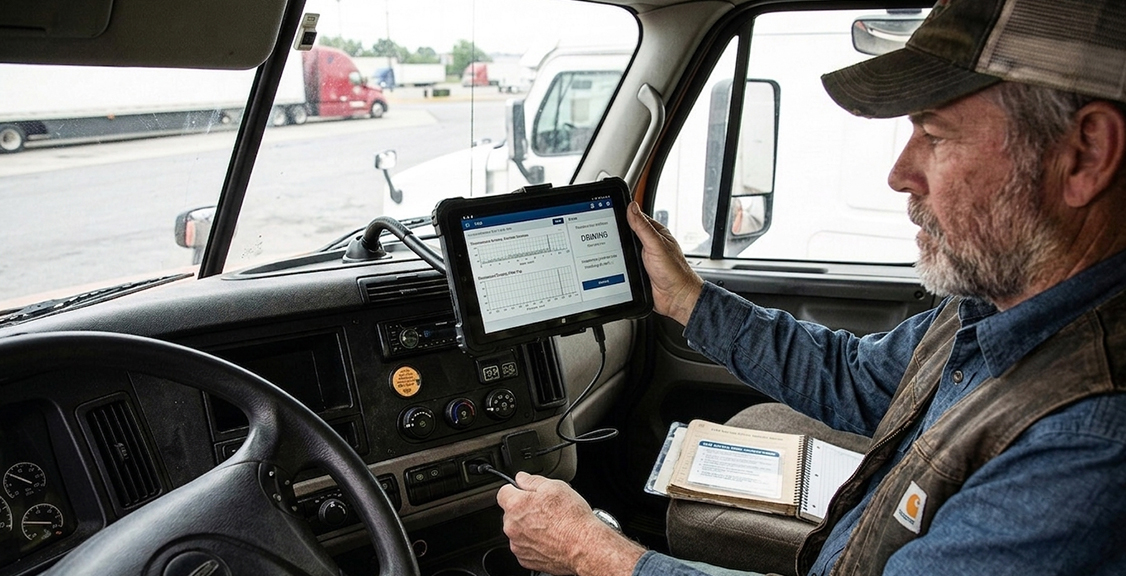
Switching from paper logs to an ELD is simpler than most drivers and back offices expect, once you choose a device built for real-world trucking conditions. The transition comes down to four steps: selecting a compliant device, connecting it to the truck, setting up driver profiles, and learning how to present logs at an inspection.
Confirming that the ELD you are considering is currently on the FMCSA-registered list before committing to any purchase or subscription is the first and most important step. A device that was registered when it was marketed to you may have since been revoked. Check the FMCSA-registered ELD list at the time of purchase and build a habit of rechecking every few months, since the list updates whenever a device is added, revoked, or reinstated. Once you have a confirmed registered device, installation connects the ELD to the truck’s diagnostic port. The connection type depends on the engine: heavy-duty trucks typically use J1939 or J1708, while lighter commercial vehicles connect through OBD-II. Our hardware supports all three connection types, which matters for fleets running mixed equipment with different engine generations.
After installation and driver profile setup, your drivers need a short walkthrough covering how to change duty status, how to review and certify logs at the end of the day, how to handle an unidentified driving event under 49 CFR 395.32(c), and how to initiate the ELD’s supported transfer option during an inspection. Under Appendix A, an ELD must support either the telematics option (web services and email) or the local option (USB 2.0 and Bluetooth), rather than every listed method. The in-vehicle materials required under 49 CFR 395.22(h) are data-transfer instructions, malfunction reporting and recordkeeping instructions, and enough blank graph-grid RODS for at least eight days. These materials should be in the truck before the first run on the new device. If you want a full breakdown of how ELD data recording, storage, and inspection transfers work, our guide on how an ELD records and transfers hours of service data covers the full process step by step.

What Should Your Drivers Carry in the Cab During a Paper Log Period?
During any legitimate paper log period, your driver needs specific documentation ready for an inspector at the roadside. Missing pieces can turn an otherwise legal paper log window into a citation regardless of whether the situation was genuinely permitted.
The driver must be able to produce the current day’s RODS and the required records for the previous seven consecutive days when those records are required. Depending on the situation, prior records may be manual records, records retrieved from the ELD, or copies carried in another permitted form. Manual RODS must use the § 395.8 graph grid and accurately record each duty status. If an ELD malfunction prevents retrieval of required records, the driver must reconstruct the current 24-hour period and previous seven consecutive days unless those records are already possessed or retrievable. Section 395.34 requires written notice to the carrier within 24 hours and requires the driver to provide the manually kept RODS during an inspection. Keeping a copy of the malfunction notice and any extension request in the cab can help explain the timeline, although the regulation specifically requires production of the RODS.
If paper records are being used under a revoked-device notice, the driver and carrier should know the exact transition deadline and follow the logging method allowed by that notice. Once the stated deadline passes, the notice no longer authorizes continued transition logging. The FMCSA ELD FAQ sets out exactly what inspectors are instructed to look for during malfunction and revocation transition periods, and it is worth reviewing before your drivers go out. Levels of inspector familiarity vary between locations, so a well-prepared driver who can clearly explain the situation and produce the right documentation is always in a stronger position than one who cannot.
How Does Paper Log Use Affect Carrier SMS and Driver Records?
Roadside inspection violations involving RODS or improper paper-log use may be assigned to the carrier’s Hours-of-Service Compliance BASIC in the FMCSA Safety Measurement System. SMS evaluates motor carriers; it does not assign individual drivers a federal CSA score. Carrier SMS measures use relevant roadside inspection and crash data from a rolling 24-month period. A driver’s Pre-Employment Screening Program report is different: it includes three years of inspection history and five years of reportable crash history without assigning a score or rating.
A pattern of HOS Compliance violations can contribute to FMCSA intervention prioritization. If FMCSA conducts a compliance review, the review may examine HOS records and broader safety-management controls, and it may result in a safety rating under Part 385.
Moving to a compliant ELD removes the entire category of violations that comes from improper paper log use. It does not eliminate all HOS violations, since drivers can still exceed their hours with an ELD, but it removes the layer of errors from manual entry mistakes, missing logbooks, and records that do not match fuel receipts or dispatch data. If your fleet has accumulated paper log violations and you want to see what your current compliance record shows, roadside inspection data and correction requests can be reviewed through the FMCSA DataQs system. Our article on how ELD violations stay on your record covers the scoring and review process in full detail.
Paper Logs vs. ELD: What Changes When You Switch
| Feature | Paper Logs | ELD |
|---|---|---|
| RODS entry method | Handwritten on graph grid by the driver | Driving status is recorded automatically from synchronized vehicle data; other duty statuses still require driver input |
| Risk of entry errors | Manual entries require careful calculation, completion, and certification | Automatic driving capture reduces manual entry, but drivers still review, edit when permitted, and certify records |
| Roadside inspection time | A safety official reviews the graph grid and supporting information | The driver uses the device’s supported telematics option (web services and email) or local option (USB 2.0 and Bluetooth), or displays/prints records as required |
| Falsification risk | Original entries, corrections, and certifications must be accurate and supportable | Original records and permitted edits are preserved under 49 CFR 395.30(f) |
| Back office visibility | Depends on how and when the driver submits records to the carrier | Depends on the ELD system, connectivity, and carrier workflow |
| Record storage | Physical logbooks retained by carrier for 6 months per 49 CFR 395.8(k) | Carrier retains ELD records for six months and maintains a separate backup copy |
| Penalty exposure | The same HOS and recordkeeping framework applies; exposure depends on the specific violation | The same HOS and recordkeeping framework applies; automation does not excuse inaccurate or uncertified records |
| Out-of-service risk at inspection | Missing, false, or unauthorized paper records may meet current out-of-service criteria | A malfunctioning, revoked, or noncompliant device may create violations or meet current out-of-service criteria |
Questions to Ask Before You Switch from Paper to ELD
Is the ELD currently on the FMCSA registered list?
Check the FMCSA-registered ELD list before agreeing to any purchase or subscription. A device that was registered when it was first marketed may have since been revoked. Verify the exact device name and model identifier, not just the provider name, and monitor FMCSA notices after purchase.
Does the ELD connect to every engine type in your fleet?
Your trucks may use different engine communication protocols depending on their age and manufacturer. J1939 is standard in most modern heavy-duty engines, J1708 is common in older equipment, and OBD-II is typical in lighter commercial vehicles. Confirm the device covers all connector types your operation uses before committing.
What support is available when a driver has a problem overnight?
ELD problems do not happen on schedule. A diagnostic event does not automatically mean the ELD has malfunctioned. If the device can no longer accurately record or present required HOS data, the driver and carrier should follow the malfunction procedures in § 395.34. Confirm that the provider offers 24-hour, 7-day phone support before signing anything.
What does data transfer look like during a roadside inspection?
Inspectors request HOS data using one of the approved transfer methods. Your driver needs to know how to initiate that transfer within the time the inspector allows. Ask the provider to walk your drivers through the process before their first inspection on the new device.
How does the ELD handle co-driver situations?
Fleets running team drivers need a device that correctly assigns driving time between drivers, supports duty status changes when a co-driver takes the wheel, and handles unidentified driving events under 49 CFR 395.32(c). Confirm how the device manages team operations before installing it.
Does the device come with a money-back guarantee?
A provider that stands behind their hardware will offer a trial period. A 30-day money-back guarantee gives you enough time to verify that the device works across your trucks and that your drivers can use it without problems before your commitment is locked in. Our ELD comes with that guarantee built in.
What is the provider’s history with FMCSA registration?
Ask the provider whether the exact device model has maintained continuous registration and how it responds to FMCSA notices. Verify the current model name and identifier on the FMCSA-registered ELD list rather than relying on the provider name alone.
Will the ELD handle both USA and Canadian HOS rules?
USA and Canadian HOS rules differ, and a device that covers only US regulations will create compliance gaps on cross-border routes. Confirm the device supports both rule sets before putting it in a truck that runs into Canada.
About ELD Rules and Paper Logs
How many days can a driver legally use paper logs in a 30-day period?
A driver who is required to keep RODS but is not required to do so for more than 8 days in any 30-day period may use paper logs under 49 CFR 395.8(a)(1)(ii)(A)(1). This is an exception to the ELD requirement based on the driver’s RODS frequency. It is not an 8-day allowance that every ELD-required driver can use, and it is separate from the malfunction procedures in § 395.34.
What must a driver do when an ELD malfunctions?
Under 49 CFR 395.34, the driver must note the malfunction and notify the carrier in writing within 24 hours. If required records for the current 24-hour period and previous 7 consecutive days are not already possessed or retrievable from the ELD, the driver must reconstruct them on paper graph grids. The driver must continue keeping paper RODS until the device is compliant again when the malfunction prevents accurate HOS recording.
Can the 8-day malfunction window be extended?
Yes. Under 49 CFR 395.34(d)(2), the carrier can request an extension from the FMCSA Division Administrator for the state where the principal place of business is located. The request must be filed within 5 days of the driver first notifying the carrier of the malfunction, must be signed by the carrier, and must describe the device, when and where the malfunction occurred, and what steps the carrier is taking. A carrier that submits a request meeting § 395.34(d)(2) is deemed compliant with the specified ELD requirements while FMCSA considers the request, provided the carrier and driver continue meeting the other malfunction requirements. FMCSA may grant additional time and impose conditions in its written determination.
Can improper paper log use affect a carrier’s SMS results?
Yes. HOS and recordkeeping violations documented during roadside inspections can contribute to a motor carrier’s Hours-of-Service Compliance BASIC in FMCSA’s Safety Measurement System. The effect depends on the violation, its severity weight, recency, and the carrier’s inspection history. Paper-log use itself is not a violation when an applicable exception or malfunction procedure is followed correctly.
What happens when an FMCSA revoked-device replacement deadline expires?
The carrier must follow the deadline and instructions in the notice for that exact device. If the device has not been replaced or otherwise resolved by the stated deadline, continued use of paper logs may no longer be authorized by that notice and may result in citations or an out-of-service condition under the criteria in effect at the time. Do not assume every revocation notice uses the same transition period.
Are drivers on paper logs subject to the same HOS limits as ELD drivers?
The logging method does not change the HOS rules that apply to the operation. Property-carrying drivers subject to 49 CFR 395.3, for example, must follow its driving, on-duty, break, and 60/70-hour limits whether they record duty status on paper or with an ELD. Different rules or exceptions may apply to other operations, so carriers should identify the provision that governs each driver.
Does an ELD malfunction excuse a driver from following HOS limits?
No. A device malfunction does not suspend any hours of service obligation. The driver must continue tracking and recording duty status on paper, and those records must show compliance with all applicable limits. If the driver’s hours are exceeded during a malfunction period, the violation stands. The FMCSA hours of service rules apply regardless of the logging method in use.
Choosing the Right ELD
How do you verify an ELD is currently on the FMCSA registered list?
Search for the device by name or provider on the FMCSA-registered ELD list, which is updated whenever a device is added, revoked, or reinstated. Do not rely on the provider’s word alone. Look the device up before you buy, and check again every few months. Match the exact device name and model identifier to the registered list, and review any FMCSA notice affecting that model.
What connection types does a compliant ELD need to support?
An ELD must connect to the vehicle’s engine through its diagnostic port to automatically record driving data. Heavy-duty trucks typically use J1939 or J1708, while lighter commercial vehicles use OBD-II. A device that does not support the correct connection type on your truck cannot legally record driving data automatically, which is a core technical requirement under the ELD technical standard Appendix A to Subpart B of Part 395.
What records must be available during an ELD malfunction?
The driver must make the current day’s RODS and the previous 7 consecutive days available for inspection. Under § 395.34, paper reconstruction is required only for records that are not already possessed or retrievable from the ELD. The driver must also keep recording duty status on paper while the malfunction prevents accurate electronic records. Retaining the written malfunction notice and any extension request is a practical way to document compliance, even though § 395.34 does not expressly require those documents to be carried in the cab.
Is there a minimum retention period for ELD and paper log records?
Yes. Both ELD records and paper logs used during a malfunction or exemption period must be retained for a minimum of six months per 49 CFR 395.8(k)(1). Keep records organised by driver and date in a format that allows fast retrieval during an audit or compliance review.
What is the difference between an ELD exemption and an ELD exception?
An exception is built directly into the ELD rule and applies automatically when the driver or vehicle meets the defined criteria, such as the 8-days-in-30 allowance or the pre-2000 engine situation. An exemption is a formal grant of temporary regulatory relief issued by FMCSA after a public comment period, limited to specific carriers and time periods under 49 CFR Part 381. If anyone tells you that your operation qualifies for an exemption, ask to see the published Federal Register notice that confirms it.
Can a tablet be used as an ELD?
Yes, provided the tablet runs ELD software meeting FMCSA technical standards and is listed on the FMCSA registered ELD list. The tablet must connect to the truck’s engine diagnostic port and record driving data automatically from the engine, not from manual input alone. Our guide on using a tablet for ELD compliance explains what specifications to look for and how tablet-based ELDs differ from phone apps. The Geosavi tablet is SAE J1455 certified, meaning it is tested for the temperature ranges, vibration levels, and power conditions found in commercial truck cabs.
What should a fleet manager do if a driver disputes a log entry recorded by the ELD?
Drivers and carriers can make edits and annotations to ELD records when a record does not accurately reflect what happened, following the rules in 49 CFR 395.30. Every edit must include an annotation explaining why the change was made, and the original record must be preserved under 49 CFR 395.30(f). Carriers cannot edit a driver’s record before the driver certifies it under 49 CFR 395.30(d). The FMCSA guidance on ELD editing and annotations walks through the full process for both drivers and carriers.
Making the Right Call Before Your Next Inspection
Knowing which paper-log situation applies to your operation, and which rule governs it, is essential to a compliant transition. Paper logs remain legitimate in specific circumstances, but the 8-days-in-30 exception, an ELD malfunction, and a revoked-device transition are separate paths with different conditions and deadlines.
CVSA’s 2026 International Roadcheck results show why accurate HOS records still matter: inspectors completed 54,575 commercial motor vehicle inspections, and 94.2% of drivers had no out-of-service violation. In the United States, 883 drivers were placed out of service for HOS violations. Carriers should monitor the FMCSA registered and revoked ELD lists, train drivers on malfunction procedures, and follow the exact instructions in any notice affecting their device.
Whether you are switching from paper for the first time, replacing a revoked device before a deadline, or verifying that your current setup still meets FMCSA standards, our compliance team is available around the clock at (800) 261-4361. Drivers and managers who want to review device options and run the numbers on a new setup can do that through our ELD pricing calculator before committing to anything.