Key Takeaways
- A driver can generally use paper logs instead of an ELD if they keep a record of duty status on 8 or fewer days within any 30-day period, under 49 CFR 395.8(a)(1)(iii).
- The 30-day period is a rolling window, not a fixed calendar month, which is where most fleets lose track of the count.
- Once a driver keeps duty status records on more than 8 days in that rolling window, federal rules generally require an ELD starting on day 9, under 49 CFR 395.8(a)(1)(iii).
- This exemption is different from the short-haul exemption, which is based on duty radius and return-to-location timing rather than a day count, under 49 CFR 395.1(e)(1).
- Paper logs used under this rule still have to meet standard recordkeeping requirements, including the retention period, under 49 CFR 395.8(k).
- Operating without a required ELD once the threshold is passed falls under the same citation used for missing records generally, 49 CFR 395.8(a)(1).
- Civil penalties tied to HOS recordkeeping violations are capped at a maximum amount that FMCSA adjusts annually for inflation, under 49 CFR Appendix B to Part 386.
- FMCSA’s own hours of service regulations are the source fleets should check whenever the current version of this rule needs confirming.
| Table of Contents |
|---|
| Rule Explained |
| Who It Applies To |
| Counting the Days |
| Hitting Day Eight |
| Comparing Exemptions |
| Recordkeeping Requirements |
| Exemption Comparison Table |
| Questions To Ask |
| FAQ |
Introduction
Most fleet managers know the ELD mandate applies to nearly every commercial driver, but far fewer know that federal rules carve out a narrow window where paper logs are still allowed. That window is built entirely around a single number: 8 days within any 30-day period. Get the count wrong in either direction and your fleet ends up either forcing an ELD on a driver who didn’t need one yet, or worse, running a driver on paper logs past the point where the law required an ELD.
The confusion usually comes from how the 30-day period actually works. It isn’t a calendar month that resets on the first, and it isn’t tied to a pay period or a dispatch schedule. It’s a rolling count that looks back over the previous 30 days from any given point, which means a driver’s status under this rule can change from one week to the next depending on how their duty days stack up. Fleets that track this manually, or not at all, are the ones most likely to get caught off guard during a roadside inspection.
Here’s what you’ll get from this guide: what the 8-in-30 rule actually says, who it’s built for, how the day count works in practice, and what happens the moment a driver crosses the threshold. It also lays out how this rule compares to other HOS exemptions your fleet might already be using, so there’s no confusion between the two.
If your team is trying to sort out whether a specific driver’s schedule falls inside or outside this exemption, it often helps to talk it through with someone who works with these rules daily rather than guess. We can walk through your schedule with you and help you figure out exactly where your drivers stand.
What Does the 8-in-30 Rule Actually Say?
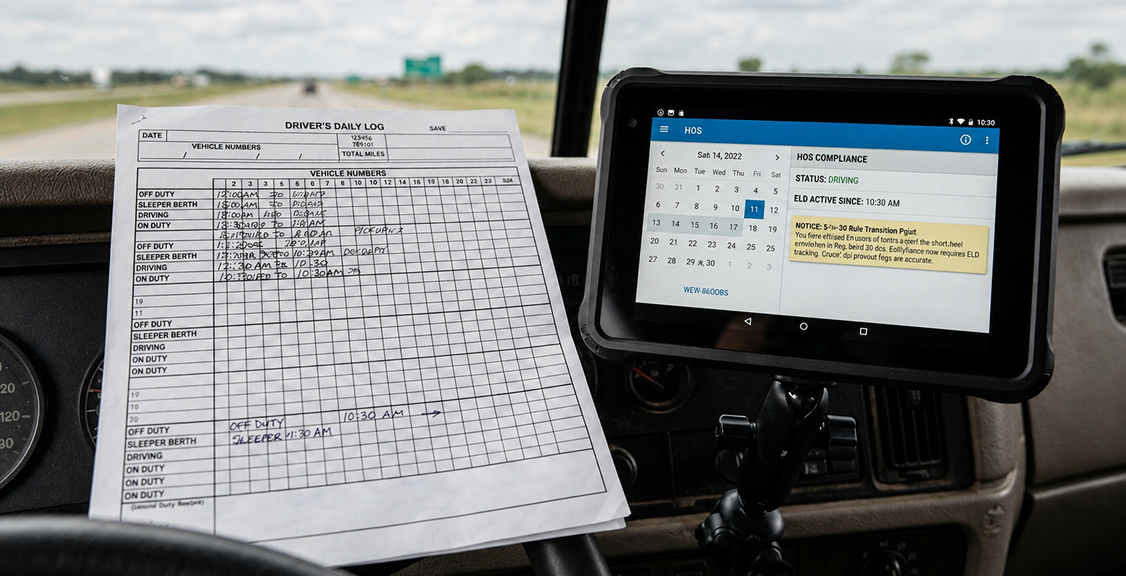
The 8-in-30 rule allows a driver to use paper records of duty status instead of an ELD, as long as they keep those records on 8 or fewer days within any 30-day period, under 49 CFR 395.8(a)(1)(iii), a provision that sits inside the broader 49 CFR Part 395 HOS rules governing hours of service overall. It exists because the ELD mandate was written with full-time, high-mileage drivers in mind, and FMCSA recognized that some drivers only occasionally need to keep a duty status record at all.
In practice, this covers drivers who mostly operate under an exemption, like the short-haul exemption, but occasionally step outside those conditions and have to log a day. Rather than requiring an ELD installed and certified for a driver who might need it a handful of days a month, the rule lets that driver fall back on paper for those occasional days. The moment the pattern changes and a driver starts logging more regularly, the exemption stops applying and the ELD requirement takes over.
Who Does the 8-in-30 Rule Apply To?
This exemption generally applies to drivers who don’t need to keep a record of duty status on most days, most commonly local or short-haul drivers who occasionally exceed their usual exemption conditions. It’s not meant for a driver who logs regularly and just wants to avoid buying an ELD.
A common example is a driver who typically qualifies for the short-haul exemption under 49 CFR 395.1(e)(1) because they stay within a set duty radius and return to the same location each day. If that driver has a week where they run outside that radius or work past the usual duty window, they have to complete a paper log for that day. As long as those logged days stay at 8 or fewer within the rolling 30-day period, the driver can keep using paper for them. If a driver’s schedule regularly puts them over the local exemption threshold, they’re likely not a fit for the 8-in-30 rule at all, and the fleet should plan for an ELD rather than treating paper logs as a long-term workaround. Fleets running mostly local routes often find it easier to sort this out by reading through our guide on ELD requirements for local trucking alongside this one, since the two exemptions frequently apply to the same drivers.
How Do You Count the 8 Days in a 30-Day Period?
The count is a rolling 30-day window, meaning you look back from today across the last 30 days, not from the start of a calendar month. Every day the driver keeps a record of duty status counts toward the total, and the oldest day drops off the count as a new day is added.
This is the part that catches fleets off guard most often. A driver might log 4 days in the first half of a month and 4 more in the second half, staying under the limit for that calendar month, but the rolling window can still push them over 8 within a 30-day span that crosses two calendar months. Tracking this by hand across a driver roster gets difficult fast, which is why fleets that rely on this exemption tend to build a simple day-count tracker rather than trying to remember it. A spreadsheet with a running 30-day total per driver, updated every time a log is filed, tends to catch the threshold before it becomes a problem.
What Happens Once a Driver Hits Day 8?
Once a driver keeps a record of duty status on more than 8 days within any 30-day period, the exemption no longer applies and the driver generally needs an ELD starting on day 9, under 49 CFR. This isn’t a grace period rule the way some ELD malfunction or removal situations work. The requirement applies as soon as the ninth logged day happens.
Continuing to run that driver on paper logs past that point puts the fleet at risk of a citation for not having a required ELD, treated under the same general no-record citation, 49 CFR 395.8(a)(1). The safest approach is to install and activate an ELD before a driver is likely to cross the threshold, rather than waiting until day 9 actually happens. Fleets that track the rolling count closely tend to see this coming a week or two out, which gives enough time to look at our ELD platform and hardware and get a device set up without a driver ending up out of compliance mid-shift.
How Is the 8-in-30 Rule Different from Other ELD Exemptions?
The 8-in-30 rule is based purely on a day count, while most other HOS exemptions are based on duty radius, vehicle type, or the kind of work being done. That difference matters because a driver can lose the 8-in-30 exemption without losing eligibility for a different one, or the other way around.
The short-haul exemptions under 49 CFR 395.1(e)(1) and 49 CFR 395.1(e)(2), for example, depend on staying within a set air-mile radius and returning to the same reporting location within a set duty window, and the exact conditions are laid out in the short-haul exemption regulation itself if your team wants to read the full text. The agricultural exemption under 49 CFR 395.1(k) and the utility service vehicle exemption under 49 CFR 395.1(n) depend on the type of work being performed during a defined season or service window, not on how many days a driver logs. Because these rules work on different logic, a driver can move between them depending on what they’re doing week to week, which is exactly why fleets need a clear picture of which exemption applies to which driver at any given time.
What Records Do You Need to Keep While Using Paper Logs Under This Rule?
Paper logs filed under the 8-in-30 rule still have to meet the same general recordkeeping standard as any other duty status record, including supporting documentation and retention, under 49 CFR 395.8(k). The exemption changes the method of logging, not the underlying obligation to keep accurate records.
That means the fleet still needs to retain those paper logs and any supporting documents for the required 6-month period, under 49 CFR 395.8(k)(1). A driver operating under this exemption should also understand that a paper log filed incorrectly or left incomplete carries the same citation risk as a bad ELD record would. Treating the paper days as a lower-stakes formality is one of the more common mistakes fleets make with this exemption, and it’s usually the reason a routine inspection turns into a longer conversation with an officer. Our FAQ covers a number of these day-to-day recordkeeping questions if your team runs into a situation this article doesn’t cover directly.
How Does the 8-in-30 Rule Compare to Other HOS Exemptions?
| Exemption | Basis for Exemption | Logging Method Allowed | Regulation | Who Typically Qualifies | Key Limit |
|---|---|---|---|---|---|
| 8-in-30 Rule | Days logged within a rolling 30-day window | Paper logs, up to the threshold | 49 CFR 395.8(a)(1)(iii) | Drivers who rarely need to log a duty status | 8 days or fewer in any 30-day period |
| Short-Haul Exemption (CDL) | Duty radius and same-day return | No duty status record required if conditions are met | 49 CFR 395.1(e)(1) | Local CDL drivers returning to the same location daily | 150 air-mile radius, set duty window |
| Short-Haul Exemption (Non-CDL) | Same concept, applied to non-CDL drivers | No duty status record required if conditions are met | 49 CFR 395.1(e)(2) | Non-CDL drivers operating locally | 150 air-mile radius, shorter duty window |
| Agricultural Exemption | Transporting agricultural commodities during defined periods | HOS requirements generally suspended during the qualifying period | 49 CFR 395.1(k) | Drivers hauling agricultural products during planting or harvest | Applies only during the state-defined season |
| Utility Service Vehicle Exemption | Operating a utility service vehicle during qualifying work | HOS requirements generally suspended during the qualifying service | 49 CFR 395.1(n) | Drivers responding to utility service needs | Applies only during the qualifying service window |
| Pre-2000 Engine Exemption | Engine model year | ELD not required, paper logs used regardless of day count | 49 CFR 395.8(a)(1)(iii) | Vehicles with an engine older than model year 2000 | No day-count limit, based on engine age instead |
What Should You Ask Before Deciding If the 8-in-30 Rule Fits Your Fleet?
How many days has this driver actually logged in the last 30 days?
Pull the actual count rather than estimating from memory. A driver who feels like they barely log can still be closer to the threshold than expected once the rolling window is checked against real records.
Are we counting the days on a rolling basis, not a fixed calendar month?
Confirm the tracking method your team uses actually reflects a true 30-day rolling window. A calendar-month tracker will eventually miss a driver who crosses the line between two months.
What happens if a driver’s schedule changes mid-month?
Think through how a route change, a new client, or a temporary reassignment might push a driver past their usual duty conditions. A single unplanned week can be enough to trigger extra logged days.
Do our paper logs meet the same recordkeeping standard an ELD would?
Paper logs filed under this exemption still need to be complete, accurate, and retained for the required period. Review whether your current paper process actually holds up to that standard.
Is this driver a better fit for a different exemption entirely?
Some drivers logging occasional days under the 8-in-30 rule might actually qualify more consistently under the short-haul exemption instead. It’s worth checking whether a schedule adjustment would remove the need to log at all.
Who on our team owns tracking each driver’s day count?
Assign this to a specific person or role rather than leaving it as a shared assumption. Rules that depend on an ongoing count tend to slip through the cracks without a clear owner.
What’s the plan for the day a driver crosses into ELD territory?
Decide ahead of time how quickly your fleet can get an ELD installed and activated once a driver approaches day 8, so there’s no gap between the exemption ending and the device being ready.
Are we storing these paper logs long enough?
Confirm your retention process covers the full 6-month period required for duty status records, not just until the driver’s next review.
Common Questions About the 8-in-30 Rule
About Hours of Service and the 8-in-30 Rule
What is the 8-in-30 rule in simple terms?
It’s the federal rule that lets a driver use paper logs instead of an ELD as long as they only need to keep a duty status record on 8 or fewer days within any rolling 30-day period, under 49 CFR 395.8(a)(1)(iii).
Does the 8-in-30 rule replace the ELD mandate?
No. It’s a narrow exception inside the mandate for drivers who rarely need to log at all, not a general alternative to using an ELD.
How is the 30-day period counted?
It’s a rolling window that looks back 30 days from any given date, not a fixed calendar month.
Does the rule apply the same way to interstate and intrastate drivers?
The underlying day-count logic is the same, though intrastate operations can carry their own state-level rules on top of the federal requirement, so it’s worth checking state guidance alongside 49 CFR 395.8(a)(1)(iii).
Can a driver go back to paper logs after using an ELD?
Generally, once a driver’s logging pattern regularly exceeds 8 days in a 30-day period, the fleet should treat that driver as needing an ELD going forward rather than switching back and forth.
What counts as a day under this rule?
Any calendar day on which the driver is required to complete a record of duty status counts toward the total, regardless of how many hours were logged that day.
About Applying the Rule to Your Fleet
How do we know if a driver qualifies for this exemption?
Check the driver’s actual logging history against a rolling 30-day count. If they’ve kept a duty status record on 8 or fewer of the last 30 days, they generally still qualify under 49 CFR 395.8(a)(1)(iii).
What records do we need to keep if we’re using paper logs under this rule?
The same standard applies as with any duty status record: accurate, complete logs retained for the required period, including supporting documentation under 49 CFR 395.8(k).
What happens if we get it wrong and a driver should have had an ELD?
The fleet risks a citation tied to missing or non-compliant records under 49 CFR 395.8(a)(1), so it’s worth correcting course as soon as the day count is caught rather than waiting for an inspection to reveal it.
Can this exemption be combined with other exemptions?
A driver can move between exemptions depending on the work being performed, but each exemption has its own conditions and the fleet needs to track which one applies on which day.
Does the 8-in-30 rule apply to owner-operators the same way?
Yes, the day-count logic applies the same way regardless of whether the driver is an employee or an owner-operator, since the rule is tied to the vehicle and the duty status record, not the employment arrangement.
Where can we go to confirm the current version of this rule?
FMCSA’s own hours of service regulations are the source to check whenever there’s doubt about how the current rule reads.
Staying Ahead of the 8-in-30 Rule in 2026
The 8-in-30 rule sounds simple on paper, but the rolling day count is exactly the kind of detail that slips past a fleet until a roadside inspection brings it up. Knowing the difference between this exemption and the others your drivers might qualify for, and tracking the count consistently instead of relying on memory, is what keeps a fleet from accidentally running a driver on paper logs past the point where the law required an ELD.
Enforcement in 2026 continues to focus heavily on log integrity and accurate recordkeeping, which means a fleet that gets caught with a driver over the 8-day threshold and no ELD in place is dealing with more than a paperwork issue. Building a simple tracking habit now, before a driver’s schedule changes unexpectedly, is far easier than sorting it out during an inspection.
If your fleet wants an easier way to see which drivers are approaching the threshold and plan ahead for the switch to an ELD, our price calculator is a useful place to start, or you can call our team at (800) 261-4361 to talk through your specific driver roster.