Key Takeaways
- FMCSA requires supporting documents to be retained for six months under 49 CFR 395.8(k)(1), but does not set a required review frequency for compliance records.
- FMCSA’s Safety Measurement System tracks HOS violations as part of a carrier’s ongoing compliance record, and that record follows the carrier over time, not just a single driver on a single trip.
- FMCSA closed 606 carrier enforcement cases nationally in the most recent FY 2026 reporting period, totaling more than $4.2 million in settled penalties across all those cases combined, according to FMCSA’s Analysis and Information system.
- Individual HOS violations carry their own maximum civil penalties, separate from the aggregate figure above, and those maximums adjust annually for inflation under the FMCSA penalty schedule.
- The DVIR requirement under 49 CFR 396.11 is one of the recurring records a review schedule should include, not just HOS logs.
- Driver qualification file review, including license and medical certificate tracking, falls under 49 CFR Part 391, and gaps here are one of the more common findings during a DOT audit.
- Recently, CVSA’s Roadcheck focus area has repeatedly centered on ELD tampering and log integrity in recent inspection cycles, which is one reason a consistent internal review schedule matters.
- Carriers can formally dispute inspection or citation data through the FMCSA DataQs system, which is a useful path when a review turns up a record that looks wrong rather than a genuine violation.
Introduction
Compliance records do not cause problems by sitting untouched. The problem shows up when nobody looks at them until an inspection, an audit notice, or a citation forces the issue, and by then it is too late to catch anything before it becomes a violation on your carrier record. This pattern shows up most often in fleets that treat their ELD system as something that runs itself once it is installed, when in practice the data it produces still needs a human eye on it at set intervals.
FMCSA sets clear boundaries for hours of service under 49 CFR Part 395 HOS rules and clear retention rules for supporting records, but nothing in the regulation tells you how often to actually check whether those boundaries are being respected day to day. That silence is not an oversight. FMCSA regulates outcomes and recordkeeping, not internal management process, which means the review schedule itself is entirely up to you to build and maintain. The stakes behind that silence are real. FMCSA closed 606 carrier enforcement cases nationally in the most recent FY 2026 reporting period alone, and that steady pace of enforcement is exactly why a consistent review habit matters more than most fleets initially assume.
Here is how to build a driver compliance record review schedule that actually holds up: what needs daily attention, what can wait for a weekly or monthly pass, and what only needs checking quarterly or during audit prep. We will also cover how fleet size changes the right review pace, walk through a fleet-size comparison table, and cover the questions worth asking before you lock in a schedule for your own operation. Whether you run one truck or fifty, the underlying logic is the same: catch small issues on a short cycle, and reserve the deeper structural checks for a longer one.
You can reach our team or call (800) 261-4361 any time to sort out what your current setup already tracks automatically versus what still depends on manual follow-up, which gives you a clearer starting point than building a schedule from nothing.
Why Does Review Frequency Matter For Compliance?
Review frequency matters because most compliance failures are not sudden, they build up between checks. A missed log edit, an expired medical certificate, or a DVIR nobody followed up on tends to compound the longer it goes unnoticed, and a gap that would have taken five minutes to fix during a weekly review can turn into a formal citation if it sits long enough to surface at a roadside inspection instead.
FMCSA’s Safety Measurement System tracks hours of service violations as part of your fleet’s ongoing compliance picture, and that record follows your carrier over time rather than resetting with each new trip or each new driver. A single missed check might not move that record much. A pattern of missed checks, repeated across months because nobody had a set schedule for catching them, is what actually drags a carrier’s compliance profile down over time.
The six-month retention requirement under 49 CFR 395.8(k)(1) is often misread as a review schedule, when it is actually just how long records need to exist, not how often someone needs to look at them. Mixing up those two things is exactly how fleets end up with records that are technically retained but never actually reviewed until something forces the issue, usually an audit notice, a roadside citation, or a driver complaint that could have been caught weeks earlier with a routine check already in place.
What Should A Fleet Manager Check Daily?
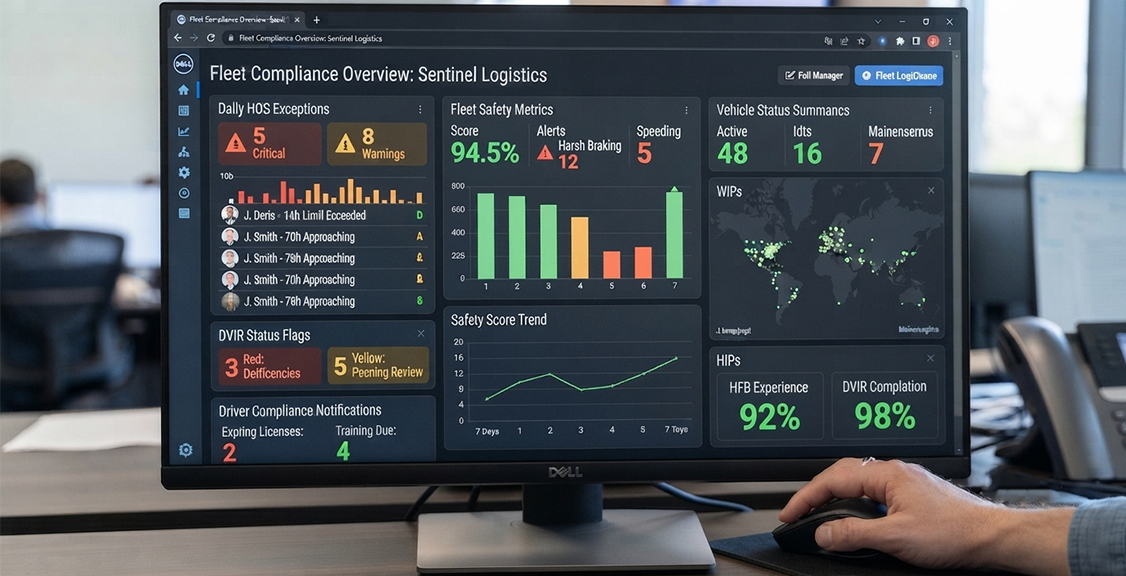
Daily review should focus on active hours of service status, since a driver approaching a limit today needs to be caught today, not during next week’s review.
This depends heavily on whether your ELD platform and hardware generates exception alerts automatically rather than requiring you to dig through raw logs by hand. A daily pass should include checking alerts for drivers close to the weekly limit under 49 CFR 395.3(b) or repeatedly triggering the 8-in-30 rule under 49 CFR 395.8(a)(1)(ii), confirming DVIR defects flagged the previous day under 49 CFR 396.11 have actually been resolved rather than just acknowledged, and reviewing any ELD malfunction or connectivity alerts that came in overnight.
If an alert points to a malfunction rather than a driver behavior issue, that is usually a fast call to support rather than something to diagnose on your own, since malfunction classification affects what fallback logging method your driver needs to use in the meantime. None of this daily pass needs to take long once it becomes routine, typically ten to fifteen minutes once you know what to look for, but skipping it even for a few days is usually where problems start compounding into something larger.
What Should A Fleet Manager Check Weekly?
A weekly pass looks for patterns across several days that a single-day check would miss entirely, including HOS exception trends by driver, whether DVIR defects from earlier in the week were actually repaired and closed out rather than left pending, and edited or annotated logs that need a second look under the recordkeeping standards in 49 CFR 395.30.
A connected ELD and DVIR integration system helps significantly here, since maintenance records that live separately from HOS logs are the ones most likely to get missed when you are reviewing compliance data in isolation from vehicle condition data. Weekly review is also a reasonable point to spot-check whether drivers running mixed routes are logged correctly, since routing changes mid-week are a common source of log errors that daily checks tend to miss because they only capture a single day’s snapshot.
Fleets running a mix of long-haul and local routes, a pattern covered in more detail in our local drivers ELD guide, often find this is exactly where those log errors first show up, since the rules that apply to a driver can shift mid-week depending on which type of route they are running that day.
What Should A Fleet Manager Check Monthly?
A monthly review shifts from individual incidents to fleet-wide compliance trends, since this is the timeframe where slow-building issues actually become visible in a way daily and weekly snapshots cannot capture on their own. A single missed log edit does not tell you much about the fleet as a whole. The same driver needing edits every single month tells you something worth investigating directly.
This monthly pass should include reviewing overall HOS violation counts against the prior month to spot whether your fleet’s compliance trend is improving or slipping, checking driver qualification file status under 49 CFR Part 391, including license and medical certificate tracking, for anything expiring in the next 60 to 90 days so there is enough lead time to renew before a lapse occurs, and confirming supporting documents are being retained correctly for the six-month window required under 49 CFR 395.8(k)(1). It is also a reasonable point in the cycle to check whether any DataQs disputes filed earlier in the month have actually been resolved, rather than assuming a filed dispute is a closed one.
What Should Be Reviewed Quarterly Or Annually?
A quarterly or annual review shifts the focus almost entirely to audit readiness, since this is the pass that determines whether your records would actually hold up if a DOT audit notice arrived tomorrow rather than months from now. Safety fitness determinations and the formal audit process follow FMCSA safety fitness procedures, and that process consistently rewards fleets whose records were organized well before the notice showed up, not fleets scrambling to reconstruct six months of history after the fact.
This quarterly pass should confirm that all supporting documents are complete and correctly filed, that driver qualification files under 49 CFR Part 391 have no gaps going back a full year rather than just the most recent quarter, and that any past DataQs disputes or citations are fully documented with their eventual outcomes on record. Once a year is also a reasonable point to step back and reassess whether your current review schedule is actually catching what it is supposed to catch, or whether gaps are still slipping through despite a process technically being in place on paper.

How Should Review Frequency Change By Fleet Size?
Fleet size changes how much you can realistically review personally versus what genuinely needs a dedicated system or a person assigned specifically to the task. The table below is a starting point based on typical operational patterns, not a fixed rule that applies identically to every fleet regardless of route complexity.
| Fleet Size | HOS Exception Review | Driver File Review | Full Audit-Readiness Pass |
|---|---|---|---|
| 1 to 5 trucks | Daily, self-managed | Monthly | Quarterly |
| 6 to 15 trucks | Daily, weekly summary | Monthly | Quarterly |
| 16 to 30 trucks | Daily, dedicated time | Every 2 weeks | Quarterly |
| 31 to 50 trucks | Daily, often delegated | Weekly | Quarterly or by audit cycle |
| 50+ trucks | Daily, dedicated role | Weekly | Ongoing, reviewed monthly |
| Any size, managed service | Continuous, by provider | Continuous, by provider | Provider-assisted |
A five-truck fleet running complex mixed routes may genuinely need more frequent driver file checks than a fifteen-truck fleet running the same simple route every single day, so treat fleet size as one input among several rather than the only factor that decides the right pace.
What Should You Ask Before Building A Review Schedule?
Who is actually responsible for each type of review, and is that written down anywhere?
A schedule only works if one person is not quietly assuming someone else is handling it. Confirm ownership for daily HOS checks, weekly patterns, and monthly file reviews separately, since these tasks often fall to different people even inside a small fleet.
How much of this can be automated versus how much genuinely needs a person looking at it?
Exception alerts can be automated fairly easily. Deciding whether a pattern is a real problem worth acting on, or a one-off that does not need attention, usually still needs a person applying judgment. Map out which parts of your schedule are actually automatable before assuming a single tool solves the entire task.
What happens if a review gets skipped for a week?
Build in a way to catch up rather than letting a missed week quietly turn into a missed month. A schedule with no recovery plan for a skipped review tends to stop happening altogether once the first gap opens up.
Are driver qualification file expirations tracked separately from HOS monitoring?
These are two different systems in most operations, and they often get reviewed on entirely different schedules by different people. Confirm both are actually covered rather than assuming one system quietly tracks everything.
How would this schedule hold up if an audit notice arrived tomorrow?
Walk through what a reviewer would find right now, not what the schedule is theoretically supposed to produce eventually. Gaps tend to show up fastest when you test the schedule against a real audit scenario instead of just trusting the process because it exists on paper.
Does the review schedule account for seasonal or route changes?
A schedule built around one type of route may not catch issues that only show up when drivers shift to different routes seasonally. Check whether your review pace actually adjusts when operations change, rather than staying fixed year-round regardless of what is happening on the road.
Is there a record of what was reviewed and when?
A review that happens but is not documented is hard to prove happened at all during an audit. Confirm your process leaves an actual trail, not just a completed task nobody wrote down.
Common Questions
About Compliance Review and Road Safety
Does FMCSA require a specific review frequency for compliance records?
No. FMCSA requires records to be retained for specific periods, such as six months for supporting documents under 49 CFR 395.8(k)(1), but the review frequency itself is left entirely to your own operational judgment rather than being set by regulation.
How often do HOS violations actually get caught between reviews rather than at roadside?
This depends heavily on how consistently exception monitoring runs across your fleet. A fleet reviewing exceptions daily catches far more issues internally, before they ever reach a roadside inspection, than one relying only on periodic manual checks, though FMCSA does not publish a specific figure comparing the two approaches directly.
Does reviewing records more often reduce the risk of a roadside violation?
Consistent review can reduce the risk of a driver crossing a limit unnoticed, since it catches patterns before they turn into an issue at a scale house rather than after. It does not eliminate the risk entirely, since a driver can still make an in-the-moment decision that a review schedule cannot prevent no matter how frequent it is. For more on how consistent ELD use ties into fewer roadside incidents overall, see our piece on how ELDs promote safer roads.
How does CVSA’s Roadcheck program relate to compliance record review?
CVSA’s Roadcheck inspection program has repeatedly focused on ELD tampering and log integrity in recent cycles, which is exactly the kind of issue a consistent internal review schedule is designed to catch before it ever reaches a roadside inspection.
Can a review schedule catch falsified logs before an officer does?
A thorough review can flag patterns that suggest falsification, such as edits that do not match engine or GPS data, though it cannot always independently confirm intent on its own. Falsification carries its own separate citation risk under 49 CFR 395.8(e)(1), distinct from a standard HOS violation.
About Setting Up an Effective Review Process
Should a one-truck owner-operator follow the same review schedule as a larger fleet?
The core daily HOS check applies at any fleet size and does not scale down just because there is only one truck. What changes with fleet size, as shown in the comparison table above, is mainly how file review and task delegation get handled, since a solo operator naturally reviews their own records directly rather than assigning that task to someone else.
What is the difference between reviewing records and just storing them?
Storing records satisfies the retention requirement on its own. Reviewing them is what actually catches a problem before it becomes a citation. A fleet can be fully compliant on retention and still miss real issues if nobody is genuinely looking at what is being stored.
How far back should a quarterly review look?
A quarterly pass should generally cover the full quarter under review, with particular attention paid to any patterns that repeat across multiple months rather than treating each incident as isolated.
Does a managed compliance service replace the need for an internal review schedule?
Not entirely. A managed service can handle continuous monitoring on your behalf, but you still remain accountable for compliance under federal law regardless of who is actually watching the dashboard day to day, so some level of internal awareness is still worth maintaining even with a provider in place.
What should happen if a monthly review finds a driver qualification file has already expired?
Treat this as an immediate priority rather than folding it into the next scheduled review cycle. An expired certificate or license discovered late is a compliance issue that continues accumulating risk with every day it sits unresolved.
How do I know if my current review process actually works?
Test it against a real scenario, such as pulling a specific driver’s records right now and checking whether every required document would genuinely be ready if requested today. If a review schedule cannot produce that quickly, the schedule needs adjusting even if it looks complete on paper.
Conclusion
There is no FMCSA-mandated schedule telling you exactly how often to review driver compliance records, and that absence is often mistaken for permission to review infrequently. In practice, the six-month retention rule and the audit process it supports both assume records are being actively watched, not simply stored until someone asks for them. A fleet that treats daily, weekly, monthly, and quarterly review as separate, deliberate habits catches problems while they are still small and easy to fix, rather than discovering all of them at once during an inspection.
CVSA’s Roadcheck program has repeatedly turned its attention to log integrity, and FMCSA’s own enforcement data shows steady activity year over year, with hundreds of carrier cases closed nationally in FY 2026 alone. Fleets that treat compliance review as routine rather than reactive are consistently the ones least likely to be caught off guard by an audit notice or a roadside inspection. Building that habit does not require a large team or a complicated system, it requires a schedule that actually gets followed week after week rather than one that looks good in a policy document but rarely gets used.
If your current process feels more reactive than scheduled, you can reach out to our team or give us a call at (800) 261-4361 to talk through a realistic review schedule for your fleet.