Key Takeaways
- The ELD mandate is a federal hours-of-service rule written by FMCSA under 49 CFR Part 395 HOS rules. CARB Clean Truck Check is a California state emissions program administered by the California Air Resources Board. Different agencies, different legal authority, no shared exemptions.
- Federal ELD exceptions address electronic records; some related short-haul, agricultural, and utility provisions also affect hours-of-service rules or recordkeeping. None creates an exemption from California emissions rules. See FMCSA’s ELD guidance.
- According to CARB, Clean Truck Check applies to nearly all diesel, alternative-fuel, and hybrid heavy-duty vehicles with a manufacturer’s gross vehicle weight rating (GVWR) over 14,000 pounds that operate on California public roads and highways. CARB determines applicability based on the vehicle’s specifications and where it operates, with no reference to the driver’s ELD category.
- Covered vehicles generally must be reported in the Clean Truck Check Vehicle Inspection System (CTC-VIS), pay the annual compliance fee, submit required passing emissions tests, and clear outstanding enforcement violations. ELD status does not change these CARB requirements.
- A qualifying vehicle does not need to be registered in California for CARB’s program to apply. CARB reiterated in March 2026 that out-of-state vehicles operating on California roads remain subject to reporting, compliance, and testing requirements.
- Local and vocational fleets should assess each vehicle separately: a driver may qualify for an ELD exception while the vehicle still meets CARB’s fuel, weight, and California-operation criteria.
- Most covered vehicles currently test twice yearly; qualifying agricultural vehicles and California-registered noncommercial motorhomes test annually. Beginning October 1, 2027, most OBD-equipped vehicles are scheduled to test four times yearly. This change is unrelated to ELD status.
- CARB lists Pacific Track’s PT40 and PT40-Q as certified continuously connected OBD devices. Whether a Geosavi-provided setup can submit tests for a particular truck depends on vehicle compatibility, enabled service, connectivity, and a valid CARB test result; a device alone does not establish compliance.
| Table of Contents |
|---|
| Two Separate Programs |
| ELD Exemptions Defined |
| CARB Obligation Explained |
| Vocational Fleets Affected |
| Out-of-State Operators |
| Side-by-Side Comparison |
| Questions Before Deciding |
| FAQs |
Introduction
An ELD exception does not decide whether a truck must meet California’s Clean Truck Check requirements. FMCSA’s federal ELD rule concerns electronic records of duty status, while CARB’s state program concerns heavy-duty vehicle emissions. The programs use separate eligibility criteria, so check each one independently.
A driver who does not need an ELD may still have hours-of-service or carrier time-record duties. Likewise, an ELD-exempt truck can still require CARB registration, an annual fee, and emissions testing if it meets Clean Truck Check criteria.
This guide compares common federal ELD exceptions with CARB’s vehicle rules. For a fuller vehicle-by-vehicle overview, see our guide to vehicles covered by Clean Truck Check; current CARB guidance controls where program details change.
If your fleet includes vehicles that may fall within CARB’s program and you are not certain where you stand, the answer typically becomes clear once you apply the right criteria: fuel type, manufacturer’s GVWR, and whether the vehicle operates on California roads. Those criteria have no connection to your driver’s log book status or daily haul radius. To explore what applies to your fleet, check our price calculator or call us at (800) 261-4361.
Are ELD Requirements and CARB Clean Truck Check the Same Program?
No. They are entirely separate programs, created by different agencies under different legal authority. Qualifying for an exemption in one program has no effect on your position under the other.
FMCSA generally requires an ELD when a driver must keep records of duty status (RODS), unless an ELD exception applies. The FMCSA ELD guidance identifies exceptions, including qualifying short-haul drivers, drivers who use RODS no more than eight days in a 30-day period, certain driveaway-towaway operations, and pre-2000 vehicles. An ELD exception does not necessarily remove applicable driving limits or other recordkeeping duties.
Under CARB’s Clean Truck Check FAQ, nearly all non-gasoline heavy-duty vehicles with a manufacturer’s GVWR over 14,000 pounds that operate on California public roads are covered, including qualifying diesel, alternative-fuel, and hybrid vehicles registered outside California. Gasoline-only vehicles are outside this non-gasoline program. CARB lists specific exclusions, including zero-emission vehicles, certain emergency and military tactical vehicles, and qualifying out-of-state motorhomes; assess any claimed exclusion under CARB’s own terms.
FMCSA’s ELD determination does not decide CARB applicability. A fleet may meet its federal driver-record requirements yet still owe California vehicle reporting, fees, and testing.
Which ELD Exemptions Do Operators Most Commonly Rely On?
The following examples explain why a driver may not need an ELD. The conditions differ, and a local route or vehicle label alone does not establish an exception.
CDL short-haul exception: Under 49 CFR § 395.1(e)(1), a qualifying driver operates within a 150 air-mile radius of the normal work reporting location, returns there, and is released within 14 consecutive hours, among other conditions; the motor carrier keeps required time records. Such a driver generally need not keep RODS or use an ELD. Our local-driver ELD guide provides more context. The radius is not a CARB exclusion.
Non-CDL short-haul exception: 49 CFR § 395.1(e)(2) has its own conditions for drivers of vehicles that do not require a CDL, including a 150 air-mile operating radius, return to the normal work reporting location, and carrier time records. Its duty-period provisions differ from the CDL short-haul exception; do not assume the two are identical. CARB coverage depends on the vehicle, not the driver’s license.
Pre-2000 vehicle or engine exception: Under FMCSA’s October 2026 guidance on 49 CFR § 395.8(a)(1)(ii)(A)(4), a pre-2000 model year based on the VIN, or a pre-2000 engine installed in a later vehicle, can qualify for the ELD exception. Carriers should retain documentation of engine changes. This is not a CARB exclusion, and other applicable HOS records may still be required.
Agricultural operations: FMCSA explains that the seasonal agricultural-commodity exception in 49 CFR § 395.1(k) applies only within its specified conditions, including the 150 air-mile area from the source. It is an HOS exception for qualifying operations, not a blanket ELD exception for every agricultural truck. CARB separately defines which agricultural vehicles receive annual emissions testing.
Utility service vehicles: The HOS exception in 49 CFR § 395.1(n) applies to vehicles meeting the federal utility service vehicle definition and conditions, not all trucks owned by a utility or telecom company. It does not change CARB’s emissions criteria.
Does an ELD Exemption Remove a Fleet’s CARB Clean Truck Check Obligation?
No. A federal ELD or HOS exception does not itself exempt a vehicle from CARB Clean Truck Check. Check CARB’s separate vehicle criteria and exclusions.
For example, a short-haul driver’s reporting location, radius, and duty period determine whether the federal short-haul exception applies. CARB instead evaluates the truck’s fuel type, manufacturer’s GVWR, California operation, and any CARB-specific exclusion. An older engine can affect ELD use without taking a heavy diesel truck outside Clean Truck Check.
Consider a diesel concrete mixer with a manufacturer’s GVWR over 14,000 pounds operating in San Bernardino. Its driver may qualify for the federal short-haul exception if all route, return, duty-period, and time-record conditions are met. The truck can still require CTC-VIS reporting, an annual fee, and passing emissions tests.
These are separate determinations. A federal exception is not a substitute for checking CARB’s current vehicle requirements.
Which Vocational Fleets Are Most Likely to Be Affected?
Local vocational fleets can have drivers who qualify for an ELD exception and trucks that remain subject to Clean Truck Check. Neither status follows automatically from the vehicle’s job or route.
Dump trucks: A diesel dump truck over 14,000 pounds manufacturer GVWR operating on California roads generally meets CARB’s basic vehicle criteria unless a specific exclusion applies. Its driver qualifies for a short-haul ELD exception only if the federal conditions are met.
Concrete and cement mixer trucks: Local work alone does not establish an ELD exception. Check the driver’s federal operating conditions and the truck’s CARB fuel, GVWR, and California-operation criteria separately.
Refuse and garbage trucks: A fixed local route may support a short-haul analysis, but it does not guarantee an ELD exception. Covered non-gasoline heavy-duty vehicles operating in California still need a CARB assessment.
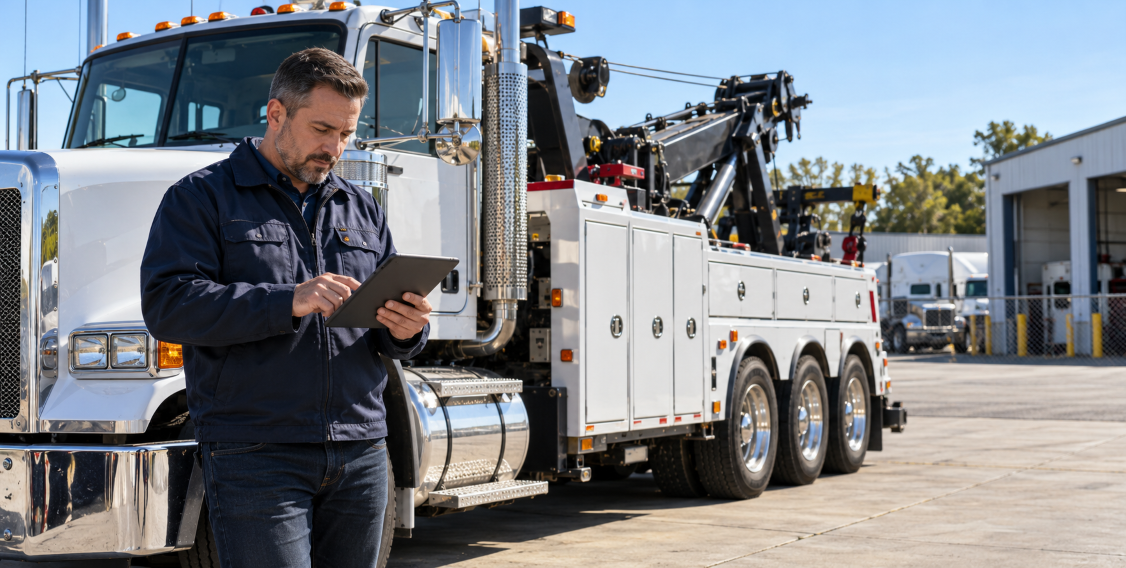
Heavy-duty tow trucks: Neither towing work nor a local route automatically waives ELD use or Clean Truck Check. Evaluate the specific driver operation and vehicle; a driveaway-towaway exception, where applicable, is different from operating a tow truck.
Large box trucks: Some configurations exceed CARB’s 14,000-pound manufacturer GVWR threshold even where the driver does not need a CDL or qualifies for a short-haul ELD exception. Our box-truck ELD guide covers the federal question; evaluate CARB coverage separately.
The vehicle’s vocation does not decide either program by itself. Verify the driver’s federal exception conditions and the truck’s CARB applicability independently.
Does It Matter If Your Fleet Is Based Outside California?
No. CARB Clean Truck Check applies to qualifying vehicles operating on California public roads and highways regardless of where the fleet is headquartered or where the vehicle is registered.
If your heavy-duty truck operates in California, California’s Clean Truck Check requirements may apply even if your fleet is based in another state.
CARB confirmed in March 2026 that qualifying out-of-state vehicles operating in California remain subject to reporting, the annual compliance fee, and required passing tests. Registration in another state is not an exemption. CARB also describes a limited five-day pass for eligible vehicles; it is not a blanket or permanent exemption.
FMCSA’s ELD guidance concerns federal driver records. CARB separately administers California emissions compliance, including program enforcement. Do not assume an ELD exception limits CARB’s authority over a qualifying truck.
A route that crosses into California can trigger CARB coverage even when a driver separately meets every federal short-haul condition. A 130-mile radius alone does not prove the driver qualifies for that exception.
How Do ELD Requirements and CARB Clean Truck Check Compare?
| ELD / HOS Program | CARB Clean Truck Check | |
|---|---|---|
| Administering agency | FMCSA (federal) | CARB (California state) |
| Legal authority | 49 CFR Part 395 | California state regulation |
| What it governs | Driver hours of service and fatigue | Vehicle emissions and air quality |
| Primary applicability trigger | RODS requirement and applicable ELD exceptions; some HOS exceptions differ | Fuel type, manufacturer’s GVWR over 14,000 lb, California operation |
| Common exemption triggers | Qualifying short-haul or pre-2000 operations; other exceptions have distinct conditions | Zero-emission vehicles and certain other vehicle categories |
| Geographic scope | Nationwide | Qualifying vehicles operating in California |
| Enforcement body | FMCSA and authorized state enforcement agencies | CARB through CTC-VIS records and roadside enforcement in California |
| Out-of-state vehicle coverage | Federal rules apply to qualifying interstate CMV operations, subject to exceptions | Applies to qualifying vehicles in California regardless of registration state |
| Shared exemptions between programs | None | None |
| Compliance record system | ELD data, paper RODS, or carrier time records as applicable | CTC-VIS registration, emissions test records, annual fee payments |

What Should You Ask Before Assuming Your Fleet Is Covered?
Does My Vehicle’s Manufacturer GVWR Exceed 14,000 Pounds?
Manufacturer GVWR is the vehicle’s rated maximum loaded weight, not its current payload. Check the manufacturer label. A rating over 14,000 pounds, non-gasoline fuel type, and operation on California public roads are the starting points for Clean Truck Check; a CARB-specific exclusion may still apply.
Does My Truck Operate on California Public Roads or Highways?
CARB coverage extends to qualifying vehicles operating on California public roads even when registered elsewhere. Occasional entry is not, by itself, an exemption; review any applicable CARB-specific exception or limited pass.
What Does My ELD Exemption Actually Cover?
An ELD exception may remove only the electronic-device requirement; a qualifying short-haul exception can also change RODS duties, while agricultural and utility provisions can affect HOS requirements under their own conditions. Check the applicable FMCSA rule and retain required records. None of these federal provisions determines CARB Clean Truck Check coverage.
Has Each Qualifying Vehicle Been Registered in CTC-VIS?
Covered vehicles must be reported in CTC-VIS and meet applicable fee and testing deadlines. Check each vehicle’s status in the system. The annual fee is $32.13 for 2026; CARB has announced $33.12 for compliance deadlines on or after January 1, 2027. An ELD exception does not waive the fee.
Is My Fleet Ready for the October 2027 Testing Change?
Most covered vehicles now test twice yearly. CARB schedules most OBD-equipped vehicles to move to four tests per year on October 1, 2027; non-OBD vehicles remain semiannual, while qualifying agricultural vehicles and California-registered noncommercial motorhomes remain annual. CARB generally identifies OBD-equipped engines as 2013-and-newer diesel or 2018-and-newer alternative-fuel, but verify each vehicle’s actual test category and CTC-VIS deadline.
Do Any of My Vehicles Qualify as Zero-Emission?
CARB excludes zero-emission battery-electric and hydrogen fuel-cell vehicles. Other narrow exclusions are listed in its official FAQ. A hybrid is not necessarily zero-emission, and a non-gasoline truck with manufacturer GVWR over 14,000 pounds may remain covered. Do not assume an ELD exception creates a CARB exclusion.
Could a Connected OBD Device Reduce My Testing Burden?
CARB lists Pacific Track’s PT40 and PT40-Q among certified continuously connected OBD devices. They support specified 9-pin/16-pin ports and SAE J1939, J1979, and J1979-2 protocols. Remote testing requires an eligible OBD-equipped vehicle, compatible installation, enabled CARB service, connectivity, and a passing result received by CARB. A certified connected device can submit tests without a separately credentialed tester; a periodic non-connected OBD test uses a CARB-credentialed tester and certified readout device. Confirm Geosavi service availability and vehicle compatibility before relying on either PT40 model. Registration, the annual fee, and other compliance obligations still apply.
Do I Know Where CARB Enforces Along My California Routes?
Check the vehicle’s CTC-VIS compliance record before California operation. CARB may enforce Clean Truck Check requirements against qualifying vehicles regardless of registration state; avoid relying on a particular roadside location or assumed enforcement pattern.
Common Questions About ELD Exemptions and CARB Clean Truck Check
ELD Exemptions and What They Cover
Does any ELD exemption also exempt my vehicle from CARB Clean Truck Check?
No. FMCSA ELD exceptions concern federal driver records or, in some cases, related HOS duties. CARB determines Clean Truck Check coverage from its own vehicle criteria and exclusions.
Does the 150 air-mile short-haul radius affect my CARB position in any way?
No. A 150 air-mile radius can be one condition of a federal short-haul exception, alongside return, duty-period, and recordkeeping conditions. CARB does not use that radius to decide emissions-program coverage.
My dump truck has a pre-2000 engine. Does that exempt it from CARB’s program?
Not automatically. FMCSA’s pre-2000 ELD exception can apply based on vehicle model year or an older engine in a later vehicle. CARB applies its own fuel, GVWR, California-operation, and exclusion criteria to the truck. Older non-OBD vehicles may have a different CARB test method, not an automatic exemption.
I am not a CDL driver. Does that change my CARB position?
No. A CDL is a driver credential; CARB generally evaluates whether a non-gasoline vehicle has a manufacturer GVWR over 14,000 pounds and operates on California public roads, subject to program exclusions.
If FMCSA says I do not need an ELD, is California required to follow that?
No. FMCSA’s ELD decisions concern federal driver requirements; CARB separately administers California emissions requirements. Neither ELD nor CDL status alone decides Clean Truck Check coverage.
Does the agricultural ELD exemption change my testing schedule under CARB?
No. FMCSA’s agricultural HOS exception and CARB’s annual testing category have different definitions. Only vehicles meeting CARB’s agricultural-vehicle criteria receive that CARB schedule; otherwise apply the vehicle’s normal Clean Truck Check testing frequency.
CARB Clean Truck Check for Your Fleet
My company is based in Texas. Does CARB Clean Truck Check apply if my trucks enter California?
Yes, if the vehicle meets CARB’s criteria and operates on California public roads. CARB’s March 2026 notice confirms that out-of-state registration does not remove reporting, fee, or testing duties. Check any specific CARB exclusion or limited pass separately.
What does CARB actually require a fleet operator to do for each vehicle?
Covered vehicles must be reported in CTC-VIS, pay the annual compliance fee, complete required passing emissions tests, and clear outstanding enforcement violations. CARB’s program guidance and the vehicle’s CTC-VIS deadlines govern; ELD status does not change these steps.
How do I check my vehicle’s manufacturer GVWR?
Check the manufacturer’s GVWR label, typically on the driver’s door frame. It is a rated maximum loaded weight, not today’s actual weight. A rating over 14,000 pounds is one of CARB’s criteria, alongside non-gasoline fuel, California operation, and any specific exclusion.
What changes in October 2027, and does it apply to ELD-exempt fleets?
On October 1, 2027, most covered OBD-equipped vehicles are scheduled to move from two to four tests yearly. Non-OBD vehicles remain semiannual; qualifying agricultural vehicles and California-registered noncommercial motorhomes remain annual. The change is based on CARB’s test category, not ELD status.
Can a connected device help my fleet meet the quarterly testing requirement?
CARB-certified continuously connected OBD devices may remotely submit qualifying tests when installed on a compatible vehicle with the CARB service enabled and connectivity working. CARB lists Pacific Track PT40 and PT40-Q, but approval of a device is not a guarantee that a particular installation passes a test or keeps the vehicle compliant. Confirm the test result in CTC-VIS; registration and annual fees remain separate.
Does CARB Clean Truck Check apply to electric or hydrogen trucks?
CARB excludes zero-emission battery-electric and hydrogen fuel-cell vehicles. That does not automatically cover hybrids with combustion engines. For each truck, check CARB’s current exclusion list and its fuel, manufacturer GVWR, and California-operation criteria.
How would CARB know my out-of-state truck is operating in California?
CARB can enforce its program against covered out-of-state vehicles; another state’s registration is not a defense. The practical step is to check the vehicle’s CTC-VIS record, testing deadline, fee payment, and any enforcement hold before California operation.
What should I do first if I think my fleet may be subject to CARB Clean Truck Check?
Check each vehicle’s manufacturer GVWR, fuel type, California use, and any CARB-specific exclusion against the current CARB FAQ. Then confirm its CTC-VIS reporting, annual fee, test type, and deadline. Evaluate the driver’s federal ELD status separately.
Conclusion
An ELD exception does not remove a truck’s Clean Truck Check duties. Federal ELD, HOS, and recordkeeping rules must be evaluated under their own conditions; being ELD-exempt does not necessarily mean being exempt from HOS limits. CARB independently evaluates the vehicle’s fuel, manufacturer GVWR, California operation, and program-specific exclusions.
For local and vocational fleets, check both the driver’s federal duties and each vehicle’s California emissions status. Most covered trucks now test twice yearly, with the scheduled October 1, 2027 quarterly change for most OBD-equipped vehicles. Confirm CTC-VIS deadlines, fees, and any proposed remote-testing setup before relying on it.
To walk through your fleet’s vehicles, operating routes, and CARB compliance position with our team, schedule a call or call us at (800) 261-4361. We will help you identify what applies to your situation.