Key Takeaways
- Federal CDL coverage depends on vehicle weight or rating, passenger capacity, or placarded hazardous materials under 49 CFR 383.5; a lighter vehicle may still be subject to other FMCSA safety rules without requiring a CDL.
- 49 CFR 383.91 defines Class A combinations, Class B heavy single vehicles, and Class C passenger or hazmat vehicles that do not meet Class A or B criteria. Check the vehicle, trailer, and required endorsements before dispatch.
- Passenger and school bus endorsements require knowledge and skills testing; hazardous-material endorsements require a security threat assessment. Applicable entry-level driver training is separate from licensing tests.
- Some major offenses result in a lifetime disqualification, but 49 CFR 383.51 allows possible state reinstatement after 10 years for certain offenses and conditions. Do not describe every lifetime sanction as permanently irreversible.
- At hire, obtain required three-year licensing-state records; thereafter, make the annual inquiry and review required by 49 CFR 391.25. Maintain the driver qualification file and medical-status evidence required by 49 CFR 391.51.
| Table of Contents |
|---|
| Who Needs a CDL |
| CDL Class Breakdown |
| Required Endorsements |
| Disqualification Offenses |
| Carrier Obligations |
| CDL and ELD Records |
| Class Comparison Table |
| Questions Before Dispatching |
| FAQs |
Introduction
CDL requirements determine which drivers may operate a particular commercial vehicle and which endorsements or restrictions apply. A license mismatch can lead to enforcement action and disrupt a trip, so fleet managers should verify the current credential and vehicle configuration before dispatch.
This guide explains the federal license classes, endorsements, exceptions, driver qualifications, and records that commonly matter to a carrier. State licensing rules can add requirements; confirm them with the relevant state driver licensing agency. For related hours-of-service questions, see our guide to local trucking ELD requirements.
Who Needs a CDL?
Under 49 CFR 383.5, a CDL generally applies to a vehicle or combination with a GVWR, GVW, GCWR, or GCW of 26,001 pounds or more (using the applicable rating or actual weight, whichever is greater); a vehicle designed to transport 16 or more people including the driver; or a vehicle carrying hazardous materials that require placards. The combination threshold includes a towed unit with a GVWR or GVW above 10,000 pounds. Section 383.91 determines the appropriate license class. A vehicle’s actual loaded weight can therefore matter; do not rely only on its nameplate rating.
Passenger capacity counts the driver. A vehicle designed for 15 occupants total is not automatically a 16-passenger CDL vehicle. Placarded hazmat generally calls for the H endorsement or a combined X endorsement, subject to the vehicle and cargo rules.
CDL versus other FMCSA rules: The interstate safety-rule definition of a CMV in 49 CFR 390.5T includes, among other vehicles, one with a GVWR, GVW, GCWR, or GCW of 10,001 pounds or more. Such a vehicle may be subject to applicable driver-qualification, inspection, and hours-of-service rules without meeting a federal CDL threshold. Determine both questions separately; state intrastate rules can differ.
Exceptions: Section 383.3 contains limited CDL exceptions. Military personnel operating qualifying military vehicles are covered by a federal exception. States may grant conditional waivers for certain farm, firefighting, emergency-response, and small-community snow-removal operations, and covered farm vehicles have a separate statutory exception. These are not blanket exemptions for all farm or emergency trips; check the precise conditions, state implementation, and whether other safety rules still apply. FMCSA’s state CDL guidance summarizes these distinctions.
What CDL Class Does Your Driver Need?
CDL groups are defined in 49 CFR 383.91. Check the actual combination and any license restrictions as well as the class letter.
Class A
Class A covers a combination with a GCWR of 26,001 pounds or more when the towed unit has a GVWR above 10,000 pounds. A Class A holder may also operate Class B or C vehicles when properly endorsed and not restricted.
Class B
Class B covers a single vehicle with a GVWR of 26,001 pounds or more, including that vehicle towing a unit with a GVWR of 10,000 pounds or less. A properly endorsed Class B holder may also operate Class C vehicles, but not Class A combinations.
Class C
Class C covers a vehicle that does not meet Class A or B criteria but is designed to transport 16 or more people including the driver, or is used for placarded hazardous materials. It does not authorize Class A or B operation.
For a combination near a threshold, verify both the power unit and trailer details. Employers must not permit operation without the proper class, endorsements, and restrictions when they know or should reasonably know of the mismatch under 49 CFR 383.37.
Which CDL Endorsements Does Your Fleet Need?
Under 49 CFR 383.93, H applies to placarded hazardous materials, N to tank vehicles, P to passenger vehicles, S to school buses, and T to double or triple trailers. X combines H and N. Check the specific regulatory definitions and the driver’s issued credential before assigning a route.
T, N, and H require the applicable knowledge tests. P and S require knowledge and skills testing; S also requires the P endorsement. H requires a Transportation Security Administration security threat assessment before issuance. The applicable entry-level driver training rules also apply to first-time Class A or B applicants, Class B-to-A upgrades, and first-time H, P, or S applicants, subject to exceptions. Training is not retroactive to credentials issued before February 7, 2022. FMCSA’s ELDT overview explains the sequence.
Also inspect restrictions printed on the CDL, such as those tied to the vehicle used for testing. A passed test or pending endorsement application alone does not replace an issued authorization. Geosavi’s support team can explain available account features, but carriers should verify licensing directly through the driver and appropriate state records.
What Can Disqualify a Driver From Operating a CMV?
49 CFR 383.51 sets disqualification periods for major offenses, serious traffic violations, railroad-highway grade crossing violations, and out-of-service order violations. The exact period depends on the offense, prior separate incidents, and whether the driver was operating a CMV or non-CMV.
Major offenses
Examples include impaired CMV operation, refusing a required test, leaving an accident scene, and certain felonies involving a CMV. A first covered major offense generally carries at least one year; a first offense while transporting placarded hazardous materials generally carries at least three years. A second covered major offense can result in lifetime disqualification. For some listed offenses, a state may reinstate a driver after 10 years if the driver completes a state-approved rehabilitation program; other lifetime bars are not eligible. Never assume reinstatement without an official state record.
Serious traffic and crossing violations
Two qualifying serious traffic violations from separate incidents within three years generally mean a 60-day disqualification; three mean 120 days. Railroad-highway grade crossing violations have separate escalating periods under the same section. Check the current licensing-state record rather than relying on a driver’s recollection.
What Are Your Responsibilities as a Carrier?
Section 383.37 prohibits an employer from allowing a driver to operate a CMV when it knows or should reasonably know that the driver lacks a current or properly classed CDL or CLP, is disqualified, violates a license restriction, or is subject to an applicable out-of-service order. Document how your fleet checks license status and responds to changes.
At hire, 49 CFR 391.23 requires an inquiry to each licensing authority where the driver held a license or permit in the preceding three years, generally within 30 days of employment. Afterward, 49 CFR 391.25 requires an MVR inquiry and review at least every 12 months, covering at least the preceding 12 months, to each licensing authority where the driver held a CMV operator license or permit during that period. The annual rule is not a repeat of the three-year hiring inquiry.
Drivers must report qualifying traffic convictions, other than parking violations, within 30 days under Section 383.31. Under Section 383.33, a driver must notify the employer by the end of the next business day after receiving notice of a license suspension, revocation, cancellation, lost CMV privilege, or disqualification. A file with no notifications does not itself prove a process failure.
Maintain the driver qualification documents required by Section 391.51, including the employment application, required MVRs and annual review notes, road-test evidence or an accepted equivalent, and applicable medical-qualification documentation. For a CDL holder, the CDLIS MVR from the current licensing state generally documents medical certification status; a paper medical examiner’s certificate is not universally the required file item. Verify the driver’s applicable medical status and any variance. Required DQ records generally remain for employment plus three years, with limited earlier removal of specified older items under the regulation.
How CDL Status Relates to ELD Records
CDL eligibility and electronic logging are separate compliance questions. When hours-of-service records are required, the carrier should ensure the ELD driver account identifies the right person and keeps accurate records. The ELD does not itself verify a CDL, monitor CDLIS, or replace the qualification-file checks in Part 391.
If a driver’s name, license number, or other profile information changes, review the applicable ELD account and carrier records for consistency. Confirm any Geosavi account capability with Geosavi support rather than assuming automatic synchronization between licensing, qualification, and ELD systems. Our ELD and inspection-record guide discusses related documentation workflows.
CDL Class and Authorization Comparison
| Feature | Class A | Class B | Class C |
|---|---|---|---|
| Vehicle type covered | Combination vehicle, GCWR 26,001 lbs or more, towed unit GVWR over 10,000 lbs | Single vehicle GVWR 26,001 lbs or more, or towing a unit with GVWR under 10,001 lbs | Below Class A and B weight thresholds, 16 or more passengers, or placarded hazmat |
| Can operate Class B vehicles | Yes, with correct endorsements | Own class only | No |
| Can operate Class C vehicles | Yes, with correct endorsements | Yes, with correct endorsements | Own class only |
| Common vehicle types | Tractor-trailers, flatbeds, tanker combinations | Straight trucks, heavy buses, dump trucks | 16-or-more-passenger vehicles, placarded-hazmat vehicles |
| Endorsements available | H, N, P, S, T, X | H, N, P, S, X | As applicable to the vehicle and license; check 49 CFR 383.93 |
| Skills test vehicle required | Class A combination vehicle | Class B vehicle | Class C vehicle |
| Interstate minimum age | 21 | 21 | 21 |
| Intrastate minimum age in select states | 18, intrastate operation only | 18, intrastate operation only | 18, intrastate operation only |
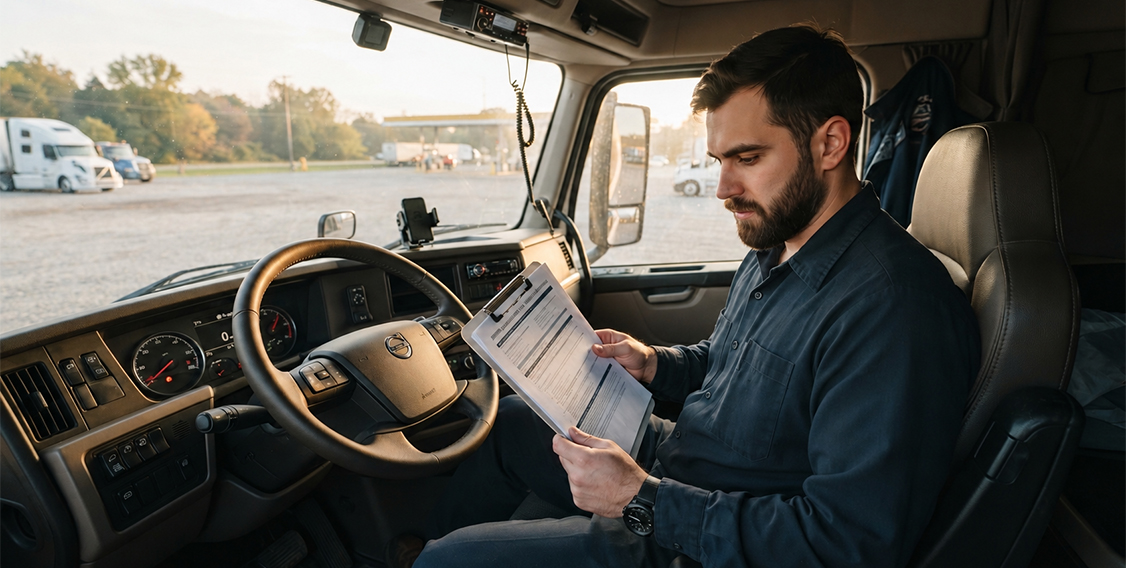
Eight Questions to Ask Before Dispatching a CDL Driver
1. Does the current CDL class fit this vehicle and trailer?
Compare the license, restrictions, manufacturer ratings, and actual weights with the vehicle configuration. Do not assume the class that fit a previous assignment fits this one.
2. Are the required endorsements active?
Confirm passenger, school bus, tank, hazmat, or doubles/triples authorization as applicable. A pending test or application is not an issued endorsement.
3. Is the CDL current and free of disqualification?
Check the credential and available licensing-state records. Escalate an unresolved status before assigning a CDL-required vehicle.
4. Is the required annual MVR inquiry and review current?
Under 49 CFR 391.25, obtain the record and document the review at least every 12 months for drivers to whom Part 391 applies. At-hire inquiries under 391.23 cover a different three-year period.
5. Is the driver medically qualified for this operation?
Confirm the appropriate medical certification status and any variance. For applicable CDL holders, obtain the current-state CDLIS MVR for the qualification file as required by 391.51.
6. Do any license actions or reported convictions need review?
Follow up on driver notices and official records. The one-license rule in 383.21 and disqualification rules in 383.51 require attention, but a carrier should not claim direct CDLIS access without an authorized service.
7. Are ELD driver details accurate when an ELD is required?
Update account details as needed. ELD records and CDL qualification are separate; do not treat the ELD as an automatic licensing check.
8. Was applicable entry-level driver training completed?
Confirm ELDT applicability for a first Class A or B CDL, B-to-A upgrade, or first H, P, or S endorsement. The state checks Training Provider Registry completion before the relevant test; it is not a universal recurring qualification-file item.
CDL Questions Answered
CDL Rules and Federal Requirements
What is the minimum age for interstate CMV driving?
Generally 21 under 49 CFR 391.11, with narrowly defined federal programs or exceptions where applicable. States may license some younger drivers for intrastate operation; verify state restrictions before dispatch.
Must a CDL driver carry the license?
Drivers must possess the appropriate valid CDL while operating a CDL-required CMV under 49 CFR 383.23. Check state credential rules; a phone photo should not be assumed sufficient.
What if a CDL expires during a trip?
A driver must have a current, valid credential to continue a CDL-required operation. Stop the assignment and confirm renewal or another properly qualified driver; the specific enforcement outcome depends on the circumstances.
Can a commercial learner’s permit holder drive alone?
No. Under 49 CFR 383.25, a properly qualified CDL holder must supervise the CLP holder from the front seat, or the specified seat near the driver in a passenger vehicle. Additional CLP conditions and passenger limits apply.
Can a driver avoid a disqualification by changing states?
No. State licensing agencies exchange CDL information through CDLIS. Verify the current official status and any valid reinstatement; a new state address does not erase an active disqualification.
Does a rented or leased vehicle require a CDL?
Ownership does not change the federal vehicle thresholds. Check the rental’s rating, actual weight, passenger capacity, cargo, and trailer combination, plus applicable state rules.
CDL Compliance for Fleet Operations
What belongs in a driver qualification file?
For covered drivers, 49 CFR 391.51 lists the application, licensing-state MVRs, annual review notes, road-test evidence or an accepted equivalent, and applicable medical-qualification evidence. A copy of the CDL is not a universal standalone requirement. Retention is generally employment plus three years, with specified older records removable earlier.
How often must a carrier review an MVR?
At least every 12 months under 391.25, covering at least the preceding 12 months, from each licensing authority where the driver held a CMV operator license or permit in that period. The initial three-year inquiry is a separate hiring requirement under 391.23.
Can a carrier set stricter driver standards?
A carrier may set lawful internal qualification standards above the federal minimum, but its policy does not change which CDL class or endorsement federal law requires. Check consistency with applicable employment and state law.
What is the difference between suspension and disqualification?
Suspension concerns license status; disqualification concerns eligibility to operate a CMV. Either may prevent a particular assignment. Check the current state record and applicable 49 CFR 383.51 period instead of assuming a uniform reinstatement rule.
What if a driver fails to report a conviction?
Document the issue, obtain the relevant driving record, and determine whether the conviction affects qualification. Section 383.31 requires reporting specified traffic convictions within 30 days; do not assume every conviction causes a CDL disqualification.
Can a driver work while a license action is under appeal?
Do not dispatch on an active suspension or disqualification based only on a pending appeal. Obtain official confirmation of any stay or restored authority from the licensing jurisdiction.
How can a CDL violation affect a carrier’s safety record?
A documented roadside violation may enter FMCSA’s Safety Measurement System. Its effect depends on the violation and applicable methodology; it does not automatically change every future inspection or a carrier’s business opportunities.
Where can a carrier verify CDL status?
Use the driver’s current state licensing authority or an authorized MVR provider, together with the required hiring and annual record inquiries. CDLIS is a state information-exchange system, not an automatic live feed into an ELD.
Conclusion
A sound dispatch check starts with the actual vehicle and operation: determine whether a CDL is required, confirm class and endorsements, then review current license status, restrictions, and applicable driver-qualification records. Separate CDL licensing from other FMCSA obligations and from ELD recordkeeping.
For help understanding Geosavi’s supported fleet tools, call (800) 261-4361 or contact the team. Confirm licensing questions with the appropriate state agency or qualified compliance adviser.