Key Takeaways
- Federal ELD exemptions and California Clean Truck Check are separate. A dump or concrete mixer truck can be ELD-exempt yet still need CARB registration, fees, and emissions testing.
- CARB’s program applies to nearly all diesel, alternative-fuel, and hybrid heavy-duty vehicles with a manufacturer’s GVWR over 14,000 pounds that operate on California public roads. CDL status, route radius, and ELD history are not part of that determination.
- CARB reiterated in March 2026 that out-of-state vehicles operating in California are subject to Clean Truck Check, covering CTC-VIS registration, the annual compliance fee, and required emissions tests.
- Dump and concrete mixer trucks are not exempt just because they are vocational vehicles. Check each truck’s GVWR, fuel type, California operations, and any CARB-specific exclusion.
- The federal short-haul exemption under 49 CFR 395.1(e) removes the ELD obligation for qualifying drivers but does not affect CARB’s Clean Truck Check requirements in any way.
- Four compliance duties apply per vehicle under CARB’s program: CTC-VIS registration, the annual compliance fee, required passing emissions tests, and no outstanding enforcement violations.
- CARB currently schedules most covered trucks for two tests per year. Its current guidance schedules four tests yearly for OBD-equipped vehicles starting October 1, 2027, except qualifying agricultural vehicles and noncommercial motorhomes.
- CARB lists Pacific Track’s PT40 and PT40-Q as certified continuously connected OBD devices under Executive Order IM-006-0001-7. Confirm vehicle and connector compatibility and service activation before relying on remote submissions.
Introduction
A dump truck or concrete mixer can run local routes without a federally required ELD and still need California Clean Truck Check. The federal ELD rule governs hours-of-service records; CARB’s program governs emissions compliance for covered vehicles operating on California public roads.
The first question for a dump or mixer fleet is whether each truck is a covered non-gasoline vehicle with a manufacturer’s GVWR over 14,000 pounds. A short-haul route, construction use, or out-of-state registration does not by itself remove the CARB obligation. Fuel type and CARB’s specific exclusions still matter.
This guide covers which dump and concrete trucks are included, current and planned test schedules, fees and reporting, and when a certified remote OBD device may help. It also explains why an ELD exemption does not change the CARB answer. For specific questions about your fleet, our team is available at (800) 261-4361.
Are the Federal ELD Mandate and CARB Clean Truck Check the Same Program?
No. They are different programs governed by different authorities with no overlap in their rules.
FMCSA administers the federal ELD mandate under federal law. CARB administers Clean Truck Check under California state authority. A compliance decision under one program tells you nothing about obligations under the other. A truck can be subject to both programs, to only one, or to neither, depending entirely on its weight, fuel type, and where it operates. Completing the federal ELD review does not complete the CARB review. Both must be run separately for every vehicle that enters California.
What Triggers the Federal ELD Requirement?
The federal ELD rule generally applies to drivers required to keep records of duty status under FMCSA’s ELD guidance, unless an ELD exception applies. A CDL is not the deciding test: some non-CDL commercial drivers also need an ELD.
Qualifying short-haul drivers may use time records instead of records of duty status and an ELD. Other ELD exceptions, including the pre-2000 vehicle-model-year exception, may still leave a driver subject to paper records of duty status. None of these federal exceptions changes CARB applicability.
What Triggers CARB Clean Truck Check?
CARB generally covers non-gasoline heavy-duty vehicles, including diesel, alternative-fuel, and applicable hybrid vehicles, with a manufacturer’s GVWR over 14,000 pounds that operate on California public roads. A dump body or concrete mixer does not create a special exemption. Check each vehicle’s fuel and weight against CARB’s applicability and exclusion guidance; CDL status, route radius, and ELD use are separate questions.
Gasoline-only and zero-emission vehicles are outside Clean Truck Check. CARB also lists specific exclusions, including emergency, military tactical, historical, experimental-permit vehicles, and motorhomes registered outside California. There is no general low-use or construction-vehicle exemption. Covered owners must report vehicles in CTC-VIS (Clean Truck Check Vehicle Inspection System), pay the annual fee, submit passing emissions tests, and clear outstanding enforcement violations. CARB’s CTC-VIS guide explains reporting.
CARB reaffirmed in March 2026 that covered out-of-state trucks operating in California must report, pay the annual fee, and pass required tests. A five-consecutive-day pass may be available once per calendar year for a vehicle with no outstanding enforcement actions, but it is not an exemption or a compliant status; CARB’s pass rules require an advance request. Check the vehicle’s CTC-VIS status before a California trip.
Testing Schedule, Deadlines, and Costs for Covered Trucks
When are emissions tests due?
Most covered dump and concrete trucks currently demonstrate compliance every six months. OBD-equipped vehicles, generally those with 2013-and-newer diesel engines or 2018-and-newer alternative-fuel engines, need a passing OBD scan from a CARB-certified device. Older diesel engines need a smoke-opacity test and emissions-equipment inspection; older alternative-fuel engines need the inspection but not the smoke-opacity test. Qualifying agricultural vehicles and noncommercial motorhomes follow an annual schedule. CARB’s testing schedule says passing tests may be submitted up to 90 days before each compliance deadline. Use the dates shown for each VIN in CTC-VIS, especially for out-of-state trucks.
What changes on October 1, 2027?
CARB’s current emissions-test flyer schedules four tests per year for OBD-equipped vehicles starting October 1, 2027. That is a future requirement, not today’s frequency. Non-OBD vehicles remain on the semiannual schedule, while qualifying agricultural vehicles and noncommercial motorhomes remain annual. Check CARB and CTC-VIS again before that date for any implementation update and vehicle-specific deadlines.
What do registration and testing cost?
Covered owners must report each vehicle in CTC-VIS and pay an annual compliance fee. CARB lists $32.13 for 2026 compliance deadlines and $33.12 for deadlines beginning January 1, 2027. The fee is separate from any tester, device, connectivity, or service charge; request a quote for those costs rather than assuming the CARB fee covers them. Keep owner and vehicle information current in CTC-VIS, confirm passing tests appear under the correct VIN, and resolve any outstanding enforcement action.
Does a continuously connected device replace periodic testing?
A CARB-certified continuously connected OBD device can remain assigned to an eligible truck and transmit test data remotely. That can reduce testing-station visits, but it does not waive the applicable compliance deadlines, passing-result requirement, annual fee, or CTC-VIS reporting. A portable certified device used for periodic OBD scans is a different pathway. Non-OBD trucks still require their specified inspection and, for older diesels, opacity test. Verify the result in CTC-VIS rather than assuming a connected device made the vehicle compliant.
Which Dump and Concrete Trucks Need Clean Truck Check?
A diesel dump truck or ready-mix concrete truck over 14,000 pounds GVWR generally falls within the program when it uses California public roads. Alternative-fuel and applicable hybrid trucks can also be covered. The same test applies to related vocational vehicles, including:
- Concrete and cement mixer trucks
- Dump trucks
- Construction trucks
- Local delivery trucks over 14,000 pounds GVWR
- Heavy service and utility trucks
- Tow trucks
- Refuse and garbage trucks
- Heavy vocational trucks
- Many large box trucks
A local concrete mixer or dump truck may qualify for a federal short-haul ELD exception, but that does not exclude the vehicle from Clean Truck Check. Conversely, a gasoline-only or zero-emission truck is not covered by this program merely because its GVWR is high. A vehicle that never operates on California public roads does not meet the program’s operating-location trigger. For related federal rules, see our construction-vehicle ELD guide. For a full breakdown of which vehicles trigger the federal ELD requirement, our ELD requirements for local trucking guide covers those distinctions, and our box truck ELD guide addresses that specific category. Federal ELD status does not change the CARB determination.
Does the Federal Short-Haul Exemption Remove a CARB Obligation?
No. Under 49 CFR 395.1(e), qualifying short-haul drivers may use time records instead of records of duty status and an ELD; other applicable HOS limits still apply. This federal exception has no effect on CARB’s program.
CARB wrote Clean Truck Check under California state authority. FMCSA wrote its ELD exemptions under federal authority. An exemption issued by one body does not carry into the other’s program. A driver fully compliant under the short-haul exemption is meeting a federal obligation. Whether that driver’s truck must be registered in CTC-VIS, current on emissions testing, and paid up on the annual CARB fee is a separate California state question that the federal exemption cannot answer.
Can a Truck Need Both Federal ELD Compliance and CARB Clean Truck Check?
Yes. For regional and over-the-road trucks operating in California, both programs frequently apply at the same time.
A truck subject to federal HOS rules that also exceeds 14,000 pounds GVWR while operating on California public roads carries obligations under both programs. The two compliance systems do not share records and do not substitute for each other.
Geosavi’s ELD platform integrates with Pacific Track’s PT40. CARB lists the PT40 and PT40-Q as certified continuously connected devices under Executive Order IM-006-0001-7 on its current OBD device list, with SAE J1939, J1979, and J1979-2 support through specified 9-pin or 16-pin connectors. For an eligible OBD-equipped truck, activated CARB service can transmit emissions test data remotely. That does not make a non-OBD truck compatible, guarantee a passing result, or replace registration and fee payment. Confirm the truck, connector, service plan, and CTC-VIS result with Geosavi before relying on the combined setup.
How Do Federal ELD and CARB Clean Truck Check Compare?
| Factor | Federal ELD Requirement | CARB Clean Truck Check |
|---|---|---|
| Governing authority | FMCSA, federal law | CARB, California state law |
| Primary trigger | Driver required to keep records of duty status, absent an ELD exception | Covered non-gasoline vehicle over 14,000 lbs GVWR on California public roads |
| CDL required | No; CDL status alone does not determine ELD use | No |
| Short-haul exemption | Yes, 150 air miles with daily return | No equivalent |
| Out-of-state vehicles | Applies nationally in interstate commerce | Applies to any qualifying vehicle operating on California public roads |
| Compliance system | Driver HOS records and an FMCSA-registered ELD when required | CTC-VIS |
| What compliance requires | ELD installed, HOS data recorded electronically | CTC-VIS registration, annual fee, passing emissions tests, no outstanding violations |
| 2027 change | None | OBD-equipped vehicles scheduled for 4 tests per year starting October 1, 2027 |

Questions to Confirm Before Your Trucks Operate in California
Does each California-operating truck exceed 14,000 pounds GVWR?
Check the manufacturer’s GVWR on the data plate for every vehicle that enters California. That number, not estimated loaded weight or vehicle class, is what CARB uses to determine applicability. Confirm it for each unit individually, including trucks that are ELD-exempt under federal rules.
Have you run the CARB and ELD reviews as two separate checks?
An ELD determination does not answer the CARB question. The two reviews use different criteria and produce independent results. If your compliance process treated them as one, the CARB check needs to be completed separately for every California-operating vehicle.
Are all affected trucks registered in CTC-VIS before entering California?
CTC-VIS registration must be in place before a qualifying vehicle operates on California public roads. A truck that has not been registered is out of compliance from its first trip. Registration applies per vehicle, not per fleet or company.
Are all affected trucks current on required CARB emissions tests?
A lapsed test creates a compliance gap in CTC-VIS regardless of prior test history. Verify each truck’s current test status before it enters California and note the next due date based on that vehicle’s engine year and OBD classification.
Has the annual CARB compliance fee been paid for each vehicle?
The fee applies per vehicle and must be renewed annually. A missed fee is a separate compliance failure from a missed test. Track renewal dates at the vehicle level.
Are drivers of ELD-exempt trucks aware of Clean Truck Check?
Drivers who have operated without an ELD for years may have no knowledge of California’s emissions compliance program. If a driver is stopped at a California border inspection point and the truck is not current on CTC-VIS, that is an enforcement exposure regardless of how clean the driver’s federal compliance record is. Include Clean Truck Check in driver orientation for any driver running California routes.
Which trucks are OBD-equipped under CARB’s definition?
CARB generally uses 2013-and-newer diesel engines and 2018-and-newer alternative-fuel engines for the OBD testing pathway. Check engine model year and diagnostic compatibility for each unit. CARB currently schedules these vehicles for four tests per year starting October 1, 2027, except its annual-testing categories.
Are you prepared for quarterly testing beginning October 2027?
CARB currently schedules OBD-equipped vehicles to move from two tests per year to four on October 1, 2027. A certified continuously connected device may reduce station visits for compatible trucks, but a passing submission and the vehicle’s CTC-VIS deadline still matter. Ask Geosavi to confirm PT40 service activation, fit, and pricing; our price calculator is only a starting estimate for our services, not CARB’s fee or a guaranteed testing price.
Common Questions
About ELD Exemptions and CARB Applicability
Does a federal ELD exemption mean my truck is exempt from CARB Clean Truck Check?
No. An ELD exception affects federal logging requirements, not California emissions rules. Check the truck’s weight, fuel, use on California public roads, and any CARB exclusion separately.
My driver qualifies for the short-haul exemption. Does Clean Truck Check still apply?
Potentially yes. The short-haul exemption removes the ELD requirement for qualifying drivers but does not exempt the vehicle from CARB’s program. If it is a covered non-gasoline truck over 14,000 pounds GVWR operating on California public roads, Clean Truck Check applies independently.
My driver does not hold a CDL. Can CARB Clean Truck Check still apply?
Yes. CDL status is not a Clean Truck Check trigger. For a non-gasoline truck over 14,000 pounds GVWR on California public roads, check CARB’s specific vehicle exclusions; do not rely on the driver’s license class.
Does the federal agricultural ELD exemption cover CARB Clean Truck Check?
No. Federal agricultural HOS exceptions do not determine CARB coverage. A vehicle that meets CARB’s agricultural-vehicle definition may have an annual Clean Truck Check testing schedule; verify that classification in CARB guidance and CTC-VIS.
My truck is ELD-exempt because it is an older model. Is it still subject to CARB?
An older diesel engine does not itself exempt a covered truck from Clean Truck Check. A 2012-or-older diesel engine generally follows CARB’s non-OBD pathway: smoke-opacity testing plus an emissions-control-equipment inspection. A continuously connected OBD device cannot substitute for those tests.
My truck is registered in Texas. Does CARB apply when it crosses into California?
Yes. CARB reiterated in March 2026 that out-of-state vehicles operating in California are subject to Clean Truck Check, including CTC-VIS registration, the annual fee, and required emissions tests. Vehicle registration state does not determine applicability; operating on California public roads does.
About CARB Compliance Requirements
What are the four CARB compliance duties?
CARB identifies four required actions per vehicle: register and report the vehicle in CTC-VIS, pay the annual compliance fee, submit required passing emissions tests on the applicable schedule, and maintain no outstanding enforcement violations. All four apply to each qualifying vehicle independently.
How often must a truck be tested under CARB’s current schedule?
Most covered trucks currently need two tests per year. CARB schedules four yearly OBD tests beginning October 1, 2027; non-OBD trucks remain semiannual, and qualifying agricultural vehicles and noncommercial motorhomes remain annual. Use each vehicle’s CTC-VIS due dates.
What does OBD-equipped mean under CARB’s program?
CARB generally treats 2013-and-newer diesel engines and 2018-and-newer alternative-fuel engines as OBD-equipped. Those vehicles have their engine’s onboard diagnostic data scanned as part of the compliance test. Vehicles with older engines follow a different testing process and are not eligible for remote Continuously Connected Device testing.
Can the PT40 transmit CARB emissions data without a testing station visit?
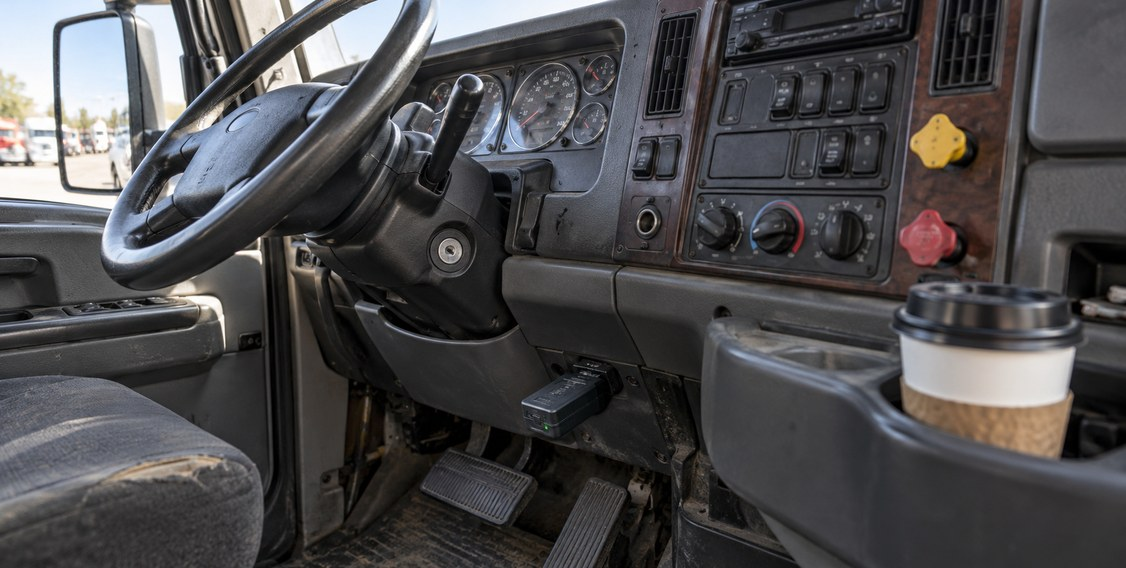
For a compatible OBD-equipped truck with CARB functionality activated, Pacific Track says the PT40 can send emissions test data remotely. CARB currently lists PT40 and PT40-Q under Executive Order IM-006-0001-7 for SAE J1939, J1979, and J1979-2 connections. This may avoid a station visit, but does not guarantee a pass or remove the need to verify the result and deadline in CTC-VIS.
Does the PT40 CARB submission include location or driving data?
No. Per Pacific Track, the CARB submission does not include telematics information such as the vehicle’s location, speed, driving behavior, or location history. The transmission covers the required emissions compliance data only.
Is the FMCSA registered ELD list related to CARB compliance?
No. The FMCSA registered ELD list is a federal resource listing devices self-certified against FMCSA’s technical standards. It has no connection to CARB’s program. CARB maintains its own separate approved device list for Continuously Connected Devices, which is where the PT40 is listed.
What should a fleet manager do if a truck is found out of compliance with Clean Truck Check?
Identify the specific gap: missing CTC-VIS registration, unpaid annual fee, lapsed emissions test, or outstanding enforcement violation, and address it directly through CTC-VIS and CARB. Each gap has its own resolution process. Questions about CARB enforcement remediation should go directly to CARB.
Conclusion
Federal ELD exemptions are valid and widely used. The issue is not whether those exemptions apply under federal rules; many do. The issue is that they only resolve the federal question. Whether a truck must be registered in CTC-VIS, kept current on CARB emissions tests, and paid up on an annual California fee is a separate determination that the federal exemption cannot make.
For every truck that operates in California, the CARB applicability check must run independently of the ELD review. Many fleets with well-managed federal compliance discover a CARB gap only when a truck is stopped at a California inspection point. CARB conducts enforcement at border crossings, ports, and railyards in 2026, and that activity covers out-of-state equipment. The time to confirm compliance for each vehicle is before it crosses into California.
To talk through what our platform covers for CARB Clean Truck Check monitoring and federal ELD compliance in a single setup, call us at (800) 261-4361 or schedule a call with our team.