Key Takeaways
- AI-powered cameras detect specific driving events in real time, including tailgating, forward collision risk, lane departure, pedestrian proximity, driver distraction, and fatigue, rather than recording everything and leaving the review to a human.
- Cloud-based AI driving-event analysis filters alerts before they reach your safety team, keeping your event log useful rather than overwhelming.
- The Xirgo KP2 stores over 50 hours of footage on a 64GB microSD card and uploads critical events to the cloud for independent preservation.
- The Xirgo CP4S supports up to four cameras with HD video across all channels, 4G/LTE real-time data transmission, and SD card storage up to 1TB for larger fleets needing multi-angle coverage.
- Road-facing cameras cover the most common liability scenario for commercial fleets. Adding a driver-facing camera extends coverage to distraction and fatigue, which are leading factors in serious commercial vehicle crashes.
- Video footage gives fleets an objective record to defend drivers against false or exaggerated accident claims, reducing the cost of disputed settlements over time.
- Video telematics can be combined with GPS fleet tracking for greater visibility into vehicle location and driver activity alongside the video record.
- The right camera configuration depends on your vehicle type, your routes, and the incidents your fleet actually encounters, not a default maximum-coverage assumption.
Introduction
Most fleet managers shopping for a camera system run into the same problem. Every product description lists similar features, and it is hard to tell from a spec sheet whether a system will hold up across a real fleet in real conditions. We put this guide together to give you a clear, direct answer to what separates a system that improves your safety program from one that creates more work than it solves.
The gap between a reliable system and a poor one comes down to three things: whether the AI detection is accurate enough to filter false positives, whether critical footage is preserved independently of the physical device, and whether the camera configuration matches the vehicles and routes your drivers actually run. Get those three right and the rest follows.
We carry the Xirgo KP2 and CP4S systems for fleets that need AI-powered camera coverage with road-facing, driver-facing, and multi-angle options. If you want to compare hardware before reading further, our video telematics solutions cover the full lineup. Our team is also available at (800) 261-4361 for questions specific to your operation.
What Does a Video Telematics System Do for Your Fleet?
A video telematics system records footage from cameras on your vehicles and uses AI to detect specific driving events, giving your safety team a documented, reviewable record they can act on. It is not a passive recording device that stores footage no one looks at.
The problem most fleets face without one is that incidents happen and there is no objective record of what actually occurred. A driver’s account and another party’s account conflict, and without footage, disputes are slow and expensive to resolve. A video telematics system captures the seconds before and during an incident and uploads critical footage to the cloud where it is preserved regardless of what happens to the physical camera.
The solution works on three levels. It gives your safety team documented behavioral data to coach drivers on specific events rather than general reminders. It gives you an objective record to defend your drivers when a claim is disputed. Combining it with GPS tracking gives you location and behavioral context in one connected record. We cover how ELDs reduce driver fatigue in a separate guide if you want to understand how electronic records and camera data work together for driver safety.
A video telematics system is most valuable when it produces data your team reviews and acts on consistently. The hardware captures the events. Your safety process determines whether those events result in coaching, documentation, or a resolved dispute.
What Features Matter Most When Choosing a Fleet Camera System?
The most important features in a commercial fleet camera system are AI event detection, cloud backup for critical footage, real-time data transmission, and a camera configuration matched to your vehicles. Resolution matters, but it is not the first question to ask.
- AI event detection: A system that flags every hard brake regardless of context trains your safety coordinator to ignore alerts. The Xirgo KP2 uses cloud-based AI driving-event analysis to filter events before they generate alerts, which keeps the queue manageable and the data meaningful in day-to-day use, not just in a product demonstration.
- Cloud backup for critical events: The Xirgo KP2 uploads critical events to the cloud as they occur. The Xirgo CP4S uses 4G/LTE for real-time transmission. In both cases the record exists independently of the device from the moment the event happens, which matters significantly if a camera is damaged in the same incident you need footage from.
- Camera coverage matched to your vehicles: A strong AI system pointed in the wrong direction for your operation still leaves gaps. We cover road-facing versus driver-facing decisions in the next section with specific guidance on when each applies.
- Ease of review: If your safety coordinator cannot pull footage quickly after an incident, or the platform requires specialist knowledge to navigate, delays happen at exactly the moments when speed matters. Ask any vendor you evaluate to walk you through how a safety coordinator retrieves footage for a specific event on a specific vehicle before you commit.
When Do You Need a Driver-Facing Camera on Top of a Road-Facing One?
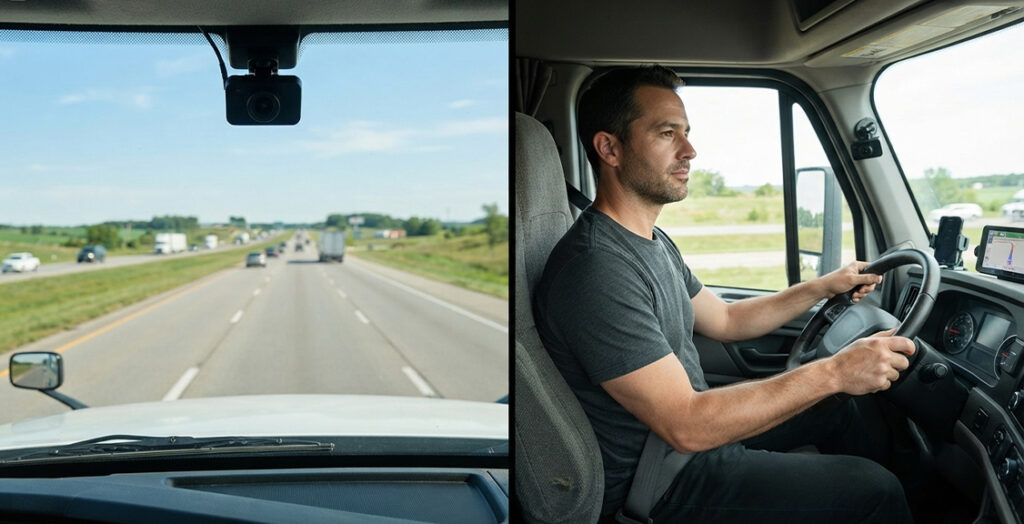
You need a driver-facing camera when driver behavior, rather than road conditions or other vehicles, is the primary risk factor you need to document and manage. A road-facing camera shows what happened in front of the vehicle, while a driver-facing camera shows what your driver was doing at the same moment, giving you the inside view that a road-facing camera alone cannot provide.
That distinction matters in two situations that come up regularly for most commercial fleets. In a disputed claim, the other party almost always argues that your driver was distracted or inattentive, and road-facing footage alone cannot answer that question because it only captures what was happening ahead, not what your driver was doing at the same moment. Driver-facing footage fills that gap by giving you a recorded visual account of your driver’s attentiveness and response, which is far harder to challenge than a verbal account filed days after the incident. In your coaching program, the value is equally practical because a driver-facing camera ties flagged events to specific individuals on specific dates rather than producing general incident reports that change no one’s behavior as a result.
For fleets running long-haul routes, fatigue detection is the most practical reason to add driver-facing coverage, since fatigue is one of the most serious and most preventable risk factors in commercial trucking that a road-facing camera cannot detect. The Xirgo KP2’s optional snap-on driver-facing camera adds AI-powered distraction and fatigue detection without requiring a full multi-camera installation, making it a practical step up for fleets that want both coverage layers without a complex installation process.
For fleets where most incidents involve other road users, a road-facing camera often covers the most important scenarios, and the decision to add driver-facing coverage should come from your incident history rather than a default assumption that more cameras always means better results. If you operate box trucks or vehicles with different compliance profiles, our guide on ELD requirements for box trucks covers how requirements and camera needs differ by vehicle type.
When Does Your Fleet Need a Multi-Camera System?
Your fleet needs a multi-camera system when a single forward-facing unit leaves meaningful coverage gaps based on how your vehicles actually operate. For a highway truck, a road-facing camera with an optional driver-facing unit covers the most common incident scenarios. For larger vehicles operating in dense urban areas, distribution centers, or loading dock environments, side and rear coverage becomes necessary rather than optional.
The Xirgo CP4S 4-Channel HD Vehicle Recorder supports up to four cameras with HD video across all channels, 4G/LTE data transmission for real-time event notification, SD card storage up to 1TB, an optional in-cab LCD monitor for multi-camera viewing, built-in temperature logic for high-temperature environments, and SD error and corruption detection with remote support and management. For operations where a single-unit solution leaves gaps, that combination covers the incidents a simpler system would miss.
Before choosing a configuration, review your last two to three years of claims and identify where your incidents actually occur. Front-end, side, rear, and cab-related events each point to different camera positions, and that analysis tells you which setup delivers real value rather than maximum coverage at unnecessary cost. For fleets managing driver safety and maintenance records alongside camera data, having the right coverage from the start keeps your documentation complete and defensible.
Which system fits your fleet?
- Single truck or small fleet on highway routes: Xirgo KP2 All-in-One AI Video Telematics Camera with ADAS alerts, cloud-based AI driving-event analysis, and over 50 hours of local footage storage.
- Mid-size fleet with driver behavior concerns: Xirgo KP2 with the optional Xirgo KP2 Driver-Facing Snap-In Camera, adding AI-powered distraction and fatigue detection on top of the full road-facing feature set.
- Larger fleet, urban routes, or mixed vehicle types: Xirgo CP4S 4-Channel HD Vehicle Recorder with up to four cameras, 4G/LTE real-time transmission, and up to 1TB of local storage.
What Does Combining Video Telematics with GPS Tracking Add?
Combining video telematics with GPS fleet tracking gives you two independent records of the same event, which is significantly more useful than either record alone when a dispute or claim needs to be resolved. GPS establishes where the vehicle was, how fast it was moving, and what route it was on. Video shows what was happening inside and outside the cab at the same moment. When both records are consistent and available, the combined evidence is much harder to challenge than a single-source account.
Beyond incident response, the combination gives you daily operational visibility that neither system provides on its own. GPS shows movement patterns. Video shows the behavioral context behind those patterns. That context turns raw location data into something your safety team can use to improve operations and respond to driver needs in ways that a location ping alone never could.
Our video telematics systems are designed to work alongside GPS fleet tracking for fleets that want both layers of coverage. If you are already running our ELD and fleet management platform and want to add camera coverage, our team can walk you through how the systems connect for your specific setup. For fleets with local drivers who may have different compliance requirements, our guide on local driver compliance requirements covers what applies before you build out your full technology stack.
How Do the Main Camera Configurations Compare?
Before you browse our fleet camera hardware, here is how the main configurations differ side by side so you know exactly what you are choosing between.
| Feature | Xirgo KP2 Road-Facing | Xirgo KP2 with Driver-Facing | Xirgo CP4S 4-Channel |
|---|---|---|---|
| Road-facing coverage | Yes | Yes | Yes |
| Driver-facing coverage | No | Yes, AI-powered | Yes |
| AI distraction and fatigue detection | No | Yes | Yes |
| ADAS alerts (tailgating, collision, lane departure, pedestrian) | Yes | Yes | Yes |
| Cloud-based AI event analysis | Yes | Yes | Yes |
| Local storage | 64GB microSD, 50+ hours | 64GB microSD, 50+ hours | Up to 1TB SD card |
| Real-time data transmission | Cloud upload on event | Cloud upload on event | 4G/LTE real-time |
| Camera channels | 1 | 2 | Up to 4 |
| In-cab monitor option | No | No | Yes, optional LCD |
| Temperature management | Standard | Standard | Built-in temperature logic |
| SD error detection and remote support | No | No | Yes |
| Best suited for | Owner-operators, small highway fleets | Fleets prioritizing driver behavior data | Larger fleets, multi-angle coverage needs |
Questions to Ask Before Choosing a Video Telematics System
Does the system use AI event detection or basic motion detection?
This is the most important technical question to ask any vendor. Basic motion detection flags everything that triggers the sensor and leaves all review to your team. AI event detection analyzes footage against specific behavioral criteria and filters events before they reach your safety coordinator. Ask any vendor you evaluate to explain exactly how their system separates a genuine risk event from normal driving, and get a specific answer before you commit.
What specific driving events does the system detect?
Get a list of named events, not a general description of safety features. The events that matter most for commercial fleet liability and coaching are tailgating, forward collision risk, lane departure, pedestrian proximity, driver distraction, and driver fatigue. If a vendor cannot give you a specific list of detected events, that gap matters before you buy.
How does the system store footage and what happens if the device is damaged in an incident?
Local SD card storage is the minimum requirement. Critical events should upload to the cloud as they occur so the record is preserved independently of the physical camera. If a device is damaged in the same incident you need footage from, local-only storage may leave you without the record you need. Understand the cloud backup policy before an incident makes the question urgent.
What does installation look like for your vehicle type and who handles it?
Ask for a realistic per-vehicle installation timeline and confirm who is responsible for the work. A system installed incorrectly across a mixed fleet creates coverage gaps and calibration errors that directly affect AI detection accuracy. You can also use our price calculator to work out the cost for your fleet before committing to a configuration.
How does your team review flagged events and follow up with drivers?
A camera system that captures events no one reviews does not improve safety and does not build the coaching record that makes a difference over time. Before deploying, decide who receives alerts, how quickly they are reviewed, and what the follow-up process looks like for each driver. That internal process is as important as the hardware.
What support is available when the system malfunctions or a camera stops recording?
Ask specifically what happens if a camera goes offline or stops uploading events. The Xirgo CP4S includes SD error and corruption detection with remote support and management, meaning issues can often be identified and resolved without a physical inspection. Our technical support team is available if you run into hardware or platform issues after installation.
Can the system integrate with GPS tracking and does your provider support that configuration?
If you are already running GPS fleet tracking or plan to add it, confirm whether the video telematics system is designed to work alongside it and what that integration looks like in practice. Combined records from both systems are more useful for incident response and more persuasive in a disputed claim than either record alone. Our systems are designed to combine video and GPS coverage for fleets that need both layers of visibility.
What is the data retention period for local and cloud storage?
Know how long footage is retained before you need to retrieve something specific. The Xirgo KP2 stores over 50 hours locally before older footage is overwritten. Cloud-stored critical events are preserved longer, but confirm the specific retention period with us before finalizing your setup. If claims in your operation are typically filed weeks after an incident, short local retention combined with no cloud backup for non-critical footage may leave gaps in your record.
Common Questions About Fleet Video Telematics
About Video Telematics Systems
What is video telematics and how is it different from a standard dash cam?
A video telematics system adds AI-based event detection, cloud connectivity, and fleet management integration to a camera system, so the system identifies and flags specific driving events automatically and uploads critical footage to the cloud. A standard dash cam records continuously and stores footage locally, leaving all review to a human. The practical difference is that a telematics system produces data your safety team can act on, while a standard dash cam produces footage most teams never review.
What driving events do AI-powered fleet cameras detect?
The Xirgo KP2 detects tailgating, forward collision risk, lane departure, and pedestrian proximity through its road-facing ADAS features. The optional driver-facing snap-on camera adds AI-powered distraction and fatigue detection. Cloud-based AI analysis reviews events before they generate alerts, which reduces false positives and keeps the event queue manageable for your safety team.
How much footage can a fleet camera store locally?
The Xirgo KP2 stores over 50 hours of footage on a 64GB microSD card before the oldest footage is overwritten. The Xirgo CP4S supports SD card storage up to 1TB across its four-channel system. Critical events are uploaded to the cloud as they occur, preserving the footage that matters most independently of the local storage cycle.
Does a video telematics system require a cellular connection to work?
Local recording and AI event detection work without a cellular connection. Cloud upload and real-time notification require connectivity. The Xirgo KP2 uploads critical events when a connection is available. The Xirgo CP4S uses 4G/LTE for real-time transmission. In areas without cellular coverage, footage continues recording locally and uploads when connectivity is restored.
What is the difference between ADAS and AI driver monitoring?
ADAS monitors the road ahead and alerts on events like tailgating, forward collision risk, lane departure, and pedestrian proximity. AI driver monitoring watches the driver, detecting distraction, fatigue, and similar behaviors. The Xirgo KP2 provides ADAS through its road-facing camera and adds AI driver monitoring through the optional snap-on driver-facing camera. Our FAQ cover additional detail on how our systems handle specific detection scenarios.
Can video footage be used as evidence in an accident dispute?
Yes. Road-facing footage establishes traffic conditions, following distance, and the approach to an incident. Driver-facing footage shows driver attentiveness at the time. Cloud-stored footage is generally more reliable as evidence because it is preserved independently of the physical device and cannot be disputed as having been altered after the fact.

About Choosing the Right System for Your Fleet
How do I decide between a single-camera and a multi-camera system?
Start with your incident history. If most of your claims involve front-end events with other vehicles, a road-facing camera covers your most important liability scenario. If driver behavior is a significant factor, add a driver-facing camera. If your vehicles operate in environments with frequent backing incidents or dense urban traffic, side and rear coverage from the Xirgo CP4S adds meaningful protection. The right system covers the incidents your fleet actually encounters, not the ones that sound most serious on paper.
What size fleet benefits most from a four-channel system?
Larger fleets running vehicles in complex environments, such as distribution trucks on urban routes or vehicles with frequent reversing requirements, benefit most from multi-camera coverage. The Xirgo CP4S supports up to four cameras with HD video, 4G/LTE transmission, and up to 1TB of local storage. Smaller fleets running highway routes typically get adequate coverage from a single or dual-camera setup.
Can I start with one camera and add more later?
That depends on the system. Some systems are designed to expand while others are fixed configurations. Ask specifically whether the hardware supports additional cameras and whether the platform handles multi-camera management from the start. Planning for expansion at initial purchase is easier than retrofitting a system not designed for it.
How long does it take to see results from a driver coaching program?
Behavioral change in response to coaching typically shows in event data within four to eight weeks of consistent follow-through, meaning flagged events are reviewed promptly and discussed with the relevant driver. Fleets that capture events but do not follow up see slower improvement. The speed of change depends on how consistently your safety team uses the data, not on the hardware itself.
What should I look for in a video telematics provider beyond the hardware?
Look for clear answers on installation support, ongoing technical assistance, cloud storage terms, and response time when hardware fails. A provider that helps you configure the right system for your vehicle types and responds quickly when something goes wrong is more valuable than the lowest per-unit price. Our team is available at (800) 261-4361 to answer questions about the systems we carry and how they fit different fleet operations.
Is video telematics worth it for an owner-operator running a single truck?
Yes, for most single-truck operations. The most direct value is liability protection. A road-facing camera gives an owner-operator an objective record for any disputed claim, which can be the difference between a costly settlement and a resolved dispute. Driver-facing coverage adds documented evidence of attentiveness, which some insurers and freight brokers are beginning to ask for as a condition of doing business.
Which Video Telematics System Is Right for Your Fleet?
The best video telematics system for your fleet is the one that covers the incidents your vehicles actually encounter, produces data your safety team can use, and holds up in the conditions your drivers work in every day.
The Xirgo KP2 gives smaller fleets and owner-operators a road-facing AI camera with the option to add driver-facing distraction and fatigue detection without a full multi-camera installation. The Xirgo CP4S gives larger fleets up to four channels of HD coverage, real-time 4G/LTE transmission, and up to 1TB of local storage for operations that need broader visibility across complex environments. Both systems can be combined with GPS fleet tracking for fleets that want location and behavioral data in one connected setup.
If you want help working out which configuration fits your fleet, schedule a call with our team or call us at (800) 261-4361 and we will help you find the right fit.