Key Takeaways
- Per CARB’s Clean Truck Check overview, the program generally covers diesel and alternative-fuel heavy-duty vehicles with a manufacturer’s GVWR over 14,000 pounds operating on California public roads. The vehicle does not have to be registered in California for the requirement to apply.
- Compliance due dates are vehicle-specific and must be checked in CTC-VIS for each unit in your fleet, per CARB’s published requirements.
- Per CARB’s Clean Truck Check overview, every covered vehicle owner must register and report in CTC-VIS, pay the annual compliance fee, submit passing emissions tests, and resolve any outstanding enforcement issues.
- OBD-equipped vehicles, generally 2013-and-newer diesel engines and 2018-and-newer alternative-fuel engines, are tested using a CARB-certified OBD testing device, per CARB’s published OBD testing requirements.
- Almost all affected vehicles are currently on semiannual testing; beginning October 2027, OBD-equipped vehicles generally move to four tests per year, per CARB’s published emissions compliance testing requirements.
- The Pacific Track PT40 and PT40-Q are listed on CARB’s certified device registry as continuously connected devices under Executive Order IM-006-0001-5, per CARB’s OBD test device records.
- Fuel type, vehicle category, and applicable exemptions all affect whether Clean Truck Check applies to a specific truck. Not every vehicle over 14,000 pounds GVWR is automatically covered, per CARB’s published requirements.
- Qualifying for a federal ELD exemption under 49 CFR Part 395 HOS rules has no effect on whether CARB Clean Truck Check applies to your truck. The two programs are administered by different agencies under entirely different legal authority.
| Table of Contents |
|---|
| Program Overview |
| Who Must Comply |
| Four Owner Steps |
| OBD Testing Explained |
| ELD vs Clean Truck Check |
| Compliance Comparison |
| Questions Before California |
| FAQs |
Introduction
When we talk with fleet operators who run trucks into California, most of them are already managing federal compliance well: Hours of Service records, ELD requirements, DVIR, and roadside inspections. What catches many of them off guard is that California runs its own separate emissions compliance program, and it applies to your trucks based on where they operate, not where they are registered. That program is CARB Clean Truck Check, and in our experience it covers a much wider range of vehicle types than most operators expect when they first hear about it.
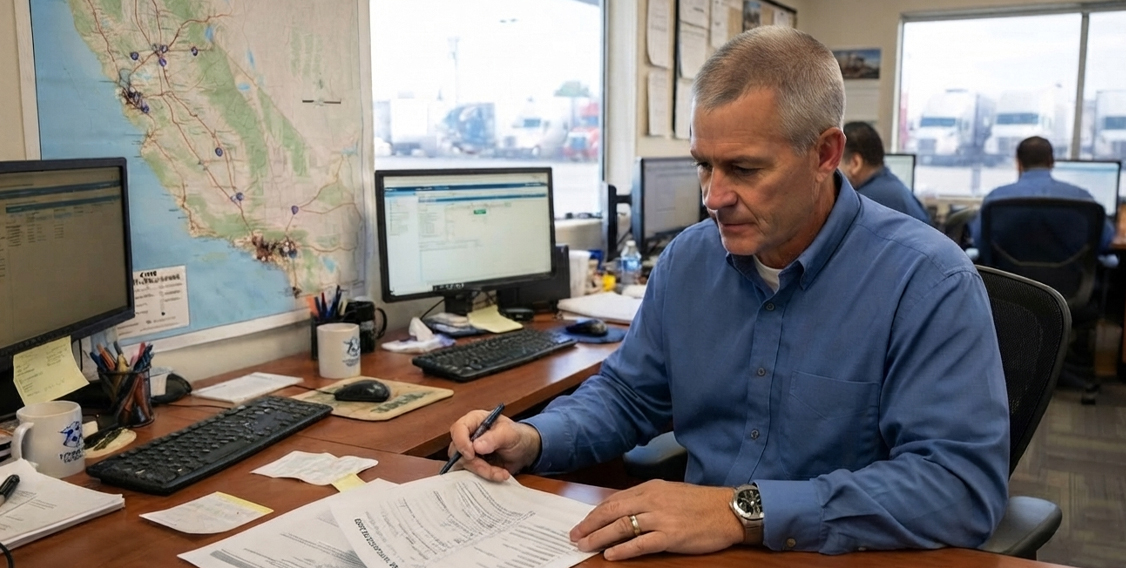
The gap we see most often is this: a carrier based in Arizona, Texas, or Nevada sends trucks into California, assumes their FMCSA compliance covers them, and never registers in the system CARB uses to track emissions compliance. That gap does not show up in a federal inspection and does not appear on an FMCSA safety report. It surfaces during CARB enforcement activity when the truck has no compliance record to show.
In this article, we walk through what the program is, which vehicles it covers, what the four owner steps require, how OBD testing works, and what the October 2027 testing frequency change means for your fleet planning right now. We also explain where a CARB-certified continuously connected device fits in, and why that matters for fleets managing both federal and California obligations at the same time. Any fleet operator who wants to talk through their specific situation before reading further is welcome to schedule a call with our team or reach us at (800) 261-4361.
What Is the CARB Clean Truck Check Program?
Every time we speak with an out-of-state carrier about this program, we hear the same assumption: California emissions requirements only apply to trucks based in the state. That assumption is exactly where most Clean Truck Check compliance gaps begin. CARB Clean Truck Check is a California Air Resources Board emissions compliance monitoring program that requires covered heavy-duty vehicles operating on California public roads to register, submit passing emissions tests, and maintain good standing in a state-administered tracking system. It is not a federal program, it is not administered by the FMCSA, and it operates entirely independently of your ELD or HOS obligations.
The system that tracks all of this is called the Clean Truck Check Vehicle Inspection System, or CTC-VIS. Vehicle registrations, annual compliance fees, emissions test results, and enforcement records all live there. Compliance due dates are vehicle-specific and must be checked in CTC-VIS for each unit in your fleet, per CARB’s Clean Truck Check overview. A truck with no CTC-VIS record is not an unknown quantity to CARB; it is a non-compliant vehicle with nothing to show.
CARB built this program to reduce diesel particulate matter and nitrogen oxide emissions from heavy-duty commercial vehicles. The compliance obligation applies to the vehicle operating in California. That means if you are acquiring used trucks that have previously operated in California, you should check CTC-VIS status for each unit before dispatch, because any compliance gaps or enforcement history on that vehicle carry forward to you as the new owner. For the most current program details, review CARB’s Clean Truck Check overview, as requirements can change.
The detail that surprises most out-of-state operators is not the program itself but how far its reach extends. Any covered truck on California public roads and highways is within scope regardless of where it is registered. That includes a fleet making one delivery into California as much as it includes a carrier running daily California lanes.
Which Trucks Have to Comply With CARB Clean Truck Check?
One of the most common mistakes out-of-state operators make is assuming Clean Truck Check only applies to long-haul interstate freight carriers. That assumption leaves a wide range of vehicle types unprotected. Per CARB’s Clean Truck Check overview, the program generally covers diesel and alternative-fuel heavy-duty vehicles over 14,000 pounds GVWR operating in California, subject to exemptions. Your company does not have to be based in California, and the vehicle does not have to be registered there.
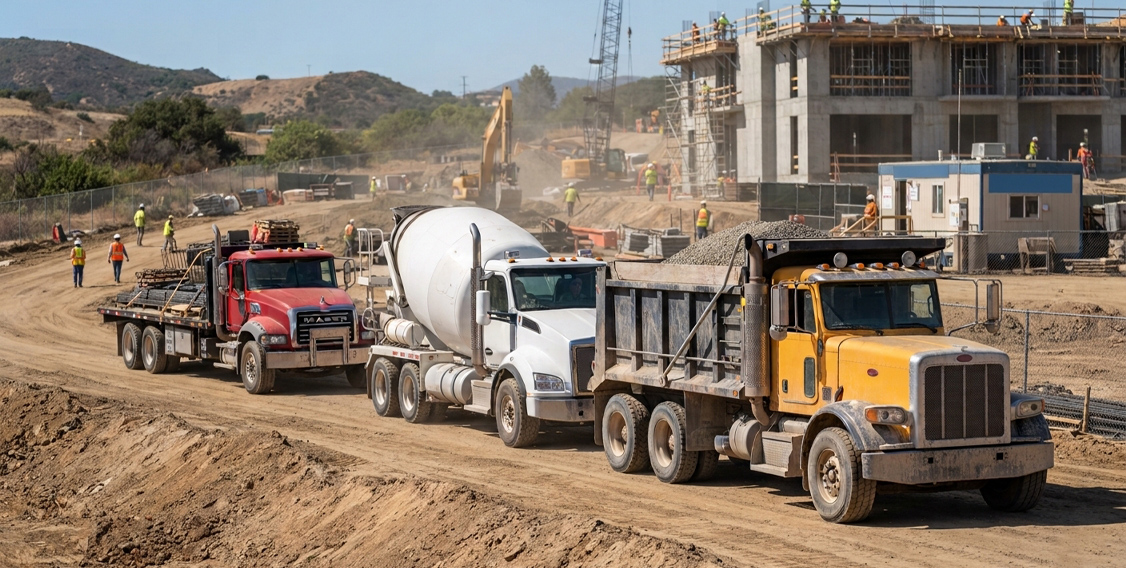
When we work through applicability with fleet managers, the list of potentially covered vehicle types is consistently broader than they expected. The program can reach concrete and cement mixer trucks, dump trucks, construction vehicles, heavy local delivery trucks, heavy service and utility trucks, tow trucks, refuse/garbage trucks, heavy vocational trucks, and many large box trucks, provided the vehicle’s GVWR clears the 14,000-pound threshold and the vehicle type is not in an excluded category. A concrete company running mixers into California on construction contracts faces the same registration and testing obligations as a long-haul freight carrier.
Fuel type, vehicle category, and exemptions all affect whether Clean Truck Check applies to a specific truck, per CARB’s published requirements. Zero-emission vehicles are among the excluded categories, and other exemptions exist. Make every applicability determination against your specific vehicle type and current CARB guidance, not against a general assumption that every truck over 14,000 pounds GVWR is automatically covered. The framing CARB itself supports is this: if your heavy-duty truck operates in California, California’s Clean Truck Check requirements may apply even if your fleet is based in another state. Operators running local routes who are unsure whether federal HOS rules apply to their trucks will find the distinction between state and federal programs explained in our guide on ELD requirements for local trucking.
What Are the Four Owner Steps Under Clean Truck Check?
Per CARB’s Clean Truck Check overview, covered vehicle owners must complete four steps to establish and maintain compliance: register and report the vehicle in CTC-VIS, pay the annual compliance fee, submit required passing emissions tests, and resolve any outstanding enforcement issues. All four must be current for a vehicle to be in good standing. A gap in any one of them puts the vehicle out of good standing regardless of the others.
Register and Report Your Vehicle in CTC-VIS
Without a CTC-VIS registration, none of the other steps can be satisfied because there is no record for fees, tests, or enforcement history to attach to. Registration creates the vehicle’s compliance record, ties it to the responsible owner, and establishes the starting point for fee obligations and testing windows. For operators acquiring used trucks or dispatching vehicles they did not personally enroll, check CTC-VIS registration status for each unit before those trucks enter California. This is not something to circle back to after they are already running.
Pay the Annual Compliance Fee
CARB requires an annual compliance fee for each registered vehicle, and a payment gap creates a compliance deficiency in CTC-VIS regardless of how current the vehicle’s testing record is. Compliance due dates are vehicle-specific, per CARB’s Clean Truck Check overview, so a fleet-wide due date assumption will not hold across every unit. Track fee due dates per vehicle as an ongoing process, not a one-time task.
Submit Required Passing Emissions Tests
Covered vehicles must pass emissions testing within the schedule that applies to their vehicle type and engine model year, and that result must be recorded in CTC-VIS. Per CARB’s published OBD readiness criteria, failed or Not Ready OBD tests can require repairs, additional drive time, and retesting before the vehicle returns to good standing. A vehicle that completed its last OBD scan after its deadline has a compliance gap for the overdue period even if the test result itself was clean. Tracking per-vehicle test due dates is a practical necessity, not optional administration.
Resolve Any Outstanding Enforcement Issues
A vehicle that is registered, fee-current, and test-current can still fall out of good standing if it carries an unresolved enforcement issue in CARB’s system. Per CARB’s published program requirements, noncompliance can lead to enforcement action and, for California-registered vehicles, potential DMV registration holds. Check each vehicle’s CTC-VIS enforcement history when acquiring used trucks, because an unresolved issue on a vehicle you did not create affects your compliance standing as the new owner until it is resolved.
How Does OBD Testing Work Under Clean Truck Check?
When we explain OBD testing to operators unfamiliar with it, the first assumption is usually that it requires a mandatory physical station visit, which makes quarterly testing sound like a major operational disruption. For most covered vehicles the process is far less disruptive, provided the right equipment is in place. Per CARB’s published OBD testing requirements, OBD-equipped vehicles, generally 2013-and-newer diesel engines and 2018-and-newer alternative-fuel engines, have their engine OBD data scanned using a CARB-certified OBD testing device, and that data is transmitted as a compliance record to CTC-VIS. Testing must use a CARB-certified device; not every OBD scanner qualifies.
The OBD port is the same diagnostic connection point used for engine fault code reading and routine maintenance. A CARB-certified device connects via a 9-pin J1939 or 16-pin J1979/J1979-2 connection, reads the required emissions data, and submits it to CARB. Drivers do not need to take the truck to a fixed testing station when a certified device handles data retrieval and transmission directly.
Testing frequency is where the operational challenge grows. Almost all affected vehicles are currently on semiannual testing, meaning two submissions per year. Beginning October 2027, OBD-equipped vehicles generally move to four tests per year, per CARB’s emissions compliance testing requirements, while agricultural vehicles and qualifying noncommercial motorhomes remain annual. Quarterly testing increases scheduling, documentation, downtime, and administrative workload for fleets managing this process manually. For a fleet of 15 trucks currently submitting 30 total tests per year, the shift means 60 annual submissions.
A continuously connected device changes the calculation for fleets facing that submission volume. Per CARB’s OBD test device records, Pacific Track is listed under Executive Order IM-006-0001-5, and their PT40 and PT40-Q are certified as continuously connected devices, supporting SAE J1939, J1979, and J1979-2 connections. When CARB functionality is enabled by the solution provider and applicable to the vehicle’s compliance situation, the PT40 can periodically or on request retrieve the required emissions data and transmit it to CARB. Pacific Track states on their website that this capability can, in applicable situations, reduce or eliminate the need to take the vehicle to a testing station for OBD compliance tests. Per Pacific Track, the CARB submission does not include telematics information such as the vehicle’s location, speed, driving behavior, or location history.
Our ELD hardware and platform is integrated with the PT40, and Pacific Track described it at CARB certification as the first 3-in-1 telematics, ELD, and CARB Clean Truck Check solution with certification for both J1939 and J1979 vehicles. If you want to confirm current PT40 availability, pricing, and how it fits into your existing setup, our team is reachable at (800) 261-4361.
Does a Federal ELD Exemption Affect Clean Truck Check Compliance?
We hear this question regularly from carriers who have invested in full ELD compliance and assume their federal obligations cover their California obligations too. They do not. A federal ELD exemption has no effect on whether CARB Clean Truck Check applies to your truck. The two programs are administered by different agencies under entirely different legal authority, and neither satisfies or overrides the other.
Federal ELD requirements are established under 49 CFR Part 395, which governs Hours of Service recordkeeping and is administered by the FMCSA. Clean Truck Check is a California state emissions program administered by CARB under California environmental regulations. A driver who meets the criteria for the short-haul exemption and is not required to use an ELD under federal rules is still subject to Clean Truck Check if their vehicle meets CARB’s GVWR threshold and operates on California public roads.
The separation works the other way too, and we want to be direct about this. A carrier running Geosavi Compliance Now with a clean FMCSA safety record has not satisfied a single one of Clean Truck Check’s four owner steps if they have never registered their trucks in CTC-VIS. Federal safety fitness standards track your FMCSA compliance history, and that record carries no weight with CARB.
FMCSA ELD Requirements vs CARB Clean Truck Check
| Factor | FMCSA ELD Requirements | CARB Clean Truck Check |
|---|---|---|
| Administering agency | Federal Motor Carrier Safety Administration | California Air Resources Board |
| Legal authority | Federal, 49 CFR Part 395 | California state environmental law |
| Primary purpose | Hours of Service recordkeeping | Heavy-duty vehicle emissions monitoring |
| Geographic trigger | Operating a CMV in interstate commerce, or intrastate where the state adopts the federal rule | Operating a covered vehicle on California public roads and highways |
| Vehicle threshold | Generally GVWR 10,001 lb or more in qualifying commerce, per 49 CFR 390.5 | Manufacturer GVWR over 14,000 lb, diesel or alternative-fuel, subject to exemptions |
| Out-of-state reach | Applies based on commerce type and route, not registration state | Applies to qualifying vehicles operating in California regardless of registration state |
| Compliance record | ELD data transferred to DOT officer at roadside per 49 CFR 395.8 | CTC-VIS registration, annual fee payment, and passing test submission |
| Recurring obligations | Real-time HOS logging, DVIR, supporting document retention | Annual fee, periodic OBD emissions testing, no unresolved enforcement issues |
| Testing method | Roadside ELD data transfer via Bluetooth, USB, or encrypted email | OBD scan using a CARB-certified OBD testing device |
| Key exemptions | Short-haul, pre-2000 engine, agricultural, utility service vehicle, and others | Zero-emission vehicles and certain other categories, per CARB’s published requirements |
| Non-compliance consequences | Citation, out-of-service order, maximum civil penalties per 49 CFR Appendix B to Part 386 | Enforcement action and, for California-registered vehicles, potential DMV registration holds, per CARB’s published requirements |
Questions to Ask Before Your Fleet Enters California
Does my truck’s GVWR exceed 14,000 pounds?
The manufacturer’s GVWR on your vehicle’s door placard or title is the figure CARB uses, not the actual loaded weight on any given trip. If your truck’s GVWR exceeds 14,000 pounds, your fleet is in the range where Clean Truck Check applicability analysis begins. In our experience this threshold regularly reaches concrete mixers, dump trucks, heavy tow trucks, refuse vehicles, and many large box trucks. Check the placard rather than estimating, because a CARB inspector will check it if your trucks are ever subject to enforcement activity.
Does my vehicle type fall into an excluded category?
Fuel type, vehicle category, and exemptions all affect whether Clean Truck Check applies to your specific truck, per CARB’s published requirements. Zero-emission vehicles are among the excluded categories, and other exemptions exist. If your operation involves agricultural equipment, qualifying noncommercial motorhomes, or another specialized vehicle type, verify your classification against CARB’s Clean Truck Check overview before drawing any conclusion about applicability. Assuming an exemption applies without confirming it carries the same enforcement risk as assuming the program does not apply at all.
Is each truck registered in CTC-VIS, and is that registration current?
A vehicle with no CTC-VIS registration has no compliance record, and in our experience that is the most serious gap a fleet can carry into California. If you are managing inherited trucks, recently acquired vehicles, or a fleet you did not personally enroll, confirm CTC-VIS status for each unit before dispatch. A lapsed registration is easier to correct than no registration, but neither is acceptable when CARB enforcement reaches your trucks.
Has each vehicle submitted a passing test within the required window?
Compliance due dates are vehicle-specific and must be checked in CTC-VIS for each unit, per CARB’s Clean Truck Check overview. Per CARB’s published OBD readiness criteria, failed or Not Ready OBD tests can require repairs, additional drive time, and retesting before a vehicle returns to good standing. Build a per-vehicle test tracking process now rather than waiting until the quarterly testing requirement takes effect in October 2027.
Is my fleet ready for quarterly OBD testing beginning October 2027?
Most of the fleets we work with currently complete two emissions tests per truck per year. Beginning October 2027, OBD-equipped vehicles generally move to four tests per year, per CARB’s emissions compliance testing requirements. Quarterly testing increases scheduling, documentation, downtime, and administrative workload. For a fleet managing this manually, the doubling of submissions is an immediate operational change when it takes effect. The period between now and October 2027 is your planning window.
Would a continuously connected OBD device reduce my testing burden?
The PT40, listed on CARB’s certified device registry under Executive Order IM-006-0001-5, can retrieve and transmit required emissions data to CARB periodically or on request when CARB functionality is enabled and applicable to the vehicle’s compliance situation. Pacific Track states this can, in applicable situations, reduce or eliminate the need for physical testing station visits. Fleets interested in exploring this option can review setup costs through our fleet pricing calculator and contact our team to confirm how the PT40 applies to their specific vehicle types and compliance schedule.
Does my ELD platform integrate with a CARB-certified device?
Running separate systems for federal ELD compliance and California emissions testing creates duplicate overhead for your back office and additional hardware in the cab. Our ELD platform is integrated with the PT40, meaning a single in-cab installation can cover the FMCSA’s hours-of-service requirements, GPS, and CARB Clean Truck Check OBD submissions together. Call our team at (800) 261-4361 to confirm how this integration works for your fleet before deployment.
What should I do if I am unsure whether my specific vehicles qualify?
Uncertainty about applicability is not a reason to delay. Fuel type, GVWR, model year, and vehicle category all factor into the analysis, per CARB’s published requirements. Verify your specific vehicle types against current CARB guidance before dispatch. Fleets with questions spanning both federal ELD obligations and California emissions compliance will find answers to many of the most common situations in our compliance FAQ, or can reach our team for fleet-specific guidance.
Common Questions About Clean Truck Check
About CARB Clean Truck Check and California Compliance
What does CARB stand for, and what does it have to do with my trucks?
CARB stands for the California Air Resources Board, the state agency responsible for controlling air pollution from vehicles and other sources in California. Clean Truck Check is one of CARB’s heavy-duty vehicle emissions monitoring programs. Per CARB’s published requirements, it applies to qualifying trucks over 14,000 pounds GVWR operating on California public roads, including trucks from out-of-state fleets that enter California on any basis.
We operate out of Texas. Does CARB Clean Truck Check apply to our trucks when they run routes into California?
Per CARB’s published program requirements, the rule applies to qualifying trucks operating in California even when registered in another state. If your trucks operate on California public roads and meet the GVWR and vehicle type criteria, Clean Truck Check may apply regardless of where your fleet is registered. Verify your specific situation against CARB’s vehicle inspection system guide to confirm applicability.
What is CTC-VIS and why does it matter?
CTC-VIS is the Clean Truck Check Vehicle Inspection System, CARB’s online platform where vehicle owners register, pay annual fees, and submit emissions test results. Compliance due dates are vehicle-specific and tracked in CTC-VIS, per CARB’s Clean Truck Check overview. A truck with no CTC-VIS record has no compliance history to present if CARB enforcement activity reaches it.
Which vehicles are excluded from Clean Truck Check?
Fuel type, vehicle category, and exemptions all affect whether Clean Truck Check applies, per CARB’s published requirements. Zero-emission vehicles are among the excluded categories, and other exemptions exist. Verify your specific vehicle type against current CARB guidance to confirm whether your trucks are covered or excluded.
How often does my truck need to be tested right now?
Almost all affected vehicles are currently on semiannual testing, meaning two submissions per year. Beginning October 2027, OBD-equipped vehicles generally move to four tests per year, per CARB’s emissions compliance testing requirements. Agricultural vehicles and qualifying noncommercial motorhomes remain on an annual schedule.
What happens if my truck fails a CARB emissions test?
Per CARB’s published OBD readiness criteria, failed or Not Ready OBD tests can require repairs, additional drive time, retesting, and may risk missed deadlines. A failed test creates a compliance gap in CTC-VIS. Address the underlying emissions issue and retest as quickly as possible to minimize the gap in your compliance record.
What are the consequences of non-compliance?
Per CARB’s published program requirements, noncompliance can lead to enforcement action and, for California-registered vehicles, potential DMV registration holds. For the most current information on consequences specific to your vehicle type and situation, review CARB’s Clean Truck Check compliance requirements.
ELD Compliance, the PT40, and How We Can Help
Does having a registered ELD mean I am compliant with CARB Clean Truck Check?
No, and this is one of the most important points we make with every out-of-state fleet we work with. A registered ELD satisfies federal FMCSA requirements for Hours of Service recordkeeping under 49 CFR Part 395. Clean Truck Check is a California state emissions program with entirely separate compliance steps. Having a compliant ELD does not register your vehicle in CTC-VIS, pay your annual fee, or submit any emissions test on your behalf.
If I qualify for a federal ELD exemption, am I also exempt from Clean Truck Check?
No. Federal ELD exemptions apply to FMCSA’s HOS recordkeeping requirement and have no bearing on California state emissions compliance. A driver exempt from the ELD mandate is still subject to Clean Truck Check if their vehicle meets CARB’s applicability criteria.
What is the PT40 and what does it do for Clean Truck Check compliance?
The Pacific Track PT40 is listed on CARB’s certified device registry under Executive Order IM-006-0001-5 as a continuously connected device, supporting SAE J1939, J1979, and J1979-2 connections via a 9-pin J1939 or 16-pin J1979/J1979-2 diagnostic port. When CARB functionality is enabled by the solution provider and applicable to the vehicle’s compliance situation, Pacific Track states the PT40 can retrieve and transmit required emissions data to CARB, potentially reducing the need for physical testing station visits. Talk with Pacific Track and our team to confirm how this applies to your specific vehicles and compliance schedule before building it into your operations.
Does the PT40’s CARB data submission include my truck’s location or driving history?
No. Per Pacific Track’s published statements, the CARB submission does not include telematics information such as the vehicle’s location, speed, driving behavior, or location history. The submission covers only the emissions-related OBD data CARB requires.
Is Geosavi’s ELD platform compatible with the PT40?
Yes. Our ELD platform is integrated with the PT40. Reach out to our team to confirm current PT40 availability, pricing, and how the integration works alongside your existing setup before making a purchasing decision.
Where can I find more about Geosavi’s ELD tools while I research Clean Truck Check?
Our support team is available 24/7 for technical questions covering ELD rules, HOS requirements, fleet management, and related compliance topics.
Conclusion
CARB Clean Truck Check is the compliance program most out-of-state fleet operators did not plan for, and in our experience it catches carriers off guard precisely because their federal compliance record looks clean. Per CARB’s published requirements, the program applies to qualifying trucks operating in California regardless of where they are registered. CTC-VIS registration, annual fees, passing emissions tests within the required window, and resolving enforcement issues are the four owner steps every covered vehicle must maintain, and none of them overlap with anything the FMCSA tracks.
The October 2027 shift to quarterly OBD testing gives fleets that act now a real advantage over those that wait. Getting your CTC-VIS registration current and your testing process in place before the change takes effect means you are not scrambling to catch up while also absorbing a doubled submission load. The PT40 is listed on CARB’s certified device registry and integrates with our ELD platform, which means your fleet can handle ELD compliance, GPS, and CARB OBD submissions through a single in-cab device rather than managing separate systems.
Call us at (800) 261-4361 or use our pricing calculator to see what that setup looks like for your fleet size.