Key Takeaways
- A CDL must be verified before a new driver takes the wheel, under 49 CFR Part 383.
- English proficiency checks have been enforced at roadside since June 25, 2025, under 49 CFR 391.11(b)(2), with a narrow exception for drivers operating entirely within U.S.-Mexico border commercial zones.
- HOS violations climbed from 410,000 in 2023 to more than 500,000 in 2025, according to RigDig data cited by Overdrive, April 2026.
- Carrier fines for HOS violations run as high as $19,246, driver fines up to $4,812, and falsification fines up to $15,846, all maximum civil penalty amounts adjusted annually for inflation under the FMCSA penalty schedule.
- CVSA recorded 58,382 falsification-of-record-of-duty-status violations in 2024, the second most-cited driver violation that year.
- Driver harassment protections apply starting on a new driver’s first day of employment under 49 CFR 390.36.
- As of July 22, 2026, new drivers need data transfer instructions, malfunction reporting instructions, and at least 8 days of blank graph-grid paper logs in the cab, under 49 CFR 395.22(h). The separate ELD user’s manual requirement has been rescinded.
- DVIR training belongs in week one, not week three, and is required under 49 CFR 396.11.
| Table of Contents |
|---|
| Why Onboarding Matters |
| Verify Before Driving |
| ELD Training |
| HOS Training |
| DVIR Training |
| Risks of Rushing |
| Onboarding Comparison |
| Questions to Ask |
| Onboarding FAQ |
Introduction
You hire a new driver, hand over the keys, and hope for the best. That’s how a lot of fleets still handle onboarding, and it’s how a lot of fleets end up with a driver’s first violation showing up in week one. We’ve watched this pattern repeat across small and mid-size operations: the driver has a clean CDL, a decent interview, and zero idea how your ELD actually works.
The mistakes that show up early rarely stay small. A driver who doesn’t know how to log an unassigned segment, doesn’t understand when an ELD exception applies, or doesn’t know what to do when a DVIR flags a defect isn’t just a training gap. That’s a citation waiting to happen, and under current enforcement, it’s the kind of gap inspectors are trained to find during a roadside stop.
What fixes it is a real onboarding process, not a rushed one. Here, we’ll walk through what you verify before a driver ever starts the truck, how you train them on your ELD, what they need to know about hours of service and DVIRs, and what happens when any of these steps get skipped. None of this is complicated. It just has to happen in the right order, with the right documentation behind it.
If you’re rebuilding your onboarding process from scratch or just tightening what you already have, it helps to see how your current setup handles a brand-new driver from the start. Our price calculator can give you a clear read on what a properly equipped truck costs to bring online, which is often the first practical question that comes up once onboarding gets formalized. If you’d rather just talk it through, you can always schedule a call with our team at (800) 261-4361.
Why Does Onboarding Matter for Compliance?
Onboarding is where your compliance record actually gets set, because most HOS and log violations trace back to a driver who was never properly trained rather than one who deliberately broke a rule.
When a new driver climbs into your truck for the first time, they’re carrying whatever habits their last carrier taught them, good or bad. If that carrier ran loose, your new hire probably logged loose too. Onboarding is your one real chance to reset that before it becomes a pattern on your record.
HOS violations rose from 410,000 in 2023 to more than 500,000 in 2025, according to RigDig data cited by Overdrive, April 2026. A good share of that growth comes from drivers who never got a real walkthrough of how their ELD logs duty status, handles personal conveyance, or flags an unassigned segment. A driver who understands your system starting on their first day drives with fewer surprises, and your fleet carries fewer unexplained violations on its safety record.
What Bad Onboarding Habits Look Like
A driver who was never shown how personal conveyance works, never walked through an unassigned segment, and never saw a real DVIR before their first solo run isn’t unprepared by accident. That’s a training gap your fleet inherited from whoever hired last.
What Should You Verify Before a New Driver Gets Behind the Wheel?
Before any new driver starts a shift, confirm their CDL status, English proficiency, and that your ELD is registered on the FMCSA list, because skipping any of these turns a hiring decision into a compliance risk.
Confirm the CDL
Every driver operating a commercial motor vehicle needs a valid CDL that matches the vehicle class and endorsements your fleet actually runs, under 49 CFR Part 383. Don’t take a photo of the card at face value. Confirm it’s current and not restricted in a way that conflicts with the routes you’re assigning.
Confirm English Proficiency
English proficiency is the next check, and it’s not optional paperwork anymore. Enforcement under 49 CFR 391.11(b)(2) has been active since June 25, 2025, and inspectors are trained to test it during a roadside stop. If a driver can’t read a road sign or explain a log entry to an officer, that’s an out-of-service order waiting to happen, regardless of how clean the rest of their file looks.
There’s one narrow exception worth knowing. FMCSA guidance allows a driver to be cited for an English proficiency violation without being placed out of service, but only while that driver’s trip stays entirely within a designated U.S.-Mexico border commercial zone. The moment the trip extends beyond that zone, the standard out-of-service consequence applies. Don’t treat this as a general pass for any driver on your fleet; it only covers a specific route pattern in a specific geography.
Confirm Your ELD Is Still Registered
Then confirm your own equipment is in order. Your ELD needs to be on the FMCSA registered ELD list before a new driver’s first log is ever recorded on it. If you’re bringing on drivers for local routes, it’s worth reviewing our local drivers ELD guide alongside this step, since local operations sometimes qualify for exemptions that affect what training a driver actually needs.
How Do You Train a New Driver on Your ELD System?
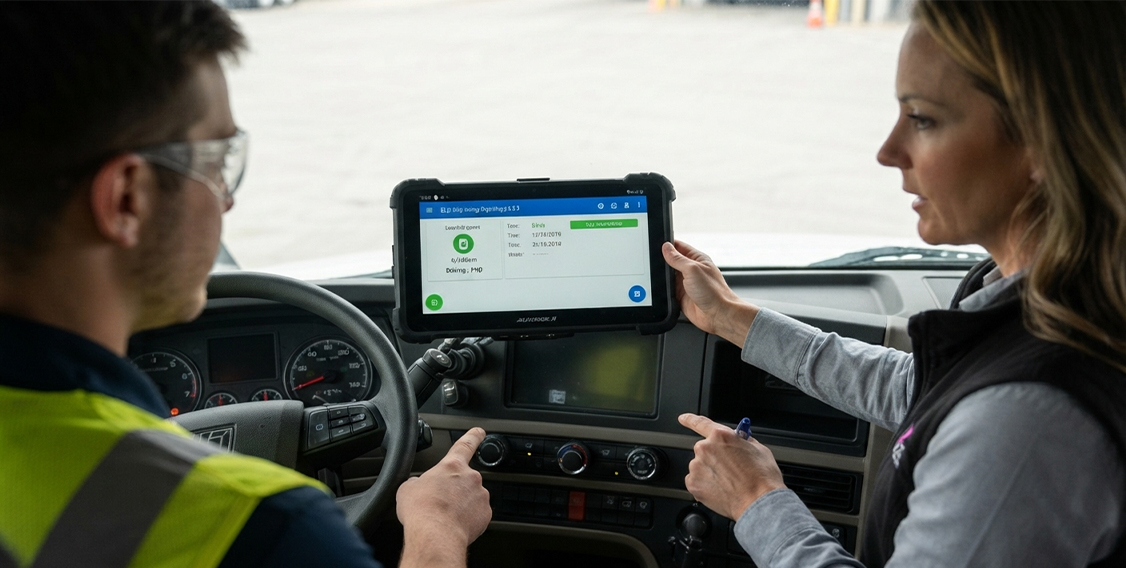
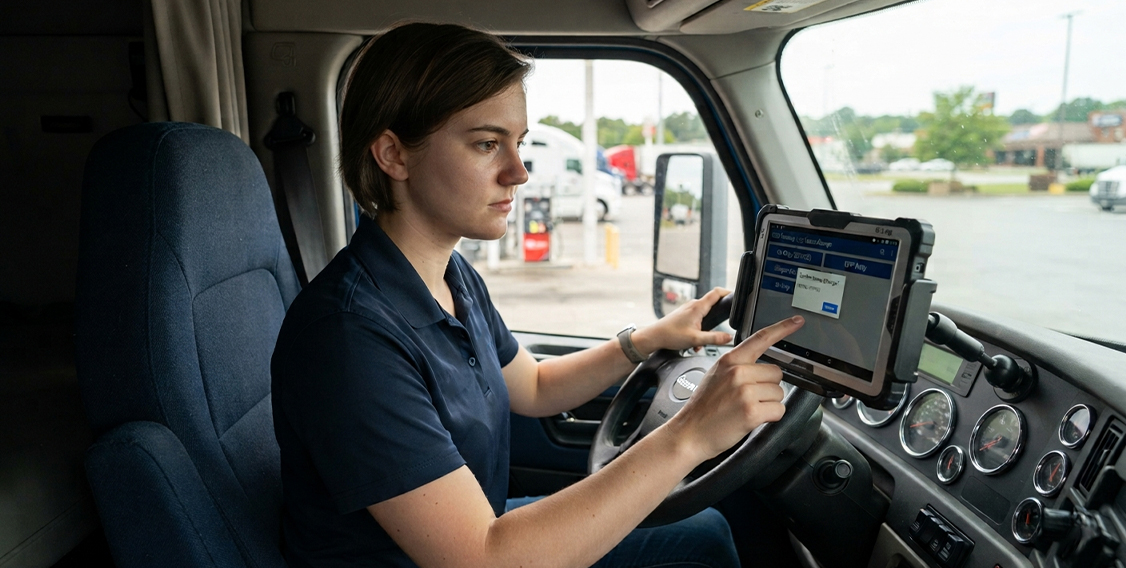
ELD training should happen in the cab, not in a break room, and should cover login, duty status changes, unassigned driving segments, and the current in-cab documentation requirements before the driver’s first solo trip.
A new driver doesn’t need a lecture on ELD history. They need to sit in the truck, log in with their own credentials, and walk through a full duty cycle: on-duty not driving, driving, off-duty, and personal conveyance if your fleet allows it. Have them make a mistake during training rather than during a roadside inspection.
Cover Unassigned Driving Segments Early
New drivers are the ones most likely to leave one unclaimed, which shows up as a red flag the moment an inspector pulls the log. Walk through how your platform handles this, and show them where the required in-cab materials are kept.
What Belongs in the Cab as of July 2026
As of July 22, 2026, FMCSA rescinded the requirement to carry a printed ELD user’s manual under 49 CFR 395.22(h). What still has to be in the vehicle, per the same regulation, is an instruction sheet describing the ELD’s data transfer process, an instruction sheet covering malfunction reporting and recordkeeping, and a supply of blank graph-grid paper logs sufficient for at least 8 days. Carrying a copy of the user’s manual is still allowed, and it’s still a useful reference for a new hire, but it’s no longer a citable item if it’s missing.
Our ELD platform and hardware breaks down exactly what the device shows a driver at each stage of a duty cycle, and it’s a useful reference to hand a new hire during their first week rather than relying on memory alone. If a device gets flagged or removed from the registered list, don’t wait to retrain drivers on the replacement. Check the FMCSA registered ELD list directly rather than relying on secondhand word from another carrier.
What Do New Drivers Need to Know About Hours of Service?
New drivers need to understand their daily and weekly driving limits, trequired rest breaks, and how a violation actually gets logged, because most first-week HOS mistakes come from drivers who never had the rule walked through with them.
Hours of service training goes wrong when it’s handed over as a printed regulation with no context. Walk a new driver through what their day actually looks like: driving limits, required breaks, and how the weekly limit resets. The rules themselves live in FMCSA HOS regulations, but a driver retains almost none of that from a PDF alone.
Make Sure Drivers Understand ELD Exceptions
Drivers should understand when an ELD is required and when an exception may apply. Under 49 CFR 395.8(a)(1)(iii), a driver who is required to prepare records of duty status on no more than 8 days within any rolling 30-day period may qualify for the limited ELD exception. This is different from the Hours of Service rules governing driving limits and required breaks, so fleets should make sure new drivers understand the distinction.
The same goes for knowing falsification under 49 CFR 395.8(e)(1). Make it clear from the start that editing a log to cover a missed break isn’t a shortcut. It’s a separate violation, and one of the more expensive ones on the books.
Fatigue and HOS Habits Are Connected
A driver who doesn’t respect their own limits during the first few weeks tends to keep pushing them later. Our ELD safer roads article covers how consistent HOS habits connect directly to fewer fatigue-related incidents, and it’s worth sharing with new hires as part of training rather than treating it as a separate read.
How Should New Drivers Learn to Handle DVIRs?
New drivers should complete a supervised pre-trip and post-trip DVIR before their first solo run, because a driver who doesn’t know what a defect looks like won’t report one, and that gap shows up in inspections and in maintenance costs alike.
DVIR training gets treated as a formality far too often. A rushed walk-around teaches a new driver that inspections are a box to check rather than a genuine safety step. Under 49 CFR 396.11, drivers are required to report any defect that could affect safety, and that only works if they actually know what they’re looking at.
Why the Post-Trip Report Matters Most
The post-trip DVIR carries the most weight in this process. If a driver finds a defect that could affect safety, it has to go on that report. From there, the vehicle can’t be dispatched again until the defect is certified as repaired, and that repair record has to be kept on file. A new driver who doesn’t understand this reporting, certification, and record-retention chain is the one most likely to skip a step or assume someone else already caught the problem. That’s exactly why this training belongs in week one.
Walk Through a Full DVIR Cycle Before the First Solo Run
Show a new hire how a defect gets logged in your system, what happens after it’s flagged, and how that record connects back to your maintenance file. Our ELD and DVIR integration covers how this connection works in more detail, and it’s a solid piece to send a new driver before their first day on the road rather than after.
Once a driver understands that a flagged defect protects them, not just the vehicle, DVIR training stops feeling like paperwork and starts feeling like part of the job.
What Happens When Onboarding Gets Skipped or Rushed?
Rushed onboarding shows up as violations, not immediately, but within the first few weeks, once a driver’s untrained habits meet a roadside inspection.
Skipping steps in onboarding rarely causes an immediate problem; it causes a delayed one instead. A driver who wasn’t properly trained on unassigned segments looks fine for a week or two, right up until an inspector pulls their log and finds gaps. At that point, you’re not just correcting a training issue. You’re looking at a citation, a mark on your safety record, and a driver who now associates your fleet with confusion rather than clarity.
Carrier fines for HOS violations run as high as $19,246, and knowing falsification carries penalties up to $15,846, both maximum civil penalty amounts adjusted annually for inflation under the FMCSA penalty schedule. CVSA recorded 58,382 falsification-of-record-of-duty-status violations in 2024, the second most-cited driver violation that year, and a meaningful share trace back to drivers who never received a real explanation of what an edit or annotation actually requires.
If you’re not sure whether your current onboarding covers everything it should, our support team can walk through your setup and point out gaps before they turn into violations on the road.
Onboarding Comparison
| Onboarding Step | Rushed Approach | Structured Approach |
|---|---|---|
| CDL verification | Glanced at during hiring | Confirmed against class and endorsements before first shift |
| English proficiency check | Assumed, not tested | Verified in person before dispatch |
| ELD login and duty status | Driver figures it out alone | Supervised walkthrough of a full duty cycle |
| Unassigned driving segments | Left for the driver to discover | Explained and demonstrated before solo runs |
| HOS limits and required breaks | Handed over as a printed page | Walked through with real shift examples |
| DVIR pre-trip and post-trip | Treated as a formality | Completed under supervision before first solo trip |
Questions to Ask Before You Finalize Your Onboarding Process
How long should onboarding take before a driver runs solo?
Most fleets can cover CDL verification, ELD training, and a supervised DVIR cycle within 2 to 3 days. Rushing this to a single afternoon is usually where the gaps start.
What documents need to be on file before a driver’s first trip?
At minimum, a verified CDL, proof of English proficiency review, and confirmation the driver has the current in-cab ELD materials required under 49 CFR 395.22(h): data transfer instructions, malfunction reporting instructions, and at least 8 days of blank graph-grid paper logs. Missing any of these leaves your fleet exposed during an audit.
How do you confirm a driver actually understands your ELD before their first solo run?
Have them complete a full duty cycle in front of a supervisor, not just log in and drive off. A driver who can explain what they’re doing is far less likely to leave an unassigned segment unclaimed.
What should a new driver know about supporting documents?
They should understand that supporting documents back up their logs under 49 CFR 395.8(k), and that carriers are required to retain them for 6 months under 395.8(k)(1). A driver who doesn’t save receipts or bills of lading makes that retention requirement harder to meet.
How do you handle a driver who struggles with the English proficiency check?
Handle it before their first dispatch, not after a roadside stop. This isn’t a step to work around, since enforcement under 49 CFR 391.11(b)(2) applies regardless of how strong the rest of the driver’s file looks, outside of the narrow border-zone exception covered earlier in this guide.
What’s the difference between onboarding a new CDL holder and retraining an experienced hire?
A new CDL holder usually needs the full process from scratch. An experienced hire often just needs a walkthrough of your specific ELD platform, since their HOS habits are already formed, for better or worse.
How do you document that onboarding actually happened?
Keep a simple checklist signed by both the driver and the supervisor who ran the training. If a violation ever gets disputed, that record is what shows your fleet did its part.
What’s the plan if a new driver’s ELD malfunctions during their first week?
Make sure they know the paper log fallback before it’s needed, not after. Confirm the truck actually has the required 8-day supply of blank graph-grid logs under 49 CFR 395.22(h) before they ever leave the yard. A driver who’s never seen a malfunction before their first week is far more likely to panic and log incorrectly.
Onboarding FAQ
About New Driver Compliance and Road Safety
Does a new driver need CDL verification before their first trip?
Yes. A valid CDL matching the vehicle class and endorsements is required under 49 CFR Part 383 before a driver operates any commercial motor vehicle.
Is English proficiency actually enforced at roadside inspections?
Yes, and it has been since June 25, 2025, under 49 CFR 391.11(b)(2). Inspectors can place a driver out of service if they can’t demonstrate it, with the exception of drivers whose current trip stays entirely within a U.S.-Mexico border commercial zone, who can be cited but not placed out of service.
Does a driver still need to carry a printed ELD user’s manual?
No. FMCSA rescinded that requirement effective July 22, 2026. Drivers still need data transfer instructions, malfunction reporting instructions, and at least 8 days of blank graph-grid paper logs in the vehicle, under 49 CFR 395.22(h).
What happens if a new driver logs an unassigned driving segment?
It stays flagged on the vehicle’s ELD until claimed or resolved. Left unresolved, it becomes visible during a roadside inspection and can raise questions about who was actually driving.
Can a new driver be held responsible for a falsified log they didn’t understand?
Knowing falsification carries fines up to $15,846 under 49 CFR 395.8(e)(1), and a driver who wasn’t trained properly is still the one whose name is on the log. That’s exactly why onboarding matters.
How does DVIR training connect to road safety?
A driver who knows how to spot and report a defect catches problems before they become breakdowns or crashes, the same connection between good habits and fewer incidents on the road that we cover in our article on how ELDs support safer driving. It also means a flagged defect gets certified as repaired before the truck goes back out, which is where the real safety benefit sits.
Do harassment protections apply to a driver during their first week?
Yes. Protections under 49 CFR 390.36 apply starting on the first day of employment, not after a probationary period.
About Building Your Onboarding Process
What’s the minimum a fleet should cover during onboarding?
CDL verification, English proficiency review, a supervised ELD walkthrough, HOS training, and a supervised DVIR cycle. Skipping any of these leaves a real gap.
Should onboarding differ for local drivers versus long-haul drivers?
Some of the requirements shift. Local operations sometimes qualify for different exemptions, a distinction we cover in our guide on local driver ELD requirements referenced earlier in this article.
How do you know if your ELD is still on the FMCSA registered list?
Check the FMCSA registered ELD list directly rather than assuming your device is still approved. Devices have been removed from that list regularly through 2026.
What questions should you ask before choosing an ELD platform for a growing fleet?
Ask how the platform handles training for new drivers, what support looks like after installation, and how clear the pricing is as your truck count grows. Our FAQ covers many of the questions fleets ask before switching providers.
How much should onboarding cost per truck?
That depends on your current setup and how many trucks you’re bringing online at once. Our price calculator, linked earlier in this article, gives a clear estimate based on your actual fleet size rather than a generic quote.
What should a fleet do if onboarding reveals a driver isn’t ready?
Hold them back from solo runs until the gap is closed. A short delay in onboarding costs far less than a violation on your safety record.
Conclusion
Most fleets don’t struggle with a lack of rules. They struggle with a lack of process. A new driver’s first week sets the tone for everything that follows. Skip the details now, and you’ll spend months untangling habits that never should have formed in the first place.
Build it right from the start instead, and your fleet gains a driver who understands your system instead of guessing at it. Enforcement in 2026 isn’t getting lighter. English proficiency checks are active at roadside, the in-cab ELD documentation requirements changed as recently as July 22, 2026, and inspectors are trained to spot the gaps that rushed onboarding leaves behind. A structured process isn’t extra work. It’s the difference between a driver who protects your safety record and one who quietly puts it at risk.
If you want a second set of eyes on your current onboarding process, reach out to our team at (800) 261-4361 or schedule a call with our team, and we’ll walk through what your fleet has in place and where it might need tightening.