Key Takeaways
- A DOT safety audit is governed by the FMCSA safety fitness procedures under 49 CFR Part 385, which set the standards for how carriers are rated Satisfactory, Conditional, or Unsatisfactory.
- Motor carriers face a maximum civil penalty of up to $19,246 per HOS violation, and drivers face up to $4,812, under 49 CFR Appendix B to Part 386, adjusted annually for inflation.
- HOS violations nationwide rose from 410,000 in 2023 to more than 500,000 in 2025, according to RigDig data cited by Overdrive in April 2026.
- 79 ELD devices have been removed from the FMCSA-registered ELD list since January 2025, with the most recent batch of 12 devices pulled on May 20, 2026, and auditors check every device against this list.
- CVSA’s 2026 International Roadcheck ran May 12 to 14 and made ELD tampering and log integrity its primary focus, following 58,382 falsification violations recorded in 2024.
- HOS citation rates dropped from 1.19 percent in December 2017 to 0.69 percent once full ELD enforcement began in April 2018, according to FMCSA enforcement data.
- English proficiency enforcement under 49 CFR 391.11(b)(2) has been active since June 25, 2025, and auditors now check this during driver qualification file review.
- Supporting documents must be retained for at least 6 months under 49 CFR 395.8(k)(1), and missing documentation is one of the most common findings in a safety audit.
| Table of contents |
|---|
| Audit Basics |
| Audit Triggers |
| SMS and Audits |
| Audit Outcomes |
| Getting Ahead of It |
| Buyer Questions |
| Compliance Questions |
Introduction
Most fleet owners think of a DOT safety audit as something that happens to someone else, right up until the letter arrives with a date on it. A safety audit is not a roadside inspection and it is not a courtesy check. It is a formal review of your entire operation, and it can end with a rating that follows your business into every insurance renewal and every load broker’s screening process.
This matters because the outcome is not just a grade. A Conditional or Unsatisfactory rating can restrict your operating authority, and in serious cases FMCSA can order a carrier to stop operating entirely. What most fleet owners get wrong is assuming an audit is random. It rarely is. FMCSA’s own data tells the agency where to look before an investigator ever picks up the phone.
The confusion usually starts there: what actually puts a carrier on FMCSA’s radar, what your SMS data has to do with it, and what the difference is between a rating that limits you and one that shuts you down. A lot of fleets do not find out where their gaps are until an investigator points them out.
Here is what actually triggers a DOT safety audit in 2026, how your SMS standing feeds into that decision, and what a rating means for your operation afterward. If it has been a while since you checked your own SMS percentiles or confirmed every device in your fleet is still on the current registered list, that is worth doing before anyone else does it for you. If you would rather talk it through than dig through the data alone, our support team can help you look at where things stand.
What Is a DOT Safety Audit and Why Does FMCSA Conduct One?
A DOT safety audit, formally a compliance review, is a detailed FMCSA investigation into whether your carrier is meeting federal safety regulations, and it ends with a safety rating that becomes part of your public record. FMCSA conducts these reviews to confirm that carriers operating commercial vehicles are not creating unacceptable risk on public roads.
The process and the ratings themselves are defined under the FMCSA safety fitness procedures, which set out exactly how an investigator evaluates a carrier and how that evaluation converts into a Satisfactory, Conditional, or Unsatisfactory rating. This is different from a roadside inspection, which looks at one truck and one driver on one day. A compliance review looks at your whole operation, often pulling six months or more of records across every truck and every driver on your roster.
Not every carrier gets audited, and the reasons one carrier gets a letter and another does not are rarely arbitrary, which is what the next section covers.
What Actually Triggers a DOT Safety Audit for Your Carrier in 2026?
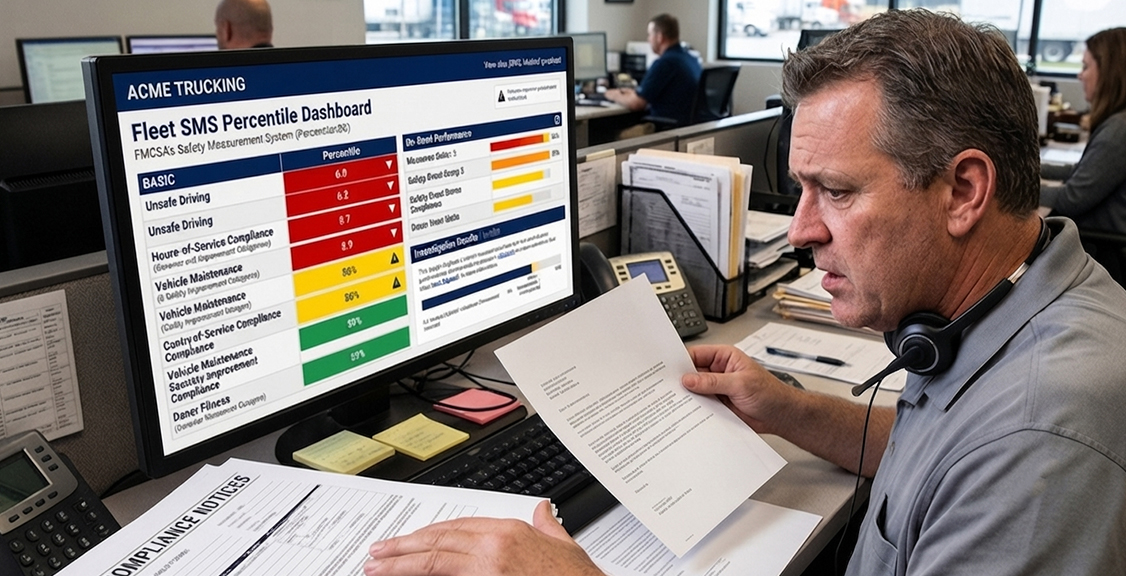
Most safety audits are triggered by a pattern in your data, not a single bad day. FMCSA is far more likely to open a review because your SMS percentiles have crossed a threshold in one or more BASIC categories than because of one isolated citation.
| Trigger Type | What It Signals to FMCSA | How Fast the Audit Follows | What You Can Do Now |
|---|---|---|---|
| New entrant safety audit | First-time carrier, unproven safety record | Within the first 12 months of operating | Keep every required file complete from the start of operation |
| Elevated BASIC percentile | Repeated pattern of violations in one safety category | Weeks to a few months | Review your SMS data monthly, not just at renewal |
| Reportable crash involvement | A crash meeting FMCSA’s reporting threshold | Can follow within weeks of the crash | Keep post-crash documentation and driver statements organized |
| Complaint-driven review | A formal complaint filed against your carrier | Varies, often faster than percentile-based reviews | Respond to any FMCSA correspondence right away |
| Random selection | Part of FMCSA’s general oversight of the industry | Unpredictable | Stay audit-ready at all times rather than reacting to a notice |
| Referral from a state enforcement agency | A state inspector flagged a serious concern | Can be rapid depending on severity | Fix any roadside finding the same week it happens |
A fleet that reviews its own compliance data on a regular schedule is far less likely to be caught off guard by any of these triggers. Our ELD and DVIR integration guide covers how connecting these two records helps surface the kind of pattern that would otherwise show up first on an FMCSA investigator’s screen.
How Does Your SMS Score Factor Into Whether You Get Audited?
Your Safety Measurement System percentiles are the single biggest factor in whether FMCSA opens a review, since the system is built specifically to flag carriers whose violation patterns suggest higher crash risk. A carrier sitting above the intervention threshold in a BASIC category is far more likely to draw attention than one with an isolated citation.
FMCSA explains the scoring methodology behind these percentiles through its published documentation, and the FMCSA Safety Measurement System is the tool that tracks your carrier’s standing across all seven BASIC categories in something close to real time. Reviewing your own percentiles through this system on a set schedule, rather than waiting for a letter, is one of the simplest habits that keeps a fleet off FMCSA’s radar. If you want the full breakdown of how the underlying math works, FMCSA’s own CSA methodology documentation lays out exactly how violations convert into a percentile.
There is no single published SMS threshold that guarantees an audit, and no confirmed FMCSA source states one, so treating any specific percentage as a hard trigger would be inaccurate. What matters is the trend across months, not a single data point. We flag a rising trend in any BASIC category before it reaches a level that would draw FMCSA’s attention, which gives your back office time to act on it rather than react to it.
Supporting documents matter here too. Under 49 CFR 395.8(k)(1), you are required to retain supporting documents for at least six months, and gaps in that record are exactly the kind of thing that turns an elevated percentile into a confirmed finding once an investigator starts looking.
What Are the Possible Outcomes After a DOT Safety Audit?
A compliance review ends in one of three ratings, Satisfactory, Conditional, or Unsatisfactory, each carrying different consequences for your operating authority. A Satisfactory rating means your safety management controls meet FMCSA’s standards. Conditional means controls are inadequate in one or more areas but you can continue operating while you correct them. Unsatisfactory means your controls do not meet minimum standards, and FMCSA can order you to stop operating.
An Unsatisfactory rating typically comes with a required corrective action plan, and failing to follow through on that plan can escalate the consequences further. A Conditional rating is not a final judgment either, since FMCSA’s safety fitness procedures allow a carrier to request a change in rating once corrective actions are documented and verified, though FMCSA does not publish a fixed timeline for how quickly that review happens.
Ratings are public record, and freight brokers, insurance underwriters, and shippers routinely check them before doing business with a carrier. A rating earned years ago does not disappear from that record just because your operation has since improved, which is exactly why catching a rising SMS trend early matters more than reacting to a letter after the fact.
How Do You Get Ahead of an Audit Before It Ever Happens?
The best audit preparation is not a scramble before a scheduled review, it is a back office that reviews its own SMS trend and record completeness on a set schedule regardless of whether an audit is expected. Fleets that treat this as a routine habit rarely find themselves surprised by what an investigator asks for.
Start with your ELD compliance and confirm every device in your fleet is still on the FMCSA registered ELD list, since a device removed from that list is an immediate and easily avoidable finding. Our ELD platform and hardware page shows what a currently compliant setup looks like if you are due for a device check.
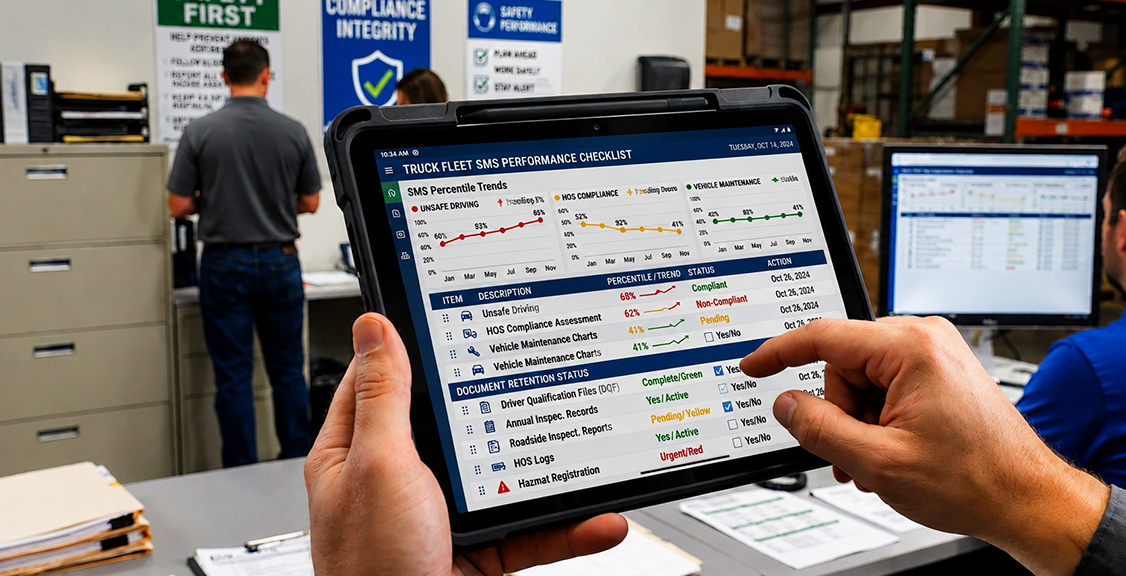
Next, review your SMS percentiles monthly rather than waiting for a warning letter, and keep supporting documents organized well within the six-month retention window under 49 CFR 395.8(k)(1). A fleet with a clean SMS record and no elevated percentiles gives an investigator less to question in the first place.
Questions to Ask Before Your Next Audit or Compliance Review
How do I know if my SMS percentile puts me at risk for an audit?
Check your carrier’s standing in the FMCSA Safety Measurement System regularly rather than only at renewal time. A pattern of elevation in one BASIC category over several months is a stronger signal than a single citation, so track the trend, not just the current number.
What documents should I always have ready regardless of audit likelihood?
Driver qualification files, HOS and ELD records, DVIRs, and supporting documents within the six-month retention window should always be current. These are the first things an investigator asks for, and having them organized before a request comes in saves real time during a review.
Should I hire a compliance consultant or handle audit prep with my back office?
It depends on your fleet size and how confident your back office already is in your record-keeping. A consultant can be worth it if you have never been through a review before or if your last rating was Conditional, but a well-organized back office with a reliable ELD platform can often handle preparation without outside help.
Does one elevated BASIC percentile guarantee an audit?
Not on its own. FMCSA weighs the pattern across categories and over time rather than acting on a single elevated score, but a percentile that keeps climbing month over month is worth addressing before it becomes the reason for a review.
Does switching ELD providers before an audit create more risk than it solves?
It can, if historical data does not transfer cleanly. Ask any provider how they handle data migration and confirm your existing logs stay accessible after the switch, since a gap in your record history during a review looks the same to an investigator as a missing record.
What happens if I discover a violation myself before FMCSA does?
Document it, correct it, and keep a clear internal record of when it was found and what was done about it. An investigator who sees evidence of self-correction generally treats it very differently than a violation that was never addressed at all.
How do I know if my ELD device is still on the registered list?
Check your device against the FMCSA registered ELD list directly rather than relying on memory of when you purchased it, since devices get removed on a rolling basis throughout the year. This takes only a few minutes and is one of the simplest audit-prep steps available.
What should I ask an ELD provider about supporting me through a compliance review?
Ask whether historical logs, edit histories, and supporting documents can be pulled quickly and whether support is available outside standard business hours. Audits and the documentation requests that come with them do not wait for convenient timing.
Compliance Questions Answered
About DOT Safety Audits and Ratings
How long does a DOT safety audit usually take?
It varies by fleet size and complexity, but a compliance review can take anywhere from a single day for a small carrier to several days for a larger fleet with more drivers and vehicles to review.
Can a small fleet be audited the same way as a large one?
Yes. The same safety fitness procedures apply regardless of fleet size, though a smaller fleet’s review is typically faster simply because there are fewer records to go through.
What is the difference between a compliance review and a roadside inspection?
A roadside inspection checks one truck and driver on one day. A compliance review examines your entire operation’s records, often going back six months or more, and results in a formal safety rating.
Does a Conditional rating mean my carrier has to stop operating?
No. A Conditional rating means your safety management controls need improvement in specific areas, but you can continue operating while corrective actions are made and documented.
Does a Conditional or Unsatisfactory rating affect my insurance premiums?
It can. Insurance underwriters routinely pull safety ratings before renewal, and a downgraded rating is the kind of thing that shows up in a premium quote even after the underlying issue has been corrected.
Are DOT safety ratings available to the public?
Yes. Ratings are part of the public record, and shippers, brokers, and insurance companies regularly check them before working with a carrier.
Does a good SMS score guarantee I will not be audited?
No. It lowers the likelihood a lot, but random selection, complaint-driven reviews, and reportable crashes can still trigger an audit regardless of your SMS standing.
About Staying Ahead of an Audit With Your ELD Data
What ELD records does an investigator typically ask for first?
HOS logs, edit histories, and any records of ELD malfunctions and how they were resolved are usually requested early in a review.
How soon after corrective actions are verified does a rating actually change?
FMCSA does not publish a fixed timeline for this, so treat a rating change as something you follow up on rather than something that happens automatically once your corrective action plan is submitted.
What should my back office track monthly to stay ahead of an audit?
SMS percentile trends, DVIR completion rates, HOS violation patterns, and confirmation that supporting documents remain within the retention window are the core items worth a monthly check.
Is there a way to dispute a violation that shows up incorrectly on my record?
Yes, drivers and carriers can dispute inaccurate violations through the FMCSA DataQs system rather than letting an incorrect mark affect your SMS standing.
Does having a strong safety record reduce how often I get inspected roadside?
It can influence how carriers are prioritized for certain enforcement activity, though it does not guarantee any individual truck will avoid a roadside stop.
Conclusion
A DOT safety audit is rarely a surprise to FMCSA, even when it feels like one to the carrier. Your SMS percentiles, your document retention, and your ELD record all point to the same thing before an investigator ever opens a file, and the fleets that come through a compliance review with a Satisfactory rating are almost always the ones that checked that data every month instead of waiting for a letter to worry about it.
None of this is easing up in 2026. HOS violations are rising nationally, ELD devices continue coming off the registered list on a rolling basis, and CVSA’s own roadcheck focus this year shows inspectors and investigators are paying closer attention to log integrity, not less. A fleet that waits for a letter before checking its own SMS trend is taking on more risk than it needs to.
If you are not confident your SMS standing, driver files, and ELD data would hold up under a DOT safety audit today, reach out through our contact form to talk through where the gaps are, or give us a call at (800) 261-4361 if that’s easier.