Key Takeaways
- 49 CFR 390.36 protects drivers from carrier pressure or harassment tied to ELD data and hours of service compliance.
- Carriers cannot coerce a driver into violating HOS limits or falsifying an ELD record, and drivers can report coercion through the FMCSA coercion complaint process.
- Under 49 CFR 395.30(d), a carrier-proposed edit does not take effect until the driver reviews and confirms it; the driver may instead reject the proposed change, and an accepted change requires recertification and resubmission of the record.
- If an ELD malfunctions, the driver must notify the carrier in writing within 24 hours under 49 CFR 395.34(a)(1). The carrier generally has eight days from discovery of the malfunction or the driver’s notification, whichever occurs first, to correct, repair, replace, or service the ELD, unless FMCSA grants an extension.
- A driver’s original ELD entry stays preserved even after an edit is made, per 49 CFR 395.30(f); the original unedited record and edit history must be retained.
- Drivers who believe an inspection or violation record is inaccurate can dispute it through the FMCSA DataQs system.
- Unidentified driving time must be reviewed rather than left attached to the wrong driver, and drivers have a role in claiming or disputing those segments under 49 CFR 395.32(c).
- The current 2026 maximum civil penalty for knowing falsification runs up to $15,846 per violation under 49 CFR Appendix B to Part 386, which is part of why accurate, driver-reviewed logs matter for both sides.
Introduction
Most conversations about the ELD mandate focus on what a driver has to do: log hours, respond to inspections, keep the device running. Far fewer conversations cover what a driver is entitled to under that same set of rules. That gap matters, because the regulations that created the ELD mandate did not just hand carriers a monitoring tool; they also built in specific protections for the person actually behind the wheel.
Those protections cover real, everyday situations, including a dispatcher pressuring a driver to keep moving past the applicable HOS limit, a carrier wanting to change a log entry the driver does not agree with, and questions about who is responsible when the ELD itself breaks down mid-route. For drivers and the fleet owners who employ them, not knowing where these lines sit generally means more friction during a roadside inspection, more disputes back at the terminal, and more risk of a violation that did not need to happen.
Here is what you need to know about the core rights built into the ELD mandate: protection from harassment and coercion, control over edits to your own log data, what happens to your responsibilities during a device malfunction, and how unidentified driving time gets sorted out. Each section stands on its own, so you can jump straight to the situation that applies to you.
If a specific situation on your fleet needs more than a general explanation, our support team can walk through how your ELD setup handles it in practice, and if you would rather talk it through than search it yourself, we’re happy to hear from you at (800) 261-4361.
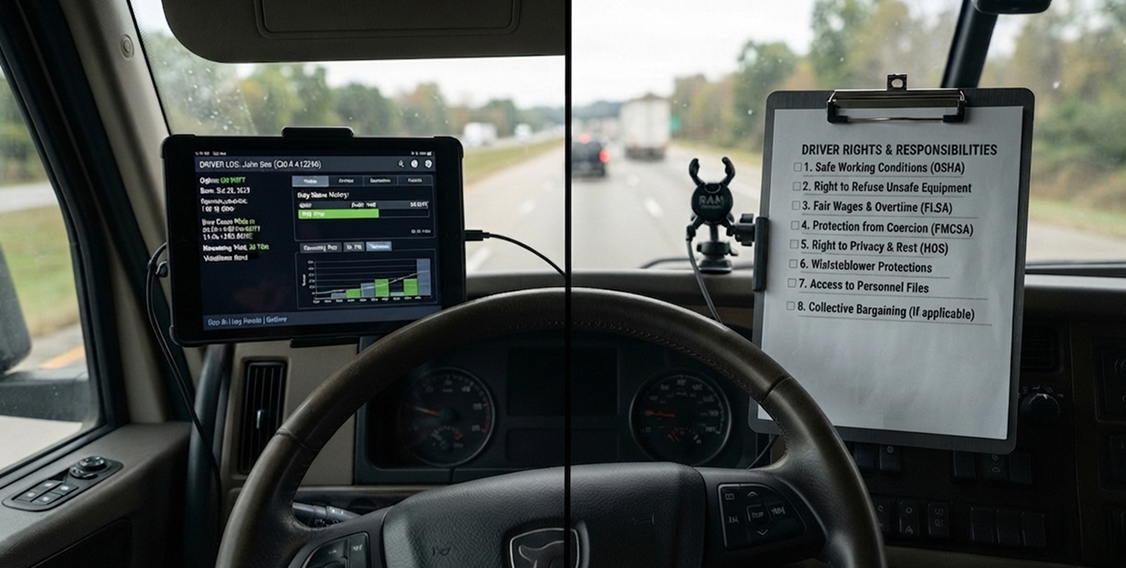
What Rights Do Drivers Have Under the ELD Mandate?
Drivers operating under the ELD mandate have specific, rule-based protections covering harassment, log edits, malfunction handling, and dispute rights, all built into the same federal framework that requires the device in the first place.
The ELD mandate lives inside the FMCSA HOS regulations, and it was never written as a one-directional monitoring rule. Alongside the requirement to log hours electronically, the rule set includes provisions that limit what a carrier can do with that data and how a carrier can treat a driver in connection with it. That includes a harassment protection tied specifically to ELD and HOS data, a prohibition on coercing a driver into violating the rules, a certification step that keeps carriers from silently editing a driver’s record, and a defined process for what happens when the device itself fails.
None of these protections require a driver to take extraordinary action to invoke them. They apply automatically as part of running a registered ELD platform like the one your fleet uses day to day. What they do require is knowing they exist, because a driver who does not know a right is being crossed has a harder time raising it before it turns into a bigger dispute. The next four sections take each of these protections in turn, starting with the one most drivers encounter first: pressure tied directly to their hours.
Are Drivers Protected From Harassment Over ELD Data?
Yes. 49 CFR 390.36 prohibits a motor carrier from harassing a driver based on information available through an ELD. Under the FMCSA rule, harassment involves a carrier using ELD information in a way that results in the driver violating specified hours-of-service requirements or 49 CFR 392.3, which prohibits operating a commercial motor vehicle while impaired by fatigue, illness, or another condition that makes driving unsafe.
Not every unwanted message, dispatch request, or disagreement involving ELD data meets FMCSA’s regulatory definition of harassment. The rule is specifically tied to a carrier’s use of ELD information and an action that results in one of the covered violations. Carriers may still use ELD information for legitimate dispatch, scheduling, safety, and compliance purposes.
Harassment and coercion are related but separate protections. Coercion generally involves threatening a driver with job, work, or other economic consequences to pressure the driver to violate certain federal safety regulations. Unlike harassment under the ELD rule, a coercion violation can occur even if the driver refuses the demand and does not ultimately commit the underlying violation. Drivers who believe they have been harassed or coerced should document the circumstances and use the appropriate FMCSA complaint process.
Can a Carrier Force a Driver to Falsify Logs or Ignore a Malfunction?
No. A carrier, shipper, receiver, or transportation intermediary may not coerce a driver to violate applicable federal safety regulations. This can include pressuring a driver to exceed hours-of-service limits, falsify an ELD record, or disregard required procedures for an ELD malfunction when doing so would result in a regulatory violation.
Under FMCSA’s coercion rule, coercion can involve a threat to withhold work, take employment action, or otherwise punish a driver for refusing to operate in violation of covered federal regulations. For example, a carrier cannot threaten a driver for refusing a dispatch that would require an hours-of-service violation. Drivers who believe they have been coerced can file a written complaint through FMCSA’s National Consumer Complaint Database or with the appropriate FMCSA Division Administrator.
Documentation matters here in much the same way it does for harassment complaints: dates, the specific instruction given, and any written record of it, such as text messages, dispatch notes, or emails, generally make a coercion complaint easier for FMCSA to evaluate. Harassment and coercion both involve how a carrier treats a driver around the data. The next protection works differently: it governs what a carrier can and cannot do to the data itself.
Can Drivers Edit or Dispute Their Own ELD Records?
A carrier cannot make a proposed edit to a driver’s ELD record take effect without the driver’s review. The driver must confirm or reject the proposed change, and if the edit is made, recertify and resubmit the record.
Under 49 CFR 395.30, edits to an ELD record go through a defined process rather than being applied unilaterally. Before an edit becomes part of the certified record, 49 CFR 395.30(d) requires the driver to review the proposed change and either accept or reject it, and 49 CFR 395.30(c)(2) requires an annotation explaining why the edit was made. Even after an edit is accepted, the original entry is not erased: 49 CFR 395.30(f) requires that the original unedited record and edit history be retained, so there is always a record of what the driver logged before any change was applied. For situations involving two drivers sharing a vehicle, 49 CFR 395.30(c)(3) governs how driving time gets reassigned between them, and that reassignment still runs through the same review and annotation requirements.
The FMCSA guidance on ELD editing walks through how this process is expected to work in practice, and it is a useful reference if a driver and carrier disagree about whether a specific edit followed the rule correctly. If a driver believes a record still reflects an error, or believes a roadside inspection captured inaccurate data, the FMCSA DataQs system is the formal channel for disputing it. Edit rights protect the record once it already exists. The next section covers a related but different problem: what happens when the device recording that data stops working altogether.
What Happens to a Driver’s Rights When an ELD Malfunctions?
A driver is not held responsible for a device malfunction itself, and specific notification and fallback rules apply the moment a malfunction is identified.
Once a driver identifies an ELD malfunction, 49 CFR 395.34(a)(1) requires the driver to notify the carrier in writing within 24 hours. If the malfunction prevents the ELD from accurately recording the driver’s hours-of-service data, the driver must reconstruct the required records of duty status and continue recording them on paper logs or another compliant method until the ELD is back in service. Under 49 CFR 395.34(d), the carrier generally has eight days from discovery of the malfunction or the driver’s notification, whichever occurs first, to correct, repair, replace, or service the ELD, unless FMCSA grants an extension. Following these malfunction procedures allows the driver and carrier to maintain required HOS records while the equipment problem is being resolved. This connects to the same recordkeeping expectations covered in our piece on ELD and DVIR recordkeeping, which explains how maintenance-related documentation ties back into compliance records more broadly.
For the full breakdown of malfunction categories and carrier repair obligations, FMCSA advises carriers on how each malfunction type should be handled, which is a useful reference if a specific situation does not match the general pattern described here. Malfunctions are one way a record can go temporarily blank. The next section covers a related gap: drive time the ELD captured but never attached to a specific person.

Do Drivers Have a Say in Unidentified Driving Time Assignments?
Yes. When a carrier proposes assigning unidentified driving time to a driver’s record, the driver has the opportunity to review the proposed change and confirm or reject it rather than having the time automatically added to the driver’s certified record.
ELDs sometimes record driving time when no specific driver is logged in. Under 49 CFR 395.32, the motor carrier must review unidentified driving records and assign them to the appropriate driver or explain why the time remains unidentified. When unidentified driving time is proposed for assignment to a driver’s record, the applicable ELD editing and certification process gives the driver an opportunity to confirm or reject the change. This helps prevent driving time from being incorrectly attributed to a driver and affecting that driver’s hours-of-service record.
Driver Protections at a Glance
| Right or Protection | Governing Rule | What It Protects You From | Where to Go If It’s Violated |
|---|---|---|---|
| Harassment protection | 49 CFR 390.36 | Harassment based on ELD information that results in a covered HOS violation or a violation of 49 CFR 392.3 | Document the incident and use the appropriate FMCSA complaint process |
| Coercion protection | 49 CFR 390.6 | Being threatened into violating HOS, ELD, or CDL rules | FMCSA coercion complaint process |
| Malfunction notification | 49 CFR 395.34(a)(1) | Being cited for a device failure outside your control | Notify the carrier in writing within 24 hours; use paper logs or another compliant method when the malfunction prevents accurate HOS recording |
| Carrier repair deadline | 49 CFR 395.34(d)(1) | Extended use of a known-broken ELD | Carrier generally has eight days from discovery or driver notification, whichever occurs first, to correct, repair, replace, or service the ELD unless FMCSA grants an extension |
| Edit certification | 49 CFR 395.30(d) | A carrier silently changing your record without review | Driver reviews and confirms or rejects a carrier-proposed edit; an accepted change requires recertification and resubmission |
| Original record preservation | 49 CFR 395.30(f) | Losing your first version of an entry after an edit | Original unedited record and edit history retained even after a certified edit |
| Unidentified driving review | 49 CFR 395.32(c) | Unidentified driving time being incorrectly assigned to your record | Carrier reviews unidentified driving records; a driver can confirm or reject a proposed assignment to their record |
Questions Every Driver and Fleet Owner Should Ask About ELD Rights
Does the ELD on this truck currently appear on FMCSA’s registered list?
Using a device that has been removed from the registered list can create compliance exposure regardless of how well it otherwise functions. Checking the status periodically, rather than assuming it never changes, is a simple way to avoid an avoidable violation.
Does the carrier have a written policy addressing ELD harassment and coercion?
A written policy gives drivers a clear internal process before a situation escalates to a federal complaint. If a carrier does not have one, that is worth raising directly rather than assuming the protections apply automatically without any internal process behind them.
What is the carrier’s process for notifying a driver when an ELD malfunctions?
Since the notification and fallback window is time-sensitive, a driver should know in advance what the carrier expects, whether that is a specific contact, a paper log kit kept in the cab, or a defined reporting step.
How does the provider handle driver certification for proposed log edits?
Some platforms make the review-and-certify step easy to find and act on; others bury it. A driver should be able to see a proposed edit clearly enough to make an informed decision rather than certifying changes by habit.
Can a driver see or request their own original, unedited ELD records?
Because 49 CFR 395.30(f) requires the original unedited record and edit history to be retained, a driver should be able to confirm that access exists rather than only trusting that it does.
What is the process for reviewing and resolving unidentified driving time?
Under 49 CFR 395.32, the motor carrier must review unidentified driving records and assign them to the appropriate driver or annotate why the time remains unidentified. If unidentified driving time is proposed for assignment to a driver’s record, the driver can review and confirm or reject the proposed change through the ELD editing and certification process. Regular review is especially important for fleets where vehicles may be moved without the appropriate driver logged into the ELD.
Where does the carrier direct drivers who want to dispute inspection data through DataQs?
A driver should know this path exists before they need it, not while standing at the side of the road after an inspection.
What support is available if a driver has a specific rights question that does not fit a general answer?
Since individual situations vary, a driver or fleet manager evaluating a provider should confirm there is a real support channel, not just documentation, for compliance-specific questions. Our ELD platform and hardware and price calculator are a reasonable starting point for comparing what’s included before a purchasing decision, alongside direct support access.
ELD Driver Rights FAQs
About Driver Rights and Protections Under the ELD Mandate
Can my carrier make me keep driving if I’ve reported an ELD malfunction?
A carrier cannot require a driver to violate applicable federal safety regulations because of an ELD malfunction. If the malfunction prevents the ELD from accurately recording hours-of-service data, the driver must follow the procedures in 49 CFR 395.34, including using paper logs or another compliant method as required while the ELD is repaired, replaced, or serviced.
What counts as harassment under the ELD mandate?
Under 49 CFR 390.36, harassment involves a motor carrier using information available through an ELD in a way that results in the driver violating specified hours-of-service requirements or 49 CFR 392.3. Not every unwanted dispatch request or disagreement involving ELD data meets FMCSA’s regulatory definition of harassment.
Can I be forced to accept an edit to my ELD log?
No. Under 49 CFR 395.30(d), a carrier-proposed edit requires driver review. The driver can confirm or reject the proposed change, and if the change is accepted, the driver must recertify and resubmit the record.
Am I responsible if my carrier assigns unidentified driving time to me by mistake?
No. If a carrier proposes assigning unidentified driving time to a driver’s record, the driver can review and confirm or reject the proposed change. Under 49 CFR 395.32, the carrier is responsible for reviewing unidentified driving records and assigning them to the appropriate driver or explaining why the time remains unidentified.
Do I have a right to see my own ELD data?
Yes, including the original version of any entry that was later edited, since 49 CFR 395.30(f) requires the original unedited record and edit history to be retained.
Can a carrier penalize me for refusing to violate HOS rules?
No. That kind of pressure falls under the coercion protections, and it can be reported through the FMCSA coercion complaint process.
About Resolving ELD Disputes and Malfunctions
What should I do first if my ELD stops working?
Notify your carrier in writing within 24 hours as required by 49 CFR 395.34(a)(1). If the malfunction prevents the ELD from accurately recording your hours-of-service data, reconstruct the required records of duty status and use paper logs or another compliant method as required until the ELD is back in service.
How long can I use paper logs after a malfunction?
When a malfunction requires the use of paper logs or another compliant method, the carrier generally has eight days from discovery of the malfunction or the driver’s notification, whichever occurs first, to correct, repair, replace, or service the ELD. FMCSA may grant an extension under the procedures in 49 CFR 395.34.
How do I report a coercion complaint to FMCSA?
Through the FMCSA coercion complaint process, which is separate from a general customer service or dispatch channel.
What is DataQs, and when should I use it?
DataQs is FMCSA’s system for disputing what a driver believes is inaccurate inspection or violation data. It’s the right channel once an issue has already been recorded, rather than a tool for day-to-day log edits.
Who is responsible for fixing a malfunctioning ELD, the driver or the carrier?
The carrier is responsible for correcting, repairing, replacing, or servicing the malfunctioning ELD under 49 CFR 395.34(d). The driver is responsible for notifying the carrier in writing within 24 hours and following the applicable recordkeeping procedures while the malfunction is being resolved.
Can I be cited for a malfunction that wasn’t my fault?
A device malfunction itself is not necessarily a driver violation, but the driver must follow the applicable requirements in 49 CFR 395.34 after discovering the malfunction. That includes notifying the carrier in writing within 24 hours and, when the malfunction prevents accurate HOS recording, using the required alternative recordkeeping method.
What happens to my original log entry after a dispute is resolved?
The original unedited record and edit history must be retained under 49 CFR 395.30(f) regardless of the outcome, so the record of what was originally logged remains available.
Conclusion
The ELD mandate is often described purely as a monitoring requirement, but the same regulations that require the device also build in specific protections for the driver operating it. Harassment and coercion protections, a defined edit-and-certification process, malfunction notification rules, and a clear path for disputing unidentified driving time are not optional extras; they’re part of the same rule set, and knowing where they apply makes it easier to catch a problem early instead of after it turns into a violation or a dispute during a roadside inspection.
The practical difference between a smooth interaction and a disputed one often comes down to whether a driver and carrier both understood these rights before they were needed. That’s worth building into onboarding and ongoing training, not just handling reactively when something goes wrong.
If you’d like to schedule a walkthrough of how your fleet’s ELD setup handles driver rights in practice, start there, or if you’d rather talk it through with a real person first, give our team a call at (800) 261-4361.