Key Takeaways
- The national average price for on-highway diesel reached $5.454 per gallon for the week ending August 17, 2026, up from $3.713 a year earlier, according to EIA’s weekly retail fuel price data.
- A long-haul truck that cuts unnecessary idling can save more than 900 gallons of fuel a year, according to the EPA’s idle reduction guidance.
- An idling diesel engine burns roughly 0.8 gallons of fuel per hour even when the truck isn’t moving, per EPA idle reduction research.
- FMCSA’s Safety Measurement System uses driving behavior events, including speeding and harsh braking, as part of a carrier’s Unsafe Driving safety record.
- GPS location tracking is a separate function from Hours of Service recording, which falls under 49 CFR Part 395.
- Hours of Service compliance still requires an ELD; GPS data supports day-to-day operations but doesn’t replace HOS records, per FMCSA’s HOS regulations.
- Driver fatigue and distraction remain leading factors in large truck crashes, according to FMCSA’s research on driver fatigue, part of why continuous vehicle monitoring has become common in fleet operations.
Introduction
If you manage a fleet, you already know the feeling of not knowing. A truck is late and you don’t know if it’s traffic, a wrong turn, or something worse. Fuel costs have risen again this month, and you can’t say exactly why, and with the national average diesel price above $5.45 per gallon as of mid-August 2026, that uncertainty gets more expensive by the week. A driver mentions a near-miss and you have no record of what actually happened on the road. None of these problems are unusual. They’re what happens when you’re running a fleet on phone calls and guesswork instead of live data.
Real-time GPS tracking closes that gap. Instead of finding out about a problem after your driver gets back, you can see it soon after the system reports it: where every truck is right now, how long it’s been sitting still, and whether it just crossed into or out of a job site or customer location. That shift, from finding out later to knowing sooner, is what turns daily fleet management from reactive into controlled.
The sections below walk through what this actually looks like in practice: how live tracking affects fuel spending, how it changes driver coaching, how geofencing and asset tracking work day to day, and how GPS tracking is different from the Hours of Service tracking your ELD already handles. Each section stands on its own, so skip to whatever’s most relevant to your fleet right now, or read straight through, since the fuel and safety sections build on the location data explained first.
If it’s ever useful to see how this would work for your own trucks, you can schedule a call with our team or call (800) 261-4361, no obligation either way.
How Does Real-Time GPS Tracking Work for a Fleet?
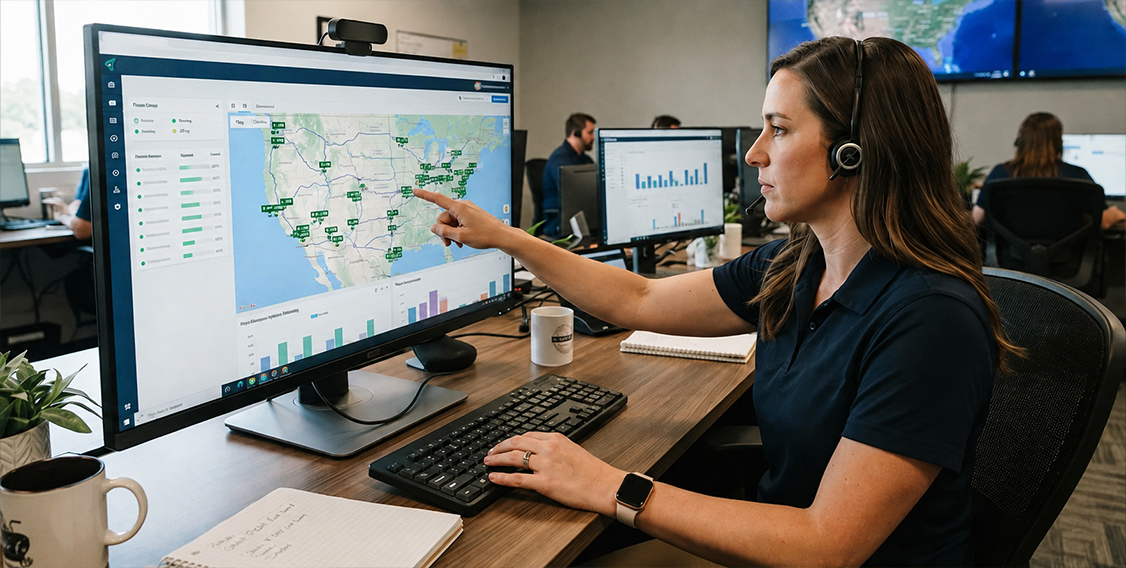
Real-time GPS tracking shows you the latest reported location of each tracked vehicle in your fleet on an interactive map, updated at intervals set by the device and platform rather than on a long delay. Each vehicle carries a tracking device, either hardwired or plug-in, that reports its position, trip history, and status back to a central platform you can check from a computer or phone.
The difference between real-time tracking and older location systems comes down to how current the data is. A basic location check might tell you where a truck was 10 or 20 minutes ago. Real-time tracking gives you a live feed, so if a truck stops, detours, or sits idle, you can see it soon after the system reports it instead of piecing it together after the fact from a driver’s account.
For a fleet manager, this means dispatch decisions, customer updates, and problem-solving all happen with current information instead of guesses. If a customer calls asking where their delivery is, you have an answer in seconds. If a truck hasn’t moved in an hour on a route with no scheduled stop, you know to check in before it becomes a bigger issue. That same location data is also what makes the cost and safety benefits in the next few sections possible.

How Does GPS Tracking Improve Fleet Efficiency?
GPS tracking improves fleet efficiency by giving you accurate trip data and vehicle history instead of driver-reported estimates, which makes routing, scheduling, and reporting more reliable across the board.
Trip history and mileage tracking replace the handwritten logs and rough time estimates fleets have relied on for decades. Every trip is recorded automatically, with start and stop times, routes taken, and total distance, which gives you clean data for customer billing, tax reporting, and internal recordkeeping without extra paperwork from drivers.
That same data also helps you spot patterns you’d otherwise miss. If one route consistently runs longer than expected, or one vehicle logs unusual downtime between stops, you can catch it in the reporting instead of hearing about it weeks later when a customer complains or a maintenance bill comes in higher than expected. One of the clearest examples of this shows up in fuel spending, which is where the next section picks up.
How Does GPS Tracking Help Control Fuel Costs?
GPS tracking helps control fuel costs by identifying exactly where fuel is being wasted, most often through excess idling, so you can address it directly instead of guessing at fleetwide averages. That control matters more now that diesel prices have climbed sharply in 2026.
The national average price for on-highway diesel reached $5.454 a gallon for the week ending August 17, 2026, according to EIA’s own retail fuel price tracking, up from $3.713 a year earlier. At that price, idling waste stops being a minor expense and becomes a meaningful line item. A truck sitting with the engine running burns close to a gallon of fuel an hour without moving, and eliminating unnecessary idling can save a long-haul truck several hundred gallons of fuel a year. Multiply that waste across a fleet of 10 or 20 trucks at current diesel prices, and the annual cost runs into thousands of dollars in fuel alone.
Fuel consumption tracking pairs idle time data with fuel purchase records, so you can see fuel usage by vehicle and by driver instead of just one number on a monthly statement. That visibility makes it possible to identify which trucks are running less efficiently, whether that’s driver habits, a mechanical issue, or a route that needs adjusting, and to catch fuel theft or unauthorized use before it adds up. Fuel habits and driving habits tend to move together, which is where driver behavior monitoring comes in.
How Does GPS Tracking Improve Driver Safety and Behavior?
GPS tracking improves driver safety by monitoring driving events like harsh braking, rapid acceleration, and sudden maneuvering, which gives you objective data to coach drivers instead of relying on complaints or guesswork after an incident.
Driving behavior monitoring doesn’t watch drivers to catch them doing something wrong. It flags patterns, a driver whose harsh-braking events occur more often than the fleet baseline, or one whose habits changed after a schedule shift, so you can have a specific, useful conversation instead of an unfocused one. Over time, that kind of coaching tends to reduce risky driving events and the wear and tear that comes with them.
This kind of monitoring matters because fatigue and distraction remain leading contributors to large truck crashes, according to FMCSA’s driver fatigue research. Real-time visibility into driving patterns gives you an early warning system rather than a report you only read after something has already gone wrong. For more on how continuous monitoring connects to overall road safety, see our guide on how ELDs help reduce driver fatigue. Location data plays into safety too, particularly once you start setting boundaries around where vehicles should and shouldn’t be.
How Does Geofencing Help Fleet Managers?
Geofencing helps fleet managers by automatically alerting them when a vehicle enters or leaves a defined location, such as a job site, warehouse, or customer address, without anyone needing to check the map manually.
You set the boundaries around the locations that matter to your operation, and the platform can send an alert when a vehicle crosses one, whether that means confirming a truck arrived at a delivery site, verifying it left the yard on schedule, or flagging that it showed up somewhere it has no reason to be. Combined with custom points of interest, geofencing turns location data into something you can act on instead of something you have to interpret.
For fleets with recurring routes or fixed customer locations, geofencing also simplifies reporting. Instead of manually logging arrival and departure times, the system captures them automatically, which saves time and reduces the chance of a missed or inaccurate entry. Geofencing works well for vehicles, but a lot of fleets also need that same accountability for equipment that doesn’t have a driver attached to it.
How Does GPS Tracking Support Asset and Trailer Visibility?
GPS tracking supports asset and trailer visibility by extending location monitoring beyond powered vehicles to trailers, containers, and equipment, so assets are less likely to be unaccounted for between jobs.
Trailers, generators, and other non-powered assets don’t show up in a standard vehicle-only tracking setup, which is a gap for fleets that lease out equipment, run drop-and-hook operations, or manage a lot of trailers relative to trucks. Dedicated asset trackers, including solar-powered options for equipment that sits for long stretches without external power, close that gap and give you the same accountability for assets that you already have for vehicles.
This matters most when equipment goes missing or sits idle longer than it should. Knowing where a trailer is, and how long it’s been there, helps you recover assets faster and get idle equipment back into rotation instead of paying for equipment you can’t locate. If you’re evaluating tracking hardware for a mixed fleet of trucks and trailers, our store has options built for both. Vehicle and asset tracking cover location and utilization, but they don’t cover one specific requirement: Hours of Service recording, which still falls to your ELD.
How Is GPS Tracking Different From an ELD?
GPS tracking and an ELD serve two different purposes: GPS tracking shows you where a vehicle is and how it’s being used, while an ELD is the FMCSA-required device that records a driver’s Hours of Service.
An electronic logging device exists to satisfy a specific federal requirement under 49 CFR Part 395: recording driving time, on-duty status, and rest breaks so drivers and carriers can demonstrate Hours of Service compliance during a roadside inspection. GPS tracking isn’t a compliance requirement in the same way. It’s an operational tool that gives you visibility into vehicle location, fuel use, driver behavior, and asset status, information that helps you run the business but isn’t itself an FMCSA mandate.
Many fleets use both together because they solve different problems. Your ELD platform keeps your Hours of Service records accurate and audit-ready. GPS tracking gives you the day-to-day operational picture that HOS records were never designed to show. The table below lays out that difference side by side.
GPS Tracking at a Glance
| Question | Without GPS Tracking | With Real-Time GPS Tracking |
|---|---|---|
| Where is a specific truck right now? | Depends on a phone call to the driver | Visible on a live map, based on the latest reported location |
| How much fuel is idling wasting? | Estimated from monthly fuel totals | Tracked by vehicle, based on real idle time |
| How do you know about risky driving? | Usually after a complaint or incident | Flagged through braking, speed, and direction data |
| How do you confirm a job site arrival? | Driver call-in or paper log | Automatic geofence alert |
| Can you locate an idle trailer? | Often untracked between jobs | Tracked using a dedicated asset-tracking device |
| How is mileage documented for tax records? | Manual logs, prone to gaps | Automatic trip and mileage history |
| How fast can you respond to a deviation? | After the fact, once noticed | Soon after the system reports it |
What Questions Should You Ask Before Choosing a GPS Tracking Provider?
Does the hardware fit how your fleet actually operates?
A hardwired tracker suits vehicles that stay in service long-term, while asset trackers with internal batteries make more sense for trailers or equipment that sit unpowered between jobs. Match the hardware to the asset, not the other way around.
How often does the location data update?
Some systems report every few minutes, others closer to real time. If dispatch decisions depend on current location, ask specifically how real-time is defined by the provider.
Can the platform separate business and personal trips?
This matters for tax reporting and for driver privacy, especially with vehicles that go home with drivers overnight. Ask how trip classification works before you commit.
What does driver behavior monitoring actually track?
Harsh braking and rapid acceleration are common, but ask whether the system gives you usable reports for coaching or just raw alerts you have to interpret yourself.
Does it integrate with the systems you already use?
If you run IFTA reporting, fuel cards, or an ERP system, ask whether the platform can export data or connect through an API instead of creating a second, disconnected record system.
What happens if a tracker loses signal or power?
Ask how the system handles dead zones or tampering, and whether you get an alert when a device goes offline unexpectedly.
Is support available when something breaks in the field?
A tracking system is only useful if it’s working. Ask about support hours and how quickly hardware issues typically get resolved.
What’s the full cost, not just the monthly rate?
Hardware, activation, and subscription fees can vary a lot between providers, so it’s worth asking for the whole picture up front rather than comparing headline prices alone. If it helps, our price calculator gives a starting number based on fleet size, no obligation either way.
Common Questions About GPS Tracking for Fleets
About GPS Tracking and Fleet Operations
Does GPS tracking replace my ELD?
No. GPS tracking and an ELD do different jobs. Your ELD satisfies the federal Hours of Service recording requirement under 49 CFR Part 395. GPS tracking gives you operational visibility, location, fuel use, and driver behavior that HOS records don’t cover.
How current is real-time location data?
It varies by provider and device, but real-time tracking generally means location updates on a continuous or near-continuous basis rather than a delayed check-in. Ask any provider exactly how often their system updates.
Can GPS tracking help reduce fuel costs?
Yes. Idling is one of the largest avoidable fuel costs in trucking, and with diesel averaging above $5.45 per gallon nationally as of mid-August 2026, tracking idle time by vehicle makes it easier to identify the source instead of relying on a fleetwide average.
Does GPS tracking work for trailers and equipment, not just trucks?
Yes, through dedicated asset trackers designed for non-powered equipment. This is separate from vehicle tracking and typically uses battery or solar-powered devices built for long-term placement.
What is geofencing and why does it matter?
Geofencing sets a virtual boundary around a location, like a job site or warehouse, and automatically alerts you when a vehicle enters or leaves it. It removes the need to manually check arrival and departure times.
Can GPS tracking data support tax and business reporting?
Yes. Automatic trip history and mileage records support recordkeeping for both operational reporting and tax purposes, since the data is captured consistently rather than relying on manual logs.
About Choosing the Right GPS Tracking Provider
What should I look for in tracking hardware?
Match the hardware to how the asset is used. Hardwired trackers work well for vehicles in regular service. Battery or solar-powered trackers make more sense for trailers, containers, or equipment that isn’t always connected to power.
Does driver behavior monitoring feel invasive to drivers?
It depends on how it’s framed and used. Most fleets get the best results when behavior data is used for coaching and pattern recognition rather than as a punishment tool, and when drivers understand what’s being tracked and why.
Can I integrate GPS tracking data with other business systems?
Many platforms support API access or data exports, which lets you connect tracking data with ERP, HR, or fleet management systems you already use instead of managing separate records.
How do I know if a tracking provider’s support is reliable?
Ask directly about support hours and typical response times for hardware issues. A tracking system that isn’t reporting is a blind spot, so support responsiveness matters as much as the platform’s features.
Is GPS tracking required by federal regulation the way an ELD is?
No. ELDs are required for Hours of Service compliance under 49 CFR Part 395. GPS tracking is an operational tool fleets choose to adopt for visibility and cost control, not a separate federal mandate.
What’s a reasonable way to compare pricing between providers?
Ask for full cost breakdowns, including hardware, activation, and ongoing subscription fees, rather than comparing monthly rates alone. Hardware and setup costs can vary significantly between providers.
Conclusion
Running a fleet without real-time visibility means making decisions after the fact, after the fuel is already burned, after the near-miss has already happened, after the trailer has already gone missing. Real-time GPS tracking changes that by putting current, accurate data in front of you: where your trucks are, how they’re being driven, and where your fuel and maintenance dollars are actually going, which matters even more with diesel prices running well above five dollars a gallon in 2026.
Enforcement and operating costs aren’t getting simpler, and fleets that run on guesswork are the ones that get caught off guard by a fuel bill that doesn’t add up, a driver habit that goes unnoticed until it causes damage, or equipment that quietly disappears between jobs. The fleets that stay ahead of these problems are the ones with visibility built in from the start, not added after something goes wrong.
If you’d like to see what real-time tracking looks like for your own trucks and trailers, take a look at Geosavi’s GPS tracking platform or call our team at (800) 261-4361 whenever it’s convenient.