Key Takeaways
-
- We check the FMCSA registered ELD list to confirm our own device stays compliant, and we recommend every fleet check theirs the same way.
- Hours-of-service violations recorded through your ELD feed directly into your Hours-of-Service Compliance category, 49 CFR Part 395.
- A completed post-trip DVIR is the most important inspection record your fleet keeps, since a noted defect has to be repaired and certified before the truck goes back out, 49 CFR 396.11.
- Falsification of the record of duty status was the second most-cited driver violation in 2024, according to CVSA’s own enforcement data, which is why log-accuracy metrics belong on every fleet’s scorecard.
- Motor carriers face a maximum civil penalty of up to $19,246 per hours-of-service violation, adjusted annually for inflation under 49 CFR Appendix B to Part 386.
- If an inspection or violation record looks wrong, the FMCSA DataQs system is the right channel to file a formal challenge before it drags down your scorecard.
- CVSA named log tampering a focus area for its 2026 Roadcheck, which confirms log-accuracy metrics belong on every fleet’s scorecard.
- Geosavi Compliance Now pairs GPS tracking with ELD and DVIR data on one screen, giving your fleet a single place to watch these numbers instead of three.
Table of Contents Scorecard Problem CSA Score Basics HOS Data Gaps DVIR Data Gaps Behavior Blind Spots Metrics Compared Buyer Questions Scorecard FAQs Introduction
Most fleets already have the safety data they need, it’s just sitting in three different places at once. By the time a pattern is visible in any one of those places on its own, it has usually already become a violation, a claim, or months of driver risk nobody caught.
We built our ELD platform specifically so that data doesn’t have to sit in three separate places, pairing your hours-of-service records with DVIR reports and built-in GPS visibility so you can see the same picture we describe in this article without pulling it together by hand.
Below, we walk through what we recommend tracking on a fleet safety scorecard: the hours-of-service and log data your ELD is already recording, the DVIR and maintenance history that keeps a vehicle legal to dispatch, and the driver behavior signals that round out the picture once you have telematics data available. We connect each of these back to the FMCSA categories your fleet is already being measured against, whether you’re tracking them internally yet or not.
If you’d like to see how this applies to your own fleet, you can schedule a call with our team or call us at (800) 261-4361 and we’ll walk through what your data would look like on a scorecard like this.
What Problem Does a Fleet Safety Scorecard Actually Solve?
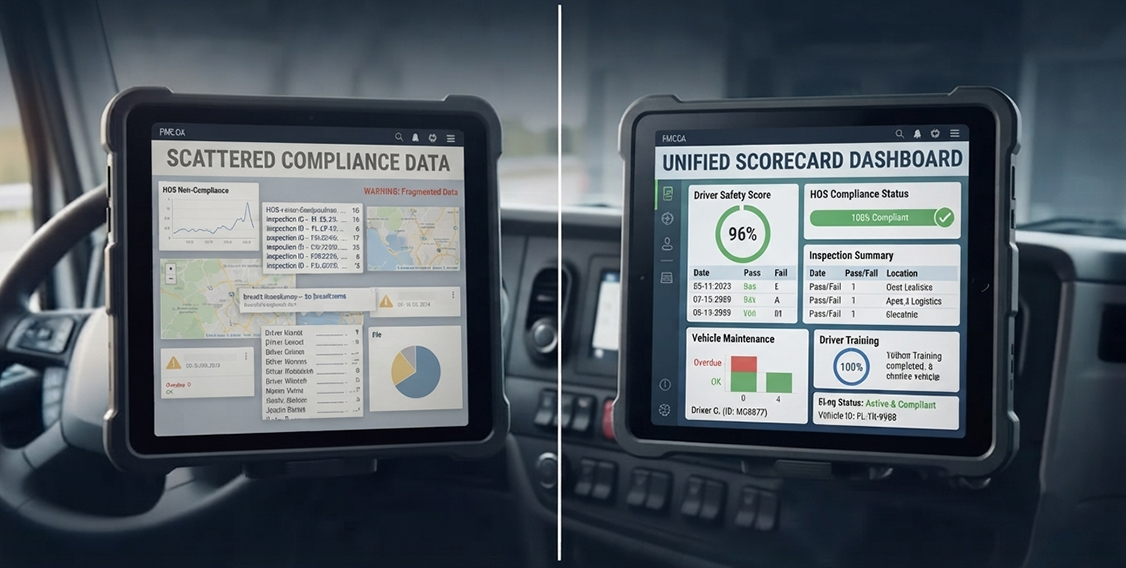
A fleet safety scorecard solves one specific problem: your team already has the data to catch a safety issue early, but it’s rarely in one place where you can act on it before it becomes a violation, a claim, or a percentile shift in FMCSA’s public system.
A driver who keeps coming close to the 11-hour driving limit, a DVIR defect that reappears on the same truck, or a gradual rise in hard-braking events all look minor when reviewed separately, but when the same signals are pulled together into one view, they point directly to where a coaching session or a shop visit is needed before the issue reaches a roadside inspection or a CSA flag. Our ELD, DVIR, and GPS tools are built to capture exactly this data in one place, which is what makes a five-to-eight metric scorecard drawn from what you already have more useful than a longer list pulled from hardware you don’t yet own and checked only occasionally.
Why Do CSA Scores Belong on Your Fleet Safety Scorecard?
CSA scores belong on your fleet’s scorecard because they represent the same risk data FMCSA is already collecting publicly, just visible to you earlier and privately.
FMCSA scores every motor carrier across seven Behavior Analysis and Safety Improvement Categories, commonly called BASICs: Unsafe Driving, Hours-of-Service Compliance, Driver Fitness, Controlled Substances/Alcohol, Vehicle Maintenance, Hazardous Materials, and Crash Indicator. Each carrier gets a percentile from 0 to 100 in the categories where there’s enough recent data, and a higher percentile means worse performance relative to similar carriers. We check our own standing, and we recommend you check yours, directly through the FMCSA Safety Measurement System. Crossing a category’s intervention threshold can lead to a warning letter, targeted roadside inspections, or a full compliance review, and the same public data typically factors into insurance pricing and freight decisions from brokers. Tracking the same categories FMCSA is watching gives your fleet a view of the same risk signal weeks or months before it would surface publicly, and hours-of-service data is usually the first place that movement shows up.
How Do You Fix HOS and Log Data Gaps on a Fleet Scorecard?
Hours-of-service gaps are rarely a data problem, they’re a timing problem, since a violation is usually the first point at which anyone looks at the record closely enough to act on it.
What Should You Pull From the ELD?
The core metrics to pull from your ELD are hours-of-service violations per driver in a rolling window, how often unassigned driving time goes unclaimed, and how frequently logs get edited after the fact. All three tie directly to 49 CFR Part 395, and flagging any driver who repeatedly comes close to the 11-hour driving limit or the 14-hour duty window gives you a conversation point before an actual violation ever appears on the record.
Why Does Log Integrity Belong on the Same List?
Log integrity belongs on the same list because falsification of the record of duty status remains one of the most common driver-level findings during roadside inspections, and CVSA’s own data puts it as the second most-cited driver violation of 2024. A scorecard that only counts hard violations and skips log-edit frequency will miss the pattern that typically shows up before a falsification finding does, which is why the same standard carries over to vehicle-side records.
How Do You Fix DVIR and Maintenance Gaps on a Fleet Scorecard?
On the vehicle side, the most common gap is a recurring defect getting patched instead of properly resolved, simply because nobody is tracking it across trips.
Under 49 CFR 396.11, the post-trip DVIR is the most important inspection record your fleet keeps. A noted safety-relevant defect keeps the vehicle out of service until it’s certified as repaired, and that repair record has to stay on file. We recommend tracking three things here: the percentage of post-trip DVIRs completed with full checklist items, how long a flagged defect stays open before resolution, and whether the same item keeps reappearing on the same unit, since a repeat defect usually points to a maintenance gap rather than a one-time issue. With Geosavi Compliance Now, drivers attach photos directly to a DVIR when logging a defect, so your shop gets the context to fix it correctly the first time instead of working from a written description alone. We built this connection between logs and inspection records into our ELD and DVIR integration, because separating the two tends to hide exactly the patterns a scorecard is meant to catch.
How Do You Fix Driver Behavior Blind Spots on a Fleet Scorecard?
Behavior data has a different blind spot from HOS and DVIR records: it’s often only reviewed after an accident, once a claims adjuster has already pulled the record.
Once you have telematics data available, we recommend adding hard-braking events, hard-acceleration events, and the percentage of drive time spent over the posted speed limit, each measured per mile or per shift rather than as a raw count so higher-mileage drivers aren’t unfairly compared against lower-mileage ones. These metrics sit alongside hours-of-service and DVIR data rather than replacing it, and they’re the layer most closely tied to catching driver fatigue before it turns into a preventable accident, a connection we cover in more depth in how ELDs promote safer roads. With HOS, DVIR, and behavior data all in view, here’s how the metrics compare side by side.
How Do the Main Scorecard Metrics Compare?
Metric Data Source Problem It Catches Regulation or BASIC Typical Next Step HOS violations per driver ELD Fatigue and scheduling risk 49 CFR Part 395, Hours-of-Service Compliance Coaching after first violation Unassigned driving time ELD Misattributed or missing logs Hours-of-Service Compliance Weekly review and driver follow-up Log edit frequency ELD Possible falsification risk 49 CFR 395.8(e)(1), Unsafe Driving Manual review of every edited log Post-trip DVIR completion rate DVIR records Missed safety documentation 49 CFR 396.11, Vehicle Maintenance Retraining below 95% completion Recurring vehicle defects DVIR records Maintenance program gaps Vehicle Maintenance Shop review after second repeat Hard-braking events per mile Telematics Following distance, attention Unsafe Driving Coaching after fleet-set threshold Speeding percentage of drive time Telematics Speed-related crash risk Unsafe Driving Ride-along after sustained rise Preventable accident rate Crash and claims records Overall outcome trend Crash Indicator Root-cause review after each event 
What Should You Ask Before Building a Fleet Safety Scorecard?
Which Data Do You Already Have, and What’s Actually Missing?
Most fleets already have ELD and DVIR data available for this purpose and aren’t using it yet for scorecard tracking, so starting there before adding new hardware gives you two solid data sources to work from rather than spreading across five thin ones.
How Many Metrics Should You Track to Start?
Five to eight core measures is enough to reveal real patterns without producing a report that takes too long to review, and adding a new metric only makes sense once the first set has run for a few months and a clear gap shows up in what it’s covering.
How Do You Weight a Compliance Violation Against a Behavior Event?
An hours-of-service violation and a hard-braking event carry different levels of risk, and treating them equally on a scorecard tends to misdirect coaching time, which is why regulatory violations should carry more weight since they bring direct CSA and penalty exposure that a single braking event doesn’t.
What Happens Once a Driver Crosses a Threshold?
A scorecard only works if crossing a threshold leads to something specific: a coaching conversation, a ride-along, or additional training, and that action should be decided before the scorecard goes live rather than after the first flag appears.
What if a Violation Was Recorded in Error?
Bad data can make a scorecard look worse than your fleet’s real performance, which is why the FMCSA DataQs system exists specifically to challenge inspection or violation records believed to be entered incorrectly, and building that step into your scorecard process protects the accuracy of everything else you’re tracking.
What Does a Poor Score Actually Cost You?
A bad BASIC percentile carries real financial exposure beyond coaching time, since motor carriers face a maximum civil penalty of up to $19,246 per hours-of-service violation, adjusted annually for inflation under 49 CFR Appendix B to Part 386, and that’s before accounting for insurance premium increases or freight lost to brokers who screen SMS data before awarding loads.
Who Should Own the Scorecard Day to Day?
Scorecard ownership works best when it sits with one person, typically a safety manager or whoever already handles ELD and DVIR review, checking it on a set schedule rather than leaving it to whoever happens to notice a problem first.
What Does Adding This Cost on Top of Your Existing ELD?
Cost depends on whether your fleet is working from ELD and DVIR data alone or adding telematics on top, and our price calculator shows what a setup covering your ELD, DVIR, and GPS reporting would run for your fleet size.
Fleet Safety Scorecard FAQs
Scorecard and CSA Basics
What is a fleet safety scorecard?
A fleet safety scorecard is an internal report that pulls HOS, DVIR, and often driver behavior data into one view per driver or fleet, so a risk pattern is visible before it becomes a violation or an accident.
Does FMCSA require carriers to keep a scorecard?
No. FMCSA scores carriers publicly through the Safety Measurement System, and a scorecard is a tool your fleet uses to manage that public score before it becomes an issue.
How closely does a scorecard need to match the CSA categories?
Mirroring the same seven categories FMCSA uses gives your fleet the earliest possible view of risk before a public percentile shift happens, which is why we recommend that structure as a starting point.
What are the seven BASIC categories?
Unsafe Driving, Hours-of-Service Compliance, Driver Fitness, Controlled Substances/Alcohol, Vehicle Maintenance, Hazardous Materials, and Crash Indicator.
Does a good internal score guarantee you avoid a compliance review?
No single score guarantees that outcome. Crossing an intervention threshold in any one category can draw FMCSA attention even when the rest of your record looks strong, so every category is worth monitoring rather than tracking an overall average.
Is the CSA scoring system changing in 2026?
FMCSA has approved changes to this methodology, including a Vehicle Maintenance split, though a confirmed nationwide launch date hasn’t been published as of this writing, so building your scorecard around the current seven-category system is the right approach until that changes.
Your Scorecard Questions Answered
What metrics should a small fleet start tracking first?
HOS violations and DVIR completion rate are the right starting point, since both come directly from data your fleet already generates through your ELD.
How often should you review the scorecard?
Weekly review works well for catching active patterns, with a deeper monthly look to identify slower trends like recurring vehicle defects.
Can you add telematics data later?
Yes. Many fleets start with HOS and DVIR metrics and add speeding or hard-braking data once GPS and telematics hardware is in place.
What if a driver disputes something on their scorecard?
We recommend reviewing the underlying record together first, and if it came from a roadside inspection that looks incorrect, the DataQs system is the right channel to challenge it formally.
How do you know a recurring defect is a bigger problem?
If the same item shows up on the same unit more than once in a short window, we recommend treating it as a maintenance program issue and routing it for a full shop review rather than another quick fix.
Does our ELD platform support this kind of scorecard?
Yes. Geosavi Compliance Now combines ELD, DVIR, and GPS data in one place, backed by a 30-day money-back guarantee and 24/7 technical support if you need help setting it up.
Should an owner-operator bother with a scorecard?
Yes, in a simpler form. Tracking HOS violations and DVIR completion alone gives an owner-operator most of the same early warning a larger fleet gets from a full scorecard.
What Should You Do Next With Your Fleet Safety Scorecard?
A fleet safety scorecard isn’t extra work layered on top of what you already do. It’s the HOS, DVIR, and inspection data your fleet already generates, pulled into one place so a pattern becomes a coaching conversation instead of a violation, and a CSA shift becomes a private early warning instead of a letter from FMCSA. We recommend starting with the two or three metrics where your data is already clean, attaching a plain action to each threshold, and building outward from there.
Enforcement in 2026 hasn’t gotten more forgiving, and CSA data now reaches further into insurance pricing and broker decisions than it used to. If you want to see how your fleet’s current HOS and DVIR records would look on a scorecard like this, you can schedule a call with our team at (800) 261-4361 and we’ll walk through it with you.