Key Takeaways
- Most motor carriers and drivers required to maintain records of duty status under 49 CFR 395.8(a) must use an ELD, including commercial buses, trucks, and drivers domiciled in Canada and Mexico operating on US roads.
- Four specific exemptions exist under federal law: the short-haul exemption, the pre-2000 engine exemption, the 8-in-30-day paper log rule, and the driveaway-towaway exemption. There is no exemption based on fleet size.
- The ELD rule sets performance and design standards, requires devices to be certified and registered with FMCSA, establishes what supporting documents drivers and carriers must keep, and prohibits harassment of drivers based on ELD data.
- 79 ELD devices have been removed from the FMCSA-registered ELD list since January 2025. Carriers using the 12 devices removed on May 20, 2026 have until July 20, 2026 to replace them or face an immediate out-of-service order.
- HOS violations rose from 410,000 in 2023 to more than 500,000 in 2025, according to RigDig data cited by Overdrive in April 2026.
- Motor carriers face maximum civil penalties of up to $19,246 per HOS violation and drivers up to $4,812 per violation, with knowing falsification carrying up to $15,846, all under the FMCSA penalty schedule, adjusted annually for inflation.
- FMCSA projects 1,844 crashes prevented, 562 fewer injuries, and 26 lives saved per year at full ELD mandate adoption, based on FMCSA’s own safety impact data.
- HOS violations have fallen sharply since the ELD rollout, according to FMCSA’s own tracking of the program’s effect on compliance across the industry.
Introduction
A lot of fleet owners and owner-operators carry an ELD because they were told they had to, without ever confirming whether their specific operation actually falls under the mandate. Some are paying for a device and subscription the law does not require of them. Others are running without one and assuming their inspection history means they are in the clear. Both positions carry real financial risk in 2026, and understanding exactly where your operation sits under federal law is the only way to get this right.
Most motor carriers and drivers required to maintain records of duty status under 49 CFR 395.8(a) must use an ELD, covering commercial buses, trucks, and drivers domiciled in Canada and Mexico operating on US roads. Federal law under 49 CFR Part 395 carves out four specific exemptions, and each one has conditions your operation must actively meet and track on a rolling basis. Assuming you qualify without confirming the details is one of the most common ways fleets end up with citations they did not see coming.
Getting this wrong costs real money in either direction. If your drivers genuinely qualify for an exemption and you document it properly, you avoid carrying a compliance cost the law does not require of you. If your drivers do not qualify and you are running without a registered device, a single roadside inspection can result in a citation under 49 CFR 395.8(a)(1) for no record of duty status and an immediate out-of-service order. In 2026, with 79 devices removed from the registered list since January 2025 and inspectors cross-referencing ELD records against fuel receipts and bills of lading more routinely than ever before, running on an assumption rather than a confirmed compliance status is a risk your fleet cannot afford.
Who Actually Has to Run an ELD in Their Semi-Truck?
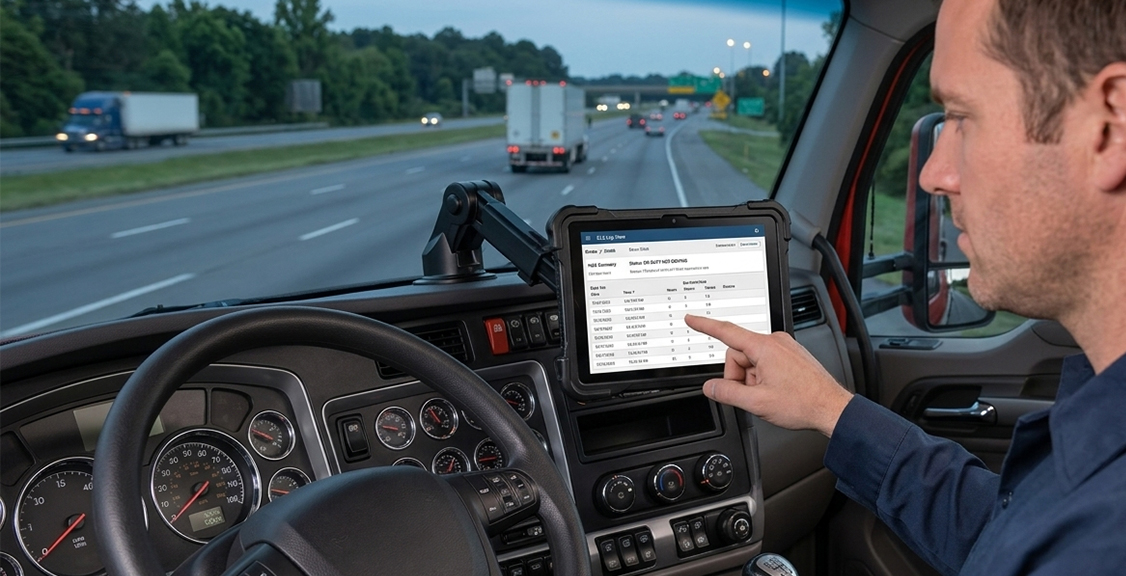
Any driver of a commercial motor vehicle who is required to maintain records of duty status under FMCSA hours of service rules must use a registered ELD, unless a specific exemption applies to their operation. Put simply, if you have to keep a log under federal HOS rules, you need an ELD to keep it. If your operation does not require you to keep a log at all, you do not need an ELD.
To understand who that covers, you need to know what qualifies as a commercial motor vehicle. Under 49 CFR Part 390.5, a CMV is any vehicle used in interstate commerce with a gross vehicle weight rating or gross combination weight rating over 10,001 pounds, any vehicle transporting hazardous materials in a quantity requiring placarding regardless of weight, or any vehicle designed to transport nine or more passengers including the driver for compensation. Most semi-trucks operating across state lines fit squarely inside that definition, which means the ELD requirement applies to the vast majority of long-haul and regional trucking operations in the United States.
There is no fleet-size exemption under the ELD mandate, which surprises many small carriers. A one-truck owner-operator running interstate with a RODS obligation is held to exactly the same standard as a carrier with 500 trucks. The exemptions that exist are based on how the operation works, the type of vehicle, the distance driven, and how frequently RODS are required, not on how large the fleet is. The rule also applies to drivers domiciled in Canada and Mexico who operate on US roads, so if your fleet runs cross-border routes, FMCSA rules govern the US portion of every trip. Our ELD platform supports both US and Canada HOS rule sets in a single system, so your drivers can switch between rule sets without managing separate records or separate devices for each country.
What Are the Four ELD Exemptions for Semi-Trucks?
Four specific exemptions are built into the ELD rule, and each one either removes the records of duty status requirement entirely for qualifying operations or allows paper logs in place of an electronic device. Meeting an exemption is not a one-time determination you make when you hire a driver or register a vehicle. It must be verified for each driver on a continuing basis, because a change in route, dispatch, or equipment on a single day can eliminate the exemption for that day without anyone in the back office realizing it until there is a problem at the roadside.
One point worth stating clearly before going through each exemption: an exemption from the ELD device requirement is not always an exemption from HOS obligations. Some drivers who qualify for an ELD exemption are still required to follow hours of service limits and must maintain paper records on days when those rules apply. The exemption covers the device requirement, not necessarily the underlying rule that governs how many hours your driver can be behind the wheel. The four exemptions are the short-haul exemption, the pre-2000 engine exemption, the 8-in-30-day paper log rule, and the driveaway-towaway exemption.
How Does the Short-Haul Exemption Work?
CDL drivers who qualify for the short-haul exemption under 49 CFR 395.1(e)(1) do not need an ELD and do not need to maintain records of duty status. They use timecards instead, which is a meaningful operational difference that saves time and removes the cost of an ELD subscription, but the qualifying conditions are strict and must be met on every single day the exemption is claimed.
Conditions That Must Be Met Every Qualifying Day
To qualify under the CDL short-haul exemption, all of the following must be true on every qualifying day. The driver must operate within 150 air miles of their normal work reporting location, must return to that same location and be released from duty within 14 consecutive hours of coming on duty, must have at least 10 consecutive hours off duty between shifts, and your company must retain timecards for each driver showing start time, release time, total on-duty hours per day, and total on-duty hours for the prior 7 days.
The 150-air-mile radius is a straight-line measurement, not road miles traveled on the actual route. A driver who covers 200 road miles on a winding delivery route may still qualify if no point on that route is more than 150 straight-line miles from their home base. Eligibility is assessed driver by driver and trip by trip, so a driver dispatched beyond the radius on any given run loses the exemption for that run and must complete full paper RODS covering the entire shift, not just the portion when the radius was exceeded.
Where Mixed-Operation Fleets Get Caught
This is the part that catches fleets with mixed operations off guard. A last-minute dispatch outside the radius, a delay that pushes a driver past the 14-hour window, or a busy period where drivers exceed the exemption conditions more than 8 times in a rolling 30-day period can all trigger ELD requirements that nobody in the back office anticipated. If any of your drivers regularly run trips that could push them outside the short-haul conditions, putting an ELD in the truck before the problem happens is the cleaner and safer decision.
Timecards are not just an internal administrative record. If your driver is stopped at a roadside inspection and claims the short-haul exemption, the officer can ask for documentation proving the driver qualified on that specific day, and missing or incomplete timecards leave your driver exposed even if they genuinely met every condition. If you are not sure whether your drivers currently qualify or what records you need to keep for timecard-only operations, our support team is available at (800) 261-4361 and can walk you through the specifics for your operation.
Does a Pre-2000 Engine Exempt a Truck From ELD?
Yes, A commercial motor vehicle powered by an engine with a model year before 2000 is exempt from the ELD requirement under 49 CFR 395.8(a)(1)(iii). The reason this exemption exists is practical: engines manufactured before 2000 generally lack the engine control module that an ELD needs to connect to and automatically record driving data.
Your Engine Year Determines Compliance, Not Your Vehicle Title
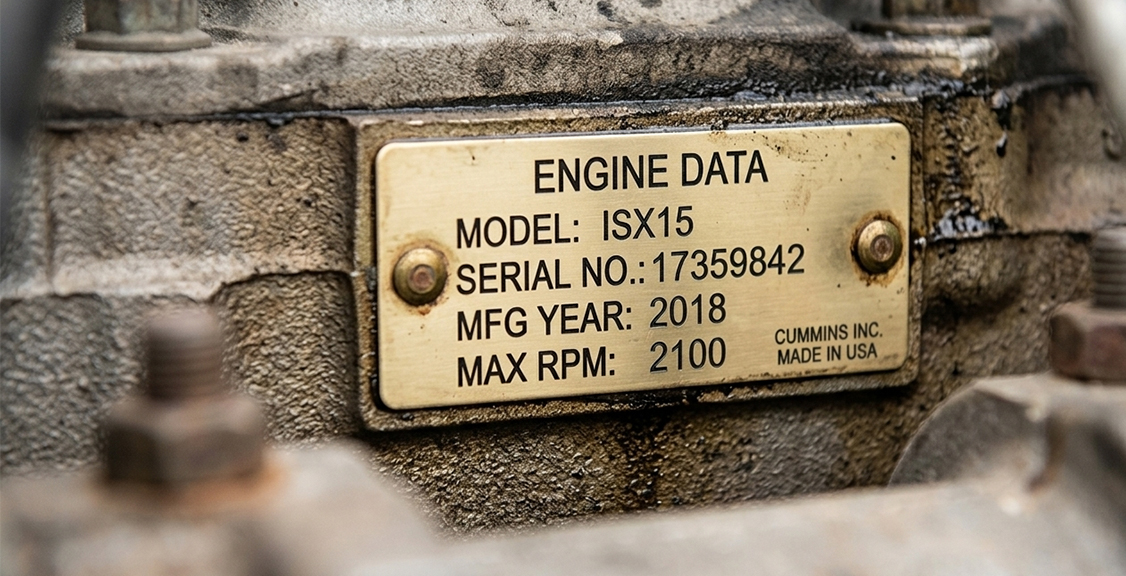
The detail that carriers frequently miss is that the exemption follows the engine, not the vehicle title or the truck chassis. A 2015 truck body fitted with a 1998 engine can qualify for the exemption, while a 1999 truck body fitted with a 2002 engine does not. The same logic applies to glider kits: a new cab and chassis built around a pre-2000 engine retains the exemption because the rule ties to the engine model year, not the year the vehicle was assembled or the year on the registration.
What this means in practice is that the vehicle title is not sufficient proof at a roadside inspection, and an inspector is not required to accept a driver’s word without documentation. The engine dataplate, a metal tag riveted to the engine block showing the engine serial number, model, and manufacture year, is what supports the claim. Carriers should keep engine documentation at their principal place of business and drivers should carry a copy in the cab at all times. Even under this exemption, drivers who are required to keep records of duty status on a given trip must do so using paper logs, because the pre-2000 exemption removes the ELD device requirement but does not remove the record-keeping obligation when HOS rules apply.
What Is the 8-in-30-Day Rule?
Drivers who are required to keep records of duty status for no more than 8 days within any rolling 30-day period are not required to use an ELD and may use paper logs for those qualifying days instead. This exemption was designed for drivers who mostly run short-haul or local routes but occasionally take longer trips that push them outside the short-haul conditions and require RODS, giving those fleets some flexibility without mandating a full-time electronic device.
Why the Rolling 30-Day Window Catches Fleets Off Guard
The count does not reset on the first of each calendar month but runs continuously, meaning your back office needs to track each driver’s RODS days across the most recent 30-day window at all times, not just at the start of a new month. If a driver hits 9 days requiring RODS in any rolling 30-day window without a registered ELD in the truck, that driver is out of compliance for every day over the limit, and the violation cannot be undone after the fact.
This is where small and mixed-operation fleets consistently get caught. A dispatcher sends a driver outside the short-haul radius a few extra times during a busy stretch, the RODS day count ticks past 8, and nobody in the back office catches it until there is a problem at a weigh station. The count needs to be tracked per driver, continuously, every week without exception, and if any of your drivers regularly run trips that could require RODS even occasionally, putting an ELD in those trucks removes the risk entirely. Our price calculator shows you what ELD coverage costs for your fleet size so you can make that decision before it gets made for you at a weigh station.
Are Driveaway-Towaway Operations Required to Use an ELD?
No, but with specific conditions attached. Driveaway-towaway operations are exempt from the ELD requirement when the vehicle being driven is the commodity being delivered, which covers a driver taking a new truck from a manufacturer to a dealership, towing a vehicle to a buyer using a saddle mount or towbar, or transporting vehicles as the cargo itself. In these situations the driver is delivering the vehicle as the product, not using it to haul separate freight, and permanent ELD installation is impractical because the vehicle changes with every delivery.
FMCSA drew the rule around the specific use case rather than the type of business. If your driver is carrying additional freight alongside or inside the vehicle being delivered, only the vehicle-transport portion of the trip qualifies for the exemption and the freight portion does not. On any trip where the driver is required to maintain HOS records, paper logs are the required method, because the exemption removes only the ELD device requirement, not the record-keeping obligation that applies when hours of service rules are in effect.
What Is Happening With Revoked ELDs in 2026?
Having an ELD in your truck is not sufficient on its own because the device must appear on the active FMCSA-registered ELD list at the time of any inspection. A device that was fully compliant when you bought it may have been removed from the list since then, and without checking regularly you would have no way of knowing until an inspector flags it at the roadside.
The Scale of 2026 Device Removals
79 ELD devices have been removed from the registered list since January 2025, and the most recent removal on May 20, 2026 covered 12 devices: 888 ELD, Dragon ELD, Action ELD, Mondo ELD HOS, First ELD, First ELD V2.0, MTL ELD, USPower ELD, Sam Freight ELD, DSGELOGS, Cobra ELD, and GT USA ELOGS. Carriers using any of those 12 devices must replace them with a device from the current registered list before July 20, 2026, because after that date operating with a revoked device is treated identically to running with no log at all, resulting in a citation under 49 CFR 395.8(a)(1) and an immediate out-of-service order.
FMCSA gives carriers a 60-day grace period from each removal date, during which you must stop using the revoked device, switch to paper logs, and complete the replacement before the grace period expires, because once the window closes there is no tolerance at the roadside. The practical step for your fleet is to check the registered list regularly, not just when you first buy a device, and if you want to confirm your current device’s status or need to start a transition before a deadline, call us at (800) 261-4361. Our ELD hardware connects via J1939, J1708, or OBD-II and remains on the active registered list.
What Are the Penalties for Running Without a Valid ELD?
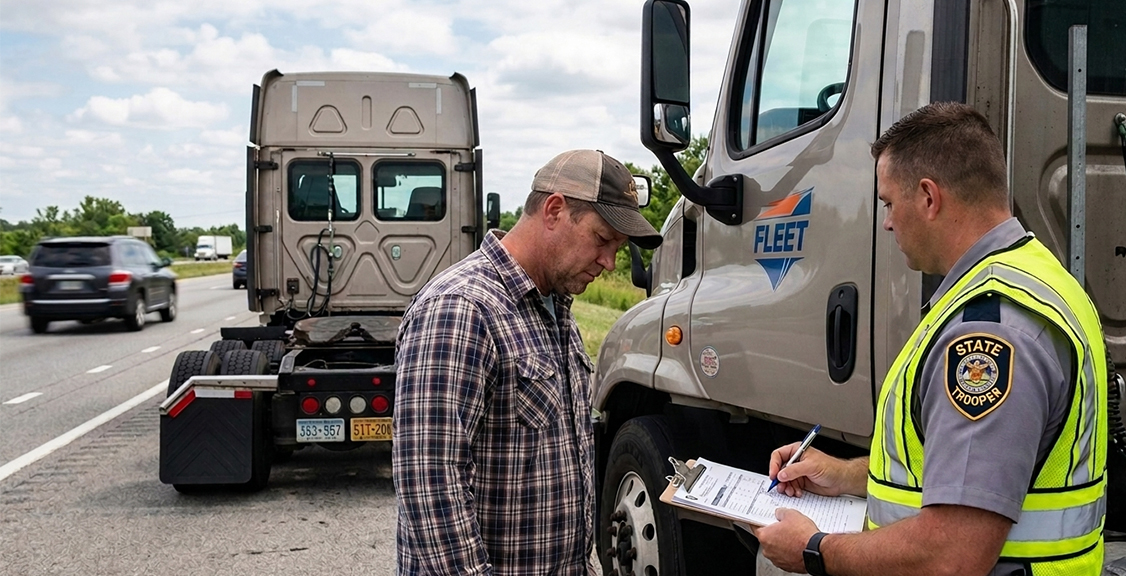
Running without a valid registered ELD when one is required results in a citation under 49 CFR 395.8(a)(1) for no record of duty status and an immediate out-of-service order, which means your driver cannot move that truck from where it sits until the violation is resolved. The load misses its delivery window, your compliance record takes a hit, and the financial damage starts accumulating before the inspector walks away.
Civil Penalties and Enforcement Consequences
Under the FMCSA penalty schedule, motor carriers face maximum civil penalties of up to $19,246 per HOS violation, drivers face up to $4,812 per violation, and knowing falsification of records of duty status, which includes tampering with ELD data or altering logs to hide driving time, carries a maximum penalty of up to $15,846. These are maximums adjusted annually for inflation under 49 CFR Appendix B to Part 386, and the amount assessed in a specific case depends on severity, prior violations, and whether the carrier acted in good faith.
Every out-of-service order becomes visible in your carrier profile through the FMCSA Safety Measurement System, and repeated HOS violations can trigger a compliance review under FMCSA safety fitness procedures regardless of how many trucks you run. Brokers and shippers check carrier profiles before awarding loads, and a pattern of out-of-service orders directly affects your ability to compete for freight in a way that outlasts the original fine by months.
HOS violations rose from 410,000 in 2023 to more than 500,000 in 2025, according to RigDig data cited by Overdrive in April 2026, and CVSA’s 2026 Roadcheck announcement confirmed that ELD tampering and log integrity were the primary enforcement focus during the May 12 to 14 roadside blitz, with falsification of records of duty status ranking as the second most-cited driver violation in 2025 at 58,382 incidents. Inspectors are now cross-referencing ELD records against fuel receipts, bills of lading, and dispatch records at a level that was not routine a few years ago. Our article on ELD violations and their impact on records covers what happens to your driver’s record and how the correction process works.
ELD Compliance Comparison
| Operation Type | ELD Required? | Record Keeping Required? | Key Regulation |
|---|---|---|---|
| Interstate CMV, GVWR over 10,001 lbs, must keep RODS | Yes | Yes, via registered ELD | 49 CFR Part 395 |
| CDL short-haul driver, within 150 air miles, back within 14 hours | No | Timecards only | 49 CFR 395.1(e)(1) |
| Driver using paper RODS 8 or fewer days in any rolling 30-day period | No, for exempt days | Yes, paper logs on those days | 49 CFR 395.8(a)(1)(ii) |
| Vehicle with a pre-2000 model year engine | No | Yes, paper logs when RODS required | 49 CFR 395.8(a)(1)(iii) |
| Driveaway-towaway, vehicle is the commodity delivered | No | Yes, paper logs when RODS required | 49 CFR 395.1(e) |
| Driver who breaks short-haul conditions on a given day | Yes, for that day | Full RODS required for that day | 49 CFR Part 395 |
| Canadian or Mexican driver on US roads | Yes, same as US drivers | Yes, via registered ELD | 49 CFR Part 395 |
| Carrier operating a revoked ELD device | Treated as no ELD | Out-of-service order applies | 49 CFR 395.8(a)(1) |
| Owner-operator, one truck, interstate, must keep RODS | Yes | Yes, via registered ELD | 49 CFR Part 395 |
Questions to Ask Before Buying an ELD for Your Fleet
Is the device currently on the active FMCSA registered list, and how do I verify that?
Check the FMCSA-registered ELD list directly and search for the exact make and model you are considering before you buy, because the list changes regularly as devices are added and removed and a device that was registered when someone else bought it six months ago may not still be on the list today. Do not rely on a vendor telling you they are registered, because your driver will not find out their device has been revoked until they are already at a weigh station and it is too late to avoid the citation.
Does the ELD connect to all the engine types in my fleet?
Your ELD must physically connect to your truck’s engine to record driving data automatically, and most modern semi-trucks use J1939 or J1708 diagnostic connectors while older trucks may use OBD-II. Our ELD supports all three connection types, which covers the full range of equipment most fleets run. Confirm compatibility with every vehicle type in your fleet before committing, because a device that cannot connect to a specific truck cannot record data for that truck and leaves your driver running without valid logs.
What happens when the ELD malfunctions on the road at 2 a.m.?
Under 49 CFR 395.34, when an ELD malfunctions the driver must notify the carrier within 24 hours under 49 CFR 395.34(a)(1), and the carrier has 8 days to repair or replace the device under 49 CFR 395.34(d)(1), during which time your driver must use paper logs. Before you buy any device, confirm that your provider has a real person available to help your driver through a malfunction at any hour of the day or night, because our team is reachable 24 hours a day, 7 days a week at (800) 261-4361 and we stay on the line until the issue is resolved.
How does the ELD transfer data to a roadside inspector?
FMCSA requires every registered ELD to support at least two data transfer methods, as set out in the ELD technical standard Appendix A, with acceptable methods including Bluetooth, USB 2.0, encrypted email, and web services. Your driver needs to hand the inspector their 8-day log history quickly and without a technical struggle at the roadside, because an ELD that fails to complete that transfer creates a compliance failure even when your logs are perfectly accurate. Test the transfer method before your driver is asked to do it in front of an officer for the first time.
Does the provider alert you immediately if your device is removed from the registered list?
79 devices have been pulled from the list since January 2025, and a reliable provider tracks registration status continuously and contacts you at the first sign that your device has been flagged, not after the grace period has already started running. Ask specifically how they handle revocations and what their notification process looks like for carriers, because the difference between finding out on day one and finding out on day 55 of a 60-day grace period is the difference between a managed transition and a scramble.
Is technical support available around the clock, every day?
ELD problems do not follow business hours, and long-haul drivers run nights, weekends, and holidays when a provider whose support team is only available during office hours leaves your driver alone with the problem during the hours it is most likely to occur. We provide 24/7 technical support at (800) 261-4361 because that is what your drivers’ schedule actually requires, not what is convenient for a vendor’s staffing model.
Does the platform support both US and Canada HOS rule sets?
If any driver in your fleet crosses into Canada, the HOS rules they operate under differ from US rules, and your ELD needs to support both rule sets on a single device so your driver can switch without managing separate systems or carrying separate logs. Ask your provider specifically which rule sets are supported and how the driver switches between them while on the road, because a system that requires your driver to figure out a workaround at the border is a liability on every cross-border trip.
How quickly can your back office pull a driver’s full record history if FMCSA requests it?
FMCSA requires HOS records to be retained for 6 months under 49 CFR 395.8(k)(1), and your platform should store records automatically and make them accessible to your back office immediately rather than requiring a manual export process or a call to the provider. If FMCSA requests records during a compliance review, the speed at which you can produce complete, accurate data matters, so ask how far back records are accessible and whether they can be exported in the format FMCSA requires.
ELD Compliance Questions
Does every semi-truck in the United States need an ELD?
No, Most commercial motor vehicle drivers required to maintain records of duty status under 49 CFR Part 395 must use a registered ELD, but four specific exemptions apply: CDL short-haul drivers operating within 150 air miles and returning to base within 14 hours, drivers of vehicles with pre-2000 engines, driveaway-towaway operators where the vehicle is the commodity, and drivers who maintain RODS for 8 or fewer days in any rolling 30-day period are all exempt when they meet the specific qualifying conditions for their category.
My truck is older and I have never been asked about an ELD at inspections. Does that mean I do not need one?
Not necessarily, because whether you need an ELD depends on your engine model year and whether your operation requires you to maintain records of duty status, not on your inspection history. If your truck has a pre-2000 engine you may qualify for the exemption under 49 CFR 395.8(a)(1)(iii), but you need to carry documentation proving the engine year rather than relying on the vehicle title, and if your engine is 2000 or newer and you are required to keep RODS, you need a registered ELD regardless of what has or has not been asked at past inspections.
I run one truck under my own authority. Do I still need an ELD?
Yes, if you are required to maintain records of duty status and none of the four exemptions apply to your operation, because there is no fleet-size exemption in the ELD mandate and a one-truck owner-operator running interstate is held to exactly the same standard as any carrier with hundreds of trucks. If you want help checking whether your specific operation qualifies for an exemption, call us at (800) 261-4361 and our team will go through the details with you.
What happens if my driver gets stopped and the ELD shows the device has been revoked?
The driver will receive a citation under 49 CFR 395.8(a)(1) for no record of duty status and an immediate out-of-service order, meaning the truck cannot move until the violation is resolved, and after the 60-day grace period following a revocation expires there is no tolerance at the roadside. Check the FMCSA registered ELD list regularly and contact your provider immediately if your device has been flagged, because the grace period clock starts running from the removal date whether or not you are aware of the removal.
My drivers mostly run local routes. Can I assume they all qualify for the short-haul exemption?
No, because the short-haul exemption applies driver by driver and day by day, and your drivers qualify only when every condition is met on every qualifying day, including the 150-air-mile radius, the 14-hour return window, and your company’s timecard records. A busy week with extra-long runs or a driver dispatched beyond the radius even once breaks the exemption for those specific days, and you need to track each driver’s qualifying days actively rather than assume the exemption applies because your operation is generally local.
What should my driver carry in the cab to prove they qualify for the pre-2000 engine exemption?
Your driver should carry documentation showing the engine model year, typically a copy of the engine dataplate information or a manufacturer certificate confirming the engine serial number and build date, because the vehicle title is not sufficient since it reflects the chassis year rather than the engine year. Carriers must keep full engine documentation at their principal place of business and drivers should have a copy accessible in the cab on every trip where the exemption applies, because an inspector who asks for proof is not required to accept a verbal claim without documentation.
Do Canadian drivers operating in the United States need an FMCSA-registered ELD?
Yes, Drivers domiciled in Canada or Mexico who operate on US roads are subject to FMCSA rules for the US portion of any trip, and the device they use must appear on the FMCSA registered list. Our ELD platform supports both US and Canada HOS rules in a single system, which removes the need to carry separate devices or maintain separate records for each country on cross-border routes.
What is the difference between the short-haul exemption and the 8-in-30-day rule?
The short-haul exemption removes the RODS requirement entirely for drivers who meet all qualifying conditions every day, while the 8-in-30-day rule is a separate provision that allows paper logs instead of an ELD for drivers who need RODS infrequently, specifically on no more than 8 days within any rolling 30-day period. A driver who regularly qualifies for the short-haul exemption but occasionally pushes outside the conditions can use the 8-in-30-day rule as a buffer, but only up to that 8-day limit before a registered ELD becomes required for those trips.
Choosing an ELD Provider
What does FMCSA-registered mean for an ELD, and why does it matter at the roadside?
It means the device manufacturer has self-certified to FMCSA that their device meets the technical specifications in the ELD technical standard Appendix A, and the device appears on the active registered list that inspectors have access to at every roadside stop. A device not on the active list is treated as no log at all, and registration is not a permanent status because it can be revoked at any time if FMCSA determines the device no longer meets minimum standards.
What connection methods should an ELD support for transferring data to an inspector?
The FMCSA ELD FAQ confirms that ELDs must support at least two data transfer methods, which can include Bluetooth, USB 2.0, web services, or encrypted email, and at a roadside inspection your driver must be able to hand the inspector their current day plus prior 7 days of log data quickly and cleanly. An ELD that cannot complete that transfer is a compliance failure on the spot even if every hour logged is accurate, so testing the transfer method before your driver encounters it at a weigh station is worth doing before you commit to a device.
Does the quality of the hardware actually matter for compliance?
Yes, more than most carriers expect, because a tablet that overheats in summer, loses its display in direct sunlight, or fails from cab vibration creates ELD malfunctions that put your driver into paper log mode mid-trip with no warning. Our tablet is SAE J1455 certified, meaning it is tested against the thermal shock, vibration, and humidity conditions found in commercial vehicle cab environments, and you can review our hardware options in our shop.
Is there a way to confirm what ELD coverage costs for my fleet before committing?
Yes. Our price calculator shows what coverage costs for your specific fleet size with no obligation, and we back every device with a 30-day money-back guarantee so your fleet can confirm the hardware, the platform, and the support all work for your operation before you are fully committed. If you have questions before or after using the calculator, our team is reachable at (800) 261-4361.
Do box trucks follow the same ELD rules as semi-trucks?
The same FMCSA requirements under 49 CFR Part 395 apply to any vehicle that meets the CMV definition, including box trucks over 10,001 pounds GVWR operating in interstate commerce, and the four exemptions apply the same way across all vehicle types. Our box truck ELD guide covers the specific weight and operation thresholds that determine whether your box trucks need a registered ELD.
What does the 30-day money-back guarantee actually cover?
It covers the full device purchase, so if you put our ELD into your truck and it does not work the way we say it does within 30 days, you get your money back without a lengthy process. We offer it because we want your fleet to have real confidence in the equipment before you are committed to it long term, and combined with 24/7 technical support at (800) 261-4361, it means you are not taking a risk on unknown hardware when you choose us.
Conclusion
If your drivers are required to maintain records of duty status under 49 CFR Part 395 and none of the four exemptions apply to their specific operation, they need a registered ELD in the cab. The four exemptions are real and legally valid, but each one has qualifying conditions your back office must track actively on a rolling basis, and a change in route, dispatch, or schedule on a single day can eliminate the exemption for that day and create a compliance gap that nobody planned for and that cannot be undone after the fact.
The enforcement environment around those gaps has shifted significantly in 2026. HOS violations topped 500,000 in 2025, 79 devices have been pulled from the registered list since January 2025, and CVSA’s 2026 International Roadcheck made ELD tampering and log integrity the year’s primary enforcement focus, with inspectors cross-referencing electronic records against physical documents at a level that was not routine a few years ago. A compliance gap that went unnoticed in 2022 carries significantly more risk of detection and citation today.
Confirming your fleet’s ELD status, checking whether your current device is still on the registered list, or talking through whether your operation qualifies for one of the exemptions takes one conversation with our team. You can contact us, call (800) 261-4361, or use our price calculator to see what a compliant setup costs for your fleet. Our tablet is SAE J1455 certified and connects via J1939, J1708, or OBD-II, we support both US and Canada HOS rules, and our team is available around the clock backed by a 30-day money-back guarantee.