Key Takeaways
- Under 49 CFR 395.34, a driver may use paper Records of Duty Status for a maximum of 8 calendar days after an ELD malfunction is discovered
- The 8-day countdown begins at discovery, not when the carrier is notified. The driver must notify the carrier in writing within 24 hours of that moment, per 49 CFR 395.34(a)(1)
- The driver must reconstruct paper RODS for the current 24-hour period and the previous 7 consecutive days, per 49 CFR 395.34(a)(2)
- The motor carrier must repair or replace the ELD within 8 days of the driver’s notification, per 49 CFR 395.34(d)(1)
- A carrier seeking more time must file an extension request within 5 days of the driver’s notification, not after the 8-day deadline passes, per 49 CFR 395.34(d)(2)
- FMCSA recognizes six official malfunction categories: power, engine synchronization, timing, positioning, data recording, and data transfer. Diagnostic events that self-clear on their own do not trigger the paper log requirement
- Every driver must carry an in-vehicle ELD information packet including malfunction instructions under 49 CFR 395.22(h). Not having it in the cab is a separately citable violation at roadside
- HOS violations rose from 410,000 in 2023 to more than 500,000 in 2025, according to RigDig data cited by Overdrive in April 2026, making correct malfunction handling a real part of any fleet’s compliance record
Introduction
Your ELD stops recording mid-route, maybe it lost its connection to the engine control module. Maybe the screen went blank after a rough stretch of road. Whatever the reason, you now have a question that needs a straight answer: how long can you keep driving on paper logs, and what do you need to do right now to stay legal?
Most drivers know paper logs are the fallback when an ELD fails. Fewer know the specific steps that make those paper logs legally valid, how tight the timelines actually are, or what happens on Day 9 if the device still has not been fixed. That gap between knowing the general idea and knowing the details is where compliance violations come from.
The regulation that covers malfunction handling is 49 CFR 395.34, and it gives drivers up to 8 days on paper logs after a malfunction. But that window comes with separate obligations for the driver and the carrier, both running on their own clocks from the moment the problem is discovered. HOS violations rose from 410,000 in 2023 to more than 500,000 in 2025, according to RigDig data cited by Overdrive in April 2026. A malfunction handled incorrectly, with incomplete logs or a missed notification deadline, contributes to that number just as easily as a driver who genuinely pushed past their hours.
This article walks through the full process in the order it actually happens: what the 8-day window means, when each clock starts, what the driver and carrier each need to do, what the six types of ELD failures trigger this process, what a valid paper log must contain, and what officers look for when a driver gets stopped while running on paper.
What Does the 8-Day Rule Actually Mean?
When an ELD malfunctions, a driver may continue operating on paper Records of Duty Status for up to 8 calendar days from the moment the malfunction is discovered. That is the outer limit, if the device is repaired on Day 5, the paper log period ends on Day 5. If it is still not fixed by the end of Day 8, the driver must stop operating until a working device is back in the cab.
What those 8 days do not change is worth being clear about. All Hours of Service rules remain fully in effect throughout the malfunction period. The 11-hour driving limit, the 14-hour on-duty window, and the weekly limit under 49 CFR 395.3(b) all apply exactly as they always did. The recording method shifts temporarily from electronic to paper, but the hours still count toward the same limits. A driver who uses a malfunction period to quietly run past their available hours is not protected by 49 CFR 395.34. That crosses into falsification under 49 CFR 395.8(e)(1), which is a different and more serious problem altogether.
The 8 days are calendar days, not business days. If the malfunction is discovered on a Wednesday, the window closes the following Wednesday regardless of weekends, rest days, or days the truck sits parked. The clock runs from discovery and does not pause for anything.

When Does the Clock Actually Start?
The countdown begins the moment the malfunction is discovered, not when it is reported to the carrier and not when anyone confirms the problem is real. If a driver notices the ELD showing a malfunction code at 6:00 AM, the 8-day window opens at 6:00 AM on that day, whether or not the driver calls dispatch for another four hours.
This matters because the 24-hour window to notify the carrier in writing also starts at the moment of discovery. Both timers run simultaneously from the same point. A driver who waits until the end of a long shift to report the problem has already used 10 or 12 hours of the time the carrier has to respond. And because the carrier’s 8-day repair obligation is measured from the driver’s written notification, the later that notification comes in, the tighter the repair deadline becomes for the back office.
The straightforward rule is this: the moment something seems wrong with the device, note the exact time, write down what the device is showing, and get written notice to the carrier as soon as possible within that 24-hour window.
What Does the Driver Need to Do Right Away?
Under 49 CFR 395.34(a), the driver must take four steps, and all four are required.

Step 1: Note the Malfunction
The driver must write down what the device displayed, the malfunction code if one appeared, and the exact date and time the problem was noticed. This becomes part of the documentation a roadside officer may ask to see, so it needs to be specific enough to show the driver recognized the issue and responded to it promptly.
Step 2: Notify the Carrier in Writing Within 24 Hours
A verbal phone call does not satisfy this requirement. Written notice means an email, a completed malfunction report form, or a documented message through the carrier’s dispatch system, something that can be produced later if needed. This notification is what triggers the carrier’s 8-day repair obligation, so getting it done promptly matters for both sides.
Step 3: Reconstruct Paper RODS
The driver must rebuild paper Records of Duty Status for the current 24-hour period and the previous 7 consecutive days. If the ELD can still retrieve and print those records, those printouts satisfy the reconstruction requirement for the days they cover. If the device cannot retrieve them, the driver rebuilds them from memory and from whatever supporting documents are in the cab, such as fuel receipts, toll records, and bills of lading, noting any approximations with written annotations on the log.
Step 4: Keep Preparing Paper Logs Every Day
The driver must complete a full paper log every day until the ELD is repaired and back in service. Stopping midway through because the repair seems close is not acceptable. The paper record needs to be complete for every day of the window, and each sheet must be signed.
One thing that catches drivers off guard at the roadside is simply not having blank paper log forms in the cab at all. If blank forms are not there when the device fails, the driver cannot satisfy the immediate switch-to-paper requirement. Blank forms should be in every truck at all times, the same way registration and insurance cards are, and they should be restocked after any malfunction period ends.
What Does the Carrier Need to Do?
The carrier’s obligation runs alongside the driver’s and is just as specific. Under 49 CFR 395.34(d)(1), the motor carrier must correct, repair, replace, or service the malfunctioning ELD within 8 days of the driver’s written notification, or of the carrier’s own discovery of the condition, whichever comes first.
That repair obligation belongs to the carrier, not the driver. If a driver reports the malfunction on Day 1 and the back office does nothing for a week, the carrier is building a violation regardless of how correctly the driver has been managing the paper logs. The two obligations are separate and both must be met.
From the moment a malfunction report comes in, the back office should log the exact date and time of that notification, contact the ELD provider or a technician to schedule repair or arrange a replacement, and keep a written record of every step taken. That documentation matters if a compliance review ever examines the malfunction period, because the carrier needs to show the repair deadline was met or that a genuine effort was underway before the deadline arrived.
Carriers that do not keep at least one backup device available tend to be the ones that miss the 8-day deadline. Ordering a replacement after a malfunction has already occurred means dealing with shipping time, installation, and driver setup inside a tight window. Having a spare on hand removes that pressure entirely. If you need to look at adding a backup device to your fleet, you can see what Geosavi carries in the ELD store.
What Are the Six Types of ELD Malfunctions?
FMCSA defines six specific malfunction categories, and only a true malfunction in one of these categories triggers the paper log requirement and the 24-hour notification obligation. Minor diagnostic events that self-clear without affecting the accuracy of the hours record do not require a driver to switch to paper or notify the carrier under the full malfunction procedure. Understanding the difference matters, because treating a diagnostic event as a malfunction creates unnecessary paperwork, and treating a true malfunction as a minor alert creates a compliance gap.

Power Compliance Malfunction
This occurs when the ELD fails to receive power for 30 or more accumulated minutes of driving time in a 24-hour period. It typically comes from a loose connection to the ECM, a damaged cable, or a vehicle power supply issue.
Engine Synchronization Malfunction
This occurs when the ELD loses its connection to the ECM and can no longer pull the required data, including engine power status, vehicle motion, miles driven, and engine hours. If that connectivity gap exceeds 30 minutes in a 24-hour period, it becomes a malfunction rather than a short-term diagnostic event.
Timing Compliance Malfunction
This occurs when the ELD’s internal clock drifts more than 10 minutes from Coordinated Universal Time, which can happen after certain firmware issues or when the device’s internal backup battery fails.
Positioning Compliance Malfunction
This occurs when the ELD cannot acquire a valid GPS position within 5 miles of a moving vehicle for 60 consecutive minutes.
Data Recording Malfunction
This occurs when the device can no longer record or retain required events, or cannot retrieve logs that are not stored remotely by the carrier. This is one of the more serious categories because it affects records that already exist, not just new ones going forward.
Data Transfer Malfunction
This occurs when the ELD cannot transfer records to an authorized safety official through the required methods. This becomes the most visible problem specifically at a roadside inspection where data transfer is mandatory.
If you want FMCSA’s own definitions for each of these categories and guidance on when a diagnostic event rises to the level of a full malfunction, the FMCSA ELD malfunction guidance covers each one in detail.
What Must a Valid Paper Log Include During a Malfunction?
Paper logs prepared during a malfunction must comply with 49 CFR 395.8, the same standard that governed paper logs before ELDs existed. A handwritten grid on plain paper does not meet that standard. Proper graph-grid log forms are required, and each form must be fully completed.
Every daily log sheet must include the driver’s name and signature, the vehicle identification number or license plate number, the carrier’s name and home terminal address, the date and 24-hour period being recorded, total miles driven that day, all duty status changes plotted accurately on the grid, the co-driver’s name if applicable, and all shipping document numbers associated with that day’s operation.
Beyond those required fields, each sheet during the malfunction period should include a brief written note explaining the situation, something along the lines of ELD malfunction, paper log per 49 CFR 395.34 with the date and time the malfunction was first noticed. That notation gives an officer immediate context for why the driver is on paper, shows the driver is aware of the regulation, and removes the kind of ambiguity that tends to invite a closer look at everything else in the records.
One paper log covers one 24-hour period, and the driver must complete a fresh sheet for each day of the malfunction window. If the malfunction lasts 6 days, there are 6 daily log sheets, each complete and signed.
What Happens at a Roadside Inspection During a Malfunction?
If your driver is stopped during the paper log period, they need to present the paper logs alongside any records still retrievable from the ELD. FMCSA’s guidance confirms that reconstructed RODS and any available ELD data together satisfy the requirement to show the current day and the previous 7 days of duty status records. What protects the driver at a roadside inspection is having that documentation ready and organized, not the malfunction itself.
A driver who cannot produce any records because of a device failure and has not switched to paper logs is not protected by 49 CFR 395.34. The paper logs are what makes the malfunction provision work. Without them, the absence of records becomes a violation under 49 CFR 395.8(a)(1) regardless of what caused the ELD to stop functioning.
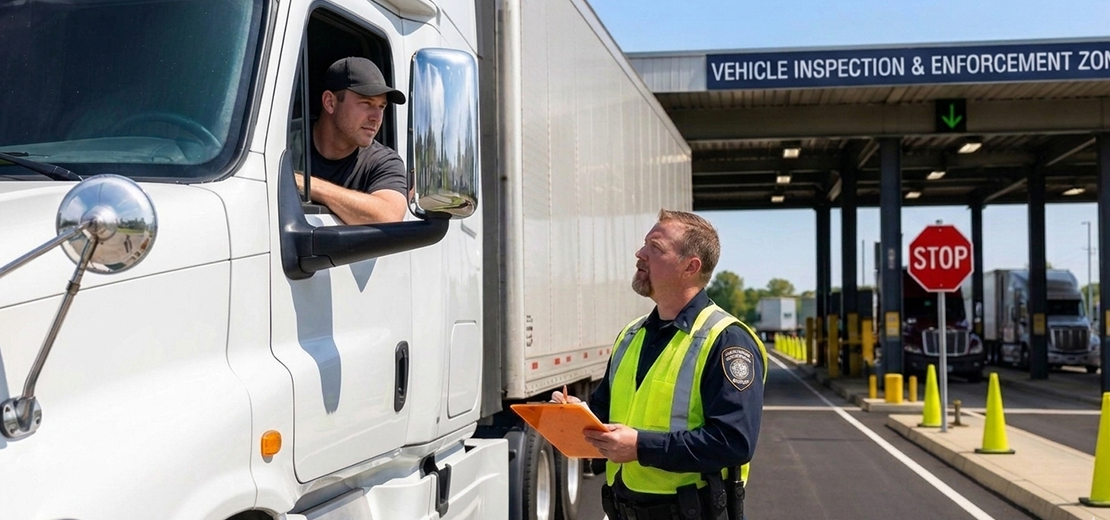
Officers also have some flexibility during malfunction situations. FMCSA has confirmed that a safety official can accept alternative retrieval methods when a device has malfunctioned, including receiving records by fax if that is what the situation requires. What matters most is that the driver can demonstrate they have been logging throughout the period and can explain clearly what happened.
The in-vehicle ELD information packet required under 49 CFR 395.22(h) must also be in the cab at all times, whether or not the device is currently working. That packet includes a user’s manual, data transfer instructions, and a malfunction instruction sheet covering exactly what to do when the device fails. Not having it during an inspection is a separate citable violation, independent of anything the officer finds in the logs themselves. If you have questions about what that packet needs to contain for your specific device, Geosavi’s FAQ covers the documentation requirements in detail.
Can You Request More Than 8 Days to Fix the ELD?
A carrier can request additional time beyond the 8-day repair deadline, but the request must be filed with the FMCSA Division Administrator for the state where the carrier’s principal place of business is located, and it must be submitted within 5 days of the driver’s malfunction notification, not after the 8-day repair window has already closed.
That 5-day filing window is easy to miss, if a driver reports a malfunction on Monday and the back office does not move quickly, the window to request an extension could close by Friday, three days before the 8-day repair deadline even arrives. The extension request must be signed by the motor carrier and must include the carrier’s legal name, principal place of business address, USDOT number, the make, model, and serial number of the malfunctioning device, the date and location of the malfunction as reported by the driver, and a clear description of what steps have already been taken and why more time is genuinely needed.
Extensions are not guaranteed, FMCSA has noted that many requests result from inadequate preparation rather than circumstances outside the carrier’s control, and those requests tend to be denied. An extension should be a last resort, not part of the standard response plan. While a properly filed extension request is pending and both the driver and carrier continue complying with the paper log requirements, the carrier is treated as compliant until FMCSA issues a determination. That protection disappears the moment either side stops following the paper log procedure while waiting for an answer.
What Happens If the 8 Days Run Out Without a Repair?
If the ELD is not repaired within 8 days and no extension has been approved, the driver must stop operating the commercial motor vehicle. Continuing to drive on paper logs past that deadline is a violation of 49 CFR 395.8(a)(1) and exposes both the driver and the carrier to enforcement action.
Under the FMCSA civil penalty schedule, motor carriers face maximum civil penalties of up to $19,246 per HOS violation and drivers face up to $4,812, with all amounts adjusted annually for inflation. An officer who stops a driver on Day 10 with no working ELD and no approved extension has clear grounds for an out-of-service order on the spot. The truck stays parked until a working device is installed and confirmed, and the operational cost of that situation almost always exceeds whatever a carrier thought it was saving by delaying the repair.
Beyond the immediate fine, each HOS citation from a mishandled malfunction enters the carrier’s record in the FMCSA Safety Measurement System, where repeated HOS violations can trigger a compliance review regardless of fleet size. The malfunction itself is not the problem. How the carrier responds to it is what determines whether it stays a manageable device failure or becomes something that follows the fleet for the next 24 months.
What Mistakes Make a Malfunction Worse?
The mistakes that turn an ELD malfunction into a compliance violation almost always come down to delays, missing paperwork, or wrong assumptions about how the rules apply.
Waiting too long to notify the carrier is the most common one. The driver has 24 hours from discovery, not from when the situation becomes convenient to report. Every hour of delay is an hour taken from the carrier’s repair window.
Not noting the malfunction reason on each paper log sheet is another. An officer who sees a driver on paper with no written explanation for why the ELD is absent has less context and more reason to look closely at the records. A brief note on each daily sheet takes seconds and removes that ambiguity completely.

Treating a diagnostic event as a full malfunction is a different kind of error. Filing a malfunction report and switching to paper for a minor alert that cleared on its own introduces inconsistencies in the compliance record that can be harder to explain than the original alert.
Assuming the 8-day window resets after a brief repair is also wrong. If the ELD is repaired and then fails again, the second failure starts a new notification and repair cycle with its own documentation requirements. It is not treated as a continuation of the first malfunction.
Using an unofficial phone application as a substitute during the malfunction period is another mistake that catches carriers off guard. Any app that is not on the FMCSA registered device list is not a compliant ELD, and paper logs prepared under 49 CFR 395.8 remain the only accepted fallback during a confirmed malfunction period. You can check whether your device is currently active on the FMCSA registered ELD list at any time.
Malfunction Response Comparison
| Situation | Correct Response | Incorrect Response |
|---|---|---|
| ELD stops recording mid-route | Switch to paper logs immediately, note the malfunction with date and time | Keep driving without logging and hope the device fixes itself |
| Notifying the carrier | Provide written notice within 24 hours of discovery | Call dispatch verbally and assume that is sufficient |
| Reconstructing past logs | Rebuild RODS for the current day and previous 7 days using available supporting documents | Start fresh from the malfunction date and leave earlier days unaccounted for |
| Annotating paper logs | Note the ELD malfunction and regulation on each daily sheet | Leave paper logs with no explanation for why the ELD is not being used |
| Carrier repair obligation | Begin repair or replacement steps immediately and document every action | Wait to see whether the device resolves itself before contacting the ELD provider |
| Extension filing | Submit to the FMCSA Division Administrator within 5 days of driver notification if repair is not possible in time | Wait until the 8-day deadline passes and then ask for more time |
| Roadside inspection during malfunction | Present paper logs, retrievable ELD records, the malfunction note, and the 395.22(h) cab packet | Tell the officer the ELD is broken and offer no documentation |
| Driver reaches Day 9 without repair | Stop operating until the ELD is back in service | Keep driving on paper logs and assume the carrier will sort it out |
Questions to Ask Before a Malfunction Happens
Does every driver in your fleet have blank paper log forms in the cab right now?
Not having forms on hand when a device fails means the driver cannot satisfy the immediate switch-to-paper requirement. Blank forms should be treated as standard cab documentation in every truck, the same way registration and insurance cards are, and they should be restocked after any malfunction period ends.
Does your back office have a written process for handling a malfunction report?
The 24-hour driver notification and the 5-day extension filing window are both short, and without a clear internal process the back office may not respond before those windows close. The process should assign responsibility, document the steps, and be tested before a device failure rather than improvised during one.
Do your drivers know the difference between a true malfunction and a diagnostic event?
Treating a minor alert that self-clears as a full malfunction creates unnecessary paperwork and introduces inconsistencies in the compliance record. Treating a true malfunction as a minor alert creates a compliance gap. Both errors are avoidable with proper driver training before the situation arises.
Does your fleet have a spare device available if an ELD cannot be repaired within 8 days?
Waiting to order a replacement after a malfunction has already occurred means racing against the deadline with shipping and installation time still ahead. Keeping one spare device on hand is far less costly than an out-of-service situation on Day 9.
Is the 49 CFR 395.22(h) in-vehicle packet in every truck and does it match the device installed?
The packet must include a user’s manual, data transfer instructions, and the malfunction instruction sheet. Not having it during a roadside inspection is a separate violation from anything the officer finds in the logs, and it applies whether or not the ELD is currently functioning.
Does your ELD provider offer technical support when a driver needs help at 2:00 AM on a Sunday?
Malfunctions do not follow business hours. If your provider cannot be reached outside of standard office hours, your driver is left making compliance decisions without support. Geosavi’s technical support team is available 24 hours a day, 7 days a week, and can be reached directly at (800) 261-4361.
Is your ELD still on the FMCSA registered list?
Since January 2025, FMCSA has removed 79 devices from its registered list, including 67 confirmed by FMCSA Administrator Derek Barrs on May 7, 2026, and 12 more removed on May 20, 2026. A device that is not on the list is not a compliant ELD, and paper logs during a period when a non-registered device is in the cab will not protect a driver the same way they would during a legitimate malfunction under a properly registered device. FMCSA posts every removal announcement on ELD news and events, which is the fastest way to know when a device has been pulled and how long carriers have to replace it.
Frequently Asked Questions
About the 8-Day Paper Log Rule
How long can a driver use paper logs after an ELD malfunction?
A driver may use paper logs for a maximum of 8 calendar days after an ELD malfunction. The countdown starts from the moment the malfunction is discovered, not from when the carrier is notified or when a repair is scheduled.
Do all Hours of Service rules still apply during the paper log period?
Yes, completely. The 8-day paper log window changes only the recording method, not the rules. The 11-hour driving limit, the 14-hour on-duty window, and the weekly limit under 49 CFR 395.3(b) all remain in full effect throughout the malfunction period.
What counts as written notice to the carrier?
Written notice can be an email, a completed malfunction report form, or a documented message through the carrier’s dispatch system. A verbal phone call does not satisfy the requirement under 49 CFR 395.34(a)(1) because it cannot be produced later as evidence the notification was given within the required 24-hour window.
Can a driver use a phone app instead of paper logs during a malfunction?
No. Any application that is not on the FMCSA registered ELD list is not a compliant ELD and cannot replace paper logs during a malfunction. Paper RODS that comply with 49 CFR 395.8 are the only accepted fallback.
Does the driver need to reconstruct logs for all 7 prior days even if the ELD can still print them?
Only if those records are not already retrievable from the device. Under 49 CFR 395.34(a)(2), reconstruction is only required for records the driver does not already have in printed or electronic form. If printouts are available and accurate, those satisfy the requirement for those days.
If the ELD is repaired on Day 5 and then fails again on Day 7, does the 8-day window reset?
The second failure starts a new malfunction event with its own discovery time, notification deadline, and 8-day repair obligation. It is not treated as a continuation of the first malfunction, and both events need separate documentation from start to finish.
Is every ELD glitch a malfunction that requires switching to paper logs?
No. Minor diagnostic events that self-clear without affecting the accuracy of the hours record do not trigger the paper log or 24-hour notification requirements. Only a true malfunction in one of FMCSA’s six defined categories requires those steps.
About Managing ELD Malfunctions as a Carrier
What must the carrier do within 8 days of a malfunction?
The carrier must correct, repair, replace, or service the malfunctioning ELD within 8 days of the driver’s written notification or of the carrier’s own discovery of the condition, whichever comes first, under 49 CFR 395.34(d)(1).
What is the penalty for continuing to operate past Day 8 without a repair?
Under the FMCSA civil penalty schedule, motor carriers face maximum civil penalties of up to $19,246 per HOS violation and drivers face up to $4,812 per violation, with amounts adjusted annually for inflation. An officer who stops a driver past the deadline with no approved extension has grounds for an immediate out-of-service order.
How should the carrier document the malfunction response?
The carrier should retain the driver’s written notification, the date and time it was received, all communications with the ELD provider or repair facility, the date the device returned to service, and every paper log submitted during the malfunction period. These are the records a compliance reviewer will ask for if the period is ever examined, and gaps in that documentation are treated as seriously as gaps in the logs themselves.
Can the carrier request more than 8 days to repair the ELD?
Yes, but the request must be filed with the FMCSA Division Administrator for the state of the carrier’s principal place of business within 5 days of the driver’s malfunction notification. The request must be signed by the carrier and include the legal name, principal address, USDOT number, make, model, and serial number of the device, and a clear explanation of what has been done and why more time is needed. Extensions are not guaranteed, and FMCSA has noted that many requests result from inadequate preparation rather than genuine circumstances beyond the carrier’s control.
Does a correctly handled malfunction period affect the carrier’s CSA score?
A malfunction that is handled correctly, with proper paper logs, timely notification, and documented repair within the deadline, does not by itself create an HOS citation. Citations arise from gaps in the record, from operating past Day 8 without an extension, or from paper logs that do not meet the 49 CFR 395.8 standard. The malfunction itself is not what enters the compliance record. How the carrier and driver respond to it determines whether anything does. You can check how your fleet’s current standing looks in the FMCSA Safety Measurement System at any time.
What is the most practical way for a fleet to prepare for an ELD malfunction before one happens?
The most practical steps are having blank paper log forms in every truck, maintaining a written malfunction response process in the back office, keeping at least one spare device on hand, and confirming your ELD provider offers live technical support around the clock. A malfunction that happens to a prepared fleet is a minor operational disruption. A malfunction that happens to an unprepared fleet can become an out-of-service order, a compliance citation, and a compliance review all at once.
Conclusion
An ELD malfunction is a situation every fleet will eventually face, and the regulation gives you a reasonable path through it. Eight days on paper logs is enough time to arrange a repair or replacement if the carrier moves quickly and the driver follows the steps correctly from the start. What makes it unmanageable is delay, missing documentation, or misunderstanding when the clocks start running.
In 2026, getting this right carries more weight than it has at any point since the ELD mandate began. Since January 2025, FMCSA has removed 79 devices from its registered list, meaning some fleets are already running on non-compliant devices without realizing it. CVSA’s 2026 International Roadcheck, which ran May 12 to 14, focused specifically on ELD tampering, falsification, and manipulation. Officers are trained to look at whether the record tells a consistent story, and a malfunction period with incomplete or unsigned paper logs tells a different story than one with clean, complete documentation from Day 1 through the repair.
Before your next dispatch, it is worth checking whether your device is still on the FMCSA registered ELD list. And if you want to talk through how the Geosavi ELD handles malfunction detection, what the device shows when a fault occurs, or how to set up a response process for your fleet, you can reach us at (800) 261-4361 or get in touch directly. Every Geosavi platform comes with a 30-day money-back guarantee and 24-hour, 7-day technical support, because a device issue at 2:00 AM on a Saturday should never leave your driver without someone to call.