Key Takeaways
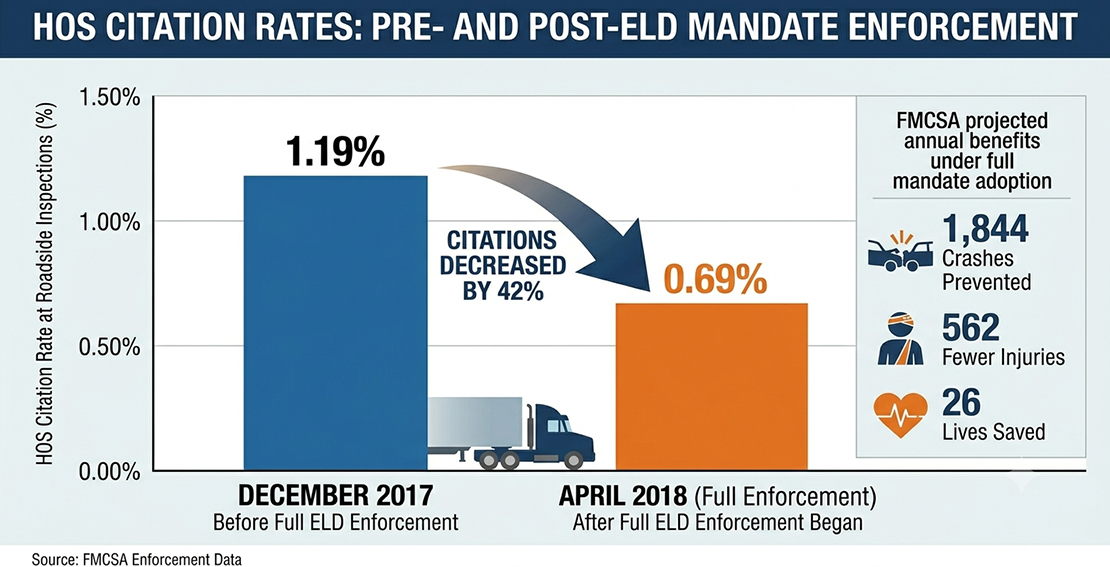
- FMCSA projects the ELD mandate prevents 1,844 crashes, 562 injuries, and 26 fatalities per year at full adoption, based on FMCSA’s own published estimates.
- HOS citation rates at roadside inspections fell from 1.19% in December 2017 to 0.69% after full enforcement began in April 2018, according to FMCSA enforcement data.
- HOS violations rose from 410,000 in 2023 to more than 500,000 in 2025, according to RigDig data cited by Overdrive in April 2026.
- Falsification of records of duty status was the second most-cited driver violation in 2025, at 58,382 violations, according to CVSA’s 2026 Roadcheck announcement.
- Motor carriers face fines of up to $19,246 per HOS violation and drivers face up to $4,812, under the FMCSA penalty schedule. These are maximum civil penalty amounts, adjusted annually for inflation.
- Since January 2025, 79 ELD devices have been removed from the FMCSA registered list, including 12 on May 20, 2026, with a replacement deadline of July 20, 2026.
- Your fleet’s HOS violation history feeds into the FMCSA Safety Measurement System, affecting your safety rating and shipper relationships.
- Our ELD connects via J1939, J1708, or OBD-II and is backed by a 30-day money-back guarantee and 24/7 technical support.
Introduction
Every time one of your drivers pulls out of the yard after too many hours, the risk is not just a fine at the next weigh station. It is a crash that never had to happen. FMCSA projects the ELD mandate prevents 1,844 crashes and saves 26 lives per year at full adoption. Those numbers reflect one thing: when fatigued driving is harder to hide, it drops. That is the entire logic behind the hours of service rules, and it is why your ELD records matter long after a driver clocks out.
The compliance picture in 2026 is not improving on its own. HOS violations climbed from 410,000 in 2023 to more than 500,000 in 2025, and falsification of records of duty status reached 58,382 violations in 2025, making it the second most-cited driver violation that year. CVSA responded by placing ELD tampering and log integrity at the center of its 2026 International Roadcheck, which ran May 12 to 14, 2026. The results were stark: roughly one in three inspected trucks was placed out of service during that three-day window.
What Does the Safety Data Say About ELDs and Crash Prevention?
ELD compliance and lower crash rates are linked directly in FMCSA’s own numbers. FMCSA enforcement data shows HOS citation rates at roadside inspections fell from 1.19% in December 2017 to 0.69% after full enforcement began in April 2018. That shift happened because drivers could no longer run out of hours and manually record whatever they chose. The ELD records driving time automatically, which means routes have to be planned around actual available hours.
At full mandate adoption, FMCSA projects 1,844 crashes prevented, 562 fewer injuries, and 26 lives saved per year. These figures reflect the measurable change in driver behavior that followed mandatory ELD use, not estimates based on modeling alone.
What This Means for Your Fleet
A clean HOS record means your drivers are rested, your equipment operates within legal time limits, and your carrier profile reflects a business that takes fatigue risk seriously. Shippers, brokers, and insurers all check carrier safety data, and every HOS violation that lands on your record costs you more than the fine. For a deeper look at how this connects to road safety outcomes, see our article on how ELDs reduce fatigue and improve compliance.
Why Are HOS Violations Rising Despite ELD Requirements?
Despite years of ELD enforcement, HOS violations climbed from 410,000 in 2023 to more than 500,000 in 2025, according to RigDig data cited by Overdrive in April 2026. The mandate is in place, but the violations keep rising, and there are specific reasons why.
Some fleets are running devices that no longer appear on the FMCSA registered list, which triggers an automatic failure at inspection. Others have drivers misusing personal conveyance or yard move status to mask actual on-duty time. Unassigned driving is another consistent problem: when a device records vehicle movement that no driver has claimed, inspectors flag it immediately. In other cases, drivers push their hours and the ELD captures it accurately, but the back office never catches it before a roadside stop does.
What the Penalties Look Like
Motor carriers face fines of up to $19,246 per HOS violation. Drivers face up to $4,812. Knowing falsification carries a separate penalty of up to $15,846. All are maximum civil penalty amounts under 49 CFR Appendix B to Part 386, adjusted annually for inflation. The fines matter, but the bigger concern is what repeated violations do to your SMS score. Once your score draws investigator attention, the disruption to your operation goes well beyond any single roadside citation.
What Is ELD Tampering and Why Did CVSA Focus on It in 2026?
ELD tampering is any deliberate interference with the device or its data that misrepresents a driver’s actual driving or duty status. CVSA made it the primary focus of the 2026 International Roadcheck because falsification of records of duty status ranked as the second most-cited driver violation in 2025, at 58,382 violations. Inspectors arrived at that Roadcheck specifically trained to find it, and the results bore that out: the out-of-service rate reached approximately 32.8% across the three-day event, up from 18.1% during the 2025 Roadcheck.
How Inspectors Detect Tampering
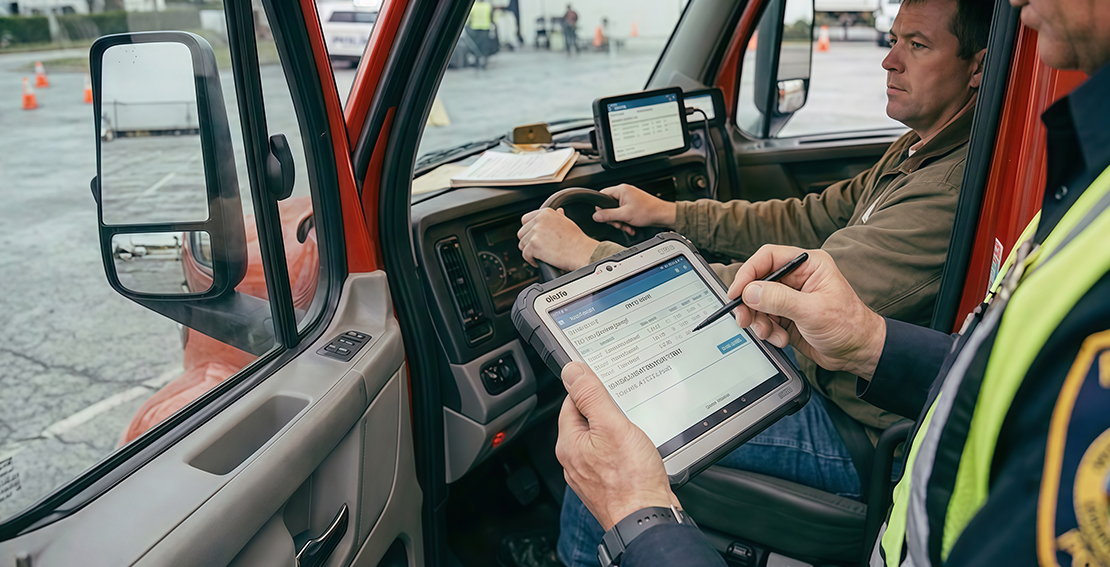
Inspectors check the raw data, not just what the screen displays. They look for unassigned driving segments, compare odometer readings against recorded distance, and identify editing patterns that do not reflect normal driver behavior. Physically disconnecting the ELD from the engine control module stops automatic recording and is one of the clearest signals of tampering. If a log shows a ten-hour break in one city but a fuel receipt places the truck in another city two hours into that break, that discrepancy is treated as a falsification finding regardless of how it occurred. For guidance on what a legitimate edit looks like, FMCSA guidance on ELD editing sets out exactly what is and is not permitted.
What a Falsification Finding Means for Your Fleet
A falsification finding on a driver’s record is treated as a serious safety violation, not a paperwork error. A driver manipulating logs to hide fatigue is a liability every time they are on the road. A pattern of such findings across your fleet can trigger a compliance review under FMCSA safety fitness procedures, which is covered in the SMS section below.
How Do the Recent ELD Device Removals Affect Your Fleet?
Running a device that has been pulled from the FMCSA registered ELD list is treated the same as running no ELD at all. Since January 2025, 79 devices have been removed. The most recent batch came on May 20, 2026, when 12 more were pulled: 888 ELD, Dragon ELD, Action ELD, Mondo ELD HOS, First ELD, First ELD V2.0, MTL ELD, USPower ELD, Sam Freight ELD, DSGELOGS, Cobra ELD, and GT USA ELOGS. If any of your trucks are running one of those devices, the replacement deadline is July 20, 2026.
What Happens After the Grace Period Ends
FMCSA gives carriers 60 days from each removal date to switch devices. After July 20, 2026, a driver at a weigh station with one of those 12 devices faces a citation under 49 CFR 395.8(a)(1) and an immediate out-of-service order. That order goes directly into your carrier safety record and affects your SMS score in the HOS compliance category.
Why Checking the Registered List Is an Ongoing Task
Devices are removed when providers fail to maintain technical certification, stop responding to required compliance checks, or shut down entirely. A device that was current six months ago may already be off the list. Two of the 12 devices removed on May 20, 2026 shared ownership ties with a fleet later linked to an on-demand log editing service that gave drivers extra hours on request. Your back office should be checking on a regular schedule, not just when purchasing new hardware.
How Do Your ELD Records Connect to Your SMS Score and Safety Rating?
The FMCSA Safety Measurement System pulls from roadside inspection data, crash reports, and investigation findings. Every HOS violation your drivers receive at inspections feeds into the HOS compliance category, whether the violation is for running an unregistered device, exceeding driving limits, failing to certify logs, or a falsification finding. Recent violations carry more weight than older ones, so a concentrated run of citations can move your score quickly.
When Does an SMS Score Become a Bigger Problem
A high HOS compliance score does not trigger an automatic safety rating change, but it puts your carrier on the radar of FMCSA investigators and of shippers and brokers who check SMS data before awarding loads. Carriers rated Unsatisfactory cannot legally operate in interstate commerce. That outcome requires a pattern of serious violations over time, but the path there runs through exactly the kind of unresolved ELD and HOS problems this article covers.
How to Challenge a Violation That Looks Wrong
If a violation on your record appears to be an error, the FMCSA DataQs system lets carriers and drivers formally request a review by the state that recorded it. Good ELD records give you the documentation to support that request. Running clean means both avoiding violations and being able to dispute the ones that should not be there.
What Does a Roadside ELD Inspection Actually Check?
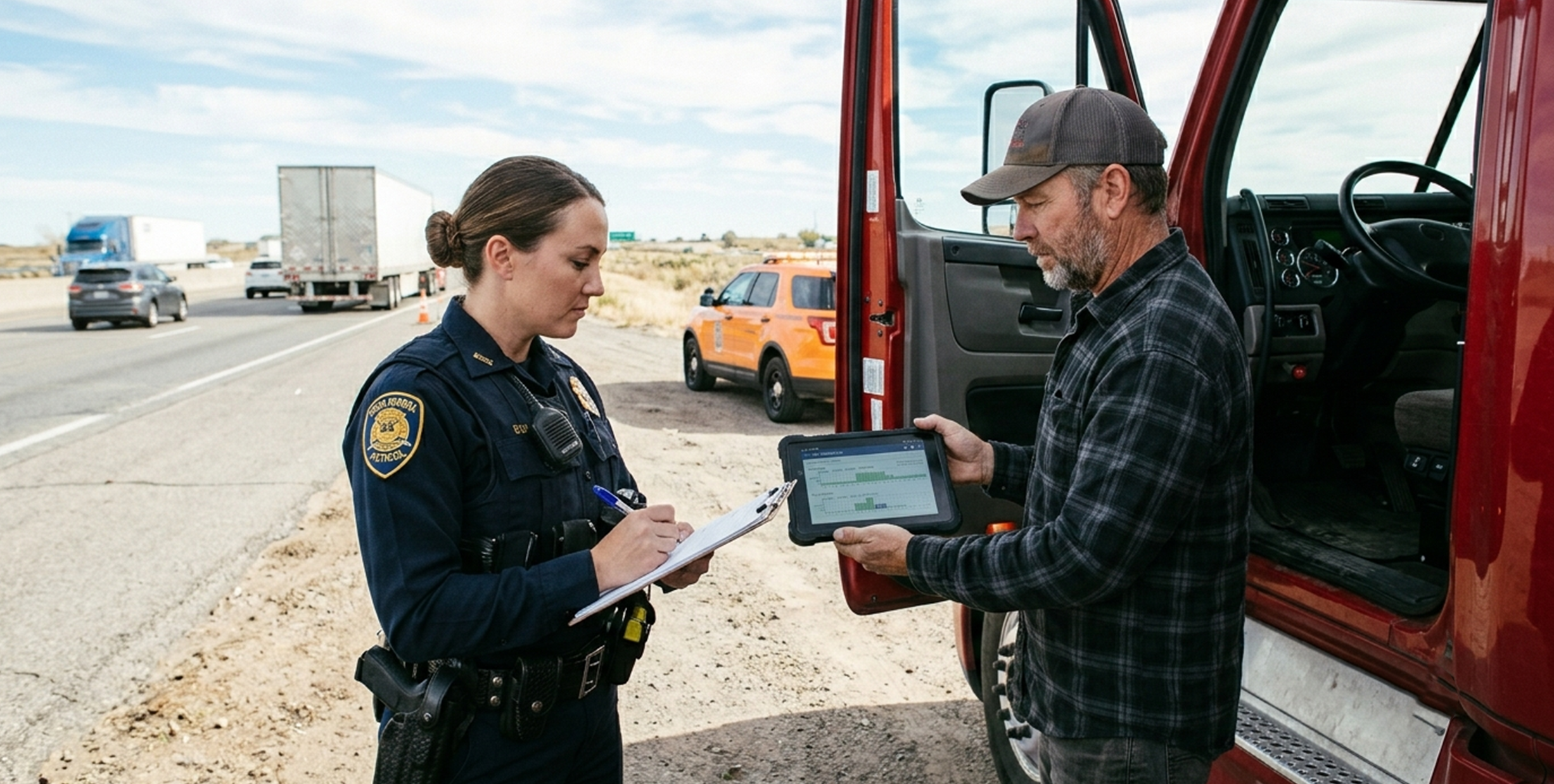
A standard Level I inspection covers the ELD itself, the data it holds, and the supporting documents your driver carries. The officer verifies the device is on the FMCSA registered list, properly mounted and connected, and that your driver can operate it and transfer data on request.
What Your Driver Needs to Have Ready
Officers review the current 24-hour period and the previous seven days of records. They check driving time against on-duty time, look for unassigned driving segments, and confirm that every edit in the log carries a documented reason. Your driver also needs the in-vehicle ELD information packet, which covers the instruction sheet, the malfunction reporting procedure, and eight days of blank paper logs in case the device goes down mid-trip.
Where Enforcement Is Heading
Level VIII electronic inspections are in operational testing in select locations, which means some of this data review is starting to happen before your driver ever pulls over. The direction of enforcement is toward more data-driven screening, and accurate, properly annotated logs are what protect your fleet at every level.
How Does a Compliant Fleet Compare to a Non-Compliant One?
The gap between a compliant fleet and a non-compliant one shows up in SMS scores, shipper relationships, and your drivers’ CDL records, not just in fines.
| Factor | Compliant Fleet | Non-Compliant Fleet |
|---|---|---|
| Device registration | Current, verified regularly against the FMCSA registered list | Risk of running a removed device past the replacement deadline |
| HOS SMS score | Low, reflecting a clean inspection history | Elevated, drawing FMCSA investigator attention |
| Roadside inspection risk | Lower out-of-service probability | Higher probability of citation and OOS order |
| Fines exposure | Kept low through accurate records | Up to $19,246 per carrier violation under 49 CFR Appendix B to Part 386 |
| Driver records | Accurate, certified, and properly annotated | Risk of falsification findings on the driver’s CDL record |
| Shipper and broker trust | High, based on publicly visible safety data | Reduced, because SMS scores are visible to anyone who checks |
| ELD malfunction response | Paper logs carried, carrier notified within required timeframe | No fallback plan, likely inspection failure |
What Questions Should You Ask Your ELD Provider?
These are the questions to ask any vendor before committing, so you can compare answers and make an informed decision.
How will you notify me if your device is at risk of being removed from the FMCSA registered list?
Since January 2025, 79 devices have been removed from the registered list. Ask any provider how far in advance they alert customers to a potential removal and what their process is for getting a replacement to your drivers before the deadline. A provider who cannot answer this clearly is leaving you exposed.
How does your system surface unassigned driving for back office review?
Unassigned driving is one of the most common sources of inspection findings. Before you sign up, ask a provider to walk you through exactly how unassigned segments appear in the back office, what the process looks like for assigning or rejecting them, and what record is kept of each decision.
What data transfer methods does the device support at a roadside stop?
Officers can request data transfer by web services, email, USB, or Bluetooth. Confirm before you commit that the device supports all four methods and ask whether drivers receive any training on using them before their first inspection.
What is your response process when a device malfunctions on the road?
Under 49 CFR 395.34, the driver switches to paper logs and notifies the carrier when a device fails. The carrier then has eight days to repair or replace it under 49 CFR 395.34(d)(1). Ask each provider how quickly they can get a replacement device to a driver who is already out on a run, and what support they offer during that window.
How does your platform manage the transition when a driver moves outside short-haul exemption limits?
Under 49 CFR 395.1(e)(1), CDL drivers operating within 150 air miles of their home terminal and returning within 14 hours are exempt from ELD requirements. The exemption ends the moment either limit is crossed on any given day, and full HOS rules apply for that entire day. Ask how the platform handles that transition automatically, without generating false violations or requiring manual intervention from the back office.
Do you supply the in-vehicle information packet, or is that left to the carrier?
The packet required under 49 CFR 395.22(h) must be present in the vehicle at all times. It is a mandatory part of every ELD setup. Ask whether the provider includes it as standard or whether sourcing it falls to you.
ELD Compliance Questions
Regulatory questions about HOS rules, inspections, violations, and record requirements. These answers apply regardless of which ELD provider you use.
What counts as ELD tampering under FMCSA rules?
Tampering is any deliberate interference with the device or its data that misrepresents actual driving time or duty status. It includes physically disconnecting the device from the engine, corrupting vehicle sensor signals, and entering edits or annotations that are false or unsupported by the actual situation. Knowing falsification carries a penalty of up to $15,846 under 49 CFR 395.8(e)(1).
Can a driver use paper logs if the ELD malfunctions?
Under 49 CFR 395.34(a)(1), the driver switches to paper logs, notes the malfunction in the record, and notifies the carrier. Drivers must carry eight days of blank paper logs at all times for exactly this reason.
Do HOS violations affect a carrier’s safety rating?
Yes, indirectly. Each violation feeds into the HOS compliance category of the FMCSA Safety Measurement System, increasing the carrier’s visibility to investigators and reducing attractiveness to shippers and brokers who check safety data. A sustained pattern of serious violations can lead to a formal compliance review and a safety rating change.
What is the short-haul CDL exemption?
Under 49 CFR 395.1(e)(1), CDL drivers who operate within 150 air miles of their reporting location and return within 14 hours are exempt from ELD requirements. The radius expanded from 100 to 150 air miles on September 29, 2020. If a driver crosses either limit on any given day, full HOS rules apply for the entire day.
What does CVSA check during an ELD inspection?
Inspectors confirm the device is on the registered list, that data transfers correctly, that unassigned driving is accounted for, and that every edit carries a documented reason. During the 2026 International Roadcheck, inspectors also cross-referenced logs against supporting documents such as fuel receipts and toll records to identify discrepancies that indicate tampering.
How long must carriers keep ELD records?
Six months, under 49 CFR 395.8(k)(1). That includes supporting documents such as bills of lading, fuel receipts, and dispatch records connected to a driver’s hours of service. All records must be available for inspection on request.
What should I do if a violation on my record looks like an error?
File a challenge through the FMCSA DataQs system. The state that recorded the violation reviews it, and if it was entered in error, it is corrected. Your ELD records are the primary evidence, so the more detailed and accurate they are, the stronger your challenge.
What is the grace period after a device is removed from the registered list?
FMCSA gives carriers 60 days from the removal date to replace the device. For the 12 devices removed on May 20, 2026, that deadline is July 20, 2026. After that date, a driver running one of those devices faces a citation under 49 CFR 395.8(a)(1) and an immediate out-of-service order.
Provider Questions
If you have questions about how our ELD platform works, the answers below cover the most common ones.
Is your ELD on the FMCSA registered list?
Yes, our device is currently registered. You can confirm that directly on the FMCSA registered list at any time.
How do you notify carriers if your device is at risk of removal?
We monitor our registration status and contact affected carriers with enough lead time to arrange a replacement before any deadline applies. You will not find out from an inspector.
What engine connections do you support?
Our ELD connects via J1939, J1708, or OBD-II, covering the full range of commercial vehicle engine interfaces. The tablet is SAE J1455 certified for in-cab durability.
What happens if my driver needs help at a roadside inspection?
Our technical support team is available around the clock, every day. Your driver can call us at any hour. We also include the full in-vehicle information packet required under 49 CFR 395.22(h) with every setup, so your driver has everything they need in the cab.
Do you offer a trial period?
Every unit comes with a 30-day money-back guarantee. If the platform does not work for your fleet in the first 30 days, you can return it. Use our price calculator to get a quote based on your fleet size.
How does your platform handle short-haul exemption tracking?
Our platform monitors exemption parameters by driver and flags your back office when a driver moves outside them. You always know which drivers need full ELD logs on any given day without having to check each record manually.
How does your platform handle ELD edits and annotations?
We follow the rules in 49 CFR 395.30. Every edit requires a documented annotation, the original record is preserved, and the system blocks carrier-side edits until the driver has certified the record. Your back office has a full view of the edit and annotation history at all times.
Does your ELD work with DVIR?
Yes, and for more on how our ELD and driver vehicle inspection records work together, see our post on ELD and DVIR integration.
Conclusion
ELD enforcement cut HOS citation rates nearly in half within months of taking effect, and the compliance record since then shows that electronic logging has permanently changed how driver hours are tracked and verified. Your drivers go out every day, and the accuracy of their records is what stands between your fleet and a citation, an out-of-service order, or a compliance review that pulls your operation off the road.
The 2026 enforcement environment rewards carriers who stay ahead of the details. Verified devices, annotated logs, a back office that checks records before an inspector does, and a provider who picks up the phone when something goes wrong on the road are what separate the carriers who passed the 2026 Roadcheck from the ones who did not. According to FreightWaves reporting on Day 1 of the 2026 International Roadcheck, roughly one in three inspected trucks was placed out of service. The carriers who were not in that group had clean, accurate records that held up under scrutiny.
If you want to talk through where your fleet stands, contact us and our team will walk you through your options. You can also visit our ELD platform to see everything we offer before you get in touch.