Key Takeaways
- Under 49 CFR 396.11, a covered driver prepares a post-trip DVIR when a safety-related defect or deficiency is discovered or reported; no-defect reports are not required under the current federal text. Check the rule’s listed exceptions and any additional state or company policy.
- The no-defect exception applies to covered property- and passenger-carrying operations. A driver still must be satisfied that the vehicle is safe before driving and review the last required DVIR under 49 CFR 396.13.
- A required DVIR identifies the vehicle and safety-related defects. The carrier or its agent must repair a listed defect likely to affect safe operation and certify on the report that it was repaired or that repair was unnecessary before the vehicle operates again.
- The carrier retains required DVIRs, repair certifications, and driver-review certifications for three months from the report date under 49 CFR 396.11(a)(4).
- FMCSA does not require defect photos. A photo can add context to a written report, but it does not replace a defect entry or prove that a repair occurred.
- Electronic DVIRs and signatures are permitted when they meet the applicable content, retention, reproduction, and access requirements of 49 CFR 390.32.
- Geosavi says its Compliance Now platform supports DVIRs and emailing defect photos. Confirm your account’s workflow, connectivity behavior, repair-certification process, and retention settings before relying on those features.
Introduction
A driver should check that a commercial motor vehicle is safe before operating it. A written post-trip Driver Vehicle Inspection Report (DVIR) is a separate duty that applies when a qualifying defect or deficiency is discovered or reported under current federal rules. Treating every uneventful trip as requiring a federal DVIR can obscure the records that matter most: reported defects, repairs, and driver review.
Photo documentation can help a maintenance team understand a defect, but it is optional supporting material. The required written entry, carrier repair decision, and certification remain the compliance record. Digital tools may make those steps easier to track; they do not complete them automatically.
This guide explains when a report is required, how 49 CFR 396.11 and 49 CFR 396.13 differ, and what to verify before using a digital DVIR and photo workflow. For questions about Geosavi’s available DVIR features, call (800) 261-4361.
What Does a DVIR Actually Have to Cover?
A post-trip DVIR is required under 49 CFR 396.11 when a covered driver discovers or is told about a defect or deficiency that could affect safe operation or cause mechanical breakdown. The report must identify the vehicle, describe the defect, and be signed by the driver. The rule lists service and parking brakes, steering, lights and reflectors, tires, horn, wipers, mirrors, coupling devices, wheels and rims, and emergency equipment as parts and accessories the report covers when applicable.
Under current 396.11(a)(2)(i), drivers are not required to prepare a report when no defect or deficiency is discovered or reported. FMCSA’s current guidance applies this no-defect rule to property- and passenger-carrying CMVs; older guidance that required no-defect passenger DVIRs is outdated. The section also excludes certain operations, including a private nonbusiness passenger carrier, driveaway-towaway operations, and a carrier operating only one CMV. Intermodal equipment has separate reporting rules in 396.11(b). State requirements and a carrier’s own policy may call for more documentation.
Before driving, 396.13 requires the driver to be satisfied that the vehicle is safe, review the last DVIR when one was required, and sign it to acknowledge review and the certification of required repairs. That pre-drive duty does not itself require a new written DVIR for every trip. A later driver cannot replace the earlier driver’s required defect report simply by signing it. See our fleet safety policy guide for separating company procedures from federal requirements.
A required report may be on paper or electronic. Under 396.11(a)(6) and 390.32, the electronic record must accurately contain the required information and be retainable and reproducible for entitled reviewers.
Is Paper Still Acceptable, or Should Your Fleet Go Digital?
Paper remains a valid way to complete and retain a required DVIR. A small carrier can use a simple process if drivers report defects accurately, the carrier documents its repair decision, and the required records can be produced for review.
A digital process may help staff locate a report by vehicle and date and share a defect with maintenance more quickly. Those capabilities depend on the actual product, connectivity, permissions, and the carrier’s workflow. A screen, timestamp, or photo does not by itself establish that a defect was repaired or that the report was retained for the required period.
When evaluating an electronic DVIR, test how the driver signs a report, how the carrier or its agent certifies repair or that repair is unnecessary, how the next driver reviews the last required report, and how records are exported. The electronic-record standard in 49 CFR 390.32 applies whether the DVIR runs beside an ELD or in a separate system.
How Does Photo Documentation Work in a Digital DVIR?
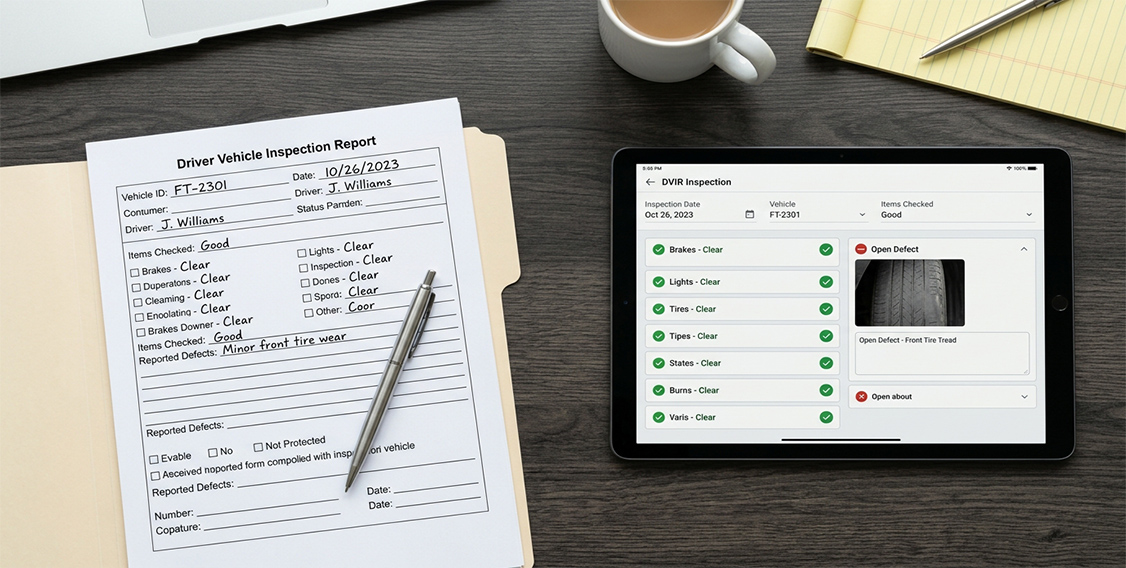
When a driver finds a reportable defect, a clear photo may show its location and condition at the time it was taken. The driver still needs to describe the defect in the DVIR; the image does not replace the signed written entry required by 396.11.
Geosavi’s published platform description says drivers can complete DVIRs and email photos showing defects or supplementary information. Confirm with Geosavi whether your configuration links, stores, and retrieves those images with the corresponding report. A sent photo should not be assumed to be a permanent attachment or proof that a mechanic completed a repair.
If an FMCSA or state inspection record is believed to be inaccurate or incomplete, a contemporaneous DVIR and photo may provide context for a DataQs request for review. Later repair does not make an accurate earlier violation invalid, and a photo does not guarantee a favorable decision.

What Happens After a Driver Finds a Defect?
When a driver reports a defect, the carrier must review it before the vehicle is operated again. Under 396.11(a)(3), the carrier or its agent must repair a listed defect likely to affect safe operation and certify on the DVIR that it was repaired or that repair was unnecessary before returning the vehicle to service. The decision and certification are carrier responsibilities, not automatic software outcomes.
Before driving, the next driver must be satisfied the vehicle is safe, review the last DVIR when required, and sign to acknowledge that review and the repair certification under 396.13. A listed defect that does not require repair still needs the carrier’s certification that repair was unnecessary.
A digital workflow can route the driver report and carrier certification to the right people. Verify who is authorized to certify, how the decision is recorded, what happens without connectivity, and whether the original report and later certification remain retrievable. The carrier must retain the required report, repair certification, and driver-review certification for three months from the report date; storing a file in an app does not establish that retention automatically.
How Do DVIR Records Hold Up at a Roadside Inspection?
During an inspection or investigation, an authorized official may examine applicable vehicle-inspection and maintenance records. Do not assume a DVIR must always be carried in the cab or transferred using an ELD’s hours-of-service data-transfer method. The carrier should be able to produce required records under the applicable request and retention rules, and the driver should know how to access the last required report for the pre-drive review.
A defect entry and repair certification can help explain what was known and done before a vehicle returned to service. A paper record can serve that purpose if complete and available; a digital record can help if the actual system preserves and reproduces it. Neither format prevents an officer from citing a defect observed at inspection.
For an incorrect or incomplete inspection record, DataQs provides a request-for-review process. Submit relevant records and photos when they genuinely bear on the disputed data. Do not suggest that a photo or a repair made after the inspection automatically removes a valid finding.
Paper vs Electronic DVIR: Side-by-Side Comparison
| Feature | Paper DVIR | Electronic DVIR |
|---|---|---|
| Regulatory standing | Compliant under 49 CFR 396.11 | Permitted when 396.11 and 390.32 content, signature, retention, and reproduction rules are met |
| Completion method | Handwritten in cab or at terminal | Completed in an electronic system; device and connection vary |
| Timestamping | Manual, date written by driver | Depends on system settings and successful record capture |
| Photo documentation | Optional photo can be attached or stored separately | Optional photo workflow; confirm capture, delivery, and storage |
| Defect-to-repair chain | Report and certification may share the same paper record | May route certification; carrier must verify completion |
| Back-office retrieval | Depends on filing process | Search and export depend on the product |
| DataQs challenge support | Written record plus any optional supporting evidence | Electronic record plus any optional supporting evidence |
| 3-month retention under 49 CFR 396.11(a)(4) | Carrier must retain and reproduce required records | Carrier must verify retention and export settings |
Questions to Ask Before Your Fleet Switches to a Digital DVIR Process
Does the electronic DVIR cover every inspection point required under 49 CFR 396.11?
Use the actual 396.11 requirements as the checklist. Confirm that a required report identifies the vehicle, records any safety-related defect or deficiency discovered or reported, and carries the driver’s signature. The rule lists specific parts and accessories, but it does not require a no-defect report merely to show that every item was checked. Check how your form handles multiple vehicles and the separate intermodal-equipment process when applicable.
Does the system include photo documentation, and how are those photos stored and sent?
Ask whether your configuration lets drivers photograph defects, how those images are emailed or uploaded, and whether they remain retrievable with the written report. Geosavi publicly describes DVIR completion and emailed defect photos, but do not assume every photo is stored indefinitely or automatically attached to the regulatory record.
How does the repair certification step work in the system?
Ask who can make the carrier’s repair-or-unnecessary certification on the DVIR, how the next driver reviews the last required report, and what prevents dispatch before the required action is complete. A digital button is useful only when the underlying repair decision and certification have actually been made.
What happens to DVIR records if the device loses connectivity on a route?
Check whether the product can capture a report without coverage, when it syncs, and how users confirm that the carrier received it. Offline completion and queued uploads are product-specific capabilities, not federal guarantees. Keep an approved fallback process for a required report if a device or connection fails.
How long are records retained, and how are they exported during an audit or DataQs challenge?
Under 396.11(a)(4), retain required DVIRs, repair certifications, and driver-review certifications for three months from the report date. Ask the vendor how records and optional photos are retained, backed up, exported, and reproduced; longer preservation may be needed for a claim or company policy.
Can a DOT officer review the record at roadside without additional software?
Ask how drivers and staff can present a required report and its repair certification to a person entitled to review it. Do not confuse DVIR access with the separate ELD hours-of-service transfer methods. Test the actual screen, export, and backup process before relying on roadside connectivity.
How does the digital DVIR connect to the ELD running on the same device?
Geosavi lists DVIR inspections alongside its ELD app, and its ELD and DVIR integration guide discusses the workflow. Confirm what data is actually shared, how records are matched to a driver and vehicle, and whether the DVIR can be exported independently. An ELD log does not replace a required DVIR.
What training does your team need to complete the switch correctly?
Train drivers to recognize and describe reportable defects, sign required reports, and review the last required DVIR before driving. Train maintenance and dispatch staff to document repair or an unnecessary-repair determination and verify it before release. Geosavi advertises support for its platform; confirm the support hours and training available under your account.
Electronic DVIR FAQs
About DVIR Requirements and Compliance
Is a DVIR required after every trip?
No. Under current 49 CFR 396.11(a)(2)(i), a covered driver is not required to prepare a post-trip DVIR if no defect or deficiency was discovered or reported. When a reportable defect exists, the driver prepares a signed report at the end of that day’s work on each vehicle operated. This no-defect rule now applies to property- and passenger-carrying CMVs under FMCSA guidance; check the section’s operational exceptions and any stricter state or company rule.
Does a DVIR have to be on paper?
No. Sections 396.11(a)(6) and 390.32 permit electronic reports when the required information, signature, retention, and accurate reproduction requirements are met. Paper remains acceptable.
What happens if a driver skips a DVIR?
If a required defect report is missing or incomplete, the carrier and driver may face a compliance finding based on the facts. A no-defect trip does not automatically require a federal DVIR. Investigate whether a report was required, whether the defect was documented, and whether the repair decision and driver review were completed; do not presume every absent form is a violation.
Can a carrier be cited for a defect a driver already noted on a DVIR?
Yes, a defect observed at inspection can still be cited even if it was previously noted. Under 396.11(a)(3), the carrier must repair a listed defect likely to affect safe operation, or certify that repair was unnecessary, before operating the vehicle again. Recording the defect does not excuse continued operation with an unsafe condition.
How long do DVIR records have to be kept?
Under 396.11(a)(4), the carrier retains a required DVIR, repair certification, and certification of the driver’s review for three months from the date the report was prepared. Keep any optional photos according to the carrier’s records and preservation policy; the federal DVIR rule does not set a separate photo-retention period.
Does FMCSA require photos on a DVIR?
No. Section 396.11 does not require photographs. A relevant, clearly dated photo can add context to a written defect entry, but it cannot replace the signed report or prove that repair occurred. Its value in a DataQs request depends on what the disputed record says and what the image actually shows.
What vehicle parts must a DVIR inspection cover?
For a required DVIR, 396.11(a)(1) lists service brakes and trailer brake connections, parking brake, steering, lights and reflectors, tires, horn, wipers, mirrors, coupling devices, wheels and rims, and emergency equipment. The report identifies the vehicle and lists discovered or reported defects that could affect safe operation or cause breakdown. The rule does not require a no-defect checklist from every driver.

About Going Digital and Photo Documentation
Is an electronic DVIR legally the same as a paper one?
Electronic DVIRs are permitted under 396.11(a)(6) and 390.32, but format alone does not establish compliance. The report must accurately contain the required information and signature and be retainable and reproducible for parties entitled to review it.
Can photos from a digital DVIR be used in a DataQs challenge?
A relevant DVIR and photo may be submitted to DataQs when an FMCSA or state inspection record is believed to be inaccurate or incomplete. A photo is not automatically stronger than a clear written record, and fixing a defect after an accurate inspection does not erase the original violation.
What if the electronic DVIR system goes offline while a driver is completing an inspection?
The answer depends on the product and configuration. Confirm whether a required report can be completed without coverage, how pending records are transmitted, and how the driver and carrier know delivery succeeded. Use the carrier’s approved fallback when the electronic process is unavailable.
Does a digital DVIR require a driver’s electronic signature?
A required DVIR must be signed by the driver under 396.11(a)(2)(ii). Under 390.32, an electronic signature may satisfy an FMCSA signature requirement if the electronic record otherwise meets the rule. Confirm how the system attributes and preserves the signature.
Can a mechanic certify a repair remotely in a digital DVIR system?
The regulation allows the carrier or its agent to certify on the DVIR that a listed defect was repaired or that repair was unnecessary before the vehicle operates again. Whether a particular digital platform supports remote certification is a product question; verify authorization, timing, and the saved record.
How does a digital DVIR connect to our ELD records?
A DVIR and an ELD log can be reviewed together when the carrier’s system makes both available, but they are distinct records under different rules. Geosavi lists DVIR inspections in its ELD offering; confirm how your account associates, retains, and exports each record rather than assuming an automatic legal link.
If a driver photographs a defect but does not note it in the written DVIR fields, does the photo count?
No. A photo is optional supporting documentation. When 396.11 requires a report, the driver must identify the vehicle, describe the qualifying defect or deficiency in the report, and sign it. A photo alone does not satisfy those duties.
What Your DVIR Record Has to Do in 2026
A sound DVIR process begins with the correct trigger: a written post-trip report when a covered driver discovers or is told about a qualifying defect, not a federal form for every uneventful trip. Before driving, the next driver must be satisfied the vehicle is safe and review the last required report. The carrier must address listed safety-related defects, certify repair or that repair was unnecessary before further operation, and retain the required records for three months.
Digital DVIRs and optional photos can support that workflow when the system is configured and staff follow it. Geosavi publicly describes DVIR completion and emailed defect photos; confirm how your account handles signatures, delivery, repair certification, and retention. For help reviewing the available setup, contact Geosavi or call (800) 261-4361.