Key Takeaways
- Drivers can edit their ELD records, but every change must include a written annotation explaining the reason, per 49 CFR 395.30(c)(2).
- Automatically recorded drive time while the vehicle was moving cannot be changed to non-driving time under any circumstances, per Section 4.3.2.8.2(b) of 49 CFR Part 395, Subpart B, Appendix A.
- The ELD must keep the original, unedited record alongside any edits made, per 49 CFR 395.30(f).
- A motor carrier may not request edits to a driver’s record before the driver has certified and submitted it, per 49 CFR 395.30(d) and FMCSA guidance on ELD editing and annotations.
- Falsification of records of duty status was the second most-cited driver violation in 2025, at 58,382 total violations, per CVSA’s 2026 International Roadcheck announcement.
- During the 2025 Roadcheck, 332 driver out-of-service violations, which was 10 percent of all driver OOS findings, were for false logs or falsified records of duty status, per CVSA.
- CVSA’s 2026 International Roadcheck ran May 12-14, 2026 with ELD tampering, falsification, and manipulation as the named driver enforcement focus, per CVSA.
- Knowing falsification of HOS records carries a maximum civil penalty of $15,846 per entry under the FMCSA penalty schedule, adjusted annually for inflation.
Understanding ELD Log Editing and Why It Matters
Yes, drivers can edit their ELD logs. But the rules on what can change, what stays locked, and how every edit must be documented are specific. Getting this wrong can turn a routine correction into a falsification citation, which carries serious consequences for your drivers and your fleet.
Under 49 CFR 395.30, drivers have both the right and the obligation to review their records and fix errors. The regulation also sets clear limits on which records can be changed, how they must be annotated, and what the carrier’s role is in the process.
With falsification of records of duty status ranking as the second most-cited driver violation in 2025 at 58,382 total violations per CVSA, and CVSA’s 2026 Roadcheck making ELD tampering its named driver enforcement focus, understanding exactly where the line sits between a legitimate correction and a compliance violation matters more than ever for fleet operators.
This guide covers the federal rules, the editing process, what inspectors look for, and how your fleet builds a log record that holds up at the roadside and during an FMCSA audit.
What Do the Federal Regulations Say About Editing ELD Logs?
The governing rule for ELD edits is 49 CFR 395.30, titled ELD record submissions, edits, annotations, and data retention.
Under 49 CFR 395.30(a), both the driver and the motor carrier are responsible for making sure ELD records are accurate. That duty to maintain accuracy creates both the right and the obligation to correct errors when they occur.
Under 49 CFR 395.30(b), a driver must review their ELD records, edit and correct inaccurate entries, enter any missing information, and certify the accuracy of the information. The driver certifies by selecting Agree to a statement that reads: I hereby certify that my data entries and my record of duty status for this 24-hour period are true and correct. If any edits are made after the driver submits records to the motor carrier, the driver must recertify.
The core protection running through all of this is data preservation. A motor carrier must not alter or erase, or permit or require the alteration or erasure of, the original information collected about the driver’s hours of service, the source data streams used to provide that information, or information in any ELD, per 49 CFR 395.30(f). Edits sit on top of original data. Nothing gets deleted.

What Is the Difference Between an Edit and an Annotation?
These two terms appear together constantly but mean different things, and mixing them up creates compliance problems in your records.
An edit is a change to an ELD record that does not overwrite the original record. An annotation is a note related to a record, update, or edit that a driver or authorised support personnel may add to the ELD. This definition comes directly from FMCSA’s official ELD editing and annotations guidance.
Under 49 CFR 395.30(c)(2), all edits, whether made by a driver or the motor carrier, must be annotated to document the reason for the change. For example, an edit switching time from Off Duty to On-Duty Not Driving could be annotated by the carrier to note, Driver logged training time incorrectly as off-duty. That edit and annotation would then be sent to the driver for approval.
A driver who edits a log entry without an annotation has a non-compliant record even if the duty status correction is accurate. The annotation is not optional.
What Types of Edits Are Allowed on ELD Logs?
Not every field in an ELD record can be changed. Federal regulations draw a clear line between what can be corrected and what cannot.
Edits that are permitted:
- Duty status corrections for periods that were manually entered incorrectly. For example, on-duty logged when the driver was off-duty during a rest stop.
- Missing information such as shipping document numbers, trailer numbers, or bill of lading references that were entered incorrectly or left blank.
- Co-driver assignment corrections when driving time was recorded under the wrong account. Under 49 CFR 395.30(c)(3), if there was a mistake resulting in the wrong driver being assigned driving-time hours, and both team drivers were shown in each other’s records as co-drivers, driving time may be edited and reassigned between them. Each co-driver must confirm the change for the edit to take effect.
- Driving time recorded after a power-off event while the vehicle was stationary. A driver may correct driving time that the ELD recorded while the vehicle was powered off and not in motion. This is confirmed in FMCSA guidance FMCSA-HOS-ELD-395-FAQ51, issued July 31, 2023.
- Personal conveyance periods where the carrier has not pre-configured the status. The driver may switch to off-duty and annotate the start and end of the personal conveyance period.
What Cannot Be Edited on an ELD Log?
Under Section 4.3.2.8.2(b) of 49 CFR Part 395, Subpart B, Appendix A, automatically recorded drive time while the CMV is in motion cannot be edited or changed to non-driving time. Edits that reduce the total amount of driving time automatically recorded by the ELD are not allowed. Driving time may not be re-assigned except in the specific team driver scenario above, and may never be cumulatively reduced.
Events of type 2 (intermediate log), 5 (login/logout), 6 (CMV power-up/shut-down), and 7 (malfunction/diagnostic) may not be edited in any way, per FMCSA guidance FMCSA-ELD-395-Q027, issued March 10, 2022.
If the vehicle was moving and the ELD recorded driving time, that time stays as driving time. There is no exception to this rule.
How Does the ELD Editing Process Work Step by Step?
A compliant ELD edit follows a clear sequence that creates an audit trail at every step.
Step 1. The driver finds the error
After reviewing their log at the end of a 24-hour period, the driver identifies a duty status that does not match what actually happened.
Step 2. The driver opens the edit function
The driver selects the time block to change. When edits, additions, or annotations are needed, the driver must use the ELD and respond to its prompts, per 49 CFR 395.30(c)(1).
Step 3. The driver writes the annotation before saving
The annotation field must be filled in before the edit can be saved. A specific annotation names what the ELD recorded, why it was wrong, and what supporting document confirms the correction.
Step 4. The original record is kept
The ELD stores the original entry alongside the edit. Per 49 CFR 395.30(f), the original, unedited record is retained along with the edits. An inspector can view both versions.
Step 5. The driver recertifies
If edits are made after the driver has already submitted records to the motor carrier, the driver must recertify before those records are valid.
For carrier-proposed edits, per 49 CFR 395.30(d) and FMCSA guidance on ELD editing, a motor carrier may not request edits before the driver has certified and submitted the record. After the driver submits, the carrier may propose a change. The driver must then confirm or reject it, annotate the record, and recertify and resubmit for the change to take effect.
Your Geosavi ELD handles this through a built-in annotation and co-signature workflow. If you need help walking your back-office staff through the edit review process, the Geosavi support team is available 24 hours a day, 7 days a week.
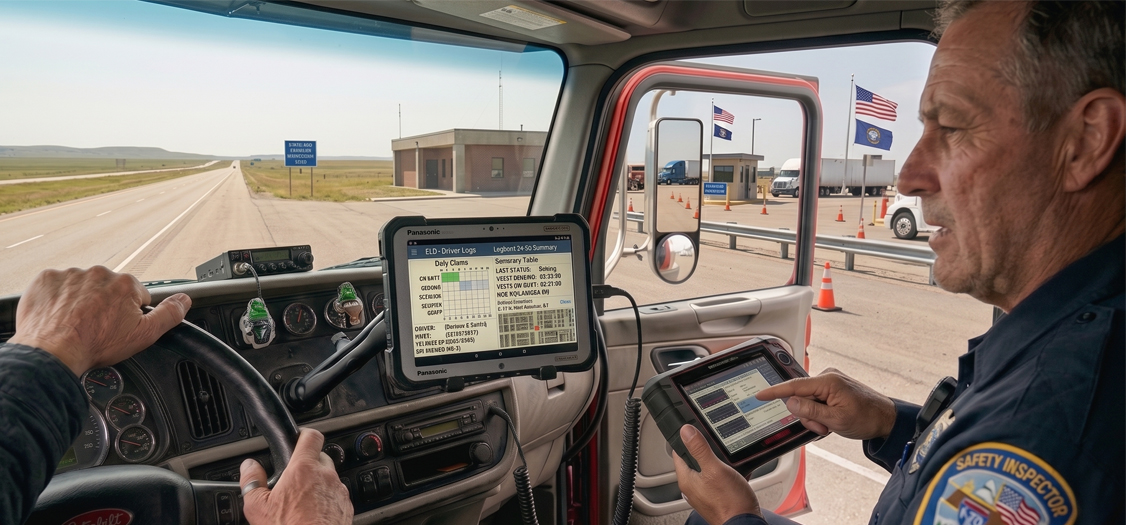
What Do Roadside Inspectors Actually Look For in 2026?
CVSA’s 2026 International Roadcheck ran May 12-14, 2026 with a named focus on ELD tampering, falsification, and manipulation. Inspectors were specifically trained to cross-reference the record of duty status against supporting documents, including fuel receipts, bills of lading, and toll records, and to flag driving time recorded while the device was in an unidentified or disconnected state.
A real example from CVSA’s 2025 Roadcheck results: a driver was shown as off duty in Tolleson, Arizona at around 9 p.m. on August 10, 2024. The inspector obtained a fuel receipt showing the driver fueling in Strafford, Missouri on August 11, 2024, yet the record of duty status showed the driver off duty all day in Tolleson.
The patterns that draw a closer look at your logs:
- Driving time that was reduced or removed, particularly to keep a driver just under the 11-hour driving limit under 49 CFR 395.3
- Edits with no annotation, or identical generic annotations across multiple log dates
- Log records that do not match fuel receipts, toll records, or other supporting documents kept under 49 CFR 395.8(k)
- Engine data showing movement during a period logged as off-duty or sleeper berth
- Multiple edits made shortly before or during an inspection
If the inspector finds falsification occurred and the driver is not over hours at the time of inspection, the false records of duty status should be cited under 49 CFR 395.8(e)(1) and the driver should be allowed to proceed. If the driver is over HOS limits at the time of inspection, the driver should be placed out of service until they have the hours to drive again.
Can a Motor Carrier Edit a Driver’s ELD Logs?
A carrier can propose edits, but those edits only take effect when the driver accepts them. Per 49 CFR 395.30(d) and FMCSA guidance on ELD editing, a motor carrier may not request edits to a driver’s record before the driver has certified and submitted it. After the driver submits, the carrier may propose a change. The driver must confirm or reject it, annotate the record, and recertify and resubmit for the change to take effect.
What carriers can do:
- Flag a log entry that looks inconsistent with dispatch records and route it to the driver for review
- Assign unidentified driving time to the correct driver when the driver failed to log in, under 49 CFR 395.32(c)
- Propose corrections to co-driver assignments, trailer numbers, or shipping document entries
What carriers cannot do:
- Request edits to a driver’s record before the driver has certified and submitted it
- Reduce logged driving time through a carrier-side edit
- Pressure a driver to accept an edit that affects HOS compliance. Under 49 CFR 390.36, FMCSA prohibits a motor carrier from harassing a driver. The ELD rule allows only limited edits by both the driver and the motor carrier’s staff, and in all cases the original record is preserved
What Makes a Good ELD Log Annotation?
The annotation is what separates a proper correction from a suspicious edit. A strong annotation gives any inspector enough information to understand why the original record was wrong and what actually happened.
Weak annotations that will not hold up:
- Error
- Driver mistake
- Correction needed
- System issue
These tell an inspector nothing and look like edits made without any real attention to the reason.
Strong annotations that work:
Duty status auto-changed to On-Duty at 14:32 when the engine restarted. The driver was at TA Travel Center, Amarillo TX, waiting for dispatch. Fuel receipt attached as a supporting document.
The off-duty period from 09:15 to 10:00 was not captured after an extended idle shutdown. The vehicle was stationary. Engine data confirms the unit was not moving.
Driving time recorded under the Driver A account because Driver B did not log in at shift start. Both drivers confirmed as co-drivers for this dispatch. Both have co-signed the reassignment per 49 CFR 395.30(c)(3).
Write annotations at or close to the time of the event. Under 49 CFR 395.8(k)(1), supporting documents such as fuel receipts and dispatch confirmations must be kept for six months. Tying your annotation to a specific supporting document makes the edit much harder to challenge during an audit.
Edit vs. Falsification: Side-by-Side Comparison
| Scenario | Allowed? | Regulation |
|---|---|---|
| Driver corrects a duty status that auto-changed incorrectly, with annotation | Yes | 49 CFR 395.30(c)(1) |
| Driver adds a missed off-duty period with annotation and supporting document | Yes | 49 CFR 395.30(c)(1) |
| Team drivers reassign erroneously logged driving time, both confirm | Yes | 49 CFR 395.30(c)(3) |
| Driver corrects driving time logged after power-off while vehicle was stationary | Yes | FMCSA-HOS-ELD-395-FAQ51 (2023-07-31) |
| Carrier assigns unidentified driving time to correct driver with annotation | Yes | 49 CFR 395.32(c) |
| Carrier proposes edit before driver has certified and submitted records | No | 49 CFR 395.30(d); FMCSA-ELD-395-Q083 |
| Driver or carrier reduces automatically recorded driving time while CMV was moving | No | 49 CFR Part 395 Appendix A, 4.3.2.8.2(b) |
| Any edit made with no annotation or a one-word generic annotation | No | 49 CFR 395.30(c)(2) |
| Motor carrier pressures driver to accept edits that extend driving hours | No | 49 CFR 390.36 |
| Editing intermediate log, login/logout, power events, or malfunction events | No | FMCSA-ELD-395-Q027; Appendix A 4.3.2.8.2 |
| Driver removes logged driving time to avoid a violation showing at inspection | No falsification | 49 CFR 395.8(e)(1) |
| Original record overwritten rather than preserved alongside the edit | No | 49 CFR 395.30(f) |

Questions Every Fleet Manager Should Ask About ELD Log Editing
Does your ELD keep the original data record after every edit?
This is a federal requirement under 49 CFR 395.30(f). The ELD must keep the original, unedited record along with any edits. Check the FMCSA-registered ELD list to confirm your device is currently active. As of May 2026, 67 ELDs had been removed from the registered list since January 2025. Carriers using revoked devices face out-of-service exposure on every inspection. Browse active replacement options through the Geosavi ELD store.
Does the editing process require a written annotation before the change saves?
The annotation is required under 49 CFR 395.30(c)(2), not a platform option. Ask your provider whether the annotation field can be skipped. If it can, that is a compliance gap. Check the Geosavi FAQ for how the annotation step works on the Geosavi device.
Can your back-office team see all edit requests and edit history in real time?
Visibility into the edit queue means your compliance staff can catch problems before an inspector does. An edit that reduces driving time, or a pattern of edits on a particular driver or route, should be reviewed against supporting documents before those logs are ever presented at the roadside.
Does your ELD require driver review and acceptance before a carrier-proposed edit takes effect?
Per 49 CFR 395.30(d), the driver must confirm or reject any proposed change, annotate the record, and recertify before the change takes effect. If your platform lets carrier-side edits go through without driver review, you have a compliance gap and exposure under 49 CFR 390.36.
How long does your platform keep edit history and original data?
Supporting documents must be kept for six months under 49 CFR 395.8(k)(1). Your edit history should be available for the same period. Ask whether data is stored on the device, on the cloud, or both, and what happens to the edit record if a device is lost or replaced.
Do your drivers know which edits are allowed and which are not?
Many falsification violations happen because a driver or dispatcher did not know that automatically reducing driving time is prohibited. Plain-language training that covers 49 CFR 395.30 and Section 4.3.2.8.2(b) of Appendix A, with worked examples, reduces that exposure directly. Contact the Geosavi support team if you need help walking your drivers through the edit process.
Do you cross-check edited logs against supporting documents during internal audits?
An edit that reduces driving time during a period where a fuel receipt shows the truck was on the road is a problem waiting to be found by an FMCSA auditor. Internal audits that compare edit history against the supporting document package under 49 CFR 395.8(k) catch those issues on your timeline, not an inspector’s.
Does your fleet have a written policy on log edits?
Without a written policy, individual practice across your fleet will vary, and some of that variation creates liability. A one-page policy covering approved edit reasons, annotation requirements, the driver recertification step, and the prohibition on editing automatically recorded driving time gives every driver and dispatcher the same baseline. Use the Geosavi price calculator to review your current fleet setup costs.
Your ELD Log Editing Questions Answered
Can a driver edit their own ELD log?
Yes. A driver may edit, enter missing information, and annotate ELD-recorded events, subject to the edit limitations of the ELD. Every change requires a written annotation explaining the reason, per 49 CFR 395.30(c).
Can a motor carrier change a driver’s ELD log without telling the driver?
No. Per 49 CFR 395.30(d) and FMCSA’s ELD editing guidance, a motor carrier may not request edits before the driver has certified and submitted their records. The driver must review, annotate, and recertify before any carrier-proposed change takes effect.
Can automatically recorded driving time ever be changed to non-driving time?
Only in two specific cases: a team driver reassignment where both drivers confirm the change, and a correction of driving time recorded after a power-off event while the vehicle was not moving. In all other cases, automatically recorded drive time when the vehicle is in motion cannot be changed, per Section 4.3.2.8.2(b) of 49 CFR Part 395, Subpart B, Appendix A.
What happens if a driver refuses a carrier-proposed edit?
The original record stands. The driver cannot be penalised for rejecting a proposed edit. Pressure from a carrier to accept an edit that affects HOS compliance is a driver harassment violation under 49 CFR 390.36.
What ELD event types can never be edited?
Events of type 2 (intermediate log), 5 (login/logout), 6 (CMV power-up/shut-down), and 7 (malfunction/diagnostic) may not be edited in any way, per FMCSA guidance FMCSA-ELD-395-Q027, issued March 10, 2022. These records form the core of the engine data audit trail.
How long do ELD records and edit history need to be kept?
Supporting documents and records of duty status must be kept for six months under 49 CFR 395.8(k)(1). Edit history is part of that record and must be available for the same period, per 49 CFR 395.30(f).
What should an annotation include?
At minimum, the annotation should state what the ELD recorded, why that entry was wrong, what the correct duty status was, and which supporting document can verify the correction. A one-word entry like Error or System issue is not enough. The more specific the annotation, the harder it is to challenge during an audit.
What is the penalty for falsifying ELD records?
Knowingly falsifying HOS records under 49 CFR 395.8(e)(1) carries a maximum civil penalty of $15,846 per entry under the FMCSA penalty schedule, adjusted annually for inflation. These are maximum amounts. Actual penalties depend on the gravity of the violation and whether a pattern exists.
Can a driver edit their log after a roadside inspection has started?
No. Edits made during or after an inspection are treated as attempted falsification. The record at the moment the officer begins the inspection is what governs the outcome.
What does a 2026 roadside inspector look for in edited logs?
Inspectors cross-reference the record of duty status against supporting documents including fuel receipts, bills of lading, and toll records, and flag driving time recorded while the device was in an unidentified or disconnected state, per CVSA’s 2026 Roadcheck focus. They look for edits that reduce driving time, edits without annotations, and records that contradict engine data.
Does correcting a log entry affect a carrier’s Safety Measurement System score?
A well-annotated correction made before a roadside inspection does not create an SMS violation on its own. An existing violation found during an inspection is assigned to the carrier under the FMCSA Safety Measurement System. The HOS compliance threshold in SMS is 65 percent, lower than the 80 percent threshold used for most other violation categories, so HOS-related findings carry more weight on a carrier’s score.
How Geosavi Helps Your Fleet Stay Compliant With ELD Log Editing Rules
ELD log editing done correctly is part of accurate record-keeping, not a compliance risk. Drivers who review their logs at the end of each period, write specific annotations when corrections are needed, and recertify after any change are doing exactly what the regulations require. A log with well-documented edits is actually a stronger document during an audit than one with no edits at all, because it shows your drivers are checking their records for accuracy.
The risk comes from the specific things the regulations prohibit: editing automatically recorded driving time to reduce hours while the vehicle was moving, making changes without annotations, and carrier-side edits that skip driver review. With falsification of records of duty status ranking as the second most-cited driver violation in 2025 at 58,382 total violations per CVSA, and the 2026 Roadcheck focused on ELD tampering and log integrity, your fleet’s edit history is visible to every inspector who reviews your logs.
Geosavi’s ELD platform is built around this process. The annotation workflow is required before any edit can save. Edit history is retained alongside original data. Carrier-proposed changes are routed to the driver for review and co-signature before they take effect. The device connects via J1939, J1708, or OBD-II for accurate engine data from the start.
If you want to check how your current setup handles the edit and annotation process, or want to make sure your fleet is ready before the next inspection, reach out through the Geosavi contact page. You can also learn more about how the edit workflow is built into the platform on the Geosavi ELD platform page.