Key Takeaways
- Under 49 CFR § 395.3, a property-carrying commercial motor vehicle (CMV) driver generally may drive up to 11 hours after 10 consecutive hours off duty, but may not drive after the 14th consecutive hour after coming on duty.
- On-duty time spent loading, inspecting, or fueling does not use the 11 driving hours. It does use the 14-hour driving window. Off-duty breaks generally do not pause that window either.
- After eight cumulative hours of driving without a qualifying interruption, a property-carrying driver must take at least 30 consecutive minutes in a non-driving status. Off duty, sleeper berth, on duty not driving, or a combination can qualify.
- The FMCSA hours-of-service summary describes important exceptions. Qualifying adverse driving conditions can extend both the 11-hour driving limit and 14-hour window by up to two hours; a qualifying sleeper-berth split changes the window calculation. Neither exception overrides the 60/70-hour limit.
- ELDs record vehicle movement and support HOS recordkeeping, but the driver and carrier still need to review duty-status entries, applicable exceptions, and remaining hours. A device alert is not a legal determination or a guarantee against a violation.
| Table of Contents |
|---|
| The 11-Hour Rule |
| Two Clocks, One Day |
| Rest and Exceptions |
| Who the Rule Covers |
| ELDs and Enforcement |
| HOS Limits Compared |
| Questions to Ask |
| FAQs |
Introduction
A driver can have driving hours left and still be unable to drive. That happens when the 14-hour window closes first, or when the driver reaches the applicable 60/70-hour on-duty limit. Knowing how these limits work together is more useful than watching the 11-hour total alone.
This guide explains the federal property-carrying rules, the most relevant exceptions, and what an ELD can and cannot do. It addresses interstate operations subject to FMCSA rules; state rules and specific exemptions may differ. For the broader framework, see our hours-of-service guide.
What Is the 11-Hour Driving Rule?
Under 49 CFR § 395.3(a)(1), a property-carrying CMV driver may drive no more than 11 hours following 10 consecutive hours off duty. The 11 hours measure driving, not every hour spent working. On-duty-not-driving activities such as inspections, loading, and fueling do not themselves add to the driving total.
An ELD automatically switches to driving status when the vehicle moves at a configured speed threshold of no more than 5 mph. The driver must still record other duty statuses accurately. An ELD’s calculated hours depend on correct records and the applicable rule or exception; it does not replace the driver and carrier’s responsibility to comply. See FMCSA’s ELD guidance.
How the 11-Hour and 14-Hour Limits Work Together
The 11-hour driving allowance is cumulative. The 14-hour window is generally consecutive: under § 395.3(a)(2), a property-carrying driver may not drive after the end of the 14th consecutive hour after coming on duty following 10 consecutive hours off duty. Neither clock begins merely because a driver logs in to an ELD. Actual duty and rest history determine the available hours.
For example, after 10 consecutive hours off duty, a driver comes on duty at 6:00 a.m. and spends three hours loading before driving. The driver has used no driving hours during loading, but the ordinary driving window ends at 8:00 p.m. A two-hour delivery wait also consumes window time if the driver remains on duty. An ordinary 30-minute break does not extend the window. A qualifying sleeper-berth split or adverse-conditions exception can change this calculation, so dispatch should confirm the applicable rule rather than assume that every day ends exactly 14 hours after the first duty event.
The weekly 60-hour-in-7-days or 70-hour-in-8-days limit is another separate constraint under § 395.3(b). A driver may not drive after reaching the applicable on-duty limit, even if daily driving and window time remain. See our related explanation of the 14-hour clock for more planning context.
Rest, Breaks, and Exceptions
Ten consecutive hours off duty ordinarily allow a property-carrying driver to begin a new 11-hour driving allowance and 14-hour window. A 30-minute non-driving interruption does not reset the 11-hour limit or restart the 14-hour window. Under § 395.3(a)(3)(ii), it is required before driving after eight cumulative hours of driving without at least 30 consecutive minutes in a non-driving status. Off duty, sleeper berth, on duty not driving, or a combination may qualify. Our fact-checked 30-minute break guide explains the details.
Under § 395.1(g), a qualifying property-carrying sleeper-berth split consists of one period of at least seven consecutive hours in the berth and another period of at least two hours off duty or in the berth, totaling at least 10 hours. When the two periods are paired, neither counts against the 14-hour window. This is not simply a 10-hour reset; the driving and window calculations must be made around the paired periods.
When genuinely unforeseen adverse driving conditions meet § 395.1(b)(1), a property-carrying driver may extend both the 11-hour driving limit and 14-hour driving window by up to two hours, to the extent needed. Ordinary predictable congestion or conditions known before dispatch do not qualify. The exception does not extend the 60/70-hour on-duty limit. Drivers should record the circumstances accurately, including an ELD annotation where applicable. See the FMCSA driver’s guide.
Which Drivers Does the Rule Apply To?
The 11-hour rule applies to property-carrying CMV drivers subject to federal HOS rules unless a specific exception or exemption applies. It does not mean that every local driver must use an ELD. Under § 395.1(e)(1), a driver who stays within a 150-air-mile radius of the normal work reporting location, returns there, and is released within 14 consecutive hours may use the short-haul recordkeeping exception if the other conditions are met. The carrier must keep the required time records. The ordinary 11-hour driving and 10-hour off-duty rules still apply, but qualifying short-haul drivers are excepted from the 30-minute break requirement.
If a driver does not meet the short-haul conditions on a particular day, a record of duty status for that day and the applicable break rule are required. Do not assume an ELD will detect the change or reconstruct every earlier duty event automatically; drivers and carriers should have a way to capture accurate records. See our local-driver logbook guide and FMCSA’s short-haul summary.
Passenger-carrying CMV drivers are governed by § 395.5: generally no more than 10 hours driving after eight consecutive hours off duty, and no driving after 15 hours on duty following eight consecutive hours off duty. The passenger 15-hour limit is on-duty time, not the same consecutive 14-hour window as the property rule. Passenger drivers do not have the property-carrier 30-minute break requirement. Different sleeper-berth rules also apply.
What Happens When a Driver Exceeds the Limit?
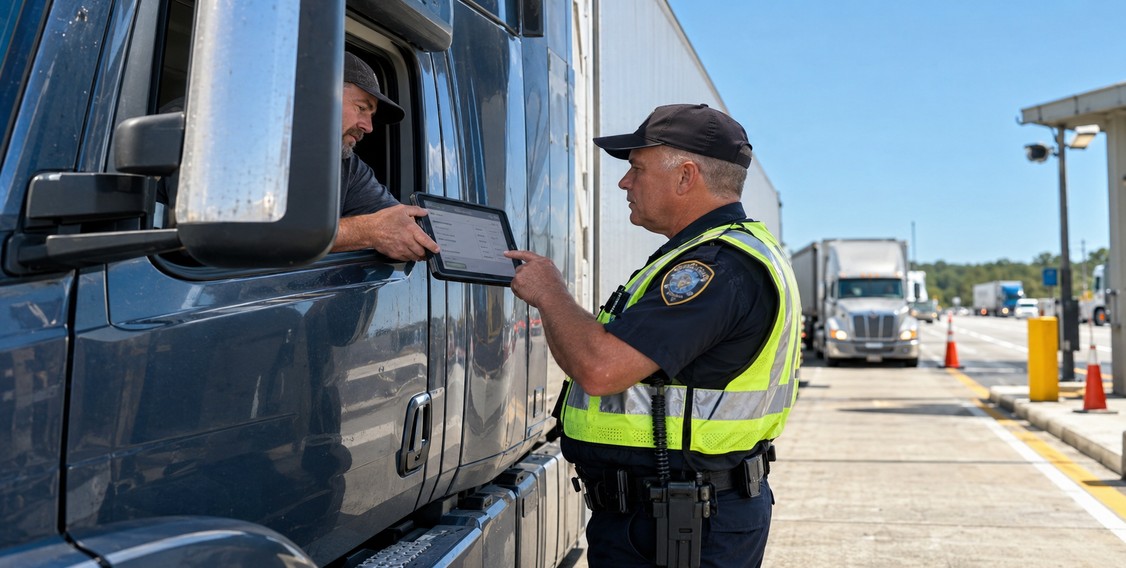
Driving beyond an applicable HOS limit can result in a roadside violation and, depending on the facts and current out-of-service criteria, an out-of-service order or other enforcement action. Neither a citation nor an out-of-service order is automatic in every case. Penalty amounts vary by violation, enforcement authority, and applicable schedules; this article does not promise a fixed result.
An ELD records vehicle movement and maintains duty records, but it does not physically prevent over-limit driving. A carrier’s portal or alert may help with planning, yet the driver and carrier must review inaccurate or missing statuses, prior duty time, exceptions, and the applicable limits. Not every ELD alert or recorded event becomes an FMCSA Safety Measurement System (SMS) violation; SMS reflects qualifying inspection and investigation data, not every internal alert. See FMCSA’s SMS and ELD editing guidance.
Geosavi offers ELD hardware and software for electronic HOS records. Vehicle connections and available alerts depend on the installed configuration and compatible vehicle; confirm those details with Geosavi for your fleet. No ELD can guarantee legal compliance or replace accurate driver entries and review. A dispatcher or carrier must not coerce a driver to violate safety rules; FMCSA describes the complaint process.
HOS Daily Limits at a Glance
| HOS requirement | Property-carrying CMV | Passenger-carrying CMV |
|---|---|---|
| Daily driving limit | 11 hours after 10 consecutive hours off duty | 10 hours after 8 consecutive hours off duty |
| Other daily driving constraint | No driving after 14th consecutive hour after coming on duty, subject to exceptions | No driving after 15 hours on duty following 8 consecutive hours off duty |
| 30-minute break | After 8 cumulative driving hours without a 30-minute non-driving interruption; qualifying short-haul drivers excepted | Property-carrier break provision does not apply |
| 60/70-hour limit | No driving after 60/70 hours on duty in 7/8 consecutive days | No driving after 60/70 hours on duty in 7/8 consecutive days |
| Adverse driving conditions | Up to 2 additional driving hours and up to 2 hours added to driving window, when qualified | Up to 2 additional driving hours and up to 2 hours added to on-duty limit, when qualified |
| Sleeper-berth split | Qualifying 7/3 or 8/2 pairing totaling at least 10 hours | Separate passenger rules under § 395.1(g)(3) |

Questions to Ask Before Your Next Compliance Review
Do drivers and dispatchers see both daily and 60/70-hour availability?
A driver may have unused driving time but no legal driving time under the window or weekly limit. Check how your workflow accounts for all three and how recently portal information was refreshed.
Are non-driving activities and qualifying breaks recorded accurately?
Drivers should distinguish on-duty work from off-duty time and review edits. On-duty not driving can satisfy the 30-minute break, but it still counts as on-duty time for other HOS limits.
How are short-haul exceptions and prior duty history handled?
Confirm that time records are available for qualifying short-haul days and that a full record can be completed when the exception no longer applies. Confirm a new driver’s earlier on-duty hours are included in the applicable 7/8-day calculation.
What is the process for an ELD malfunction?
Under § 395.34, a driver must give written notice within 24 hours of discovering a malfunction. When it hinders accurate HOS recording, the driver must reconstruct the current day and previous seven days unless records are already possessed or retrievable, and maintain paper records until the ELD is back in compliance. The carrier generally has eight days from discovery or notice, whichever is first, to correct it; an extension requires a timely request to the appropriate FMCSA Division Administrator. A data diagnostic event is not automatically a malfunction.
Common Questions About the 11-Hour Rule
Daily Limits and Exceptions
What is the 11-hour driving rule?
A property-carrying CMV driver generally may drive up to 11 hours after at least 10 consecutive hours off duty, but must also stay within the applicable 14-hour driving window and 60/70-hour limit.
Does on-duty-not-driving time count toward 11 hours?
No. It counts toward on-duty totals and generally uses time in the consecutive 14-hour window, but it does not itself add to the 11-hour driving total.
Can a 30-minute break be on duty?
Yes. For property-carrying drivers subject to the break rule, at least 30 consecutive minutes in a non-driving status can qualify, including on duty not driving, off duty, sleeper berth, or a combination. The break does not reset the 11-hour allowance or extend the ordinary 14-hour window.
Can a driver go past 11 hours under an exception?
A driver who qualifies for the adverse driving conditions exception may use up to two additional hours of driving and extend the driving window by up to two hours as needed. It does not extend the 60/70-hour limit. Other exemptions have their own conditions; routine traffic does not qualify as an adverse condition.
Does a sleeper-berth split reset the clock?
A qualifying property-carrying split pairs at least seven consecutive hours in the sleeper berth with at least two hours off duty or in the berth, totaling at least 10. Neither paired period counts against the 14-hour window, but calculating remaining hours requires reviewing the duty periods around both breaks.
Do unused driving hours carry over?
No. After a qualifying 10-hour off-duty period, the driver begins a new allowance of up to 11 driving hours; unused hours from the previous duty period are not banked.
Is the 11-hour rule the same for passenger drivers?
No. Passenger-carrying CMV drivers generally have a 10-hour driving limit after eight consecutive hours off duty and may not drive after 15 hours on duty following that rest. Their 15-hour on-duty limit is not the same as the property’s consecutive 14-hour window.
ELDs and Responsibility
Does an ELD prevent a driver from exceeding a limit?
No. It records vehicle movement and can support HOS monitoring, but it does not stop the vehicle. Drivers and carriers remain responsible for accurate duty statuses and applying the correct limits and exceptions.
What happens if a driver exceeds the limit?
An applicable overage can lead to an inspection violation and other enforcement depending on the facts. An automatic citation, out-of-service order, or fixed penalty should not be assumed.
Conclusion
The practical rule is to plan around the earliest applicable limit: 11 driving hours, the 14-hour window, or the 60/70-hour cycle. A break, qualifying exception, or sleeper-berth split can change the calculation, so verify the underlying duty record rather than relying only on one displayed countdown.
For questions about how Geosavi’s ELD fits your vehicles and workflow, contact our team.