Key Takeaways
- Every edit to an ELD record needs an annotation explaining why the change was made, under 49 CFR 395.30.
- An edit changes how a record reads, but it never erases the original entry. Both versions stay in the ELD’s file (49 CFR 395.30(f)).
- Annotation-length limits vary by ELD provider.
- A carrier can only request an edit after the driver has already submitted that day’s record, not before, and the driver must confirm or reject the request before it becomes part of the official record (49 CFR 395.30(d)(1)-(2)).
- Automatically recorded driving events have strict edit limitations and generally cannot be changed to off-duty or another non-driving status to alter hours-of-service time.
- A missing or unclear annotation is not, by itself, falsification. Knowingly falsifying a record of duty status is a separate and more serious violation, under 49 CFR 395.8(e)(1).
- We built this guidance around FMCSA’s own process for correcting a record and explaining why the change was made, per FMCSA’s ELD editing guidance.
- Falsification of record of duty status was the second most-cited driver violation in 2025, with 58,382 violations recorded, per CVSA’s 2026 Roadcheck announcement.
| Table of Contents |
|---|
| ELD Edit Basics |
| Annotation Requirements |
| Edit Limitations |
| Edit Process Steps |
| Missing Annotation Risks |
| Record Retention |
| Edit vs Annotation |
| Provider Questions |
| Annotation FAQs |
Introduction
We hear the same handful of situations come up again and again. A driver forgets to switch from off-duty to on-duty for fifteen minutes spent loading freight. A dispatcher notices a status logged as off-duty when the truck was clearly moving. A carrier reviewing weekly records spots a gap that needs to be filled in before the week closes out. None of these are violations by themselves, but each one leaves a record that no longer matches what actually happened, and FMCSA built a specific process into the ELD rule for fixing exactly this kind of thing.
That process runs through two connected pieces: the edit itself, and the annotation that explains it. Skip the second one, or leave it unclear, and a change that should have been routine can end up drawing more attention than it needs to during a roadside check or a compliance review. We see this trip up newer drivers and established carriers alike, usually not because anyone did anything wrong, but because the annotation didn’t say enough to make the edit self-explanatory.
Here’s what we’ll walk through: what counts as an edit under the ELD rule, why every one of them needs an annotation, what can and cannot be changed once a record exists, and how long your fleet needs to keep that history on file. We’ll also cover what a missing or unclear annotation does and doesn’t mean, since that distinction causes a fair amount of confusion.
If your team is still working out how your current ELD platform handles this part of the process, our ELD platform and hardware setup is built to make daily log management easier for your drivers, and if you have questions about how it works, you can schedule a call with our team or reach us at (800) 261-4361.
What Counts as an ELD Edit?
An edit is any change made to an ELD record after it was first recorded, whether that’s correcting a duty status, filling in a missed entry, or adjusting a detail your driver typed in wrong the first time, and it is not the same as deleting something. Under 49 CFR 395.30(f), the original data has to stay on file even after an edit is made, so an inspector or auditor pulling the full record can see both what was first logged and what was changed.
We think of this distinction as the whole point of the rule. An edit is not erasing a mistake, it’s layering a corrected version on top of the original while keeping both visible. That’s also why the ELD system your fleet uses matters here. We built our platform to support this kind of layered record, similar to how our ELD and DVIR integration setup keeps inspection history connected to a vehicle’s full record rather than replacing it, and we’ve found it makes this part of compliance easier for drivers filling out logs at the end of a shift.
Common edits include switching an event from off-duty to on-duty not driving, adding a missed sleeper berth period, or correcting a location that was entered incorrectly. What an edit generally cannot do is convert automatically recorded driving time into a different category, which we cover in more detail further down.
Why Does Every Edit Need an Annotation?
An annotation is the short written explanation that has to travel with every edit, and FMCSA requires one every time, without exception, under 49 CFR 395.30(c)(2). A record that changes without an explanation gives an inspector nothing to work with, whether the change was a genuine correction or something else, and the annotation is what fills in that gap.
A useful annotation states the actual reason for the change in simple, direct wording, something like noting that a driver forgot to log off duty at the end of a shift, or that training time had been logged incorrectly as off-duty. Annotation-length limits vary by ELD provider, which is part of why we encourage drivers and carrier staff to be direct rather than unclear when writing one. A missing annotation does not, by itself, mean the record was falsified, but it does fail to document the reason for the edit as required under 49 CFR 395.30(c)(2). An unclear annotation may also make it harder to demonstrate why the correction was made.
This is also where your own review habits come into play. We recommend reviewing driver compliance records on a regular schedule, not just before an audit, since that helps catch a thin annotation before it becomes a pattern rather than a one-time gap.

What Can and Cannot Be Edited on an ELD?
Drivers and authorized carrier staff can edit the status of an existing event, add missing information, and correct clear mistakes, all under the framework laid out in 49 CFR Part 395 HOS rules. Automatically recorded driving events have strict edit limitations and generally cannot be changed to off-duty or another non-driving status to alter hours-of-service time. That data comes directly from the vehicle’s engine, not from a manual entry, which is why the rule treats it differently from other event types.
In practice, this means your driver can change how a non-driving period is classified, say, moving fifteen minutes from off-duty to on-duty not driving for a yard move, but cannot convert a recorded driving segment into off-duty time, or the reverse. This limit exists specifically to prevent hours-of-service numbers from being adjusted after the fact, which is the exact scenario the falsification rule under 49 CFR 395.8(e)(1) is meant to catch.
We’d also point out that carrier staff carry an additional restriction on top of this. Under 49 CFR 395.30(d)(1)-(2), they can only request an edit, never apply one directly to a driver’s record, and they cannot make that request before the driver has already submitted the day’s log. The driver then has to confirm or reject the proposed change before it becomes official, which keeps the final say over the record with the person who was actually driving.
How Does the Edit Process Actually Work?
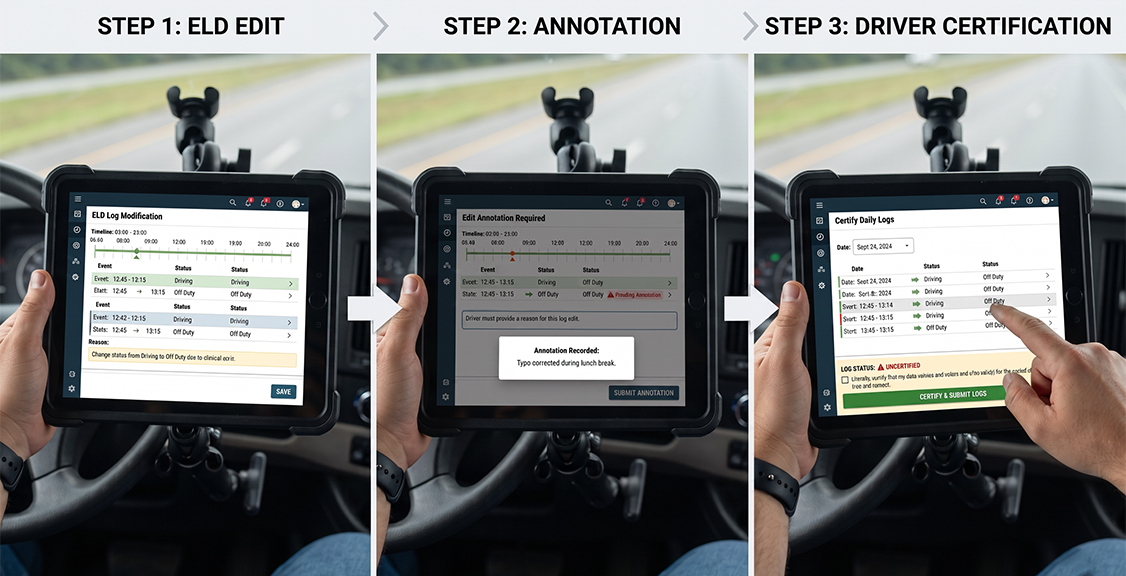
The process runs in a specific order, and skipping a step is usually where confusion starts. A driver reviews their own daily record first and can make direct corrections themselves, along with the required annotation, before certifying the log as accurate. If a carrier notices something that needs fixing after that certification, staff can request an edit, but only once the driver’s version has already been submitted, per 49 CFR 395.30(d)(1)-(2).
From there, the requested edit goes back to the driver, not as a finished change but as something to review. The driver reviews it, adds or confirms the annotation, and either confirms or rejects it. If the driver rejects a proposed edit, that rejection is recorded too, which means there’s no version of this process where a record changes silently without the driver’s input showing up somewhere in the history.
We know this back-and-forth can feel slower than just fixing something directly, and we understand why some carriers find it frustrating when a correction seems obvious. The structure exists specifically so a driver’s hours can’t be adjusted by someone else without their knowledge, which protects your drivers as much as it protects the accuracy of the record itself.
What Happens If an Edit Is Missing an Annotation?
A missing or unclear annotation is not, by itself, falsification. Knowingly falsifying a record of duty status is a separate and more serious violation, covered under 49 CFR 395.8(e)(1), and we’re careful not to treat the two as the same thing. What a missing annotation does remove is the explanation that would otherwise show a change was a genuine correction rather than something that needs a closer look.
Knowing falsification carries its own maximum civil penalty under the FMCSA penalty schedule, adjusted annually for inflation. We’ve seen carriers that build annotation review into their regular log checks stay ahead of this distinction, since a clear annotation habit makes it easier to demonstrate that an edit was routine rather than something else.
How Long Do Edited Records Need to Be Kept?
Edited ELD records fall under the same retention rules as any other hours-of-service record, which generally means keeping supporting documentation and the full record history, original and edited versions together, on file for six months under 49 CFR 395.8(k)(1). The original data and every subsequent edit stay attached to the record for that entire period, so an audit months later can still see the full sequence of changes rather than just the final version.
This is one area where the technical side of an ELD system matters more than most carriers expect. We’ve designed our platform to work within the ELD technical standard Appendix A, which requires preserving this kind of history, and that requirement is a core part of why the certification process for ELD hardware and software exists in the first place.
Edit vs Annotation vs Certification
| Aspect | Edit | Annotation | Certification |
|---|---|---|---|
| What it does | Changes how a record reads | Explains why the edit was made | Confirms the record is accurate |
| Who can create it | Driver, or carrier staff (as a request) | Whoever made the edit | Driver only |
| Required every time | No, only when a correction is needed | Yes, whenever an edit is made | Yes, for every daily record |
| Character limit | Not applicable | Varies by ELD provider | Not applicable |
| Governing rule | 49 CFR 395.30 | 49 CFR 395.30(c)(2) | 49 CFR 395.30(b) |
| Recordkeeping | Original data is preserved, not erased | The ELD must retain the edit history and associated annotations | If a log changes through a permitted edit, the driver reviews and recertifies/resubmits it as required |
Questions to Ask Your ELD Provider
Does the annotation field appear on the same screen as the edit itself?
If a driver has to leave the edit screen to find a separate annotation field, annotations tend to get skipped or rushed. Ask your provider directly whether their platform keeps both together, since this is a design choice that varies between systems.
Can carrier staff apply an edit directly, or only request one?
Under the rule, carrier staff should only ever be able to request an edit, never apply it directly to a driver’s record. If a platform allows staff to bypass driver confirmation, that’s a compliance gap worth asking about before you commit to it.
How does the system store the original record after an edit is made?
Ask whether the original entry stays visible alongside the edited version, or whether it’s only accessible through a separate report. Both approaches can meet the retention rule, but one makes an audit much faster than the other.
What happens if a driver rejects a proposed edit?
The rejection itself needs to show up in the record. If a platform simply discards a rejected edit without logging that it was proposed and turned down, that’s missing part of the required history.
What are the annotation-length limits, and does the system warn drivers before they hit them?
Since annotation-length limits vary by ELD provider, ask specifically what your platform allows and whether it flags the limit as a driver types, which helps avoid a truncated, unclear explanation.
How far back can your team pull edit history during an audit?
Since edited records generally need to stay on file for six months, confirm the platform actually keeps that full window accessible, not just the most recent few weeks.
How does the platform handle attempted edits to automatically recorded driving time?
Since driving events generally cannot be reclassified through an edit, ask how the system communicates that limitation to a driver who tries, rather than just silently rejecting the attempt.
Will your drivers get any built-in guidance on what makes a strong annotation?
Some platforms offer short prompts or examples within the annotation field itself. We’ve found that kind of built-in guidance can reduce how often a compliance team has to follow up on a vague annotation after the fact.
Edit Annotation FAQs
About ELD Edits and Annotations
Does every single edit need an annotation, even a small one?
Yes. The rule under 49 CFR 395.30(c)(2) does not carve out an exception for minor edits, so even a small correction needs a short explanation attached to it.
Can a driver edit their own driving time if they think it was recorded wrong?
Generally no. Automatically recorded driving events have strict edit limitations and cannot typically be reclassified, even by the driver themselves. If a driver believes the vehicle data itself is wrong, that’s generally a malfunction issue rather than something an edit can fix.
Who writes the annotation when a carrier requests an edit?
Typically the carrier staff member requesting the change writes an initial annotation, and the driver can add to or confirm it when reviewing the request.
What happens if a driver never responds to a requested carrier edit?
If a driver does not confirm and recertify a carrier-proposed edit, the proposed change does not replace the driver’s certified record. However, the carrier’s proposed edit and annotation remain part of the ELD record. Carriers should follow up rather than assume silence means approval.
Is there a time limit on how long after the original entry an edit can be made?
FMCSA does not set a single universal deadline for every scenario, so the exact timing can depend on your specific ELD platform and your carrier’s own internal policy. Check with your compliance team or your provider’s support resources for anything specific to your situation.
Does an edited record look different to an inspector than an unedited one?
Generally yes. Most ELD systems visually flag which entries have been edited and display the associated annotation alongside them, which is part of what makes a clear, specific annotation useful during a roadside review.
About Staying Compliant During a Roadside Inspection
Will a roadside inspector always ask about edited entries?
Not necessarily, but it’s worth being ready to explain any recent edits if asked, since edited entries are one of the things inspectors know to look for.
Does a pattern of frequent edits raise a red flag by itself?
It can draw more attention than a single, well-explained correction, particularly if the annotations attached to those edits are thin or missing.
What’s the difference between an edit issue and actual falsification?
An edit issue is generally a process or documentation gap, like a missing annotation. A missing or unclear annotation is not, by itself, falsification. Knowingly falsifying a record of duty status is a separate and more serious violation under 49 CFR 395.8(e)(1). If you believe a violation was recorded in error, you can challenge it directly through the FMCSA DataQs system.
How common are falsification violations industry-wide?
Falsification of record of duty status was the second most-cited driver violation in 2025, with 58,382 violations recorded, according to CVSA’s 2026 Roadcheck announcement, which also named ELD tampering and falsification as this year’s driver focus area.
Can a carrier be penalized for a driver’s incomplete annotation?
Carriers can face penalties tied to hours-of-service recordkeeping generally, and maximum civil penalty amounts are adjusted annually for inflation under 49 CFR Appendix B to Part 386. Whether a specific incomplete annotation leads to a penalty depends on the full circumstances, so we’d suggest discussing this with your carrier’s compliance team if it comes up.
What should a driver do if they realize an annotation was unclear after the fact?
Reach out to your carrier’s compliance contact as soon as possible. In many cases a clearer follow-up annotation or explanation can be added before the record becomes an issue during a review.
Conclusion
We built our approach to edits and annotations around a simple problem: records change over time, whether from an honest mistake or a missed entry, and FMCSA needs a way to tell a genuine correction apart from something more serious. A clear, specific annotation attached to every edit is what makes that distinction easier to see, both for your own compliance team and for anyone reviewing your logs at the roadside.
Going into 2026, log integrity remains one of the areas inspectors are watching closely, with ELD tampering and falsification named as this year’s driver-side focus for CVSA’s International Roadcheck. A fleet with a habit of clear, specific annotations is simply in a better position if a stop or an audit raises a question about a past edit.
If you have questions about how edits and annotations work on your fleet’s ELD, you can schedule a call with our team or reach us at (800) 261-4361.