Key Takeaways
- Portable ELDs must be mounted in a fixed position and remain visible to the driver from the normal seated driving position while the commercial motor vehicle is in operation, per 49 CFR 395.22(g).
- Whether a device counts as portable generally depends on whether the display itself is designed to be removed from the cab, though FMCSA has not published one precise technical test covering every hardware configuration, per 49 CFR Part 395 HOS rules.
- Mounting under 49 CFR 395.22(g) and an ELD’s separate capability to display the required data set to an authorized safety official during an inspection are two distinct requirements; the coverage here focuses specifically on mounting.
- FMCSA does not prescribe or approve a specific mount brand or bracket style; ELD providers self-certify their devices against the ELD technical standard Appendix A for listing purposes.
- A device only counts as usable hardware if it appears on the FMCSA registered ELD list, which is a separate requirement from where or how that device is mounted.
- Whether the mounting rule applies to a given vehicle traces back to how a commercial motor vehicle is defined under 49 CFR Part 390.5.
- Hardwired ELD is industry terminology describing a permanently installed display, not a formal FMCSA classification; the regulation specifically addresses portable devices under 49 CFR 395.22(g).
- Outcomes for a mounting issue found during a roadside inspection vary by officer, state, and situation, so no single typical enforcement pattern applies across every stop.
| Table of Contents |
|---|
| Portable ELD Basics |
| Mounting Requirements |
| Why Placement Matters |
| Common Mounting Mistakes |
| Noncompliance Risks |
| Portable vs Installed Displays |
| Buyer Questions |
| Portable ELD FAQs |
Introduction
If your fleet runs a portable ELD, where that display sits inside the cab is not just a matter of convenience. It is part of the compliance rule itself. Under 49 CFR 395.22(g), a portable ELD must be mounted in a fixed position and stay visible to the driver from the normal seated driving position while the vehicle is in operation. A device that is technically registered but sitting loose on a seat or tucked into a door pocket while the truck is moving does not meet that standard.
That gap between owning compliant hardware and mounting it correctly is where fleets tend to run into avoidable trouble. A tablet propped against the windshield with a phone charger cable is not the same thing as a fixed mount built to hold up over daily use. Understanding the actual regulatory language, rather than a general sense that ELDs need to be mounted somewhere, is what keeps a fleet in clear compliance.
Here, we walk through what makes an ELD display portable under FMCSA’s framework, what 49 CFR 395.22(g) requires versus what is simply good practice, why placement affects both compliance and driver safety, and the mounting mistakes that show up most often. It also compares portable and permanently installed displays and works through the questions fleet managers tend to ask before settling on a mounting solution.
If you would rather talk through your specific truck configuration than sort through the regulations on your own, you can schedule a time with our team and we’ll walk through what a compliant setup looks like for your fleet. You can also reach us at (800) 261-4361 if that’s easier.

What Makes an ELD Display Portable Under FMCSA Rules?
An ELD display is generally treated as portable if it can be detached from its mount and carried out of the cab, as opposed to a display built permanently into the vehicle’s dash or console.
Connection method alone does not settle the question. A tablet that pairs with the vehicle over Bluetooth is a common example of a portable display, since the unit itself is the kind of component a driver picks up and carries. The practical distinction that matters most for 49 CFR 395.22(g) is whether the display is designed to be taken in and out of the cab, not simply how it connects to the vehicle. That said, FMCSA has not published a single, precise technical test spelling out exactly where that line falls in every hardware configuration, so fleets running less typical setups should confirm with FMCSA or their carrier’s compliance team how their specific hardware is classified rather than assume based on this general description alone.
Whether the mounting rule applies to a given vehicle at all comes back to how that vehicle qualifies as a commercial motor vehicle under 49 CFR Part 390.5, since that classification is what brings a vehicle into the ELD mandate in the first place. Many fleets running Bluetooth-connected tablet hardware fall into this portable category, which means the mounting rule applies to that display every time the truck is in motion, not just during setup or inspection.
What Does FMCSA Require for Portable ELD Mounting?
A portable ELD must be mounted in a fixed position and remain visible to the driver from the normal seated driving position while the commercial motor vehicle is being operated, under 49 CFR 395.22(g). That is the full legal requirement, stated once here and referenced more briefly from this point forward.
It is worth being clear that this mounting rule is separate from another requirement that sometimes gets folded into the same conversation: the ELD also has to be capable of displaying the required hours-of-service data set to an authorized safety official on request during a roadside inspection, under the ELD technical standard Appendix A. That is a functional capability of the device itself, not a statement about where it sits in the cab. A device can be mounted correctly and still need to meet that separate display standard when an officer asks to review it. We cover exactly what that display has to show and how during a roadside stop in a dedicated article, and we’d point you there for the full detail rather than repeat it here.
The regulation does not go further than the mounting rule itself. It does not specify mounting height, angle, or a particular bracket style, and it does not use language about leaning, reaching, or eye contact with the road. Those are practical safety considerations worth thinking through when choosing a mount, not requirements written into 49 CFR 395.22(g) itself. FMCSA does not prescribe or approve a specific mount brand; ELD providers self-certify their devices against the ELD technical standard Appendix A for listing purposes, and carriers are responsible for making sure drivers use portable devices correctly once they are on the road.
Why Does Mounting Placement Matter for Compliance and Driver Safety?
Placement matters for two related reasons: it is what the regulation itself requires, and a stable, visible mount reduces the chance a driver handles the device while the truck is moving.
The FMCSA ELD program is built around the idea that a driver’s hours-of-service data needs to be readily accessible on request. A device that is technically working but hard to reach or view can slow that process down during a roadside check. Separately, from a general safety standpoint, a loose tablet sliding around a cab is the kind of distraction risk most fleets already train drivers to avoid with phones and other loose items. A mount positioned within a driver’s normal sightline supports both goals at once. This connects to the broader case for ELDs in general, and our earlier article on how ELDs promote safer roads covers that case in more depth.
What Mistakes Do Fleets Make with Portable ELD Mounts?
The most common mounting problems are unstable mounts, poorly angled placement, and devices that get unmounted out of habit and not remounted before driving resumes.
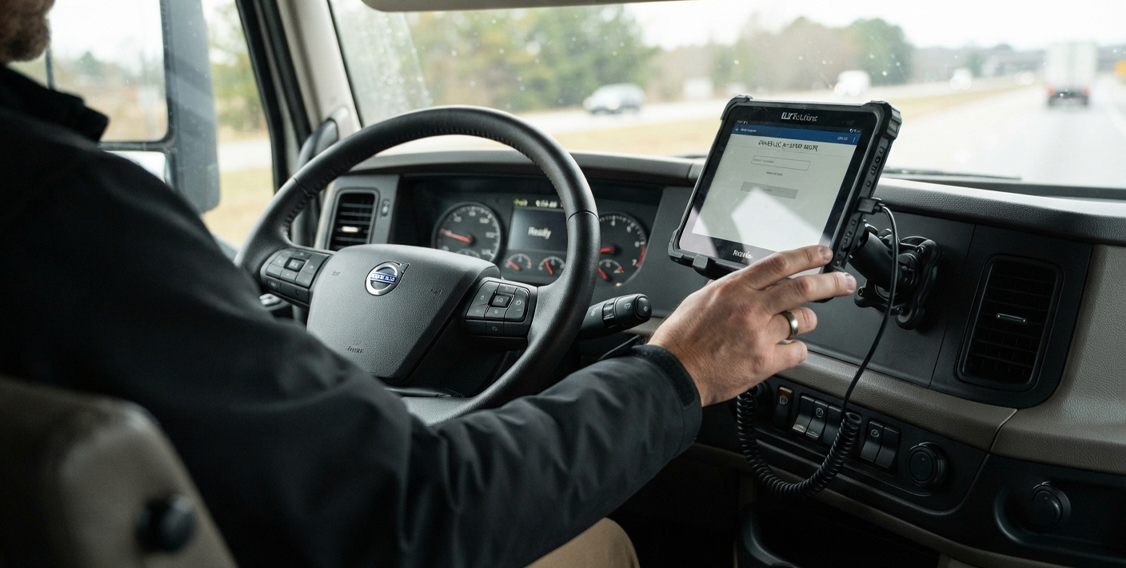
The first is a cradle that loosens over weeks of daily use until the display shifts or falls out of position. Choosing a mount intended for commercial vehicle use, rather than a general-purpose consumer phone or tablet holder, is a reasonable starting point, though actual durability depends on the specific product rather than that category alone. Geosavi’s tablet hardware includes a charging cradle with a RAM mount, which is a widely used vehicle-mounting system in commercial settings, though we’d encourage you to confirm fit and performance for your specific trucks rather than take that as a guarantee. The second mistake is a mount that is technically fixed but positioned low or off to the side, forcing the driver to look away from the road further than necessary to read it. Positioning the cradle closer to the driver’s normal line of sight, similar to where a dash-mounted GPS unit often sits, addresses this. The third is drivers who unclip the device to check something quickly and then forget to remount it before pulling back onto the road. That last one is a habit and training issue more than a hardware issue: treating the mount the way a driver would treat a seatbelt, back in place before the truck moves, closes that gap. If your team runs into recurring mount issues, our support resources walk through cradle setup and troubleshooting for tablet-based hardware.
What Happens If a Portable ELD Isn’t Mounted Correctly?
An improperly mounted portable ELD can result in a roadside inspection violation. Under 49 CFR 395.22(g), a portable ELD must be mounted in a fixed position during commercial motor vehicle operation and visible to the driver from the normal seated driving position.
FMCSA identifies failure to meet this requirement as an Hours-of-Service Compliance violation for a portable ELD that is not mounted in a fixed position and visible to the driver. This is separate from whether the ELD itself is registered and otherwise compliant. A fleet can use an FMCSA-registered ELD and still have a mounting-compliance issue if a portable device is not properly secured and visible while the vehicle is being operated.
Portable vs Permanently Installed ELD Displays: How Do They Compare?
Hardwired ELD is a term the industry uses informally to describe a display that stays permanently fixed to the vehicle. FMCSA’s regulation does not create that as a separate legal category; it specifically addresses portable devices under 49 CFR 395.22(g), and a permanently installed display simply falls outside that particular mounting requirement because it isn’t portable to begin with.
| Feature | Portable Display | Permanently Installed Display |
|---|---|---|
| Governed by 49 CFR 395.22(g) | Yes, must be fixed and visible while operating | No, the mounting rule specifically addresses portable devices |
| Typical hardware | Tablet or handheld unit, removable from its mount | Dedicated unit built into the dash or console |
| Movement between vehicles | Can generally move with the driver between trucks | Stays with the specific vehicle |
| Setup | Cradle installation plus device pairing | Installation tied to the vehicle’s dash and wiring |
| Troubleshooting | Device or cradle issues can often be addressed without a shop visit | Wiring or built-in hardware issues may require a technician |
| Common fit | Fleets that want flexibility across a mixed or changing truck lineup | Fleets running a stable, long-term vehicle lineup |
If you’re weighing this decision for a smaller vehicle rather than a full sleeper cab, our guide on ELD requirements for box trucks covers how vehicle type factors into the broader compliance picture.
Questions to Ask Before Choosing a Portable ELD Mount
Does the mount hold up to daily use, not just a test drive?
A mount that feels solid in a parking lot can loosen over weeks of real driving. Ask whether the mounting hardware is intended for commercial vehicle use specifically, and ask for any specifications or warranty terms rather than relying on general claims.
Can the device be repositioned without tools?
Cabs vary, and a driver’s ideal sightline in one truck may not match another. A cradle that adjusts by hand makes it easier to get the angle right the first time.
Is the charging solution built into the mount itself?
A separate charging cable that isn’t integrated into the cradle is one more thing that can come loose, which adds friction to keeping the device properly mounted throughout a shift.
Does the mount obstruct the driver’s forward view or interfere with other controls?
This applies beyond the federal mounting rule itself; state law, company policy, and individual cab layout can all factor into whether a given placement, including windshield-mounted options, is appropriate.
How easily can the device move between trucks?
If your fleet reassigns drivers or vehicles regularly, a mount that’s simple to detach and reinstall matters as much as one that’s simple to view.
What’s the plan if the mount fails on the road?
Ask your provider what backup process exists if hardware fails mid-route, since a driver without a working mount is functionally back to holding the device loose.
Is the mount included with the device, or a separate purchase?
This affects both upfront cost and how consistent your fleet’s mounting setup ends up being across trucks. If cost is a factor in comparing setups, our price calculator breaks down what’s included at each tier.
Does the provider offer support for placement or setup questions?
A provider that can walk a driver through mount installation over the phone can save a shop visit for a problem that often has a simple fix.
Portable ELD FAQs
Mounting Rules and Placement
Does FMCSA require a specific brand or type of mount for portable ELDs?
No. FMCSA does not prescribe or approve particular mounting hardware. The requirement under 49 CFR 395.22(g) is functional: fixed in place and visible to the driver, not tied to a specific product.
Can a driver hold the ELD in their hand while driving?
No. The rule requires a fixed position while the vehicle is in operation, so a handheld device does not meet that standard while the truck is moving.
Where in the cab should a portable ELD be mounted?
There’s no single required spot. It needs to be visible from the normal seated driving position, similar to where a dash-mounted GPS unit is often placed, though the regulation itself doesn’t specify an exact location.
Does the mounting rule apply differently to tablets versus dedicated ELD hardware?
Generally not, based on whether the display is removable rather than how it connects to the vehicle, though FMCSA has not spelled out one exact test for every hardware setup.
Is a suction-cup windshield mount acceptable?
It can satisfy the federal mounting rule if it holds the device securely in a fixed, visible position. Windshield placement can also raise separate considerations around forward-view obstruction, state law, or company policy, so it’s worth checking those factors too rather than relying on the federal rule alone.
Do drivers need to remount the device every time they get back in the truck?
Functionally, yes. If a device is removed from its cradle, it needs to return to a fixed, visible position before the vehicle is in operation again.
Does the mounting requirement apply during pre-trip inspections or only while driving?
The rule applies specifically to the vehicle being in operation. Devices can be removed for tasks like data transfer while the truck is not moving, then remounted before driving resumes.
Compliance, Devices, and Roadside Checks
Will an officer cite a driver just for an improperly mounted device?
Outcomes depend on the specific facts of the stop and the enforcement procedures the officer applies. FMCSA’s own ELD FAQ is the direct source worth reviewing if you want the agency’s own framing on enforcement questions.
Does a properly mounted ELD need to also be on the FMCSA registered list?
Yes. Mounting compliance and device registration are separate requirements. A device needs to appear on the FMCSA registered ELD list to count as valid hardware, and it also needs to be mounted correctly while the vehicle is operating.
What should a driver do if their mount breaks mid-route?
Contact your carrier’s compliance or support team once it’s safe to do so. Continuing to drive with an unmounted device isn’t a long-term solution.
Can a fleet use the same mounting hardware across different truck models?
Often yes with adjustable cradle systems, though cab layouts vary enough that it’s worth checking fit on each vehicle type.
Does a permanently installed ELD ever need a mounting check?
No, not under 49 CFR 395.22(g) specifically. That rule addresses portable devices, and a permanently installed display falls outside it because it isn’t portable to begin with. There isn’t a separate federal accessibility standard specific to permanently installed displays, so no general rule applies here. If you’re running hardwired hardware and have questions about placement expectations, your carrier’s compliance team or FMCSA directly can speak to your specific setup.
Is mounting compliance something FMCSA checks during ELD registration?
No. Registration and self-certification cover the device’s technical function under the ELD technical standard Appendix A. Mounting compliance during actual operation is a separate, ongoing responsibility that falls on the carrier and driver.
Where can a fleet manager find more general compliance answers beyond mounting?
Our FAQ covers a broader set of common ELD and compliance questions. For anything specific to your fleet’s vehicles or setup, your carrier’s compliance team or FMCSA directly is the right resource.
Conclusion
Portable ELD mounting is a narrow rule with a specific requirement: a fixed position, visible from the normal seated driving position, per 49 CFR 395.22(g). The distinction that matters is whether the display itself is designed to be removed from the cab, not simply how it connects to your truck, and hardwired ELD is a useful industry shorthand rather than a term FMCSA itself defines.
Getting the mount right, and keeping it right after every removal, is a small operational habit with real compliance weight behind it. A stable, well-positioned cradle removes one more variable from an already busy job.
If you’d like a hand getting your fleet’s mounting setup right, feel free to schedule a time with our team or call us (800) 261-4361, and we’ll walk through what fits your trucks.