Key Takeaways
- Unidentified driving time is created automatically whenever your ELD detects vehicle movement without a driver logged in, and federal rules address how carriers must handle those records under 49 CFR Part 395 HOS rules.
- ELDs are required to record unassigned driving segments to a generic unidentified driver profile rather than discarding them, per the ELD technical standard Appendix A.
- Carriers must review unidentified driving records and assign them to the appropriate driver when the facts support it, or annotate the record to explain why the time remains unidentified, as required under 49 CFR 395.32(c).
- Reassigned or edited records still have to preserve the original entry, since carriers are not permitted to simply overwrite what the ELD first captured, per 49 CFR 395.30(f).
- Motor carriers must retain unidentified driving records for at least six months from the date of receipt under 49 CFR 395.32(c)(2).
- CVSA’s 2026 International Roadcheck named ELD tampering, falsification, and manipulation as its driver focus area, following 58,382 falsification-of-record-of-duty-status violations recorded in 2025. Unidentified driving time is not the same thing as falsification, but unresolved driving records may receive additional scrutiny during an inspection.
- FMCSA publishes general guidance for carriers on how ELDs should be operated and reviewed, available through the FMCSA ELD program.
| Table of Contents |
|---|
| What It Means |
| Why It Happens |
| What Carriers Must Do |
| How To Fix It |
| Risk If Unresolved |
| Causes And Fixes |
| Questions Before Choosing |
| Driving FAQs |
Introduction
If you have ever opened your ELD dashboard and seen a block of driving time sitting under an unidentified driver, you already know how unsettling that looks, even when nothing is actually wrong. The system recorded the truck moving, but no one was logged in to claim it, and now that stretch of miles is sitting there unassigned in your records.
This happens more often than most fleet managers expect, and it is rarely a sign of anything sinister. A driver forgets to log in before pulling out of the yard, a co-driver switches at a fuel stop without swapping profiles first, or a shop employee moves a truck a few hundred feet during a repair. Whatever the cause, the driving time still gets recorded, because the ELD is built to capture vehicle movement whether or not a driver profile is attached to it.
The reason it matters is that unresolved unidentified driving time sits in your records exactly the way it looks: unexplained. During a roadside inspection or a compliance review, an officer or auditor reviewing your logs does not know whether that block of time is a simple login mistake or something that needs a closer look, and it is your fleet’s job to have already sorted that out under 49 CFR 395.32(c) before anyone else has to ask.
Here’s what unidentified driving time actually is, why it shows up, what the rules require your back office to do about it, and how to clear it before it becomes a pattern in your records. If you would rather talk it through than read it, call us at (800) 261-4361, or you can look at how our ELD platform and hardware handles the driver sign-in process to reduce how often this happens in the first place.
What Is Unidentified Driving Time on an ELD?
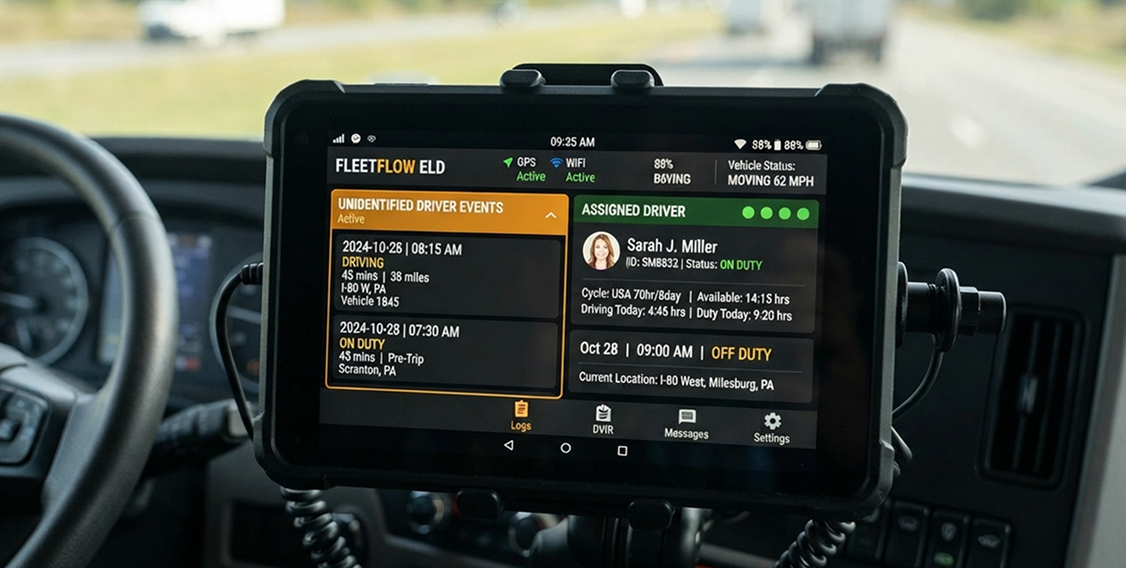
Unidentified driving time is any period an ELD records the vehicle in motion without a driver logged into the device at the time.
Under the ELD technical standard Appendix A, the device is required to capture that movement rather than simply drop it, so it gets recorded to a generic unidentified driver profile tied to the vehicle instead of a specific person. That record still shows up on the vehicle’s logs and generally needs to be resolved the same way any other log entry does, because an ELD is not permitted to just erase driving activity it cannot immediately attribute to someone.
For your fleet, that means unidentified driving time is not a glitch to ignore. It is a flag that something in the login process did not happen the way it was supposed to, and it typically needs a person on your side to look at the timing, the vehicle, and who was likely behind the wheel before it can be closed out correctly.
Why Does Unidentified Driving Time Happen?
Unidentified driving time almost always comes down to a gap between when the vehicle starts moving and when a driver is logged in to claim that movement.
The most common cause is straightforward: a driver starts the truck and pulls out before logging in, whether that is a quick yard move, a short repositioning drive, or simply forgetting the login step at the start of a shift. Team operations add another version of the same problem, since a co-driver switch that is not handled cleanly, meaning one driver logs out before the other logs in, or the truck moves between the two steps, leaves a gap the ELD has to fill with an unidentified entry. Shop and yard activity is another frequent source, since a mechanic or yard hostler moving a vehicle for a repair or a spot check is not always logged in as a driver, even though the vehicle clearly moved.
None of these situations are typically evidence of falsification on their own. They are almost always process gaps, and the fix is usually a combination of driver habit and a login step that makes it harder to start driving without logging in first.
What Does FMCSA Require Carriers to Do About Unidentified Driving Time?
Carriers are generally expected to review unidentified driving records and reassign them to the correct driver whenever the facts support doing so, rather than leaving them unresolved indefinitely.
Under 49 CFR 395.32(c), the motor carrier must review unidentified driving records and determine whether the driving time belongs to a specific driver. If the carrier can identify the appropriate driver, the record can be proposed for assignment to that driver through the ELD’s editing and certification process. If the carrier cannot determine who was driving, the carrier must annotate the record to explain why the time remains unidentified. The carrier must also retain unidentified driving records for at least six months from the date of receipt.
FMCSA’s own published guidance for carriers on ELD operation and review is available directly through the agency, and it is worth keeping as a reference for your compliance team rather than relying on secondhand summaries, since specifics can shift as the agency updates its published guidance. You can review that guidance through the FMCSA ELD program.
How Do You Fix or Reassign Unidentified Driving Time?
Fixing unidentified driving time starts with determining whether the driving record belongs to a specific driver. Under 49 CFR 395.32(c), the motor carrier must review unidentified driving records and either assign them to the appropriate driver or annotate the record to explain why the time remains unidentified.
Most ELD systems allow compliance personnel to review unidentified driving records using information such as dispatch records, fuel receipts, or driver statements. When unidentified driving time is proposed for assignment to a driver’s record, the driver must have the opportunity to review the proposed change through the ELD’s editing and certification process. Changes must be appropriately annotated, and the original ELD record must be preserved rather than deleted or overwritten. If the carrier cannot determine who was driving, the record should be annotated to explain why the time remains unidentified.
Beyond fixing individual segments after the fact, the more durable fix is reducing how often unidentified driving happens in the first place. That usually comes down to driver habit reinforcement, logging in before the truck moves every time, including short yard moves, and using an ELD setup that makes the login step hard to skip. If your fleet is seeing this pattern often enough to be a real time drain for your back office, it is worth checking whether your current ELD platform is reminding drivers clearly enough at startup, since a lot of unidentified driving time traces back to a login screen that is easy to bypass rather than deliberate driver behavior.
What Happens If Unidentified Driving Time Is Never Resolved?
Unresolved unidentified driving time generally increases scrutiny rather than triggering an automatic penalty on its own, but it raises real risk the longer it sits.
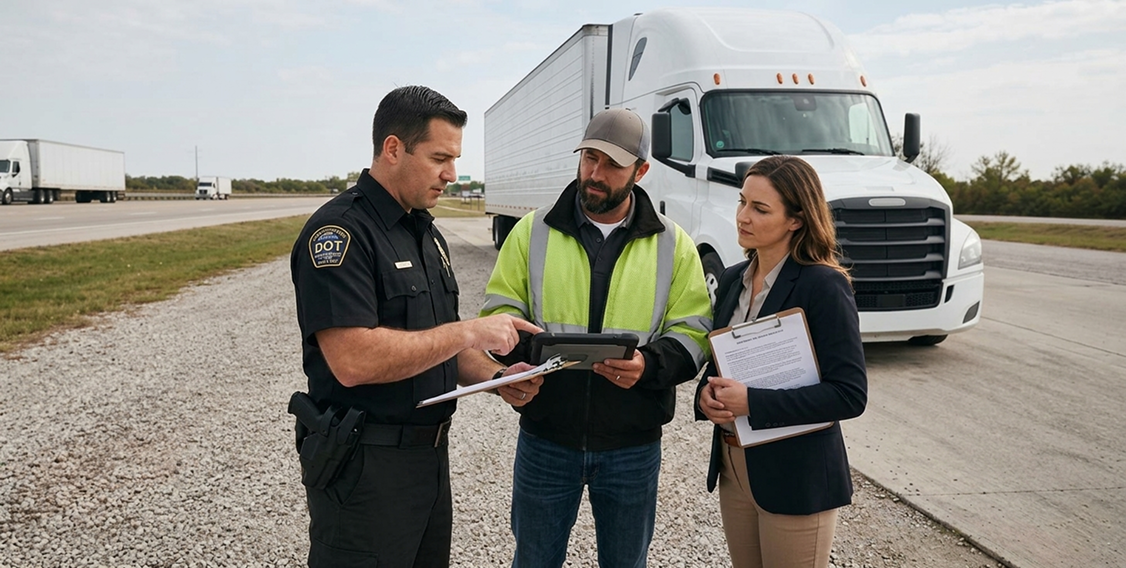
During a roadside inspection, an officer reviewing your ELD records typically wants driving time accounted for, and a pattern of unassigned segments can raise more questions than a single clean explanation would. During a compliance review, unresolved unidentified driving time can be read as a sign that your back office is not actively reviewing logs, which works against the kind of record-keeping FMCSA expects under 49 CFR Part 395. CVSA’s 2026 International Roadcheck named ELD tampering, falsification, and manipulation as its driver focus area, following 58,382 falsification-of-record-of-duty-status violations recorded in 2025. While unidentified driving time is not the same thing as falsification, unresolved driving records may receive additional scrutiny when inspectors review a driver’s record of duty status.
Causes and Fixes Compared
| Cause | Typical Scenario | Who Usually Resolves It | Prevention Approach |
|---|---|---|---|
| Late driver login | Driver starts moving before logging in | Driver, confirmed by dispatch | Login-before-drive habit reinforcement |
| Team driver switch gap | Co-driver logs out before the other logs in | Both drivers, reviewed by back office | Standardized handoff procedure |
| Yard or shop move | Vehicle repositioned by non-driver staff | Fleet manager or compliance staff | Separate yard-move login profile if available |
| Forgotten logout carryover | Prior driver’s session not closed properly | Back office reviewing timestamps | End-of-shift logout checklist |
| Device or connectivity delay | Login screen slow to load at startup | Back office, noted as a device issue | Check device performance with your provider |
| Unassigned segment with no clear driver | Short move, unclear who was driving | Fleet manager, documented as reviewed | Annotate and retain per 49 CFR 395.30(f) |
Questions to Ask Before Choosing an ELD
How clearly does the device remind a driver to log in before the vehicle can move?
A login reminder that is easy to skip is one of the most common root causes of unidentified driving time. Ask the provider to show you exactly what the driver sees at startup, not just describe it.
Can unidentified driving segments be reviewed and reassigned from the back office, not just the driver’s device?
Your compliance team needs to be able to pull up unassigned segments and reassign them with an annotation, generally without needing the original driver’s device in hand. Confirm this is a dashboard feature, not something that requires a support call every time.
Does the system preserve the original entry after a reassignment or edit?
Per 49 CFR 395.30(f), the original record has to stay intact even after a correction is made. Ask specifically how the provider’s system handles this, since some interfaces make it easier than others to see both the original and the edited version.
How does the device handle team driver switches?
Team operations are a common source of unidentified driving gaps. Ask how the login and logout process works for a two-driver switch specifically, not just a single-driver scenario.
What retention period does the system use for driving records, including unidentified segments?
Motor carriers must retain unidentified driving records for at least six months from the date of receipt under 49 CFR 395.32(c)(2). Confirm the provider’s retention settings meet this requirement and your fleet’s recordkeeping needs.
Does the provider offer support if your back office needs help interpreting an unusual unidentified driving pattern?
A pattern that is hard to explain internally is worth a second set of eyes. Ask what kind of support access comes with the platform if your compliance team runs into something they cannot resolve on their own.
How does the system distinguish a genuine unidentified driving segment from a short yard or shop move?
Not every unassigned segment is a compliance concern, but your team should be able to tell the difference quickly. Ask how the reporting view separates these so your back office is not treating every short move like a red flag.
Can you generate a report of unresolved unidentified driving time across your whole fleet, not just one vehicle at a time?
Reviewing this vehicle by vehicle does not scale once a fleet grows past a handful of trucks. Ask for a fleet-wide view so your team can catch patterns instead of individual incidents.
Unidentified Driving FAQs
About Unidentified Driving Time and Compliance
What does unidentified driver mean on an ELD report?
It means the ELD recorded the vehicle moving without a driver profile logged in at the time, so the system assigned that driving segment to a generic placeholder rather than a specific person.
Is unidentified driving time automatically a violation?
The existence of unidentified driving time is not, by itself, proof of an hours-of-service violation. However, under 49 CFR 395.32(c), the motor carrier must review unidentified driving records and either assign them to the appropriate driver or annotate the record to explain why the time remains unidentified. Failure to properly review and handle these records can create a compliance issue.
Who is responsible for reviewing unidentified driving segments?
Under 49 CFR 395.32(c), the motor carrier is responsible for reviewing unidentified driving records and determining whether they can be assigned to the appropriate driver. If the carrier cannot determine who was driving, it must annotate the record to explain why the time remains unidentified.
Can a driver be cited for unidentified driving time at a roadside inspection?
Unidentified driving time is not automatically a driver violation. During a roadside inspection, however, an inspector may review unidentified driving records when evaluating whether the driver’s record of duty status accurately accounts for driving time. If the records reveal a separate hours-of-service or recordkeeping violation, that violation may result in enforcement action.
Does unidentified driving time affect a driver’s individual record?
Once a segment is correctly reassigned to the driver who was actually operating the vehicle, it becomes part of that driver’s normal log rather than a separate flag.
How long do unidentified driving records need to be kept?
Motor carriers must retain unidentified driving records for at least 6 months from the date of receipt under 49 CFR 395.32(c)(2), and make them available to authorized safety officials when required.
About Choosing the Right ELD Provider
What should a fleet manager look for in an ELD’s login process specifically?
Look for a login step that is difficult to bypass and clear enough that drivers are not tempted to skip it, since a weak login flow is one of the most common root causes of unidentified driving time.
How can a fleet reduce unidentified driving time without adding extra steps for drivers?
A combination of a clear login reminder at startup and a short, repeated nudge during onboarding tends to work better than adding more steps, since the goal is making the existing step easier to follow, not adding new ones.
Does switching ELD providers fix a persistent unidentified driving problem?
Sometimes, if the root cause is a weak login interface, but not always, since driver habit and team handoff procedures matter just as much as the device itself. It is worth diagnosing the specific cause before assuming a new provider alone will solve it.
What should a back office ask a provider about reassigning driving time?
Ask whether reassignment can be done from a dashboard without needing the driver’s device present, and whether the system requires an annotation explaining the change, consistent with 49 CFR 395.30(c)(2).
Is unidentified driving time something an ELD provider’s support team can help troubleshoot?
Generally yes, since patterns of unidentified driving often trace back to a specific setup or workflow issue that a provider’s support team can help diagnose.
How often should a fleet review unidentified driving reports?
There is no single federally mandated frequency, but reviewing this on a routine schedule, rather than only when an inspector or auditor raises it, is generally considered a stronger compliance practice.
Can unidentified driving time show up even with a well-maintained ELD system?
Yes. Even a well-configured system can show occasional unidentified driving time from a missed login or a yard move, so the goal is minimizing and resolving it consistently, not eliminating it completely.
Conclusion
Unidentified driving time is not usually a sign that something has gone wrong with your fleet, it is a sign that the login step and the vehicle’s movement did not line up, and that gap needs to be closed by someone reviewing the record. The rules around this, particularly 49 CFR 395.32(c) and the reassignment and record-preservation requirements that go with it, exist to make sure driving time gets accounted for accurately, not to punish a fleet for the occasional missed login.
What matters going into 2026 is consistency. With CVSA naming log integrity as a Roadcheck focus area and enforcement generally paying closer attention to how carriers manage their ELD records, a fleet that reviews and resolves unidentified driving time on a routine basis is in a noticeably stronger position than one that only looks at it when asked.
If your fleet is seeing unidentified driving time often enough to be a recurring back-office task, it is worth checking whether your current setup is contributing to the problem. You can run your numbers through our price calculator or call us at (800) 261-4361 to talk through what a cleaner login workflow could look like for your trucks.