Key Takeaways
- Knowingly falsifying a record of duty status can result in significant civil penalties under 49 CFR Part 386, including Appendix B. Legitimate corrections made through the proper ELD editing process are not automatically falsification.
- Hours-of-service and recordkeeping violations can result in civil penalties under 49 CFR Part 386, including Appendix B. Applicable maximum penalty amounts depend on the specific violation and may be adjusted periodically for inflation.
- FMCSA continues to remove ELDs from its Registered Devices list when devices fail to meet federal requirements. Fleets should verify that an ELD remains on FMCSA’s current Registered Devices list rather than relying solely on its previous registration status.
- Motor carriers subject to the ELD requirement must use an ELD that is listed on FMCSA’s Registered ELDs list. Fleets should periodically verify that their ELD remains listed because a device can later be removed from the list.
- Under 49 CFR 395.1(e)(1), qualifying short-haul drivers may use motor-carrier time records instead of preparing RODS when they operate within a 150 air-mile radius of the normal work reporting location and meet the applicable return, release, and recordkeeping requirements.
- Under 49 CFR 395.8(a)(1)(iii), a driver who is required to prepare records of duty status on no more than 8 days within any rolling 30-day period may qualify for the limited ELD exception. If RODS are required on more than 8 days, the driver generally must use a compliant ELD unless another exception applies.
- Motor carriers must retain required supporting documents in accordance with 49 CFR 395.11, and RODS and supporting documents generally must be retained for six months from the date the motor carrier receives them under 49 CFR 395.8(k)(1).
- CVSA’s 2026 International Roadcheck, held May 12–14, 2026, named ELD tampering, falsification, and manipulation as its driver focus area, following 58,382 falsification-of-record-of-duty-status violations recorded in 2025.
- A truck does not have to be a Class 8 tractor-trailer to fall within the federal commercial motor vehicle definition. Depending on the vehicle’s weight, passenger capacity, hazardous-materials requirements, and operation in interstate commerce, smaller commercial vehicles may also be subject to applicable Federal Motor Carrier Safety Regulations.
Introduction
Running your own authority for the first time means compliance stops being someone else’s job and becomes yours alone. There is no dispatcher checking your logs before they go out, no safety department flagging a missing entry before it turns into a citation. That shift catches a lot of new owner-operators off guard, not because they do not care about the rules, but because nobody walked them through where the actual traps sit.
Most of the mistakes that show up in a driver’s first year are not about ignoring the rules on purpose. They come from a wrong assumption made early and repeated for months, like believing a short trip falls under an exemption it does not, or thinking a log edit without a note is no big deal. A driver might make the same small error for weeks without any consequence at all, which makes the mistake feel harmless right up until the day a roadside inspection or an audit brings it to the surface. By then it can mean a citation, a fine, or a driver placed out of service while the paperwork gets sorted out.
We put this guide together to walk you through the mistakes that come up most often in a new owner-operator’s first year, why they happen, and what to check instead. Each section covers one mistake on its own, so you can read the whole thing in order or jump straight to the one that matches what you are dealing with right now. Every claim ties back to a specific federal rule, so you can see exactly what the requirement is and how to stay on the right side of it, rather than relying on secondhand advice that may or may not be current.
We are based in Tucson, Arizona, and if any of this sounds close to home, our team can walk you through ELD Compliance Now and confirm it matches what your operation actually needs. You can reach us at (800) 261-4361 anytime you want to talk it through.
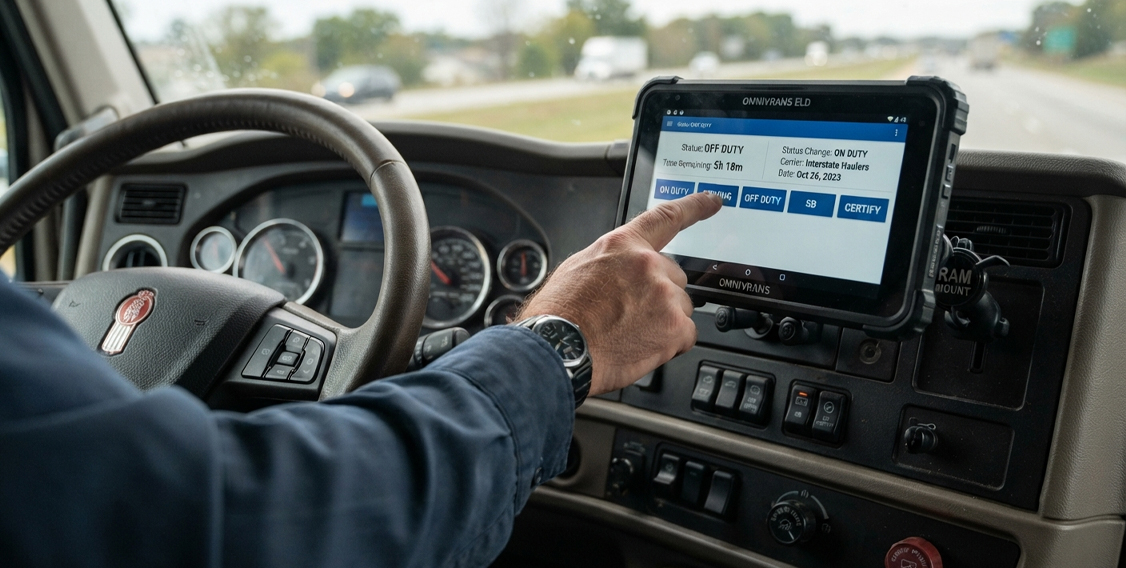
What Happens If You Run an ELD Device That Gets Removed From the FMCSA List?
If an ELD is removed from FMCSA’s Registered Devices list, FMCSA generally establishes a replacement period during which affected motor carriers should replace the revoked device with a compliant ELD. Because FMCSA continues to remove devices that fail to meet federal requirements, fleets should check the current Registered Devices list and any applicable FMCSA removal notice rather than relying on an older device count or replacement deadline.
New owner-operators often buy an ELD once and assume it stays registered forever, since nothing about the hardware itself changes when a device is removed. Devices get removed for two different reasons, and it helps to understand the difference. A manufacturer can self revoke and pull its own product from the list, often because it is discontinuing support or replacing it with a newer model. FMCSA can also determine a device is not meeting the technical standard under 49 CFR Appendix A to Subpart B of Part 395 and revoke it directly. Either way, the device stops being a valid ELD under the rule even though the hardware still physically works, still displays data on the screen, and still feels normal to use day to day.
This is exactly why it catches people off guard. There is no obvious warning light on the dashboard when your device is removed from the list. The only way to know is to check the device’s make and model against the current registry, which most new owner-operators simply never think to do after their first setup. Choosing an ELD model that appears on FMCSA’s Registered ELDs list, and periodically confirming that it remains listed, is one of the best ways to avoid this compliance problem under 49 CFR 395.22(a).
During an FMCSA-established replacement period for a removed ELD, affected motor carriers and drivers should follow the specific instructions in FMCSA’s removal notice, which may allow temporary use of paper logs, logging software, or the revoked device’s display to document hours of service. After the replacement deadline, continued use of the revoked device does not satisfy the ELD requirement. A driver who is required to use an ELD may then be cited for failing to use a compliant ELD and may be placed out of service in accordance with applicable enforcement criteria.
The fix is simple but easy to forget: check your device against the current FMCSA registered ELD list every few months, not just when you first buy it, and set a reminder to check again after any FMCSA enforcement news mentions a new removal batch.
Are You Confusing the Short-Haul Exemption With a Full ELD Exemption?
The short-haul exception can allow a qualifying driver to use motor-carrier time records instead of preparing a record of duty status (RODS). Because the ELD requirement generally applies to drivers who are required to prepare RODS, a driver who fully qualifies for the short-haul exception under 49 CFR 395.1(e)(1) generally does not need to use an ELD for those qualifying operations. The exception includes a 150 air-mile radius from the normal work reporting location and other specific requirements.
A common first-year mistake is assuming a route that looks short qualifies without actually checking the mileage in air miles, which is measured in a straight line between two points and not by the distance shown on a road map or a GPS route. A trip that feels local by road can still sit outside the exemption radius once measured as a straight line, especially in areas where roads wind around terrain rather than running direct.
There is also a time component that gets missed just as often as the mileage. The exemption generally requires returning to the normal work reporting location within a set number of hours, on top of staying inside the radius. A driver who stays inside the mileage limit but comes back late, or who starts from a different location than usual, is not automatically covered for that day either.
The short-haul exception also has important time and return-to-location requirements. Under 49 CFR 395.1(e)(1), the driver must operate within a 150 air-mile radius of the normal work reporting location, return to that location, and be released from work within 14 consecutive hours. The motor carrier must also maintain the required time records.
If a driver does not satisfy the short-haul conditions on a particular day, the driver generally must prepare a record of duty status for that day. Whether an ELD is then required depends on the driver’s overall operation and whether another ELD exception applies, including the limited 8-day exception under 49 CFR 395.8(a)(1)(iii).
How Can the 8-Day ELD Exception Catch New Owner-Operators Off Guard?
One common mistake is misunderstanding FMCSA’s limited ELD exception for drivers who do not regularly need to prepare records of duty status (RODS). Under 49 CFR 395.8(a)(1)(iii), a driver who is required to prepare RODS on no more than 8 days within any rolling 30-day period may qualify to use paper logs instead of an ELD on those days.
The key is that the rule counts days when the driver is required to prepare RODS—not days when the driver happened to use an ELD. If a driver must prepare RODS on more than 8 days during a rolling 30-day period, this limited exception no longer applies, and the driver generally must use a compliant ELD unless another exception applies.
The 30-day period is rolling, not a calendar month. That means drivers and owner-operators need to look back over the preceding 30 days rather than assuming the count resets on the first day of each month. Short-haul operations can also affect the calculation because days when a driver qualifies for the short-haul exception and is not required to prepare RODS generally do not count toward the 8-day threshold.
For owner-operators whose operations move between short-haul and longer-distance work, tracking RODS-required days carefully is essential. Do not assume that a slow week, time off, or occasional local work automatically resets the calculation. When in doubt, review the preceding rolling 30-day period and determine how many days actually required a record of duty status.
Why Do Falsification Citations Catch New Owner-Operators Off Guard?
Falsification citations can carry serious consequences, but correcting an ELD record is not automatically falsification. Drivers are permitted to make appropriate edits to their records of duty status, and ELD rules require changes to be documented while preserving the original record. A falsification issue arises when a record of duty status does not accurately reflect the driver’s actual duty status or when records are intentionally altered or misrepresented.
A driver who notices an incorrect duty status, missed entry, or other legitimate error should correct the record through the ELD’s proper editing process and provide the required annotation explaining the change. The goal is an accurate record with a clear audit trail—not avoiding necessary corrections because an edit itself might look suspicious.
FMCSA’s ELD editing rules require changes to preserve a clear audit trail. Under 49 CFR 395.30(c)(2), a driver or authorized support personnel must annotate each change or addition to a record. Under 49 CFR 395.30(d), a motor carrier may request an edit after a driver submits a record, but the driver must confirm or reject the proposed change, and any accepted change must be properly recertified and resubmitted. Under 49 CFR 395.30(f), the original ELD information must be preserved rather than overwritten or erased.
This connects directly to CVSA’s 2026 International Roadcheck, held May 12–14, 2026, which named ELD tampering, falsification, and manipulation as its driver focus area, following 58,382 falsification-of-record-of-duty-status violations recorded in 2025. If a log needs to be corrected, use the proper ELD editing process, provide the required annotation, and preserve the original record as required by the ELD rules.
What Happens If You Miss the 24-Hour Window to Report an ELD Malfunction?
If an ELD malfunctions, 49 CFR 395.34(a)(1) requires the driver to notify the motor carrier in writing within 24 hours after discovering the malfunction. If the malfunction prevents the ELD from accurately recording the driver’s hours-of-service data, the driver must reconstruct the required records of duty status and continue recording duty status on paper logs or another compliant method until the ELD is back in service.
The reason this catches people off guard is that a malfunction rarely looks urgent in the moment. The truck still runs, the tablet still turns on, and the display may still show something on the screen even if the underlying data is no longer being recorded correctly. A driver focused on finishing a route does not always stop to treat a flickering indicator as something with a compliance clock attached to it.
This is a narrower topic than this article can fully cover, and we have a separate guide focused entirely on malfunction rules, notification steps, and the carrier repair deadline under 49 CFR 395.34(d)(1) if you want the full breakdown. For your first year, the habit worth building is simple: when you discover an ELD malfunction, document it promptly, notify the motor carrier in writing within 24 hours, and follow the applicable record-reconstruction and fallback procedures if the malfunction prevents the ELD from accurately recording hours-of-service data.If you run into an issue and are not sure what to do next, our support team is available 24 hours a day, 7 days a week and can walk you through it.
Why Do New Owner-Operators Get Cited for Missing Supporting Documents?
Motor carriers must retain required supporting documents under 49 CFR 395.11, and records of duty status (RODS) and supporting documents generally must be retained for six months from the date the motor carrier receives them under 49 CFR 395.8(k)(1). Supporting documents can include qualifying records such as bills of lading, itineraries, dispatch records, expense receipts related to on-duty not-driving time, electronic mobile communications, and payroll or settlement records.
Under 49 CFR 395.11, a motor carrier generally must retain up to eight supporting documents for each 24-hour period that a driver is on duty. If more than eight qualifying documents are available, the carrier must retain the document containing the earliest time indication, the document containing the latest time indication, and six additional supporting documents. Special rules also apply to toll receipts when a driver uses paper RODS under the limited ELD exception in 49 CFR 395.8(a)(1)(iii).
Whether records are maintained electronically or on paper, fleets should organize them so they can be matched to the appropriate driver and date and retrieved when required during an audit or investigation. Simply keeping miscellaneous receipts is not enough; the carrier should make sure its recordkeeping process satisfies the supporting-document requirements in 49 CFR 395.11.
Do You Know How to Dispute an Inspection Error Through DataQs?
If you believe information from a roadside inspection or other Federal or State data maintained by FMCSA is incomplete or incorrect, the DataQs system allows drivers and motor carriers to submit a Request for Data Review (RDR). The request is forwarded to the appropriate agency for review, which determines whether the record should be corrected.
DataQs can be used to request review of potentially incorrect inspection information, such as an incorrectly recorded violation, duplicate violation, incorrect driver or carrier information, or other inaccurate or incomplete inspection data. Submitting an RDR does not automatically remove or change a violation; the responsible agency reviews the request and supporting documentation before determining whether a correction is appropriate.
Filing early, while the details are still fresh, tends to produce a cleaner outcome than trying to reconstruct the situation months later once the specifics of the stop have faded. A driver who keeps a basic note of the date, location, and what happened at any inspection is in a much better position to file an accurate request if something on the report looks wrong later.
If something on an inspection report does not look right, it is worth checking with your carrier’s compliance team or FMCSA directly rather than letting it sit unresolved.
Are You Sure Your Vehicle Actually Needs an ELD?
Whether an owner-operator must use an ELD depends on more than whether the vehicle meets the commercial motor vehicle definition in 49 CFR 390.5. The driver generally must also be required to prepare records of duty status under Part 395 and not qualify for an applicable ELD exception. This distinction matters because a vehicle can be subject to Federal Motor Carrier Safety Regulations without every driver or operation automatically requiring an ELD.
The confusion tends to come up most for owner-operators running lighter or mixed-use vehicles, where it is not immediately obvious whether the vehicle configuration meets the commercial motor vehicle definition for that trip. A vehicle that qualifies on one load or configuration may not automatically qualify the same way on a different one, depending on weight and how the vehicle is being used at the time.
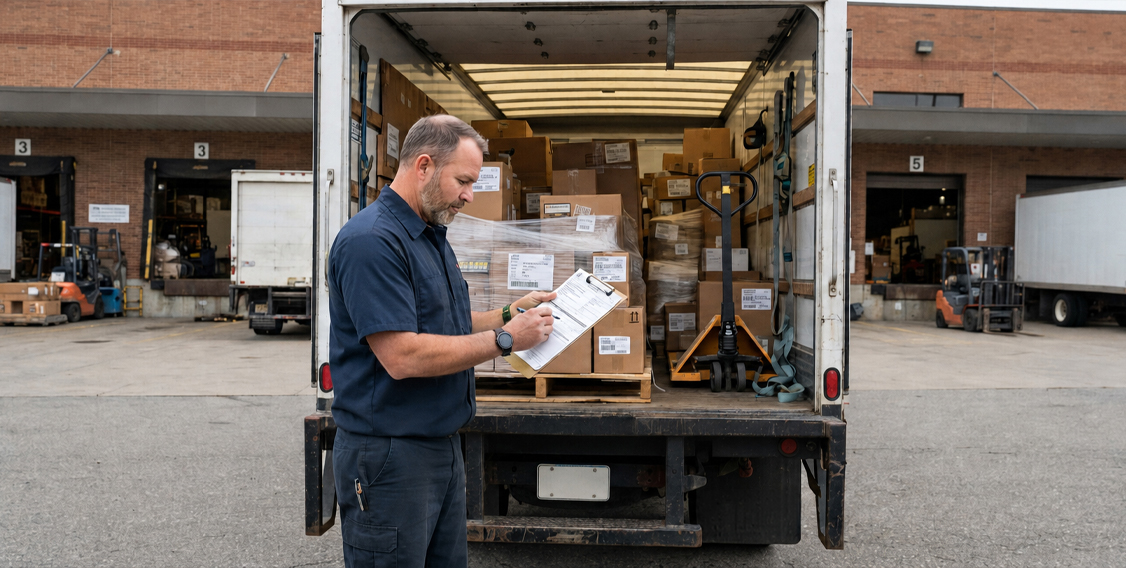
Smaller commercial vehicles can also create confusion about ELD applicability. A vehicle does not have to be a Class 8 tractor-trailer to fall within the federal commercial motor vehicle definition, and depending on the operation, a vehicle in the 10,001-to-26,000-pound range may be subject to applicable Federal Motor Carrier Safety Regulations. Whether an ELD is required depends on the driver’s record-of-duty-status requirements and whether an ELD exception applies.
Our guide on ELD requirements for box trucks looks at this exact question in more depth, covering how the commercial motor vehicle definition applies to smaller and mixed-use vehicles specifically, which is worth reading if your setup does not clearly match a typical long-haul tractor-trailer.
Mistake Comparison Table
| Mistake | What It Looks Like | Relevant Regulation | Typical Consequence |
|---|---|---|---|
| Running a removed ELD | Device still in use after being pulled from the registered list | 49 CFR 395.22(a) | Treated as operating without an ELD; driver placed out of service |
| Misjudging the short-haul exemption | Logging skipped outside the 150 air-mile CDL radius or the return-time window | 49 CFR 395.1(e)(1) | No-record-of-duty-status citation |
| Misunderstanding the 8-day ELD exception | Using the limited ELD exception after being required to prepare RODS on more than 8 days within a rolling 30-day period | 49 CFR 395.8(a)(1)(iii) | ELD compliance violation if an ELD is required and no other exception applies |
| Editing a log without the required annotation | A log correction or addition made without an annotation explaining the change | 49 CFR 395.30(c)(2) | Incomplete edit documentation and potential compliance concerns during record review |
| Missing the malfunction notification requirement | Failing to notify the motor carrier in writing within 24 hours after discovering an ELD malfunction | 49 CFR 395.34(a)(1) | Malfunction procedures not properly followed; potential HOS recordkeeping compliance issue |
| Discarding supporting documents early | Required supporting documents discarded before the six-month retention period ends | 49 CFR 395.11; 49 CFR 395.8(k)(1) | Missing required documentation during an audit or investigation |
| Not requesting review of potentially incorrect FMCSA data | Potentially incorrect inspection data left without a Request for Data Review | FMCSA DataQs process | Inaccurate record carried forward |
| Assuming a vehicle is exempt from ELD use | Running a lighter or mixed-use vehicle without checking the CMV definition | 49 CFR 390.5 | Potentially incorrect data may remain in the FMCSA record unless corrected |
Questions to Ask Yourself Before Your First Year on the Road
Is my ELD still on the FMCSA registered list?
Check the list against your device’s make and model every few months, not just when you first buy it. Devices can be removed for reasons that have nothing to do with how the hardware feels day to day, so a device that seems fine can still be off the list without any obvious sign.
Am I actually inside the short-haul exemption radius, or just close to it?
If you are not certain, log the day in full rather than guessing. A citation for a marginal exemption call costs more than the few extra minutes it takes to enter a duty status, and the radius is measured in air miles, not the miles shown on a route planner.
Have I logged every day this month, even the slow ones?
The 8-in-30 rule does not pause because a week was quiet, since the 30-day window is constantly moving rather than resetting on a calendar date. Keep the habit consistent regardless of how much driving actually happened that particular week.
What do I do the moment I notice a log needs a correction?
Use the proper ELD editing process, provide the required annotation explaining the change, and do not remove or overwrite the original record. A legitimate correction made through the proper editing process is not automatically falsification; the corrected record should accurately reflect the driver’s actual duty status and preserve a clear audit trail.
How long am I actually required to keep supporting documents?
Required supporting documents generally must be retained for six months from the date the motor carrier receives them under 49 CFR 395.8(k)(1). The carrier must also follow the supporting-document requirements in 49 CFR 395.11, including the applicable document-selection and retention rules. Records may be maintained electronically or on paper as long as they are properly retained and can be produced when required.
If my ELD malfunctions, do I know the notification timeline?
Generally 24 hours to notify your carrier under 49 CFR 395.34(a)(1). Note the time it happened and switch to paper logs if needed while the malfunction gets sorted out and a repair or replacement is arranged.
If an inspection report looks wrong, do I know how to challenge it?
The FMCSA DataQs system exists for exactly this. Filing while the details are fresh tends to produce a cleaner result than trying to reconstruct the stop from memory weeks later.
Am I certain my vehicle actually falls under the ELD requirement?
Check whether your vehicle and operation are subject to the Federal Motor Carrier Safety Regulations, and then determine whether you are required to prepare records of duty status under Part 395. A smaller or medium-duty commercial vehicle is not automatically exempt from the ELD rules, but being a commercial motor vehicle does not by itself mean an ELD is required. Applicable ELD exceptions, including the short-haul and limited 8-day exceptions, must also be considered.
Reducing driver fatigue and staying inside these rules also connects to road safety more broadly. We look at that connection in more depth in our article on how ELDs support safer roads by reducing driver fatigue, if you want the wider context.
First-Year Compliance FAQs
About ELD Rules for New Owner-Operators
Do I need an ELD if I only drive short local routes?
Whether you need an ELD depends on whether you are required to prepare records of duty status (RODS). If your operation qualifies for the short-haul exception under 49 CFR 395.1(e)(1), you may use the required motor-carrier time records instead of RODS and generally do not need an ELD for those qualifying operations. If you do not meet the short-haul conditions, determine whether another ELD exception applies.
What counts as the short-haul exemption radius?
Under 49 CFR 395.1(e)(1), the short-haul radius is 150 air miles from the driver’s normal work reporting location. An air mile is a nautical mile, so the radius is measured differently from ordinary road miles and is not based on the distance shown by a driving route. Drivers must also satisfy the other applicable short-haul requirements; staying within the 150-air-mile radius alone is not enough to qualify for the exception.
Can I use paper logs instead of an ELD?
Generally only in specific situations, such as a documented malfunction or certain exemptions. Outside of those situations, a registered ELD is required for a full and current record of duty status.
What is the 8-in-30 rule?
Under 49 CFR 395.8(a)(1)(iii), a driver who is required to prepare records of duty status (RODS) on no more than 8 days within any rolling 30-day period may qualify for the limited ELD exception. If the driver is required to prepare RODS on more than 8 days during that rolling 30-day period, the driver generally must use a compliant ELD unless another exception applies.
How do I check if my ELD is still FMCSA registered?
Check your device’s make and model against the current FMCSA registered ELD list. Devices can be removed even if the hardware still appears to work normally on the truck.
Does my vehicle actually need an ELD?
It depends on both the vehicle and the driver’s operation. A vehicle may fall within the federal commercial motor vehicle definition, but that does not automatically mean the driver must use an ELD. ELD applicability generally depends on whether the driver is required to prepare records of duty status under Part 395 and whether an exception, such as the short-haul or limited 8-day exception, applies.
About Avoiding Common First-Year Mistakes
What is the difference between a log correction and falsification?
A legitimate correction made through the ELD editing process, with the required annotation and preservation of the original data, is not automatically falsification. Falsification involves a record that does not truthfully reflect the driver’s actual duty status. A missing annotation is a separate documentation problem under 49 CFR 395.30(c)(2) and does not by itself establish falsification.
How much can a falsification citation actually cost?
Knowingly falsifying a record of duty status can result in significant civil penalties. Applicable penalties are governed by 49 CFR Part 386, including Appendix B, and maximum civil penalty amounts may be adjusted periodically for inflation. Fleets should consult the current FMCSA penalty schedule for the applicable amount.
What should I do if my ELD malfunctions on the road?
Notify the motor carrier in writing within 24 hours after discovering the malfunction, as required by 49 CFR 395.34(a)(1). If the malfunction prevents the ELD from accurately recording hours-of-service data, reconstruct the required records of duty status and continue recording duty status on paper logs or another compliant method until the ELD is back in service.
How long do I need to keep required supporting documents?
Required supporting documents generally must be retained for six months from the date the motor carrier receives them under 49 CFR 395.8(k)(1). Which documents must be retained is governed by the supporting-document requirements and selection rules in 49 CFR 395.11.
What is DataQs and when should I use it?
DataQs is FMCSA’s system for submitting a Request for Data Review (RDR) when Federal or State data maintained by FMCSA is believed to be incomplete or incorrect. The appropriate agency reviews the request and supporting information and determines whether a correction should be made.
Can medium-duty trucks be subject to ELD requirements?
Yes. Medium-duty trucks can be subject to ELD requirements depending on the vehicle, the operation, and whether the driver is required to prepare records of duty status under Part 395. A truck does not have to be a Class 8 tractor-trailer for federal motor carrier safety rules to apply, but qualifying for the federal commercial motor vehicle definition does not by itself mean an ELD is required. Applicable ELD exceptions must also be considered.
Where can I find compliant ELD hardware if I need to replace a removed device?
You can review ELD Compliance Now on our electronic logging device and hardware. It is 100% FMCSA approved and tested, backed by a 30-day money-back guarantee, and our support team is available 24 hours a day, 7 days a week if you want help matching hardware to your specific setup.
Conclusion
Most of the mistakes new owner-operators make in their first year do not come from ignoring the rules. They come from a wrong assumption made early, whether that is about a short-haul radius, a log edit that felt minor, a malfunction that seemed easy to deal with later, or a vehicle that seemed too small to fall under the ELD requirement in the first place. These requirements can be easy to misunderstand, particularly when an operation changes, an ELD is removed from FMCSA’s Registered ELDs list, or a driver moves between short-haul operations and days that require RODS.
The good news is that almost every mistake on this list can be reduced with consistent compliance habits: check your ELD against FMCSA’s Registered ELDs list, maintain the records required for your operation, track which days require RODS when relying on an ELD exception, properly annotate log edits, retain required supporting documents for the required period, and regularly verify that your vehicle and operating assumptions remain accurate. Building these steps into your routine can help prevent small compliance mistakes from becoming larger problems during an inspection or audit.
If you want to walk through your current setup or compare it against what your operation actually needs, you can reach our team to schedule a time to talk or call us at (800) 261-4361.