Key Takeaways
- FMCSA uses the terms safety audit and compliance review for different processes under 49 CFR 385.3.
- A New Entrant safety audit checks whether a carrier has basic safety management controls. It results in a pass or fail determination and does not issue a safety rating.
- Property-carrier New Entrants generally receive a safety audit within 12 months after receiving a USDOT number; passenger carriers have a 120-day timetable under the current regulation.
- A ratable compliance review or onsite investigation may produce a Satisfactory, Conditional, or Unsatisfactory safety rating.
- SMS data can prioritize a carrier for monitoring, warning letters, or investigations, but a BASIC percentile is not a federal safety rating.
- SMS uses rolling inspection and crash data, while records of duty status and their supporting documents generally must be retained for 6 months under 49 CFR 395.8(k)(1).
- Carriers should confirm that each ELD remains on FMCSA’s registered-device list and preserve access to required historical records.
- CVSA’s published 2026 International Roadcheck results reported 54,575 inspections and 146 driver out-of-service orders for ELD tampering.
| Table of contents |
|---|
| Safety Audit vs. Compliance Review |
| What Triggers Each Process |
| SMS and Investigations |
| Possible Outcomes |
| How to Prepare |
| Questions Before a Review |
| Compliance FAQs |
Introduction
A letter, phone call, or document-upload request from FMCSA can put a carrier under immediate pressure. The first step is identifying which process the agency is using, because a New Entrant safety audit and a compliance review are not the same thing.
A safety audit is part of the New Entrant program. It evaluates whether a new carrier has basic safety management controls and ends in a pass or fail determination. A compliance review is a separate examination that may investigate suspected violations, complaints, or a request to change a safety rating. A ratable review can lead to a Satisfactory, Conditional, or Unsatisfactory rating.
Both processes can involve driver qualification, hours-of-service and ELD records, vehicle maintenance, drug and alcohol testing, crash information, financial responsibility, and other applicable records. The difference is why FMCSA is reviewing the carrier and what can result.
This guide explains the distinction, how SMS information can lead to intervention, what records FMCSA may request, and how to prepare without relying on unsupported audit timelines or a single score. Our support team can also help you organize ELD records before a request arrives.
What Is a DOT Safety Audit and Why Does FMCSA Conduct One?
In FMCSA terminology, a safety audit is an examination of a New Entrant carrier’s operations that provides education and technical assistance, gathers safety data, and determines whether basic safety management controls are adequate. Under 49 CFR 385.3, it does not result in a safety rating.
A compliance review is a separate examination of carrier operations used to determine whether the carrier meets the Part 385 safety-fitness standard. It may be conducted to investigate potential violations or complaints, or in response to a request to change a rating. A ratable onsite review may produce a proposed safety rating and may also lead to enforcement.
New Entrants are monitored for 18 months. The current regulation requires a safety audit within 12 months after a property carrier receives its USDOT number and within 120 days for a passenger carrier. FMCSA may conduct the audit onsite or request records electronically.
Both reviews can cover similar records, so carriers should prepare the files actually requested rather than assuming every review has the same scope.
What Triggers a Safety Audit or Compliance Review in 2026?
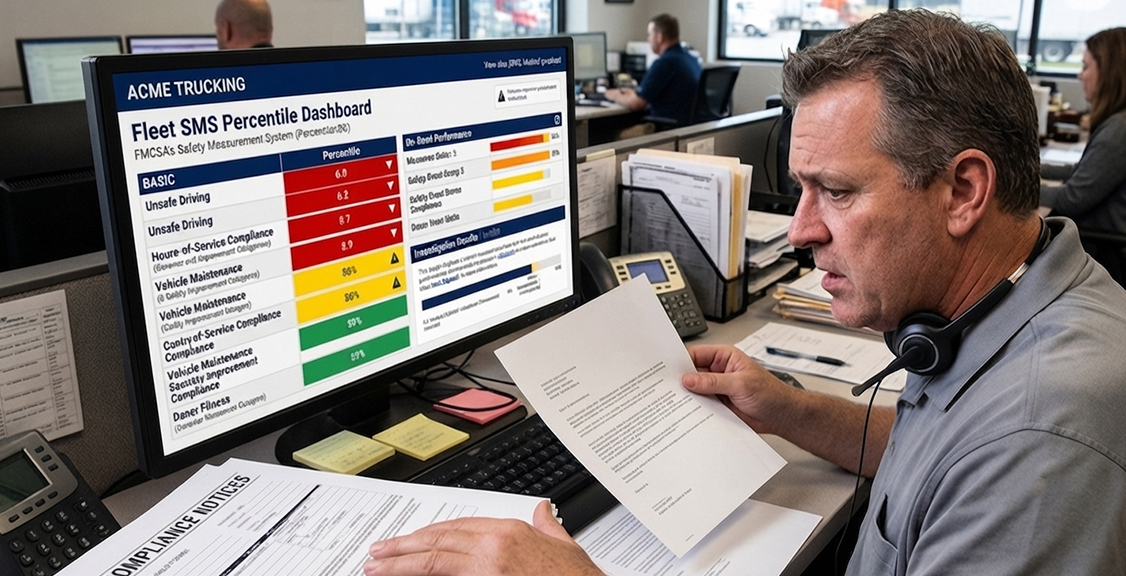
A New Entrant safety audit is a scheduled part of the New Entrant program, not a penalty triggered by one bad inspection. Compliance reviews and other investigations can arise for different reasons, including SMS prioritization, complaints, evidence of violations, or a carrier’s request to change an existing safety rating.
| FMCSA Process or Signal | Why It Happens | Published Timing | How to Prepare |
|---|---|---|---|
| New Entrant safety audit | Required review of a new interstate carrier’s basic safety management controls | Within 12 months for property carriers and 120 days for passenger carriers under 49 CFR 385.3 | Build complete driver, vehicle, testing, insurance, and HOS files from the start |
| SMS prioritization | A BASIC reaches its applicable intervention threshold or an investigation finds an Acute or Critical Violation | FMCSA does not publish a guaranteed investigation date | Review the carrier’s SMS data and correct underlying safety problems |
| Complaint or other evidence | FMCSA receives information indicating possible safety violations | No universal public timetable | Preserve responsive records and answer official correspondence promptly |
| Crash and inspection history | Rolling crash, inspection, and violation data contribute to SMS prioritization | SMS is updated periodically; prioritization does not guarantee a review | Review trends, investigate causes, and document corrective actions |
| Request to change a safety rating | A carrier submits evidence of corrective action under 49 CFR 385.17 | Depends on FMCSA’s evaluation and whether another review is needed | Submit specific corrective evidence, not only a general improvement plan |
Connecting ELD and vehicle-maintenance records can help a carrier identify recurring problems before FMCSA does. Our ELD and DVIR integration guide explains how those records can be reviewed together.
How Does Your SMS Score Factor Into Whether You Get Audited?
SMS is a prioritization system, not a federal safety rating. FMCSA uses inspection, violation, crash, and investigation data to identify carriers for interventions such as warning letters, monitoring, and investigations. The system generally evaluates 24 months of on-road performance, while recent Acute and Critical Violations from investigations can also affect prioritization.
There is no single universal percentile that guarantees a compliance review. FMCSA publishes different BASIC intervention thresholds by safety category and carrier type. Reaching a threshold means a carrier may be prioritized; it does not mean that FMCSA has assigned a safety rating or scheduled an investigation for a specific date.
Use the FMCSA Safety Measurement System to review the carrier’s current data and the events driving each BASIC. Because SMS is updated periodically and older events lose weight or age out, monthly review is more useful than treating it as a live score.
If the data is wrong, use the FMCSA DataQs system with supporting evidence. If the data is accurate, correct the underlying safety practice and document the action. For HOS compliance, retain records of duty status and supporting documents for 6 months as required by 49 CFR 395.8(k)(1).
What Are the Possible Outcomes After an FMCSA Review?
The outcome depends on the process.
A New Entrant safety audit results in pass or fail, not a Satisfactory, Conditional, or Unsatisfactory rating. Under 49 CFR 385.319, most failed New Entrants have 60 days from the notice to take the specified corrective actions. Passenger carriers and the covered hazardous-materials carriers listed in that section have 45 days. Failure to correct can lead to revocation of New Entrant registration and an out-of-service order.
A ratable compliance review or onsite investigation may result in a proposed Satisfactory, Conditional, or Unsatisfactory safety rating. Conditional means the carrier lacks adequate safety management controls. Unsatisfactory means the controls are inadequate to the degree described in Part 385 and can lead to a prohibition on operations after the applicable notice and effective period.
A carrier seeking a better rating must request a change under 49 CFR 385.17 and provide evidence that corrective actions are effective. A rating does not change automatically when a plan is submitted.
The current federal safety rating, if any, is publicly available through the SAFER Company Snapshot. SAFER displays the current rating rather than a public history of every prior rating.
How Do You Get Ahead of an Audit Before It Ever Happens?
The best preparation starts with identifying the process named in FMCSA’s notice and producing the records requested. Do not assume a New Entrant safety audit, a focused investigation, and a ratable compliance review have identical scope or outcomes.
Keep driver qualification, drug and alcohol testing, vehicle inspection and maintenance, crash, financial-responsibility, HOS, and ELD records organized for the retention period that applies to each record type. The 6-month rule in 49 CFR 395.8(k)(1) applies to records of duty status and supporting documents; other files have different retention requirements.
Confirm each device is still shown on FMCSA’s registered ELD list and check the revoked-device list and any notice-specific replacement deadline. A change in registration status does not erase the carrier’s duty to preserve and produce required historical records.
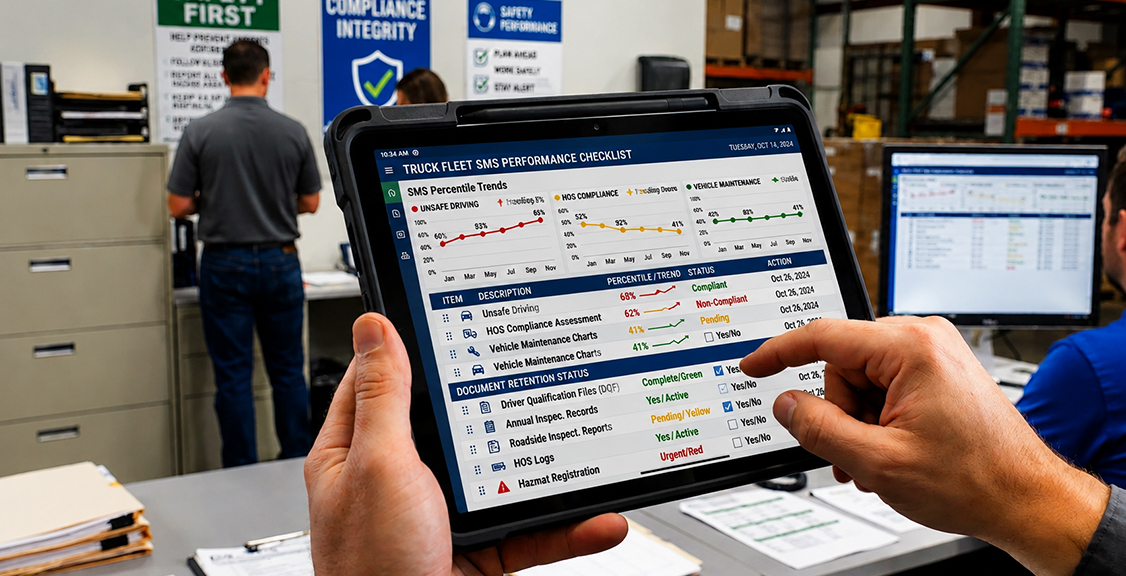
Review SMS monthly, investigate recurring violations, challenge inaccurate data through DataQs, and document corrective actions with dates and supporting evidence. Those records are more useful than a last-minute checklist after a notice arrives.
Questions to Ask Before Your Next Audit or Compliance Review
How do I know if my SMS percentile puts me at risk for an investigation?
Compare each BASIC with the intervention threshold for your carrier type in the current SMS methodology. A warning symbol means FMCSA may prioritize the carrier for intervention, but it does not guarantee an investigation or create a federal safety rating.
What documents should I keep ready?
Keep the records applicable to your operation organized, including driver qualification, HOS and ELD data, drug and alcohol testing, vehicle maintenance and inspection, crash, and financial-responsibility records. Apply the correct retention period to each category rather than assuming every record uses the 6-month HOS rule.
Should I hire a compliance consultant or prepare with my back office?
That depends on the scope of the notice, the carrier’s record quality, and the team’s experience. Outside help can be useful for a first review or a complicated corrective-action request, but the carrier remains responsible for accurate records and compliance.
Does one BASIC at an intervention threshold guarantee an investigation?
No. It can make the carrier eligible for prioritization, but FMCSA considers available safety data and enforcement resources. Correct the underlying issue even when no investigation has been scheduled.
Does switching ELD providers before a review create additional risk?
It can if the carrier loses access to required historical logs, edit histories, or supporting documents. Confirm the migration and retention plan before switching, and keep the prior records accessible for the full required period.
What should I do if I find a violation before FMCSA does?
Correct the condition, preserve the original record, and document what happened, when it was found, and what action was taken. Self-correction does not erase a violation or guarantee a particular enforcement outcome, but accurate corrective evidence is important.
How do I know whether my ELD is still registered?
Check the exact device model on FMCSA’s registered and revoked ELD lists. Registration status can change, so do not rely only on the status shown when the device was purchased.
What should I ask an ELD provider about review support?
Ask whether historical logs, edits, unidentified-driving records, malfunction records, and exports can be produced promptly, and whether support is available when FMCSA requests data.
DOT Safety Audit and Compliance Review FAQs
About DOT Safety Audits and Ratings
How long does a DOT safety audit usually take?
FMCSA does not publish one completion length for every audit. The time depends on whether the audit is onsite or electronic, the carrier’s size and operation, the records requested, and whether the submission is complete.
Can a small fleet be audited under the same rules as a large one?
Yes. The applicable safety requirements do not disappear for a small fleet, although the number of drivers, vehicles, and records can affect the scope and time needed.
What is the difference between a compliance review and a roadside inspection?
A roadside inspection examines a particular vehicle, driver, and trip. A compliance review examines the carrier’s management controls and records; a ratable onsite review can lead to a proposed safety rating.
Does a Conditional rating mean my carrier has to stop operating?
Not for every carrier. A Conditional rating is different from an Unsatisfactory rating, but passenger and certain hazardous-materials operations can face additional restrictions. Always follow the rating notice and the rules that apply to the operation.
Can a Conditional or Unsatisfactory rating affect insurance premiums?
It can. Insurers make their own underwriting decisions and may consider the carrier’s current safety rating, violations, crashes, and corrective actions.
Are federal motor-carrier safety ratings public?
Yes. The current rating, if any, is available through FMCSA’s SAFER Company Snapshot. SAFER does not present a public history of every prior rating.
Does a good SMS result guarantee that I will not be investigated?
No. SMS helps FMCSA prioritize interventions, but complaints, crashes, investigation findings, and other evidence can also lead to agency attention.
ELD Audit Preparation FAQs
What ELD records may an investigator request?
The request can include records of duty status, edits and annotations, unidentified-driving records, supporting documents, data-transfer files, malfunction records, and evidence that required records were retained.
How soon does a rating change after corrective action?
It does not change automatically. A safety-rating upgrade follows the request and evidence process in 49 CFR 385.17, and FMCSA may require additional information or another review. A failed New Entrant audit uses the separate 45- or 60-day corrective-action deadlines in 49 CFR 385.319.
What should my back office review each month?
Review SMS data and source inspections, HOS and ELD exceptions, unidentified driving, maintenance and DVIR trends, driver-file expirations, ELD registration status, and whether corrective actions were completed.
How can I challenge an inaccurate violation?
Drivers and carriers can submit a Request for Data Review through the FMCSA DataQs system with documentation supporting the correction.
Does a strong safety record reduce roadside-inspection selection?
Safety data can affect how carriers are prioritized for some enforcement activity, but it does not guarantee that a particular vehicle or driver will avoid a roadside inspection.
Conclusion
A DOT safety audit and a compliance review can examine many of the same records, but they are not interchangeable. New Entrant safety audits are pass/fail reviews and do not issue safety ratings. Ratable compliance reviews or onsite investigations can produce Satisfactory, Conditional, or Unsatisfactory ratings.
The practical response is the same at the start: read the notice carefully, identify the process, preserve the requested records, and correct verified problems without rewriting history. Review SMS and source inspection data regularly, keep required files accessible, and confirm that every ELD remains registered.
CVSA’s 2026 International Roadcheck results also reinforce the importance of accurate ELD records: inspectors reported 146 driver out-of-service orders for ELD tampering. That result does not mean every transfer problem or record error is tampering, but it shows why documented controls matter.
If you are not confident your driver files, SMS data, and ELD records would stand up to an FMCSA review, reach out through our contact form or call (800) 261-4361.