Key Takeaways
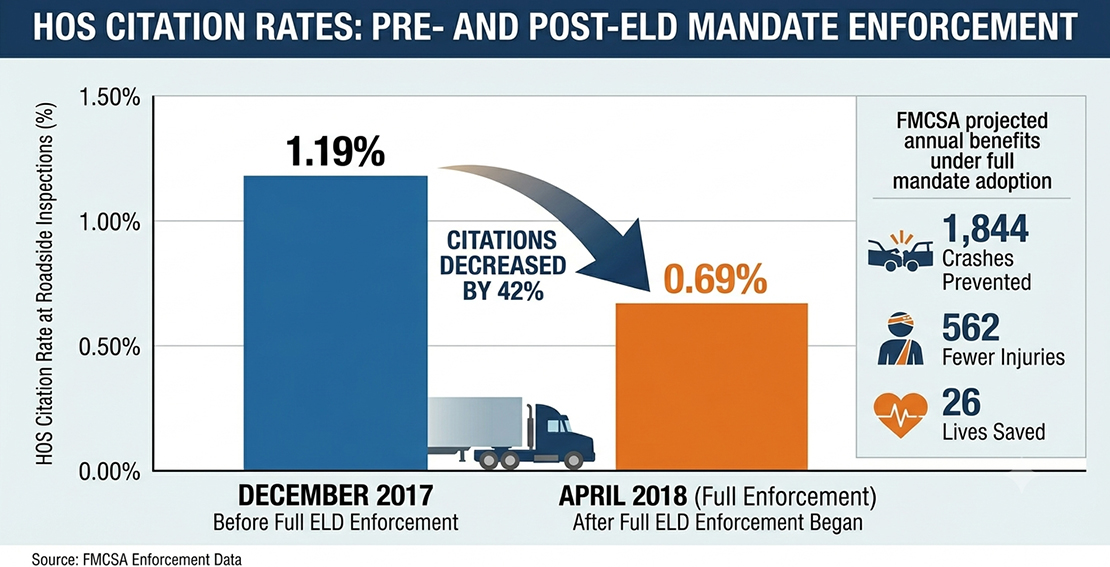
- FMCSA’s ELD final rule estimated that full adoption would avoid 1,844 crashes, prevent 562 injuries, and save 26 lives annually. These are modeled benefits, not a count of observed outcomes.
- ELDs support driver safety by recording driving time automatically, helping fleets identify HOS problems and making records easier to review during inspections.
- CVSA’s final 2026 International Roadcheck results included 146 out-of-service orders for ELD tampering, representing 3.7% of driver out-of-service violations.
- FMCSA’s registered ELD list is based on provider self-certification. Fleets should verify the exact model regularly and follow the transition deadline in any device-specific removal notice.
- A compliant ELD must support at least one complete roadside transfer option: telematics through web services and email, or local transfer through USB and Bluetooth.
- Accurate HOS records can improve compliance oversight, but an ELD does not replace driver training, scheduling controls, record review, or fatigue-risk management.
- During an ELD malfunction, the driver must provide written notice within 24 hours, reconstruct unavailable records, and continue compliant manual records until the device is restored.
Introduction
Fatigue risk cannot be managed by technology alone, but accurate driving-time records give drivers and carriers a clearer view of when legal limits are approaching. ELDs automatically capture vehicle movement and required record data, making it harder for driving time to disappear from a log and easier for a fleet to review records before a roadside inspection.
FMCSA’s ELD final rule estimated substantial annual safety benefits at full adoption, including 1,844 avoided crashes, 562 prevented injuries, and 26 lives saved. Those figures are projections from the rule’s analysis, not a later count of crashes prevented. Current enforcement results still show why accurate use matters: CVSA reported 146 driver out-of-service orders for ELD tampering during the 2026 International Roadcheck.
What Does the Safety Data Say About ELDs and Crash Prevention?
FMCSA reported that hours-of-service violations fell sharply after the ELD rollout, while the agency’s final-rule analysis estimated broader safety benefits from improved HOS compliance. An ELD automatically records driving time and other required data, giving fleets and enforcement personnel a more consistent record to review. That does not prove that every ELD installation prevents a crash, and it does not replace safe scheduling or driver judgment.
At full adoption, FMCSA estimated 1,844 crashes avoided, 562 injuries prevented, and 26 lives saved each year. The appropriate way to use these figures is as modeled regulatory benefits, not observed annual totals.
What This Means for Your Fleet
A clean HOS record is one useful indicator of compliance, but it does not by itself prove that every driver is rested or that every safety risk is controlled. Fleets still need realistic dispatch plans, driver training, prompt review of unidentified driving and edits, and a process for addressing fatigue concerns. Shippers, brokers, insurers, and regulators may also review carrier safety information when making decisions. For a deeper look at how this connects to road safety outcomes, see our article on how ELDs reduce fatigue and improve compliance.
Why Do HOS Violations Still Occur With ELDs?
ELDs improve the consistency of driving-time records, but they do not prevent every HOS violation. Problems still arise when fleets use removed devices, drivers misunderstand personal conveyance or yard-move rules, unidentified driving remains unresolved, records are not certified, or dispatch plans exceed the hours legally available.
A removed device can create a compliance problem after the transition period stated in the applicable FMCSA notice. Misused special driving categories and unresolved unidentified-driving events can also create inaccurate records. In other cases, the ELD records an HOS violation correctly, but the carrier does not identify and address the pattern before an inspection.
What the Penalties Look Like
Civil penalties depend on the violation, the responsible party, and the current inflation-adjusted penalty schedule. Because those maximum amounts can change, fleets should consult the current 49 CFR part 386 penalty schedule rather than rely on a fixed dollar figure in a buying guide. Repeated or serious violations can also increase enforcement attention and operational disruption.
What Is ELD Tampering and Why Did CVSA Focus on It in 2026?
ELD tampering includes altering, obscuring, falsifying, interfering with, or reengineering ELD data to hide hours-of-service violations. CVSA made ELD tampering, falsification, and manipulation the driver focus of the 2026 International Roadcheck. In the final results, inspectors issued 146 out-of-service orders for ELD tampering, equal to 3.7% of driver out-of-service violations. Overall, 94.2% of inspected drivers and 81% of inspected vehicles had no out-of-service violations.
How Inspectors Detect Tampering
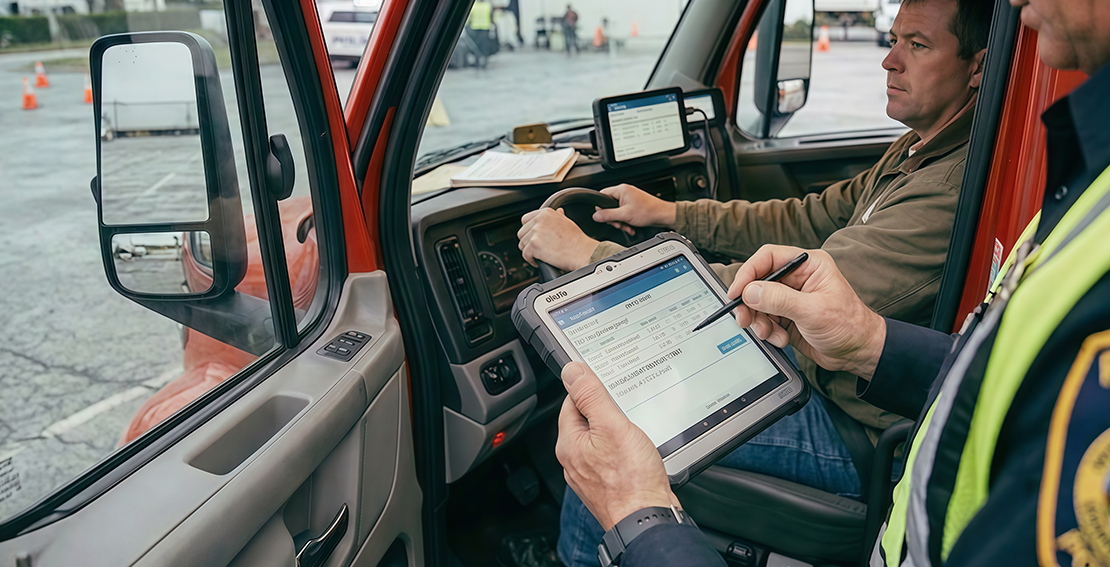
Inspectors can compare the ELD record with vehicle data, unidentified-driving events, annotations, and supporting documents. A discrepancy does not automatically establish intentional falsification, but it can prompt closer review. Drivers and carriers should correct inaccurate records through permitted edits and annotations while preserving the original record. For guidance on what a legitimate edit looks like, FMCSA guidance on ELD editing sets out exactly what is and is not permitted.
What a Falsification Finding Means for Your Fleet
A falsification finding on a driver’s record is treated as a serious safety violation, not a paperwork error. A driver manipulating logs to hide fatigue is a liability every time they are on the road. A pattern of such findings across your fleet can trigger a compliance review under FMCSA safety fitness procedures, which is covered in the SMS section below.
How Do the Recent ELD Device Removals Affect Your Fleet?
A motor carrier that is required to use an ELD must use a model on the FMCSA registered ELD list. The list is based on provider self-certification, and FMCSA can remove devices that fail to meet minimum requirements. On August 6, 2026, FMCSA announced the removal of five devices and directed affected carriers to replace them before October 6, 2026. Check the notice for the exact model and deadline that apply to your fleet.
What Happens After the Grace Period Ends
A removal notice sets the transition date for the affected devices. After that date, continued use can result in a citation under the ELD requirements and an out-of-service order under applicable enforcement criteria. Do not assume that every future notice will use the same transition period; follow the dates in the notice for your model.
Why Checking the Registered List Is an Ongoing Task
Registration status can change after a purchase. Assign someone to check the exact model on a regular schedule, subscribe to FMCSA ELD updates, preserve access to historical records, and document the fleet’s replacement plan. Registration means the provider self-certified the device; it is not an FMCSA endorsement.
How Do Your ELD Records Connect to Your SMS Score and Safety Rating?
The FMCSA Safety Measurement System pulls from roadside inspection data, crash reports, and investigation findings. Applicable HOS violations from roadside inspections and investigations can affect the carrier’s Hours-of-Service Compliance BASIC in SMS. Severity, recency, exposure, and other methodology factors influence the measure, so a violation is not a simple one-for-one change in a public score.
When Does an SMS Score Become a Bigger Problem
SMS results do not by themselves change a carrier’s federal safety rating. They are prioritization data that FMCSA may use when deciding where to focus interventions. A formal safety rating follows the applicable safety-fitness process, and a carrier rated Unsatisfactory may not continue interstate operations after the rating becomes final.
How to Challenge a Violation That Looks Wrong
If a violation on your record appears to be an error, the FMCSA DataQs system lets carriers and drivers formally request a review by the state that recorded it. Good ELD records give you the documentation to support that request. Running clean means both avoiding violations and being able to dispute the ones that should not be there.
What Does a Roadside ELD Inspection Actually Check?
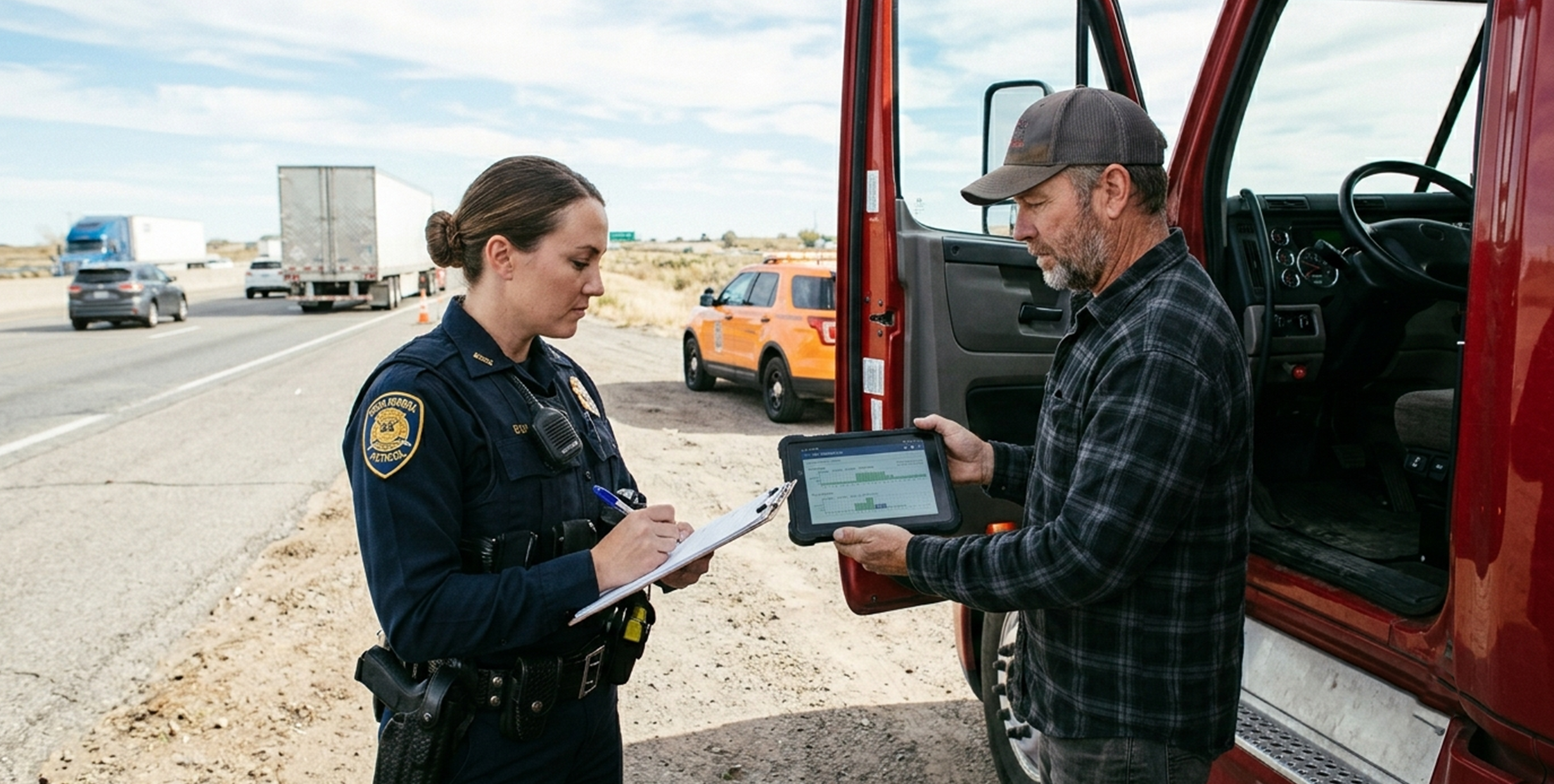
During a roadside inspection, an officer may review the driver’s current day and previous seven days of records, confirm the ELD model is registered, review unidentified driving and annotations, and request the supported transfer method. A portable ELD must be mounted in a fixed position and visible to the driver while the vehicle is operating.
What Your Driver Needs to Have Ready
The driver should know how to display or transfer the current 24-hour period and the previous seven consecutive days. Under 49 CFR 395.22(h), the vehicle must carry data-transfer instructions, malfunction and recordkeeping instructions, and enough blank graph-grid records of duty status for at least eight days.
Where Enforcement Is Heading
Enforcement continues to use electronic records and data-transfer tools to review HOS compliance efficiently. Accurate records, resolved unidentified-driving events, appropriate annotations, and trained drivers remain the best preparation for any inspection format.
How Does a Compliant Fleet Compare to a Non-Compliant One?
The gap between a compliant fleet and a non-compliant one shows up in inspection histories, SMS results, enforcement exposure, and business relationships.
| Factor | Compliant Fleet | Non-Compliant Fleet |
|---|---|---|
| Device registration | Current, verified regularly against the FMCSA registered list | Risk of running a removed device past the replacement deadline |
| HOS SMS score | Low, reflecting a clean inspection history | Elevated, drawing FMCSA investigator attention |
| Roadside inspection risk | Lower out-of-service probability | Higher probability of citation and OOS order |
| Fines exposure | Kept low through accurate records | Exposure under the current 49 CFR part 386 penalty schedule |
| Driver records | Accurate, certified, and properly annotated | Risk of falsification findings on the driver’s CDL record |
| Shipper and broker trust | High, based on publicly visible safety data | Reduced, because SMS scores are visible to anyone who checks |
| ELD malfunction response | Paper logs carried, carrier notified within required timeframe | No fallback plan, likely inspection failure |
What Questions Should You Ask Your ELD Provider?
These are the questions to ask any vendor before committing, so you can compare answers and make an informed decision.
How will you notify me if your device is at risk of being removed from the FMCSA registered list?
Ask how the provider alerts customers to a possible removal, how quickly it can supply a replacement, and how the fleet will export and retain required historical records. Compare that answer with the transition process in recent FMCSA removal notices.
How does your system surface unassigned driving for back office review?
Unassigned driving is one of the most common sources of inspection findings. Before you sign up, ask a provider to walk you through exactly how unassigned segments appear in the back office, what the process looks like for assigning or rejecting them, and what record is kept of each decision.
What data transfer methods does the device support at a roadside stop?
A compliant ELD must support at least one complete option: telematics using web services and email, or local transfer using USB and Bluetooth. Confirm which complete option the device supports and ask whether drivers receive any training on using them before their first inspection.
What is your response process when a device malfunctions on the road?
Under 49 CFR 395.34, the driver must note the malfunction, notify the carrier in writing within 24 hours, reconstruct the current day and previous seven days if those records are unavailable, and continue compliant manual records. The carrier generally has eight days from discovery or driver notification, whichever occurs first, to correct the malfunction. Ask each provider how quickly they can get a replacement device to a driver who is already out on a run, and what support they offer during that window.
How does your platform manage the transition when a driver moves outside short-haul exemption limits?
Under 49 CFR 395.1(e)(1), a driver who meets every condition of the 150-air-mile short-haul exception is exempt from the records-of-duty-status requirements in §§ 395.8 and 395.11 for that day. If any condition is not met, the driver must complete the required record of duty status; whether an ELD is required also depends on the limited-use exception in § 395.8(a)(1)(ii)(A)(1). Ask how the platform identifies days when the exception no longer applies and helps the driver create the required record without losing prior time-record data.
Do you supply the in-vehicle information packet, or is that left to the carrier?
The motor carrier must ensure that the information required by 49 CFR 395.22(h) is onboard the vehicle, including transfer instructions, malfunction instructions, and at least eight days of blank graph-grid records. Ask whether the provider includes it as standard or whether sourcing it falls to you.
ELD Compliance Questions
Regulatory questions about HOS rules, inspections, violations, and record requirements. These answers apply regardless of which ELD provider you use.
What counts as ELD tampering under FMCSA rules?
Tampering includes deliberately altering, obscuring, falsifying, interfering with, or reengineering ELD data to hide hours-of-service violations. False records can lead to citations, out-of-service consequences, and civil penalties under the current enforcement and penalty rules.
Can a driver use paper logs if the ELD malfunctions?
Under 49 CFR 395.34, the driver must note the malfunction, notify the carrier in writing within 24 hours, reconstruct unavailable records for the current day and previous seven days, and continue compliant manual records until the ELD is restored. The vehicle’s information packet must include at least eight days of blank graph-grid records.
Do HOS violations affect a carrier’s safety rating?
Yes, indirectly. Each violation feeds into the HOS compliance category of the FMCSA Safety Measurement System, increasing the carrier’s visibility to investigators and reducing attractiveness to shippers and brokers who check safety data. A sustained pattern of serious violations can lead to a formal compliance review and a safety rating change.
What is the short-haul CDL exemption?
Under 49 CFR 395.1(e)(1), a driver is exempt from §§ 395.8 and 395.11 when every condition is met, including operating within a 150-air-mile radius, returning to the normal work reporting location, being released within 14 consecutive hours, receiving the required off-duty period, and having the carrier maintain the required time records. If a condition is missed, a record of duty status is required for that day; an ELD may still be unnecessary if another ELD exception applies.
What does CVSA check during an ELD inspection?
Inspectors may verify the exact model’s registration, review the current day and previous seven days, examine unidentified-driving events and annotations, and request a supported data transfer. The 2026 Roadcheck placed special emphasis on ELD tampering, falsification, and manipulation.
How long must carriers keep ELD records?
Six months, under 49 CFR 395.8(k)(1). That includes supporting documents such as bills of lading, fuel receipts, and dispatch records connected to a driver’s hours of service. All records must be available for inspection on request.
What should I do if a violation on my record looks like an error?
File a challenge through the FMCSA DataQs system. The state that recorded the violation reviews it, and if it was entered in error, it is corrected. Your ELD records are the primary evidence, so the more detailed and accurate they are, the stronger your challenge.
What is the grace period after a device is removed from the registered list?
The applicable FMCSA removal notice states the replacement deadline for the affected models. After that transition date, continued use can lead to a citation and an out-of-service order. Always follow the current notice rather than assuming a universal grace period.
Provider Questions
If you have questions about how our ELD platform works, the answers below cover the most common ones.
Is your ELD on the FMCSA registered list?
Confirm the exact Geosavi device model and version on the FMCSA registered list before deployment and continue checking its status afterward.
How do you notify carriers if your device is at risk of removal?
Ask the Geosavi team to explain its customer-notification, replacement, and data-export process for any future registration issue, and subscribe to FMCSA ELD updates independently.
What engine connections do you support?
Geosavi offers connection options for J1939, J1708, and OBD-II applications. Confirm the correct cable and compatibility for each vehicle make, model, year, and engine configuration, and request the current environmental and durability specifications before deployment.
What happens if my driver needs help at a roadside inspection?
Our technical support team is available around the clock, every day. Your driver can call us at any hour. We also include the full in-vehicle information packet required under 49 CFR 395.22(h) with every setup, so your driver has everything they need in the cab.
Do you offer a trial period?
Every unit comes with a 30-day money-back guarantee. If the platform does not work for your fleet in the first 30 days, you can return it. Use our price calculator to get a quote based on your fleet size.
How does your platform handle short-haul exemption tracking?
Ask the Geosavi team to demonstrate how the platform displays short-haul status, exceptions, and days when a record of duty status is required. The carrier remains responsible for applying the correct exception and maintaining the required time records.
How does your platform handle ELD edits and annotations?
The platform supports edits and annotations while preserving the original record. Under 49 CFR 395.30, carrier-proposed edits require the driver’s confirmation or rejection, and the driver must recertify the record after an accepted change.
Does your ELD work with DVIR?
Yes, and for more on how our ELD and driver vehicle inspection records work together, see our post on ELD and DVIR integration.
Conclusion
ELDs have changed how driving time is recorded and reviewed, but the safety benefit depends on accurate use, realistic scheduling, timely record review, and driver training. A device can make HOS problems visible; it cannot by itself prevent fatigue, correct a poor dispatch plan, or resolve inaccurate records.
The final 2026 International Roadcheck results show that most inspected drivers and vehicles had no out-of-service violations, while 146 ELD-tampering out-of-service orders underscored the continuing need for accurate logs. Fleets are better prepared when they verify device registration, resolve unidentified driving, review annotations, train drivers on transfers, and maintain a written malfunction process.
If you want to talk through where your fleet stands, contact us and our team will walk you through your options. You can also visit our ELD platform to see everything we offer before you get in touch.