Key Takeaways
- HOS violations rose from 410,000 in 2023 to more than 500,000 in 2025, according to RigDig data cited by Overdrive in April 2026, making hours-of-service compliance the most tracked KPI in fleet management.
- FMCSA can fine motor carriers up to $19,246 per HOS violation and drivers up to $4,812 per violation under the FMCSA penalty schedule; these are maximum civil penalty amounts adjusted annually for inflation.
- 67 ELD devices have been removed from the FMCSA registered ELD list since January 2025, confirmed by FMCSA Administrator Derek Barrs on May 7, 2026, making device verification a live concern for every fleet manager right now.
- CVSA International Roadcheck ran May 12 to 14, 2026, with ELD tampering and log integrity as the primary focus, according to CVSA.
- 58,382 falsification violations were recorded nationally in 2024, according to CVSA annual data, showing the scale of the log accuracy problem fleet managers must watch inside their own operations.
- FMCSA’s Safety Measurement System tracks HOS violations as part of your fleet’s compliance record, and repeated citations can trigger a compliance review regardless of fleet size, according to FMCSA.
- The DVIR requirement under 49 CFR 396.11 makes vehicle condition reporting a daily compliance task that sits directly under fleet manager oversight.
- Level VIII electronic inspections are expanding nationwide in 2026, according to FMCSA, adding a new layer of data scrutiny that fleet managers must prepare for beyond the physical roadside stop.
Introduction
If you ask most drivers what fleet managers care about, the answer you get back is usually everything. That answer is not wrong, the fleet manager role sits at the intersection of federal compliance, daily operations, driver safety, and cost control. In 2026, each of those areas carries more weight than it did two years ago.
The compliance side alone has expanded. HOS violations nationally rose from 410,000 in 2023 to more than 500,000 in 2025, according to RigDig data cited by Overdrive in April 2026. CVSA ran its 2026 International Roadcheck on May 12 to 14, with ELD tampering and log integrity as the stated focus. FMCSA has removed 67 ELD devices from its registered list since January 2025. Each of these developments lands on the fleet manager’s desk, not the driver’s, because the regulatory and financial consequences trace back to the carrier on record.
At the same time, fleet managers are watching driver behavior, tracking vehicle maintenance schedules, working with dispatchers to build legal runs, and keeping an eye on the CSA scores that follow your fleet through every inspection and enforcement contact. Getting any one of these wrong costs money. Getting several wrong at once can cost your operating authority.
This article walks through the specific priorities, KPIs, and daily concerns that occupy fleet managers in 2026. Whether you are building out your back office for the first time or trying to understand what your compliance team needs to do its job well, this is a practical breakdown of what good fleet management looks like on the ground.
What Is the Most Important Thing Fleet Managers Focus On Every Day?
Hours-of-service compliance is the most consistent daily priority for fleet managers, because an HOS violation is both immediate and cumulative. It produces a roadside citation, a fine, and a mark on your SMS record that can follow your fleet into a compliance review.
The scale of the problem explains why it ranks first. HOS violations nationally rose from 410,000 in 2023 to more than 500,000 in 2025, according to RigDig data cited by Overdrive in April 2026. FMCSA can fine motor carriers up to $19,246 per HOS violation and drivers up to $4,812, under the FMCSA penalty schedule. These are maximum civil penalty amounts adjusted annually for inflation. For a fleet running multiple trucks, a single bad compliance week can translate into fine exposure that no back office wants to absorb.
What makes HOS so demanding for fleet managers is that it requires active management, not just monitoring. Drivers have 11 hours of driving time, a 14-hour on-duty window, and a 30-minute break requirement under 49 CFR Part 395. The 60- or 70-hour weekly limit under 49 CFR 395.3(b) resets only with proper off-duty time. Fleet managers must watch all of this across every truck in the fleet, every day, in real time. When a driver is close to the limit, and a load is still on the truck, the fleet manager is the one who decides whether the run is legal and who carries the liability when it is not.
Your ELD platform is the tool that makes this manageable. An ELD records hours automatically and makes the current duty status visible without a phone call to the driver. Fleet managers who try to track this manually across more than a few trucks quickly find that spreadsheets and paper do not keep up with live driving data.

How Do Fleet Managers Track and Protect Their CSA Score?
Fleet managers treat CSA scores as a long-term reputation metric that affects insurance rates, shipper relationships, and FMCSA’s decision to open a compliance review. Every roadside inspection and every citation feeds directly into your fleet’s Safety Measurement System record.
FMCSA’s Safety Measurement System tracks HOS violations as part of your compliance record, and repeated citations can trigger a compliance review regardless of fleet size, according to FMCSA. Fleet managers who understand this do not wait for a bad inspection to appear in the data. They look at the inspection pattern before that happens, checking which drivers are getting flagged, which routes are generating the most contacts, and whether any open violations are sitting unresolved.
The HOS BASIC inside SMS draws the most attention from fleet managers because it is where the highest volume of violations lands. The intervention threshold for the HOS BASIC sits at the 65th percentile, lower than the 80th percentile that applies to most other categories, according to FMCSA data. That tighter threshold means it takes fewer violations to draw enforcement attention in this category than in others. Fleet managers also watch the vehicle maintenance BASIC, which picks up DVIR failures and out-of-service equipment, and the driver fitness BASIC, which now includes English proficiency citations under 49 CFR 391.11(b)(2), active since June 25, 2025. A fleet that lets maintenance violations pile up alongside HOS violations is putting two BASIC categories at risk at the same time.
The practical step fleet managers take is to keep inspection records clean before they become SMS entries. When a driver passes a Level I inspection with zero violations, that clean inspection posts to the SMS record and helps offset prior citations over time. Fleet managers who brief drivers on inspection procedures, make sure DVIRs are completed daily under 49 CFR 396.11, and check that every truck on the road carries a current ELD information packet under 49 CFR 395.22(h) are managing the CSA score at the source rather than reacting after the fact.
What Do Fleet Managers Need to Know About ELD Compliance in 2026?
Fleet managers need to know that ELD compliance is not a one-time setup task. It requires ongoing verification that every device in the fleet is on the current FMCSA-registered ELD list and functioning correctly. A device that was compliant last year may not be compliant today.
67 ELD devices have been removed from the FMCSA-registered ELD list since January 2025, confirmed by FMCSA Administrator Derek Barrs on May 7, 2026. Safe ELD and MyLogs ELD were removed on May 7, 2026. Carriers using those specific devices have until July 7, 2026 to replace them. FMCSA gives carriers 60 days from each removal announcement before enforcement begins. After that grace period, an officer can cite a driver under 49 CFR 395.8(a)(1) for no record of duty status and issue an immediate out-of-service order.
The fleet manager’s job is to check every device against the current registered list before a removal enforcement deadline arrives, not after. That means checking the list periodically, not once at installation and never again. It also means having a replacement process ready. When a device is removed from the list, carriers who already have a backup device on hand can swap without a service gap. Carriers who have to shop for a new device during the 60-day window are working against the clock.
Beyond the registered list, fleet managers are responsible for ELD malfunction handling. When a device malfunctions, the driver must notify the carrier under 49 CFR 395.34(a)(1). The carrier then has a fixed deadline to repair or replace the device under 49 CFR 395.34(d)(1). Fleet managers who do not have a malfunction response process in place can find themselves out of compliance during the repair window. You can browse current ELD options to make sure your fleet has a replacement path ready if a device goes down or gets pulled from the registered list.
How Do Fleet Managers Handle Log Accuracy and Falsification Risk?
Fleet managers handle log accuracy by treating every edit, exception, and annotation in the ELD record as something that may be reviewed during an inspection or audit. An inaccurate log, even one that was not intentionally falsified, creates exposure.
58,382 falsification violations were recorded nationally in 2024, according to CVSA annual data. Knowing falsification of records carries a maximum penalty of $15,846 per entry under the FMCSA penalty schedule, a maximum civil penalty amount adjusted annually for inflation. CVSA’s 2026 International Roadcheck, which ran May 12 to 14, focused on ELD tampering and log integrity, showing that inspectors are actively looking for the kind of record manipulation that fleet managers are supposed to prevent internally.
Fleet managers who take log accuracy seriously check ELD records for patterns that do not match the actual route: driving time that does not match expected mileage, off-duty entries that cover hours when the truck was clearly running, or missing supporting documents that 49 CFR 395.8(k) requires carriers to retain. Supporting documents must be kept for at least six months under 49 CFR 395.8(k)(1). You can review the ELD technical standard under Appendix A to Subpart B of Part 395 to understand exactly what an ELD must capture and retain.
The fleet manager also sets the tone for how drivers interact with the ELD. When drivers understand that the log is a legal record, not a form to be adjusted for convenience, the culture inside the fleet reflects that. Fleet managers who treat log accuracy as a driver training issue, rather than just a technology issue, tend to have cleaner inspection records over time. If your drivers or your back office have questions about how your ELD records work, the Geosavi support team can walk through the specific functions your device uses for log edits and annotations.
What Role Does the DVIR Play in a Fleet Manager’s Responsibilities?
The DVIR is a daily compliance requirement, and fleet managers are the ones accountable when it does not happen. A driver who completes a trip without filing a Driver Vehicle Inspection Report under 49 CFR 396.11 is leaving your fleet exposed to a maintenance BASIC citation.
Fleet managers track DVIR completion as a routine KPI because a missing DVIR can become a CSA score problem quickly. An inspector who pulls your maintenance records and finds incomplete or skipped DVIRs is looking at a pattern, not a single missed form. Patterns are what trigger compliance reviews. The DVIR also creates the paper trail that proves defects were identified, reported, and repaired before the truck went back on the road.
For fleet managers running multiple trucks, the practical challenge is making sure every driver submits a DVIR for every trip, pre-trip and post-trip, and that the back office sees it the same day. When your ELD platform links DVIR completion to the driver’s duty status record, your fleet manager can check compliance without chasing individual drivers for paperwork. The Geosavi ELD platform connects vehicle condition reporting directly to the driver’s electronic record, making DVIR verification part of the daily compliance check rather than a separate task. You can also visit the Geosavi FAQ page for common questions about DVIR completion and how it connects to your ELD record.
What Do Fleet Managers Watch for When It Comes to Dispatcher Behavior?
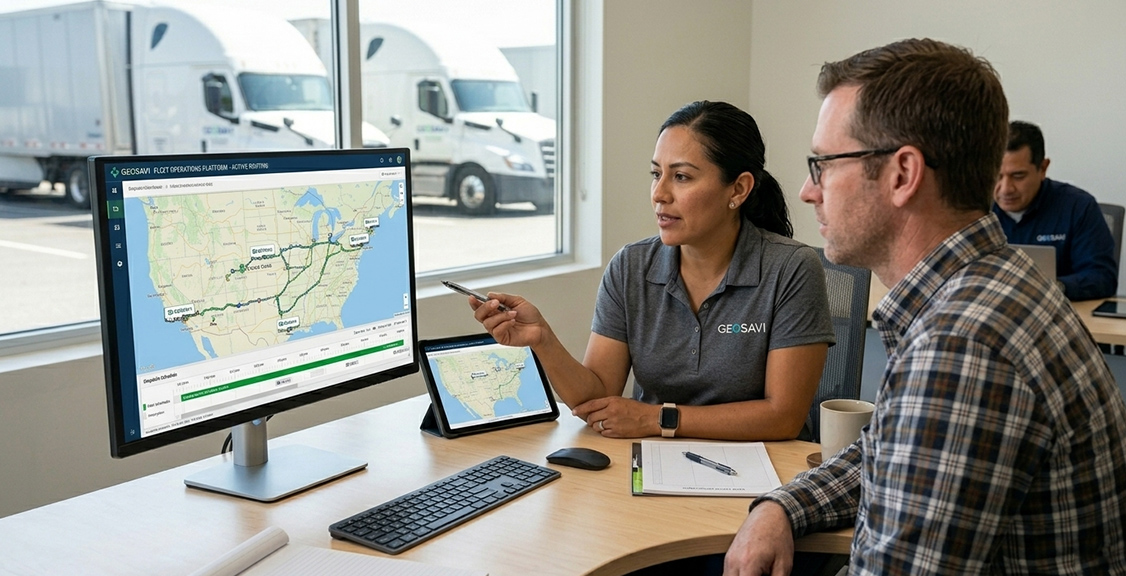
Fleet managers watch for dispatcher behavior that puts drivers in a position where completing the run requires an HOS violation. This is the regulatory definition of coercion, and it creates liability for the carrier regardless of whether the violation actually happens.
Over 30% of HOS violations involve dispatchers pressuring drivers or failing to account for driving time, according to a Forward Thinking Systems CSA guide published in 2026. FMCSA coercion occurs the moment a threat to override compliance is made, whether or not the driver actually commits the violation, as confirmed by the FMCSA coercion FAQ update cited by Overdrive in May 2026. Driver harassment protection sits under 49 CFR 390.36, and fleet managers who do not actively watch dispatcher-driver communication for coercion signals are carrying a risk they may not see until it surfaces in an audit. The FMCSA coercion page sets out what constitutes a formal coercion complaint and how carrier liability is assessed.
Fleet managers handle this in two ways. First, they set run schedules that give drivers legal time to complete the load without going past their hours. A dispatch that requires 12 hours of driving to meet a delivery window is already a compliance problem before the truck leaves the yard. Second, they create a reporting path where drivers can flag pressure from dispatch without fear of losing a load or a shift. Drivers who know they can report a coercion situation without retaliation are more likely to speak up before the violation happens rather than after it has already been logged.
What KPIs Do Fleet Managers Track to Measure Fleet Compliance?
The KPIs that fleet managers track most closely are HOS compliance rate, inspection pass rate, DVIR completion rate, ELD uptime, CSA BASIC percentiles, and the number of open violations waiting for resolution. Each one is a leading indicator of where your next enforcement problem is likely to come from.
HOS compliance rate measures the percentage of your drivers who completed their shifts without an hours violation. A fleet running at 95% or better across a month is in a different position than one averaging 80%, even if neither fleet has received a citation yet. The SMS record catches the difference over time.
Inspection pass rate tracks how your trucks perform at roadside. Level I inspections, the full driver and vehicle examination, are the most detailed. A fleet that passes Level I consistently is one whose drivers know what inspectors look for and whose vehicles are maintained to the standard that makes a clean inspection repeatable. Level VIII electronic inspections are expanding nationwide in 2026, according to FMCSA. These pull your ELD data and electronic records without a physical vehicle stop, which means the quality of your data, how complete it is, whether it has unexplained gaps, and whether it matches your supporting documents, is now subject to review independently of the driver’s physical inspection performance.
DVIR completion rate and ELD uptime are the operational KPIs that feed directly into the compliance KPIs. If your DVIR completion rate drops, your maintenance BASIC will reflect it. If your ELD uptime falls because devices are malfunctioning without timely repair, your HOS records will have gaps. Fleet managers who watch these operational numbers catch problems before they become inspection failures. You can view available ELD options in the Geosavi shop to plan what a properly equipped fleet looks like for your truck count.
COMPARISON TABLE: Fleet Manager KPIs — What They Measure and Why They Matter
| KPI | What It Measures | Why Fleet Managers Track It | Regulatory Link |
|---|---|---|---|
| HOS Compliance Rate | Percentage of shifts completed without an hours violation | Directly affects SMS HOS BASIC score and fine exposure | 49 CFR 395.3 |
| CSA BASIC Percentile | Fleet ranking in each FMCSA safety category relative to peer carriers | Higher percentiles trigger compliance reviews; HOS BASIC threshold is the 65th percentile | FMCSA Safety Measurement System |
| Inspection Pass Rate | Percentage of roadside inspections completed without a citation or out-of-service order | Indicates whether driver prep and vehicle maintenance are at the required standard | 49 CFR Part 395 |
| DVIR Completion Rate | Percentage of trips where a driver vehicle inspection report was submitted | Missing DVIRs feed directly into the vehicle maintenance BASIC | 49 CFR 396.11 |
| ELD Uptime | Percentage of operational hours where the ELD is recording correctly | ELD malfunction creates log gaps and citation risk if not repaired on deadline | 49 CFR 395.34 |
| Log Accuracy Rate | Percentage of ELD records with no unresolved edits, annotations, or missing supporting documents | Inaccurate or altered logs are the primary target of CVSA roadside inspection; 58,382 falsification violations recorded in 2024 | 49 CFR 395.8(k) |
| Open Violation Resolution Time | Average days between a citation and its resolution in the SMS record | Unresolved violations accumulate in BASIC percentiles and slow score improvement | FMCSA SMS |
| Driver Coercion Reports | Number of driver-reported dispatch pressure incidents per quarter | Tracks whether run scheduling is creating illegal pressure before violations happen | 49 CFR 390.36 |

Questions Fleet Managers Should Ask About Their Compliance Setup
Is every ELD in my fleet currently on the FMCSA-registered list?
The list changes without advance notice to carriers. 67 devices have been removed since January 2025, confirmed by FMCSA Administrator Derek Barrs on May 7, 2026. Check the FMCSA-registered ELD list against every device in your fleet today. A device that was registered at purchase may have been removed since then, and if your driver gets stopped with a deregistered device, the citation under 49 CFR 395.8(a)(1) is immediate.
Do my dispatch schedules give drivers legal time to complete every run?
Work backward from the delivery window. If the run requires more driving time than the driver has available under 49 CFR 395.3, the schedule is the problem. Building HOS into the run plan before dispatch, not after the truck is already moving, is the most effective way to cut your HOS violation rate. The FMCSA hours of service page covers the exact limits and recent rule changes that apply to your drivers.
Are my drivers completing a DVIR before and after every trip?
Under 49 CFR 396.11, a DVIR is required for every vehicle and every trip. One missing DVIR is a documentation failure. A pattern of missing DVIRs is a maintenance BASIC problem. Check your DVIR completion rate weekly, not at inspection time. The Geosavi ELD platform connects DVIR completion to the driver’s electronic record so your back office can verify it the same day.
What is my current SMS score across all seven BASICs?
Fleet managers who do not know their current percentile in each BASIC category are managing compliance without full visibility. The FMCSA Safety Measurement System is publicly available. Check it, share the relevant numbers with your drivers and dispatchers, and identify which BASIC is closest to triggering a compliance review.
Does my fleet have an ELD malfunction response process?
When an ELD malfunctions, the driver must notify the carrier under 49 CFR 395.34(a)(1) and the carrier must repair or replace it within the deadline under 49 CFR 395.34(d)(1). If your drivers do not know the notification procedure and your back office does not have a replacement device on hand, a malfunction turns into a citation gap. The Geosavi support team provides 24-hour, 7-day technical support for exactly this situation.
Are my drivers carrying the required ELD information packet in the cab?
Under 49 CFR 395.22(h), every driver operating an ELD must have the required information packet in the vehicle. Inspectors check for this. A missing packet is a separate citation from anything on the ELD itself. Make sure every truck has the packet, that it is current for the device installed, and that drivers know where to find it.
Do I have six months of supporting documents retained for every driver?
49 CFR 395.8(k)(1) requires carriers to retain supporting documents for at least six months. If you cannot produce supporting documents for a trip being questioned in an audit, the absence of records becomes its own compliance problem. This is a back-office process fleet managers own it, not drivers. Visit the Geosavi FAQ for common questions about document retention and ELD record access.
Is my fleet ready for a Level VIII electronic inspection?
Level VIII electronic inspections are expanding nationwide in 2026, according to FMCSA. These inspections pull your ELD data and electronic records without a physical vehicle stop. Fleet managers who have not reviewed how their ELD data appears in this format, what it shows, what it flags, and what an inspector would see, should do that review before the next roadside contact. Visit the Geosavi blog for articles covering 2026 inspection changes in detail.
Common Fleet Manager Questions Answered
About Fleet Manager Priorities and Compliance
What is the most important priority for fleet managers in 2026?
Hours-of-service compliance is the most consistent priority. HOS violations rose from 410,000 in 2023 to more than 500,000 in 2025, according to RigDig data cited by Overdrive in April 2026. Every HOS citation creates fine exposure and an SMS record entry, making it the KPI that most directly connects daily operations to long-term compliance risk. You can review the full HOS regulation at 49 CFR Part 395 HOS rules.
How often should a fleet manager check the FMCSA-registered ELD list?
Fleet managers should check the FMCSA-registered ELD list at least once a month, and immediately after any FMCSA announcement about device removals. 67 devices have been removed since January 2025 and FMCSA gives carriers only 60 days after each removal before enforcement begins. Monthly checks mean your fleet is never caught between a removal announcement and its enforcement deadline.
What does a fleet manager do when an ELD malfunctions?
The driver must notify the carrier immediately under 49 CFR 395.34(a)(1). The carrier then must repair or replace the device by the deadline under 49 CFR 395.34(d)(1). During the malfunction period, drivers must keep paper logs in the format specified under 49 CFR 395.8. Fleet managers who have a spare device on hand and a notification procedure in place can move through this without a compliance gap. Contact the Geosavi support team if you need help working through a malfunction situation.
What is the DVIR and why does it matter to fleet managers?
The Driver Vehicle Inspection Report is required under 49 CFR 396.11 before and after every trip. A fleet manager who does not track DVIR completion is leaving vehicle maintenance records incomplete, which feeds directly into the vehicle maintenance BASIC in FMCSA’s Safety Measurement System. A pattern of missing DVIRs is one of the fastest ways to see a BASIC percentile move in the wrong direction. Visit the Geosavi FAQ if you have questions about DVIR setup on your device.
Can a dispatcher cause a compliance problem for a fleet manager?
Yes. Over 30% of HOS violations involve dispatchers pressuring drivers or failing to account for driving time, according to a Forward Thinking Systems CSA guide from 2026. FMCSA coercion under 49 CFR 390.36 occurs the moment a threat to override compliance is made, whether or not a violation follows. Fleet managers who do not check dispatch schedules for legal compliance before loads go out are carrying coercion risk they may not see until an audit. The FMCSA coercion page sets out how carrier liability is assessed and how drivers can file a complaint.
What are the FMCSA penalty amounts fleet managers need to know?
Under the FMCSA penalty schedule, FMCSA can fine motor carriers up to $19,246 per HOS violation and drivers up to $4,812 per violation. Knowing falsification of records carries a maximum of $15,846 per entry. These are maximum civil penalty amounts adjusted annually for inflation and apply per violation. A fleet with multiple violations in one inspection faces compounding exposure.
How does a compliance review get triggered?
FMCSA’s Safety Measurement System tracks your fleet’s violation history across seven BASIC categories. Repeated citations can trigger a compliance review regardless of fleet size, according to FMCSA. Fleet managers who monitor their SMS percentiles monthly and work to resolve open violations before they accumulate are reducing the probability of a review. The HOS BASIC intervention threshold sits at the 65th percentile, lower than most other BASIC categories, according to FMCSA data.
About Using Technology to Support Fleet Manager Goals
How does an ELD help a fleet manager stay on top of HOS compliance?
An ELD records hours automatically and makes the current duty status visible across the fleet without requiring a call to the driver. Fleet managers who rely on manual tracking across multiple trucks are working with information that is already out of date. A current ELD connected via J1939, J1708, or OBD-II records the vehicle’s engine data directly, so the hours on record reflect actual driving time rather than a driver’s recollection at the end of a shift. See the Geosavi ELD platform page for details on how the connection and data recording work.
What should fleet managers look for in an ELD platform?
Fleet managers should look for a device that is on the current FMCSA-registered ELD list, connects directly to the vehicle’s engine data port, carries a current technical certification under Appendix A to Subpart B of Part 395, and comes with real technical support when something goes wrong. The Geosavi ELD platform connects via J1939, J1708, or OBD-II, and the rugged tablet is SAE J1455 certified, a durability standard that matters when the device is mounted in a working truck cab. You can browse ELD products or contact our team to talk through which setup fits your fleet.
What support should a fleet manager expect from their ELD provider?
A fleet manager should expect 24-hour, 7-day technical support that is available when a driver is stopped at a scale house at 2 a.m. with a device question, not just during business hours on weekdays. The Geosavi support team operates on that schedule. A 30-day money-back guarantee is also a reasonable standard to expect from any provider worth considering.
What does a Level VIII electronic inspection mean for fleet managers?
A Level VIII electronic inspection reviews your ELD data and electronic compliance records without a physical vehicle stop. These inspections are expanding nationwide in 2026, according to FMCSA. For fleet managers, this means the quality of your ELD data, how complete it is, whether it has unexplained gaps, and whether it matches your supporting documents, is now reviewed independently of the driver’s physical inspection result. Fleet managers who have not checked how their ELD data looks in this format should do so before the next inspection contact. Visit the Geosavi blog for current coverage of 2026 inspection developments.
How can a fleet manager find out what their current compliance exposure looks like?
The FMCSA Safety Measurement System is publicly available and shows your fleet’s BASIC percentiles based on inspection and violation history. Fleet managers who have not checked their SMS records recently should do so before the next roadside inspection season. If you have questions about how your current ELD setup affects your compliance record, contact our team at Geosavi for a direct conversation about your fleet’s situation.
Conclusion
Fleet managers in 2026 are managing more than a schedule. They are tracking HOS compliance across every driver, watching CSA scores after every inspection, checking ELD devices against a registered list that changes without warning, and making sure DVIRs, supporting documents, and in-cab packets are complete before a truck ever reaches a scale house. The priorities covered in this article, from hours-of-service to log accuracy to dispatcher behavior, are the daily checkpoints that separate a fleet running clean from one that is building toward a compliance review.
The 2026 enforcement picture makes this more pressing than it was two years ago. HOS violations have passed 500,000 nationally. 67 ELD devices have been pulled from the registered list. CVSA’s 2026 Roadcheck focused on tampering and log integrity. Level VIII electronic inspections are expanding. None of these are trends a fleet manager can watch passively. Each one calls for a response built into your daily process, not a reaction after the citation has been written.
If your back office is carrying gaps in any of the areas covered here, ELD device status, DVIR tracking, HOS scheduling, or CSA score monitoring, it is worth taking a close look at the tools and processes behind each one. Contact our team at Geosavi, and we can walk through where your current setup stands and what your fleet needs heading into the second half of 2026.