Key takeaways:
- Electronic logging devices are not mandatory for every commercial vehicle or every truck driver in the United States. The federal ELD rule generally applies when a driver must prepare records of duty status (RODS) under 49 CFR Part 395 and no ELD exception applies.
- A driver who qualifies for a short-haul exception under 49 CFR 395.1(e) does not prepare RODS on qualifying days, so an ELD is not required for those days. The carrier must still keep the required time records.
- Some drivers who must prepare RODS may use manual records instead of an ELD, including qualifying drivers who need RODS on no more than eight days in any 30-day period, certain driveaway-towaway drivers, and drivers operating qualifying pre-2000 vehicles.
- An ELD records driving time and supports HOS recordkeeping. It does not change the applicable hours-of-service limits or guarantee compliance, safety, lower costs, or better performance.
- Motor carriers are responsible for selecting a device that appears on the FMCSA registered-device list and for checking whether it has been revoked.
Are ELDs Mandatory in the USA?
ELDs are mandatory for many, but not all, drivers subject to the federal hours-of-service rules. Under 49 CFR 395.8, a motor carrier generally must require an ELD when a driver must prepare a record of duty status. Applicability depends on the operation, the driver’s recordkeeping obligation, and any exception—not simply on whether the vehicle is a truck, is used commercially, or requires a commercial driver’s license.
The federal rule applies to covered interstate operations and can include property-carrying and passenger-carrying commercial motor vehicles. Canada- and Mexico-domiciled drivers operating in the United States must also comply when the rule applies to their work. Intrastate operations may be governed by state requirements, which should be checked separately.
Use this sequence to evaluate federal ELD requirements:
- Determine whether the operation and driver are subject to 49 CFR Part 395.
- Determine whether the driver must prepare RODS or qualifies for a time-record exception such as short haul.
- If RODS are required, determine whether one of the limited exceptions allows manual RODS instead of an ELD.
What an Electronic Logging Device Records
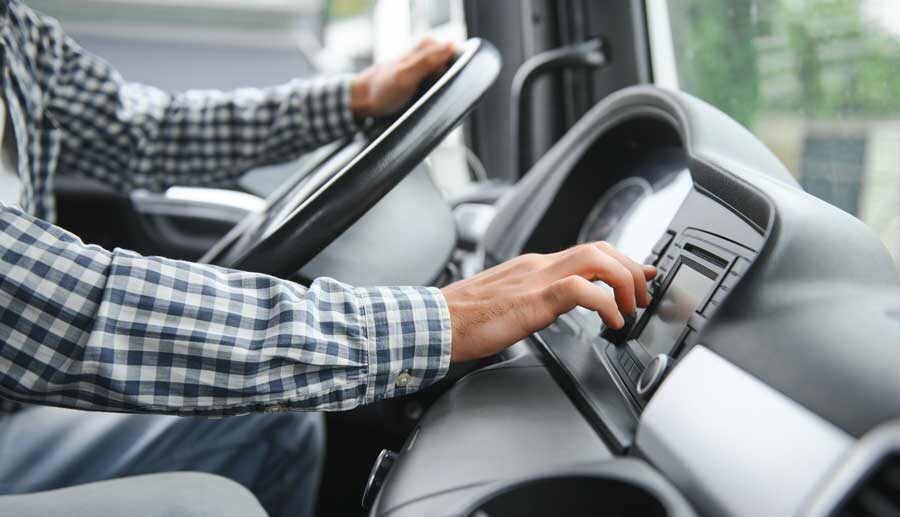
An ELD is a device or compliant system that synchronizes with a commercial motor vehicle’s engine to record driving time and other required data. The driver still has responsibilities, including selecting appropriate duty statuses, adding required information and annotations, reviewing proposed edits, and certifying the record.
An ELD can be implemented through dedicated hardware or a compliant smartphone or tablet system. A mobile application by itself is not automatically an ELD: the complete system must meet the technical requirements, synchronize with the vehicle when required, and appear on FMCSA’s registered-device list. A portable ELD must be mounted in a fixed position and visible to the driver from the normal seated driving position while the vehicle is operating.
ELD Applicability Starts With RODS
The ELD rule is a recordkeeping rule. It does not independently decide whether a driver is subject to the hours-of-service limits. First determine which HOS rules apply and whether the driver must prepare RODS. An exception from ELD use may permit a different recording method without removing the underlying HOS or RODS obligation.
This distinction matters because the exceptions fall into two broad groups:
- No RODS on qualifying days: A driver who satisfies an applicable short-haul exception uses carrier time records instead of RODS and therefore does not need an ELD for those days.
- RODS still required, but an ELD is not: The 8-days-in-30, qualifying driveaway-towaway, and pre-2000 exceptions generally allow manual RODS when records are required.
Drivers and carriers should evaluate actual operations rather than assume that a vehicle class, job title, local route, or CDL status answers the ELD question.
Current Exceptions to Federal ELD Use

Short-Haul Operations
Under 49 CFR 395.1(e)(1), a driver may use the 150-air-mile short-haul exception when all applicable conditions are met. These include operating within a 150-air-mile radius of the normal work reporting location, returning there and being released from work within 14 consecutive hours, receiving the required off-duty period, and having the carrier retain accurate time records for six months.
The required separating rest is at least 10 consecutive hours for a property-carrying CMV driver and at least eight consecutive hours for a passenger-carrying CMV driver. A separate provision in 49 CFR 395.1(e)(2) applies to certain property-carrying CMV drivers whose vehicles do not require a CDL and has its own conditions, including limited use of a 16-hour driving window.
Merely driving locally or staying within 150 air miles is not enough. If any required condition is not met, the driver may need RODS for that day and must then consider whether an ELD or an ELD exception applies.
RODS Required on No More Than 8 Days in 30
Under 49 CFR 395.8(a)(1)(ii)(A)(1), a carrier may allow manual RODS when a driver operates in a manner requiring completion of RODS on no more than eight days within any 30-day period. This is a rolling 30-day test, not eight days per calendar month.
The exception removes the requirement to use an ELD on those RODS days; it does not remove the duty to prepare accurate RODS or comply with applicable HOS limits.
Driveaway-Towaway Operations
The exception is narrower than a general exemption for vehicles being moved or towed. Manual RODS may be used when:
- the vehicle being driven is part of the shipment being delivered; or
- the vehicle being transported is a motor home or recreational vehicle trailer.
A driveaway-towaway label alone does not establish the exception. The facts must fit one of the circumstances in 49 CFR 395.8(a)(1)(ii)(A)(2) or (3).
Pre-2000 Vehicle and Engine Rules
The regulation permits manual RODS for a CMV manufactured before model year 2000, as reflected by the VIN on the vehicle registration. Current FMCSA guidance issued October 2, 2026 also explains that a vehicle with an engine predating model year 2000 may be excepted even when the registration shows a newer model year, such as after a glider-kit build or engine swap. The motor carrier should keep documentation of motor and engine changes at its principal place of business.
This is a model-year test, not an exemption for vehicles manufactured before the ELD compliance date. The former AOBRD transition ended in December 2019; a legacy AOBRD is not a current substitute unless the system independently meets today’s ELD requirements.
Agricultural Operations and Covered Farm Vehicles
There is no blanket ELD exception for every farmer, farm vehicle, or agricultural load. Under 49 CFR 395.1(k), specified agricultural-commodity and farm-supply transportation is outside Part 395 during state-determined planting and harvesting periods while the operation remains within the provision’s 150-air-mile limits. Other conditions and definitions apply.
Separately, qualifying covered farm vehicles receive HOS relief under 49 CFR 395.1(s). When an operation is outside the applicable HOS and RODS requirements, it is also outside the federal ELD requirement for that operation. Once an operation moves beyond an applicable exemption, the carrier must reassess HOS, RODS, and ELD obligations.
For a more detailed treatment, see Geosavi’s guide to ELD exemptions and required records.
What ELD Exceptions Do Not Change
Excepted drivers may still be subject to federal HOS limits, recordkeeping duties, and supporting-document requirements. For example, drivers using the 8-days-in-30, driveaway-towaway, or pre-2000 exception still prepare manual RODS whenever RODS are required.
An ELD also does not enforce every HOS rule by itself. It records required data and can support alerts or reviews, but the driver and motor carrier remain responsible for accurate duty-status entries, certifications, corrections, supporting documents, and compliant scheduling. An ELD cannot guarantee that violations, fatigue, crashes, penalties, or roadside issues will be avoided.
Selecting a Compliant ELD
ELD providers self-certify that their devices meet the technical specifications, and FMCSA lists registered devices. This is not the same as FMCSA testing or endorsing every device. The motor carrier is responsible for confirming that a selected device is on the FMCSA registered ELD list and checking the revocation list periodically.
Beyond registration, evaluate:
- compatibility with each vehicle and engine;
- supported roadside data-transfer methods;
- driver workflow for annotations, edits, certification, personal conveyance, and yard moves;
- malfunction support and replacement procedures;
- record retention, backup, privacy, and role-based access;
- integration needs, training, subscription costs, and customer support.
GPS tracking, dispatch, maintenance, fuel, camera, and analytics features may be useful fleet-management tools, but they are not required ELD functions and do not make a noncompliant product compliant. Operational results depend on the product, configuration, training, data quality, policies, and management follow-through.
Driver Documents, Roadside Reviews, and Malfunctions

A driver using an ELD must be able to display or transfer required records during a roadside inspection. Under the current 49 CFR 395.22(h), the vehicle must carry the required information packet: instructions for the ELD’s supported data-transfer methods, malfunction reporting and recordkeeping instructions, and enough blank RODS graph grids to record at least eight days.
If an ELD malfunctions, the driver must note the malfunction, notify the carrier in writing within 24 hours, and reconstruct the current day and previous seven days when those records are not available from the device. The driver generally uses paper RODS until the device is repaired or replaced. Under 49 CFR 395.34, the carrier generally has eight days from discovery or notice to correct the problem, subject to the regulation’s extension process.
Geosavi’s ELD compliance checklist for roadside inspections covers the operational documents and review steps in more detail.
How to Decide Whether Your Drivers Need ELDs
- Identify whether each operation is interstate or intrastate and which federal or state HOS rules apply.
- Determine whether each driver must prepare RODS for the day.
- Confirm every condition of any short-haul or industry-specific exception.
- If RODS are required, count RODS days across the rolling 30-day period and test the limited manual-record exceptions.
- Document the basis for the decision and retain the records required by the applicable provision.
- For drivers who require ELDs, confirm device registration, vehicle compatibility, account setup, training, required documents, and malfunction procedures.
Because applicability depends on facts and may involve state rules, carriers should use current regulatory text and seek qualified compliance or legal advice for unusual operations.
ELD Requirements: The Practical Answer
ELDs are mandatory in the United States when a driver is required to prepare RODS under the federal HOS rules and no ELD exception applies. They are not universally required for all commercial vehicles or all truck drivers. Short-haul drivers who meet every condition generally use carrier time records, while certain other drivers still prepare RODS manually under a limited ELD exception.
Geosavi provides electronic logging device solutions and implementation support for fleets that determine an ELD is required or operationally useful. Contact Geosavi to discuss vehicle compatibility, driver workflow, and deployment requirements.